
BuddhistCatholicContemplativeEvangelicalGeneral ChristianHinduJewishLatter-day SaintMuslimNew VisionsProgressive Christian
Beliefs
- Buddhist
- Catholic
- Contemplative
- Evangelical
- General Christian
- Hindu
- Jewish
- Latter-day Saint
- More Voices
- Muslim
- New Visions
- Pagan
- Progressive Christian
Topics
- Religion News
- Food and Religion
- Sports and Religion
- Religious Art
- Religious Music and Entertainment
- Religious Events
- History and Religion
- Style and Religion
- Politics and Religion
- Women in Religion
- Recreation Outdoors and Religion
- Business Finance and Religion
- Careers Workplace and Religion
- Education and Religion
- Family Parenting and Religion
- Health Fitness and Religion
- Home and Religion
- Relationships and Religion
- Technology and Religion
- Travel and Religion
Columnists
- Buddhist Columnists
- Business Finance and Religion Columnists
- Careers Workplace and Religion Columnists
- Catholic Columnists
- Contemplative Columnists
- Education and Religion Columnists
- Evangelists Columnists
- Family Parenting and Religion Columnists
- General Christian Columnists
- Health Fitness and Religion Columnists
- Hindu Columnists
- History and Religion Columnists
- Home and Religion Columnists
- Jewish Columnists
- More Voices Columnists
- Latter Day Columnists
- Muslim Columnists
- New Visions Columnists
- Nonreligious Columnists
- Pagan Columnists
- Politics and Religion Columnists
- Progressive Columnists
- Recreation Outdoors and Religion Columnists
- Relationships and Religion Columnists
- Religion News Columnists
- Religious Art Columnists
- Religious Events Columnists
- Religious Music and Entertainment Columnists
- Sports and Religion Columnists
- Style and Religion Columnists
- Technology and Religion Columnists
- Travel and Religion Columnists
- Women in Religion Columnists
Resource Library
- 2026 Calendar
- Library of World Religions
- The 100 Most Holy Places on Earth
- Patheos Answers
- Podcasts
- Videos
- Faith Leaders Database
- Anglican Episcopalian
- Bahai
- Baptist
- Buddhism
- Christianity
- Confucianism
- Eastern Orthodoxy
- Hinduism
- Holiness and Pentecostal
- ISKCON
- Islam
- Judaism
- Lutheran
- Methodist
- The Church of Jesus Christ of Latter-day Saints
- New Age
- Paganism
- Presbytarian and Reformed
- Protestantism
- Religion Behind the Scenes
- Roman Catholic
- Scientology
- Shia Islam
- Sikhism
- Sufism
- Sunni Islam
- Taoism
- Zen
- See all religions
Research Tools
 Ad-Free & Subscriber Log-In Subscription Support
Ad-Free & Subscriber Log-In Subscription Support
Follow Patheos 

- Trending:
- Forgiveness
- |
- Marriage
- |
- Consciousness
- |
- Death Penalty
- |
- Election
- |
- Halloween
 Pop Theology
- Home
- Progressive Christian
- Religious Music & Entertainment
- Entertainment Theology…
Entertainment Theology…
Last updated on: May 20, 2008 at 6:39 am by J. Ryan Parker
Entertainment Theology… 2008-05-20T06:39:20-07:00 J. Ryan Parker
Patheos Explore the world's faith through different perspectives on religion and spirituality! Patheos has the views of the prevalent religions and spiritualities of the world.
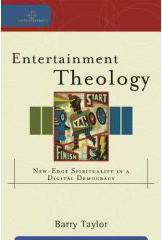
Towards the end of his latest book, Entertainment Theology: New-Edge Spirituality in a Digital Democracy, Barry Taylor offers a “new attitude” toward the process of doing theology. Recognizing the harmful “God-talk” that has preceded and continues to surround Christianity today, he writes, “At first, I was tempted to recommend a theology of silence, because I fear we have spoken too much.” Thank God he did not. Taylor’s Entertainment Theology is one of the most insightful analyses of contemporary culture and the state and fate of religion in it that I have read in quite some time.
Taylor is concerned with three interwoven ideas: (1) the implosion of modernity and the rise of the postmodern/postsecular, (2) the spiritual condition of popular culture that signifies a return to God, and (3) a vision for Christianity in this current milieu and for the future. Central to Taylor’s argument is the fact that we are, and indeed have been for quite some time, living in a post-Christian world in which traditional, authoritative religious institutions no longer primarily influence a person’s spiritual or religious experiences, if the ever did. Far from implying the extinction of these institutions, Taylor argues that they face competition from the surrounding popular culture and must fashion new ways of interacting with this culture and embodying the gospel of Christ, lest they perish. Taylor’s smooth interaction with all forms of popular media from novels to films to television programs to music videos reveals a culture not of sin and evil, though that certainly exists, but a culture fashioning its own form of spirituality and God-talk that Christianity must take seriously.
We will quickly recognize this new-edge spirituality about which Taylor writes, because we have no doubt heard confessions of it from friends, family members, or celebrities. Taylor argues that the confession, “I’m spiritual, not religious” has become a religion in and of itself in this postmodern, postsecular context. Traditional forms of religion, specifically Christianity, have suffered in both membership and effectiveness for not taking such a confession seriously. Taylor urges us not to condemn such talk as surface emptiness but to take it seriously for what it is, a sincere yearning for a connection with the sacred.
A key component of Taylor’s text is his assertion that the categories that modernity employed to define, order, or make sense of the human experience have rather quickly broken down. They no longer, if ever, encompass all the varieties of human experience. We see the continual frustration with these terms on a daily basis as politicians and voters try to move beyond partisan politics. We have seen this in a recent review of Adam Hamilton’s Seeing Gray, just one of the many textual examples of Taylor’s argument.
If modernity’s labels have already warn off so quickly, Taylor is certainly wise enough to avoid creating new ones that would expire even more rapidly. Rather, he simply seeks to describe the prevailing mood(s) in our societies. His overarching description,“Entertainment Theology,” highlights the “evolution of theology from a didactic or studied approach to the question of God to a more global communal conversation about the sacred in general.” This theological evolution relies on three movements, “the reenchantment of Western culture, the rise of postsecular society, and the democratization of spirit.”
The reenchantment of Western culture signals that God is making a comeback, although in ways that religious institutions might be resistant to or simply unaware of. Fueled by new understandings and experiences of “time, space, bodies, and governance,” this reenchantment takes the form of a heightened pluralistic spirituality. Globalization, not just Western colonialism, has resulted in increased access to cultures and forms of religious/spiritual expression heretofore unavailable to a midwestern Christian, for example. New media technologies, specifically the internet, fuel these new experiences of time and space, shrinking the distance between cultures worlds apart. This reenchantment and technologically fueled globalization also results in the democratization of the spirit, the “attempt to put desire in its rightful place, in dialogue and communion with the sacred.”
However, these new realities bring both the blessing of less judgmental and more humanizing trends and the curse of fundamentalism. Fundamentalism or, more exactly, fundamentalisms are reactions to postmodernity that emerge from the very phenomenon itself. People who cling to this long for more (ironically) modern practices or ways of being, relying on outmoded ideologies and definitions. Taylor recognizes the diversity of fundamentalisms in postmodernity, referencing Bruce Lawrence’s trilogy of literalists, terrorists, and political activists. Taylor also fins fundamentalists in film, television, and political action groups.
Taylor recognizes that megachurches might serve as the pinnacle of religious consumerism, a frequent shopping for God that defines much of contemporary religious experience. Not only can believers pick and choose what church they want to attend, megachurches also provide them with choices for various types of worship experiences, service opportunities, and children’s programs. However, Taylor argues that this religious consumerism is not the end-all-be-all of the postmordern religious experience but is rather just the tip of the iceberg.
Taylor begins to dig deeper in his understanding of Entertainment theology as “ideas about God that emerge outside of previously legitimized environments and structures of mediation.” He notes four areas worth explaining. (1) Zen Culture signifies a blending of Eastern and Western ideas and religious expressions that emerges from globalization and the democratization of the spirit. (2) The Next Enlightenment signals the age of the rational mystics that embrace a more holistic view of life. In this age, spirituality, not religion, is in the ascendancy. (3) Retrolution can be witnessed in the postmodern obsession with all things Gothic. Taylor urges us to view this Gothic retrolution as a means of dealing with uncertainty, a dominant contemporary cultural concern, by presenting aspects of the present and the future through past terms. The Gothic celebrates “mystery, the mysterious, the grotesque and the desolate,” all images of uncertainty to be sure. Taylor notes that the Gothic is especially concerned with the sublime and that this sublime landscape is mediated mostly through cinema. (4) Resistant Communities comprise his final area. These signify the implicit postmodern threat of fundamentalism mentioned above.
Like Dorothy, Taylor recognizes that postmodern Christianity isn’t in Kansas any more. Things have changed. Yet far from being pessimistic, Taylor is hopeful for Christianity’s future and, as such, has several pieces of advice for the future of the faith. Christianity must finally embrace its plurality on an institutional and personal level. Taylor aruges that we must “come to the end of the need to be ‘right,’ to be certain that [we] hold the whole truth.” This new vision is one in which, again, a focus on spirituality overrides a concern for religion. Taylor claims that we now have not a Christian religion, but rather Christian spiritualities. This is not concerned with how Christianity looks, but rather how it addresses the wider culture’s spiritual hunger and journey. Taylor writes, “The general trend seems to be engaging in desperate attention-seeking practices as if to say, ‘look at us, we do count, we are cool.’ But as any arbiter of cool will tell you, ‘cool’ cannot be claimed, only conferred.” I wonder if this isn’t a thinly veiled jab at hipster mega-churches popping up across the country.
Rather than being cool, Christianity must be relevant. The main ways in which it can be so will be through an identity shift, a new typology for missional theology, and a new encoding of the Christian message, all of are in desperate need of imagination. Taylor writes, “The shift in times demands a new reiteration of the message, one that is a pertinent and timely iteration of the timeless Christ story for our cultural context.” Thankfully this iteration can come from both inside and outside the church as he asserts that “theology is no longer a specialized field to be left to those deemed qualified.” As soon as the church fully embraces this, there can be no end to its effectiveness in again being a relevant location for theological education and spiritual formation. There is much encouragement here for artists and lovers of art to get involved in the new spirituality.
Entertainment Theology is truly an enjoyable, accessible text. Fans of pop-culture will be amazed at the diverse examples he shares from The Da Vinci Code to Donnie Darko. Like his assessment of the state of religion today, Taylor’s interactions with pop-culture, scholars, and theologians is de-centralized, or rather de-Westernized, drawing from thinkers from all corners of the world and a host of media. As such, his text is stronger for it and our reading experience richer.
Previous Post

May 19, 2008
The Biggest Surprise...
Next Post
May 27, 2008 Bad Movie Monday Turned Good
Browse Our Archives
Select a Category Classics DVD Film Music News Pop Culture Events Print Sports Television Uncategorized Video Games
Select a Month March 2017 February 2017 January 2017 December 2016 November 2016 October 2016 September 2016 August 2016 July 2016 June 2016 May 2016 April 2016 March 2016 February 2016 January 2016 December 2015 November 2015 October 2015 September 2015 August 2015 July 2015 June 2015 May 2015 April 2015 March 2015 February 2015 January 2015 December 2014 November 2014 October 2014 September 2014 August 2014 July 2014 June 2014 May 2014 April 2014 March 2014 February 2014 January 2014 December 2013 November 2013 October 2013 September 2013 August 2013 July 2013 June 2013 May 2013 April 2013 March 2013 February 2013 January 2013 December 2012 November 2012 October 2012 September 2012 August 2012 July 2012 June 2012 May 2012 April 2012 March 2012 February 2012 January 2012 December 2011 November 2011 October 2011 September 2011 August 2011 July 2011 June 2011 May 2011 April 2011 March 2011 February 2011 January 2011 December 2010 November 2010 October 2010 September 2010 August 2010 July 2010 June 2010 May 2010 April 2010 March 2010 February 2010 January 2010 December 2009 November 2009 October 2009 September 2009 August 2009 July 2009 June 2009 May 2009 April 2009 March 2009 February 2009 January 2009 December 2008 November 2008 October 2008 September 2008 August 2008 July 2008 June 2008 May 2008 April 2008 March 2008 February 2008 January 2008 December 2007 November 2007 October 2007 September 2007 August 2007 July 2007 June 2007 May 2007 April 2007 March 2007
Follow Us!
TAKE THE
Religious Wisdom Quiz
What does "Sabbath" mean?
Select your answer to see how you score.
Worship Sacrifice Rest Holy
Related posts from Pop Theology


#KillerSerials: An Interview with Kutter Callaway

Book Review: MUSLIMS AND THE MAKING OF AMERICA

TRENDING AT PATHEOS Progressive Christian

Why Christians Have a Sacred Duty to Vote:...
The Bible offers strong support for the sacred duty to vote. Here...

What Being a Modern-Day Apostle Means to Me
In my last column, I discussed the ins and outs of modern-day...

Did Ancient China Once Worship the God of...
Across human history, a common thread weaves through the origins of the...

Love Your Neighbor – Including Earth-Kin: Lev. 19,...
God’s command to love your neighbor means acting in an ethical and...

Lead a Church Study of “Jesus and Lao...
Guest writer Jack Thomas (The Irreverent Reverend) reflects on leading his church...

Principles for Understanding the Apostolic Ministry Today
Whenever people discover that my formal ministry title is "apostle," as in...
view all Progressive Christian blogs
Ad-Free & Subscriber Log-In Subscription Support
- About Us
- 2026 Calendar
- Videos
- Podcasts
- Library of World Religions
- Faith In Media Tracker
- Advertise With Us
- Write for Us
- Privacy Policy
- Terms of Service
- Do Not Sell My Data
- Contact Us
- Radiant Digital
- Manage Newsletter Subscriptions
- Unsubscribe From Notifications
- Sitemap
Copyright 2008-2026, Patheos. All rights reserved.
Subscription Support Ad-Free & Subscriber Log-In
Follow Patheos