
BuddhistCatholicContemplativeEvangelicalGeneral ChristianHinduJewishLatter-day SaintMuslimNew VisionsProgressive Christian
Beliefs
- Buddhist
- Catholic
- Contemplative
- Evangelical
- General Christian
- Hindu
- Jewish
- Latter-day Saint
- More Voices
- Muslim
- New Visions
- Pagan
- Progressive Christian
Topics
- Religion News
- Food and Religion
- Sports and Religion
- Religious Art
- Religious Music and Entertainment
- Religious Events
- History and Religion
- Style and Religion
- Politics and Religion
- Women in Religion
- Recreation Outdoors and Religion
- Business Finance and Religion
- Careers Workplace and Religion
- Education and Religion
- Family Parenting and Religion
- Health Fitness and Religion
- Home and Religion
- Relationships and Religion
- Technology and Religion
- Travel and Religion
Columnists
- Buddhist Columnists
- Business Finance and Religion Columnists
- Careers Workplace and Religion Columnists
- Catholic Columnists
- Contemplative Columnists
- Education and Religion Columnists
- Evangelists Columnists
- Family Parenting and Religion Columnists
- General Christian Columnists
- Health Fitness and Religion Columnists
- Hindu Columnists
- History and Religion Columnists
- Home and Religion Columnists
- Jewish Columnists
- More Voices Columnists
- Latter Day Columnists
- Muslim Columnists
- New Visions Columnists
- Nonreligious Columnists
- Pagan Columnists
- Politics and Religion Columnists
- Progressive Columnists
- Recreation Outdoors and Religion Columnists
- Relationships and Religion Columnists
- Religion News Columnists
- Religious Art Columnists
- Religious Events Columnists
- Religious Music and Entertainment Columnists
- Sports and Religion Columnists
- Style and Religion Columnists
- Technology and Religion Columnists
- Travel and Religion Columnists
- Women in Religion Columnists
Resource Library
- 2026 Calendar
- Library of World Religions
- The 100 Most Holy Places on Earth
- Patheos Answers
- Podcasts
- Videos
- Faith Leaders Database
- Anglican Episcopalian
- Bahai
- Baptist
- Buddhism
- Christianity
- Confucianism
- Eastern Orthodoxy
- Hinduism
- Holiness and Pentecostal
- ISKCON
- Islam
- Judaism
- Lutheran
- Methodist
- The Church of Jesus Christ of Latter-day Saints
- New Age
- Paganism
- Presbytarian and Reformed
- Protestantism
- Religion Behind the Scenes
- Roman Catholic
- Scientology
- Shia Islam
- Sikhism
- Sufism
- Sunni Islam
- Taoism
- Zen
- See all religions
Research Tools
 Ad-Free & Subscriber Log-In Subscription Support
Ad-Free & Subscriber Log-In Subscription Support
Follow Patheos 

- Trending:
- Forgiveness
- |
- Marriage
- |
- Consciousness
- |
- Death Penalty
- |
- Election
- |
- Halloween
 Pop Theology
- Home
- Progressive Christian
- Religious Music & Entertainment
- Backdraft…
Backdraft…
Last updated on: March 30, 2008 at 10:33 am by J. Ryan Parker
Backdraft… 2008-03-30T10:33:07-07:00 J. Ryan Parker
Patheos Explore the world's faith through different perspectives on religion and spirituality! Patheos has the views of the prevalent religions and spiritualities of the world.
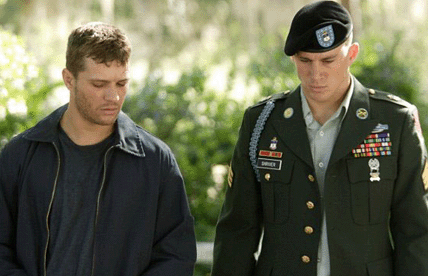
World War II has inspired at least 600 films; the Vietnam War around 100. As the American occupation of Iraq continues, I am curious to see how many films will emerge from this experience and what kinds of stories they will tell. On the heels of the fifth anniversary of the invasion of Iraq, Paramount Pictures released Kimberly Peirce’s (Boys Don’t Cry) latest film, Stop-Loss. It will be easy for most people to pigeonhole this film as an anti-Iraq War film, especially those who do not actually see it. In reality, however, we have something much more complex. Unlike In the Valley of Elah‘s Paul Haggis, Peirce has experienced the reality of having a loved one actually fight in the war. This personal experience makes her soldiers seem like real people, rather than just instruments for anti-Iraq war sentiments. It is impossible not to feel Pierce’s sympathy and respect for American soldiers. Stop-Loss only evolves into an anti-Iraq war film when the American government fails to show this same respect for its soldiers.
Stop-Loss opens at an American military checkpoint in Iraq. Here, we meet the main characters, Brandon Knight (Ryan Philippe), Steve Shriver (Channing Tatum), Tommy Burgess (Joseph Gordon-Levitt), Rico Rodriguez (Victor Rasuk), and Isaac Butler (Rob Brown). Tension fills this scene from the start and culminates not in a car bomb but a drive-by shooting reminiscent of American gangsters. Brandon and his men follow the shooters into a side alley, straight into an ambush that kills two of the troops, maims and blinds another, and leaves untold Iraqi casualties. This ambush serves as an example not only of the horrific violence that will continue to haunt these soldiers, but as an implicit critique of the idea that this war can be fought with traditional combat tactics.
In the next scene, Brandon, Steve, Tommy, and Isaac have made it home “safely” and are on a bus bound for their small hometown’s welcome home parade. At the conclusion of the parade, Brandon is awarded the Purple Heart and the Bronze Star. He stammers through his acceptance speech, trying to reflect on home in light of his overwhelming experiences abroad. When he begins to falter, his best friend Steve butts in and screams, “We’re killin’ ’em over there so we don’t have to fight ’em in Texas!” The crowd goes wild. After a weekend of partying, drinking, and shooting rifles, Brandon reports to the base to return his gear and separate from the army. Instead of beginning his process of readjustment, Brandon learns he has been stop-lossed, a fine-print rule that allows the army to re-deploy soldiers who are scheduled to separate after their tour of duty. Brandon is understandably irate and goes AWOL. His childhood friend, and Steve’s fiance, Michelle (Abbie Cornish) agrees to drive him to Washington, D.C. to meet with their Senator who had promised him, “If you need anything, just let me know.” Brandon does not make it out of Texas before he realizes the gravity of his situation. No government official, not even his Senator-friend, will meet with this hero-turned-fugitive.
Still determined to fight the system in Washington, he makes two pit stops, one to the family of one of the soldiers that died in the ambush and the other to an army hospital to visit with Rico, the soldier who lost an arm, a leg, and his sight in the ambush. At his first stop, he learns of an underground group of stop-lossed soldiers either filing lawsuits against the army or fleeing the country. One of them gives him a phone number for a “peacenik lawyer” in New York who leads soldiers over into Canada. As Brandon’s resolve to fight the system wanes, he decides to meet with the lawyer and flee the country. All this changes when he hears that the hard-drinking Tommy has killed himself. He sneaks back to his hometown for the funeral and meets with his parents at their ranch. His parents realize that he must leave the country, and Michelle and his mother drive him to the Texas/Mexico border. At the border, he must make his final decision, and in the next scene, we see him on a bus sitting next to Steve on their way back to Iraq. The film concludes with these statistics: “Since September 11, 2001, 650,000 American troops have fought in Afghanistan and Iraq; 81,000 of these troops have been stop-lossed; 30,000 troops were deployed in 2007; it is unknown how many of these have been stop-lossed.”
Unlike Haggis, who had to search for stories about Iraq War soldiers and veterans, Peirce has a much more intimate experience as her younger brother Brett enlisted shortly after the terrorist attacks of September 11, 2001. This experience bathes her portrayal of not only the soldiers but also their families and small hometowns. In his review of the film for The San Francisco Chronicle, Mick LaSalle succinctly writes, “[…Pierce] does a number of important things–and she does them all at the same time. She establishes the nature of the town, acknowledging both the expansiveness of its spirit and the narrowness of its worldview.” These soldiers are good kids with good families. They enlisted for a cause they believed was equally good. Unfortunately, their experiences dictate otherwise and begin to broaden their otherwise narrow worldview, especially when they learn that Brandon has been stop-lossed. Brandon’s father is a seemingly proud Vietnam veteran who, at the beginning of the film, literally wears evidence of his service with a T-shirt, baseball cap, and vest. At the end of the film, he has donned traditional western wear, and as Brandon leaves for Mexico, all he can say is, “Damn.”
From the very beginning, in a brilliantly orchestrated combat scene, we see the losses that these soldiers suffer on the battlefield. However, like Haggis, Peirce is much more concerned with what happens when the soldiers return home. She explores the effects of this war not only on the soldiers but on their families and loved ones as well. No civilian character better embodies the toll of this war than Michelle. Flashbacks of armed conflict haunt Steve even on the night of his return, and he lashes out at Michelle and wrecks her house. Michelle also suffers the emotional strain of his absence and his eventual decision to re-enlist as a sniper. Her friendship with Brandon gives her a double portion of stress as she too must make sense of his stop-loss.
Brandon’s stop at the army hospital reveals the physical sacrifice that so many troops have made. Rico tells Brandon that he is receiving first class care, and we certainly have no reason to doubt him, despite our fears of Walter Reed replicas. What is less clear in the film is whether or not these soldiers are receiving adequate psychological care. Unfortunately, In the Valley of Elah and Stop-Loss paint nearly every Iraq War veteran as a homicidal maniac at worst or severely depressed at the least. Doubtless there are some soldiers who return from duty with the necessary emotional baggage but who still manage to readjust and live comparatively normal lives.
In Stop-Loss, Peirce has taken what is a very impersonal issue to many of us and made it personal. I doubt that many audiences will particularly like what they see. Opponents of the war will fume at the stop-loss policy. Proponents of the war will cringe at Brandon’s statement, “F*** the President.” Coupled with the media frenzy around Reverend Jeremiah Wright’s “God Damn America” statement, this might be way too much anti-Americanism in the ether. However, Peirce’s film should never be seen as such. She has told the story of one soldier who wanted to and did serve his country bravely and without compromise or question. When he expects the government to fulfill its end of the bargain, and it does not, he then begins to make his vehement anti-Iraq war statements. From what Peirce establishes in the first act, we can easily, and rightly, assume that, had he not been stop-lossed, Brandon would have moved on with his life and viewed his military service as something that he had to do. Peirce’s film simply argues that if our government continues to send troops to Iraq they should at least do right by them when they return.
Previous Post

March 27, 2008
On the Radar...
Next Post
March 31, 2008 Bad Movie Mondays...
Browse Our Archives
Select a Category Classics DVD Film Music News Pop Culture Events Print Sports Television Uncategorized Video Games
Select a Month March 2017 February 2017 January 2017 December 2016 November 2016 October 2016 September 2016 August 2016 July 2016 June 2016 May 2016 April 2016 March 2016 February 2016 January 2016 December 2015 November 2015 October 2015 September 2015 August 2015 July 2015 June 2015 May 2015 April 2015 March 2015 February 2015 January 2015 December 2014 November 2014 October 2014 September 2014 August 2014 July 2014 June 2014 May 2014 April 2014 March 2014 February 2014 January 2014 December 2013 November 2013 October 2013 September 2013 August 2013 July 2013 June 2013 May 2013 April 2013 March 2013 February 2013 January 2013 December 2012 November 2012 October 2012 September 2012 August 2012 July 2012 June 2012 May 2012 April 2012 March 2012 February 2012 January 2012 December 2011 November 2011 October 2011 September 2011 August 2011 July 2011 June 2011 May 2011 April 2011 March 2011 February 2011 January 2011 December 2010 November 2010 October 2010 September 2010 August 2010 July 2010 June 2010 May 2010 April 2010 March 2010 February 2010 January 2010 December 2009 November 2009 October 2009 September 2009 August 2009 July 2009 June 2009 May 2009 April 2009 March 2009 February 2009 January 2009 December 2008 November 2008 October 2008 September 2008 August 2008 July 2008 June 2008 May 2008 April 2008 March 2008 February 2008 January 2008 December 2007 November 2007 October 2007 September 2007 August 2007 July 2007 June 2007 May 2007 April 2007 March 2007
Follow Us!
TAKE THE
Religious Wisdom Quiz
Who said, "Let us build us a city and a tower, whose top may reach unto heaven"?
Select your answer to see how you score.
Egyptians People of Babel Chaldeans Israelites
Related posts from Pop Theology


At SXSW2017: May It Last: A Portrait of...

At SXSW 2017: "Untold Tales of Armistead Maupin"
TRENDING AT PATHEOS Progressive Christian

Why Christians Have a Sacred Duty to Vote:...
The Bible offers strong support for the sacred duty to vote. Here...

What Being a Modern-Day Apostle Means to Me
In my last column, I discussed the ins and outs of modern-day...

Did Ancient China Once Worship the God of...
Across human history, a common thread weaves through the origins of the...

Love Your Neighbor – Including Earth-Kin: Lev. 19,...
God’s command to love your neighbor means acting in an ethical and...

Lead a Church Study of “Jesus and Lao...
Guest writer Jack Thomas (The Irreverent Reverend) reflects on leading his church...

Principles for Understanding the Apostolic Ministry Today
Whenever people discover that my formal ministry title is "apostle," as in...
view all Progressive Christian blogs
Ad-Free & Subscriber Log-In Subscription Support
- About Us
- 2026 Calendar
- Videos
- Podcasts
- Library of World Religions
- Faith In Media Tracker
- Advertise With Us
- Write for Us
- Privacy Policy
- Terms of Service
- Do Not Sell My Data
- Contact Us
- Radiant Digital
- Manage Newsletter Subscriptions
- Unsubscribe From Notifications
- Sitemap
Copyright 2008-2026, Patheos. All rights reserved.
Subscription Support Ad-Free & Subscriber Log-In
Follow Patheos