
BuddhistCatholicContemplativeEvangelicalGeneral ChristianHinduJewishLatter-day SaintMuslimNew VisionsProgressive Christian
Beliefs
- Buddhist
- Catholic
- Contemplative
- Evangelical
- General Christian
- Hindu
- Jewish
- Latter-day Saint
- More Voices
- Muslim
- New Visions
- Pagan
- Progressive Christian
Topics
- Religion News
- Food and Religion
- Sports and Religion
- Religious Art
- Religious Music and Entertainment
- Religious Events
- History and Religion
- Style and Religion
- Politics and Religion
- Women in Religion
- Recreation Outdoors and Religion
- Business Finance and Religion
- Careers Workplace and Religion
- Education and Religion
- Family Parenting and Religion
- Health Fitness and Religion
- Home and Religion
- Relationships and Religion
- Technology and Religion
- Travel and Religion
Columnists
- Buddhist Columnists
- Business Finance and Religion Columnists
- Careers Workplace and Religion Columnists
- Catholic Columnists
- Contemplative Columnists
- Education and Religion Columnists
- Evangelists Columnists
- Family Parenting and Religion Columnists
- General Christian Columnists
- Health Fitness and Religion Columnists
- Hindu Columnists
- History and Religion Columnists
- Home and Religion Columnists
- Jewish Columnists
- More Voices Columnists
- Latter Day Columnists
- Muslim Columnists
- New Visions Columnists
- Nonreligious Columnists
- Pagan Columnists
- Politics and Religion Columnists
- Progressive Columnists
- Recreation Outdoors and Religion Columnists
- Relationships and Religion Columnists
- Religion News Columnists
- Religious Art Columnists
- Religious Events Columnists
- Religious Music and Entertainment Columnists
- Sports and Religion Columnists
- Style and Religion Columnists
- Technology and Religion Columnists
- Travel and Religion Columnists
- Women in Religion Columnists
Resource Library
- 2026 Calendar
- Library of World Religions
- The 100 Most Holy Places on Earth
- Patheos Answers
- Podcasts
- Videos
- Faith Leaders Database
- Anglican Episcopalian
- Bahai
- Baptist
- Buddhism
- Christianity
- Confucianism
- Eastern Orthodoxy
- Hinduism
- Holiness and Pentecostal
- ISKCON
- Islam
- Judaism
- Lutheran
- Methodist
- The Church of Jesus Christ of Latter-day Saints
- New Age
- Paganism
- Presbytarian and Reformed
- Protestantism
- Religion Behind the Scenes
- Roman Catholic
- Scientology
- Shia Islam
- Sikhism
- Sufism
- Sunni Islam
- Taoism
- Zen
- See all religions
Research Tools
 Ad-Free & Subscriber Log-In Subscription Support
Ad-Free & Subscriber Log-In Subscription Support
Follow Patheos 

- Trending:
- Forgiveness
- |
- Marriage
- |
- Consciousness
- |
- Death Penalty
- |
- Election
- |
- Halloween
 Pop Theology
- Home
- Progressive Christian
- Religious Music & Entertainment
- Convergence
Convergence
Last updated on: February 13, 2008 at 7:43 am by J. Ryan Parker
Convergence 2008-02-13T07:43:00-08:00 J. Ryan Parker
Patheos Explore the world's faith through different perspectives on religion and spirituality! Patheos has the views of the prevalent religions and spiritualities of the world.
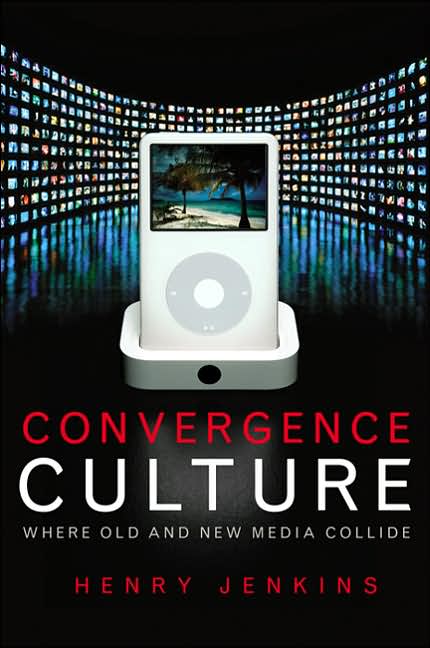 Traditionally speaking, most serious scholars would scoff at the idea of turning to popular culture for lessons in political discourse, religious consciousness, or educational formation. Yet this is just what Henry Jenkins, a professor of humanities and the founder and director of the Comparative Media Studies Program at MIT, has done in his recent book, Convergence Culture: Where Old and New Media Collide. The result is a wildly entertaining and eye-opening read that will forever change the way you view pop culture. It is simultaneously a direct challenge for all would-be educators to revolutionize their practices and for all of us to become more informed, proactive consumers and citizens.
Jenkins is not so much concerned with new technology (iPods, video phones, etc) as much as he is with how they affect the ways in which we interact with media (songs, stories, films, etc). He terms consumer interaction with, or appropriation of, media, popular culture (something of a departure from a more traditional understanding of popular culture as the media itself). He claims, “This book is about the relationship between three concepts–media convergence, participatory culture, and collective intelligence” (2). Convergence is “the flow of content across multiple media platforms, the cooperation between multiple media industries, and the migratory behavior of media audiences who will go almost anywhere in search of the kinds of entertainment experiences they want” (2). Participatory culture does away with antique ideas about passive spectatorship and embraces the notion that consumers are increasingly more involved with producers in ways they do not yet fully realize (3). Collective intelligence is just what it sounds like. Jenkins writes, “Because there is more information on any given topic than anyone can store in their head, there is an added incentive for us to talk among ourselves aobut the media we consume” (4).
 He explores six case studies of fan interaction with contemporary media: spoiler communities around the Survivor reality TV series, American Idol audiences, The Matrix as transmedia storytelling, Star Wars fan-created films, Harry Potter fans who write their own stories based on J.K. Rowling’s world, and Sims players who blur the boundary between digital and real world politics. In each of these cases, he outlines the legal disputes between producers and consumers (appropriators). His first two case studies especially reveal fascinating information into the future of marketing and programming in which consumers potentially have increasing control over what is created, aired, or distributed.
Unfortunately, Jenkin’s weakest component of his book involves what I had hoped would have been the strongest. In his discussion of the controversy surrounding fan-created Harry Potter stories, he introduces the implications that convergence culture holds for religious  communities. Here, he simply re-hashes the argument within Christian circles concerning the appropriateness of Harry Potter for young Christian readers: do they ban it altogether or appropriate it to highlight and teach Christian principles? His discussion of young Harry Potter fans joining together in on-line communities to not only critique each others’ writing but to ban together to fight Warner Brothers’ attempts to quiet them is cerainly inspiring. However, we can imagine what these “knowledge communities,” about which I will say more below, could mean for theological dialogue, spiritual reflection, or scriptural interpretation. If knowledge is now found in community, what role do scripture, ministers, or educators now play? His interest in participatory culture, how consumers influence producers, has great implications for church life as well.
Yet Jenkins’ discussion of Harry Potter also shows his greatest strength and perhaps the greatest potential of convergence culture. In his discussion of Survivor, Jenkins reveals the spoiler community, thousands of avid fans who form relationships on-line in order to find out locations and winners of upcoming seasons. Recognizing their limited personal knowledge, they join to form knowledge communities whose collective knowledge, while not limitless, certainly seems so.  Whether spoiling Survivor or critiquing Harry Potter fan fiction, Jenkins argues that countless individuals, especially children and teenagers, are becoming parts of these diverse communities. Therefore, “kids” have access to a wealth of information that directly influences not only the way they interact with one another and popular media, but how they can or want to learn in the classroom. The implications for educators are limitless as these kids bring a wealth of information into the classroom that only grows as they progress to higher levels of education. As if we needed any more proof, convergence culture is fossilizing the “empty vessel” approach to education that sees educators as wise elders who fill up their pupils with valuable information. Yet Jenkins is keen to point out that our educational systems, for the most part, still cling to this outdated method. A change must be on the horizon.
Jenkins’ discussion of our engagement with popular culture as beneficial to our everyday existence is especially relevant for educational theory. He argues:
[…Few] of us simply interact in political communities; most of us also join communities on the basis of our recreational interests. Many of us are fans of one or another form of popular cultur. Popular culture allows us to entertain alternative framings in part because the stakes are lower, because our viewing commitments don’t carry the same weight as our choices at the ballot box. Our willingness to step outside ideological enclaves may be greatest when we are talking about what kind of person Harry Potter is going to grow up to be or what kind of world will emerge as the machines and humans learn to work together in The Matrix (1999). That is, we may be able to talk across our differences if we find commonalities through our fantasies. This is in the end another reason why popular culture matters politically–because it doesn’t seem to be about politics at all. (249)
Moreover, he adds that what people learn through spoiling Survivor or remaking Star Wars films may quickly be applied to political activism, education, or the workplace.
In the end, Jenkins calls himself a “critical utopian.” As such, he wants to “identify the possibilities within our culture that might lead toward a better, more just society […and] to look for and promote unrealized potentials rather than reject out of hand anything that doesn’t rise to my standards” (247). Jenkins’ book is not only an encouragement to adapt in the face of convergence culture but a call to use media in the classroom as well. From such a thoughtful, insightful author, this is a welcome invitation indeed.
Previous Post

February 8, 2008
A Bright Commentary...
Next Post
February 20, 2008 Long Live Convergence...
Browse Our Archives
Select a Category Classics DVD Film Music News Pop Culture Events Print Sports Television Uncategorized Video Games
Select a Month March 2017 February 2017 January 2017 December 2016 November 2016 October 2016 September 2016 August 2016 July 2016 June 2016 May 2016 April 2016 March 2016 February 2016 January 2016 December 2015 November 2015 October 2015 September 2015 August 2015 July 2015 June 2015 May 2015 April 2015 March 2015 February 2015 January 2015 December 2014 November 2014 October 2014 September 2014 August 2014 July 2014 June 2014 May 2014 April 2014 March 2014 February 2014 January 2014 December 2013 November 2013 October 2013 September 2013 August 2013 July 2013 June 2013 May 2013 April 2013 March 2013 February 2013 January 2013 December 2012 November 2012 October 2012 September 2012 August 2012 July 2012 June 2012 May 2012 April 2012 March 2012 February 2012 January 2012 December 2011 November 2011 October 2011 September 2011 August 2011 July 2011 June 2011 May 2011 April 2011 March 2011 February 2011 January 2011 December 2010 November 2010 October 2010 September 2010 August 2010 July 2010 June 2010 May 2010 April 2010 March 2010 February 2010 January 2010 December 2009 November 2009 October 2009 September 2009 August 2009 July 2009 June 2009 May 2009 April 2009 March 2009 February 2009 January 2009 December 2008 November 2008 October 2008 September 2008 August 2008 July 2008 June 2008 May 2008 April 2008 March 2008 February 2008 January 2008 December 2007 November 2007 October 2007 September 2007 August 2007 July 2007 June 2007 May 2007 April 2007 March 2007
Follow Us!
TAKE THE
Religious Wisdom Quiz
Who built the first temple in Jerusalem?
Select your answer to see how you score.
David Moses Solomon Joshua
Related posts from Pop Theology


#KillerSerials: An Interview with Kutter Callaway

Book Review: MUSLIMS AND THE MAKING OF AMERICA

TRENDING AT PATHEOS Progressive Christian

Why Christians Have a Sacred Duty to Vote:...
The Bible offers strong support for the sacred duty to vote. Here...

What Being a Modern-Day Apostle Means to Me
In my last column, I discussed the ins and outs of modern-day...

Did Ancient China Once Worship the God of...
Across human history, a common thread weaves through the origins of the...

Love Your Neighbor – Including Earth-Kin: Lev. 19,...
God’s command to love your neighbor means acting in an ethical and...

Lead a Church Study of “Jesus and Lao...
Guest writer Jack Thomas (The Irreverent Reverend) reflects on leading his church...

Principles for Understanding the Apostolic Ministry Today
Whenever people discover that my formal ministry title is "apostle," as in...
view all Progressive Christian blogs
Ad-Free & Subscriber Log-In Subscription Support
- About Us
- 2026 Calendar
- Videos
- Podcasts
- Library of World Religions
- Faith In Media Tracker
- Advertise With Us
- Write for Us
- Privacy Policy
- Terms of Service
- Do Not Sell My Data
- Contact Us
- Radiant Digital
- Manage Newsletter Subscriptions
- Unsubscribe From Notifications
- Sitemap
Copyright 2008-2026, Patheos. All rights reserved.
Subscription Support Ad-Free & Subscriber Log-In
Follow Patheos