
BuddhistCatholicContemplativeEvangelicalGeneral ChristianHinduJewishLatter-day SaintMuslimNew VisionsProgressive Christian
Beliefs
- Buddhist
- Catholic
- Contemplative
- Evangelical
- General Christian
- Hindu
- Jewish
- Latter-day Saint
- More Voices
- Muslim
- New Visions
- Pagan
- Progressive Christian
Topics
- Religion News
- Food and Religion
- Sports and Religion
- Religious Art
- Religious Music and Entertainment
- Religious Events
- History and Religion
- Style and Religion
- Politics and Religion
- Women in Religion
- Recreation Outdoors and Religion
- Business Finance and Religion
- Careers Workplace and Religion
- Education and Religion
- Family Parenting and Religion
- Health Fitness and Religion
- Home and Religion
- Relationships and Religion
- Technology and Religion
- Travel and Religion
Columnists
- Buddhist Columnists
- Business Finance and Religion Columnists
- Careers Workplace and Religion Columnists
- Catholic Columnists
- Contemplative Columnists
- Education and Religion Columnists
- Evangelists Columnists
- Family Parenting and Religion Columnists
- General Christian Columnists
- Health Fitness and Religion Columnists
- Hindu Columnists
- History and Religion Columnists
- Home and Religion Columnists
- Jewish Columnists
- More Voices Columnists
- Latter Day Columnists
- Muslim Columnists
- New Visions Columnists
- Nonreligious Columnists
- Pagan Columnists
- Politics and Religion Columnists
- Progressive Columnists
- Recreation Outdoors and Religion Columnists
- Relationships and Religion Columnists
- Religion News Columnists
- Religious Art Columnists
- Religious Events Columnists
- Religious Music and Entertainment Columnists
- Sports and Religion Columnists
- Style and Religion Columnists
- Technology and Religion Columnists
- Travel and Religion Columnists
- Women in Religion Columnists
Resource Library
- 2026 Calendar
- Library of World Religions
- The 100 Most Holy Places on Earth
- Patheos Answers
- Podcasts
- Videos
- Faith Leaders Database
- Anglican Episcopalian
- Bahai
- Baptist
- Buddhism
- Christianity
- Confucianism
- Eastern Orthodoxy
- Hinduism
- Holiness and Pentecostal
- ISKCON
- Islam
- Judaism
- Lutheran
- Methodist
- The Church of Jesus Christ of Latter-day Saints
- New Age
- Paganism
- Presbytarian and Reformed
- Protestantism
- Religion Behind the Scenes
- Roman Catholic
- Scientology
- Shia Islam
- Sikhism
- Sufism
- Sunni Islam
- Taoism
- Zen
- See all religions
Research Tools
 Ad-Free & Subscriber Log-In Subscription Support
Ad-Free & Subscriber Log-In Subscription Support
Follow Patheos 

- Trending:
- Forgiveness
- |
- Marriage
- |
- Consciousness
- |
- Death Penalty
- |
- Election
- |
- Halloween
 Pop Feminist
- Home
- Catholic
- Religious Music & Entertainment
- A Theatre of Love: Where Have All the Catholic Artists Gone? (Pt. 3)
A Theatre of Love: Where Have All the Catholic Artists Gone? (Pt. 3)
Last updated on: June 26, 2018 at 5:41 pm by Emily C. A. Snyder
A Theatre of Love: Where Have All the Catholic Artists Gone? (Pt. 3) 2018-06-26T17:41:32-04:00 Emily C. A. Snyder
Patheos Explore the world's faith through different perspectives on religion and spirituality! Patheos has the views of the prevalent religions and spiritualities of the world.
This past weekend, I had the opportunity to be part of the Second Annual Sheen Center Theater Festival of Catholic Playwrights.
I talked a little bit about that here, but the question that kept coming up – as it always comes up – is “What is ‘Catholic theatre?'” Or perhaps: “What is ‘Catholic art?'” Why even specify that the art or the theatre is Catholic at all?
Here are some of my thoughts.
A Theatre of Hope
The festival presented three full-length productions and four excerpts, all from Catholic playwrights or theatre companies, including my own.
The offerings were massively diverse, ranging from:
- A one-woman intense drama about the genocide in Rwanda (Magis Theatre)
- A classic American dramedy, The Rainmaker (Storm Theatre)
- A comic book inspired Latino family play (by Matt Barbot)
- A heart-wrenching look at the fatal repercussions of violence and grief (by Colleen Murphy)
- A neo-Restoration farce in rhyming couplets about emotional infidelity (by yours truly)
- A Shakspearean sequel about two widows discovering their autonomy (also by yours truly)
One element that pervaded every offering, whether modern or classic, whether tragic or comical, was a sense of hope. That no matter how dire things got – genocide, school shootings, adultery, or just plain everyday old toxic relationships – this was not the end.
We were made for something better.
Comedy, then, is when we become who we were supposed to be; tragedy is when we miss it.
Compare this to some of the nihilistic stories this last century has afforded. Comedy becomes absurdism when life is merely chaotic. Tragedy is the attempt to live when life is bereft of meaning.
Very different from the Catholic imagination. For example, even one of the “darkest” plays, Murphy’s The December Man, which begins with an elderly couple committing suicide after the loss of their son, cycles backwards in time to the moment their son first encountered trauma in a school shooting – and a family reunited, and the words: “You’re safe now.”
The modern play would go forwards in time and see no way out of this valley of tears. The Catholic play doesn’t grow maudlin or trite about the very real suffering of this world, but even while looking frankly at pain, the Catholic play still hopes.
A Theatre of Faith
During the Q&A on the first night, one of the more interesting questions was how we playwrights introduced the concept of prayer in our work.
I was immediately transported to think of one of my favorite prayer-soliloquies in the canon, which is – perhaps surprisingly – Claudius’ attempt at confession in Hamlet. That speech may not, at first glance, look like a prayer. And it certainly isn’t “effective,” insofar as Claudius admits his prayer was selfish and therefore should not be answered – but the prayer is revealing. It’s a frank conversation with God; and in touching that divinity, it reveals the truth of the supplicant to himself. As Claudius says in that speech: “There, there is no hiding.”
Something I appreciate about Catholic plays is that when they do involve faith, it’s organic. The characters just are Catholic (or Christian, or Jewish, or Muslim, or pagan, or nothing), and that permeates the characters’ expletives and reasoning and social expectations.
For a Catholic, faith is not something layered on; it’s something that is breathed.
Faith – or more properly – the way we live out our faith, or fail to live it out – is also fair game for the Catholic storyteller. Both my plays criticized those who either weaponize religion, or who buy into “magical thinking” about faith.
For example, all the characters in The Merry Widows of Windsor are Catholic-Christian, and their strongest oath is “saints be praised!” But our villain, Francis Ford – the not-quite-as-dead-as-we-all-thought husband of our protagonist, Alice Ford – has a distorted view of religion as a way of dealing with his own low self-esteem; using “faith” to justify his own gaslighting and possessiveness. (Rather like this fellow Patheos columnist points out.) As Alice says in the beginning, in describing his jealousy, “He became obsessed with every chastity but his.” And through the course of the play, Alice wrestles with what it means to have been a good wife to a bad husband. Read the full play here.
Or take my play-in-progress, The Other, Other Woman, set in a very Catholic France, where problems arise largely because some of the protagonists seeking virtue have fallen prey to “magical thinking” about the sacraments. A prosperity Gospel that believes that following the commandments will protect you from all suffering and temptation. Or that God has no love for sinners, only saints. (Read the scene here! Becomes public on June 29th.)
In short:
Catholic theatre is unafraid to point out when we fail in our faith.
The religious hypocrite is everywhere. Flannery O’Connor wrote almost exclusively about them. But once again the difference is that we point out hypocrisy because it is a lie about the truth. Because it is a diminishment of reality.
Because it keeps us from the fullness of Love.
A Theatre of Love
A truly Catholic play, I believe, must have a deep, abiding love for all the characters shown on the stage.
No matter whether their life choices are good or bad or silly or serious or everything inbetween. A good Catholic play reaffirms that here on the stage before us were people worthy of being loved. And this, for a moment, is their story – as messy as that may become.
I’ll let the reporter from Catholic New York sum up what I said:
Emily C.A. Snyder, Artistic Director and co-founder of Turn to Flesh Productions, spoke about her experience working in Catholic theatre. “We wanted our company to be a little more covertly Catholic rather than overtly Catholic…When you say ‘we’re doing a Catholic show,’ people don’t show, including Catholics,” she said to chuckles from the audience.
How, then, do “Catholic shows” gain recognition and become a universal genre? The answer, once again, is by speaking the truth. Ms. Snyder said, “You can show completely, vastly different worldviews and so long as you’re showing them honestly, and giving each part of the argument truth, then everyone can come and listen.”
Catholic theatre isn’t theatre for Catholics only. “Yeah, we’re Catholic; that means you’re welcome. We’re Catholic; that means I love you. I love you, you’re welcome and I want you here,” Ms. Snyder said.
Read the full article at Catholic New York here.
Bad “religious” art judges, or preaches, or creates further rifts of “us” and “them.” We hate bad “religious” art because it is a lie. Because God’s grace is far more generous than that, and the world is far more messy.
But genuine Catholic art, or let us say, any art which is truly excellent – no matter the private beliefs of the inventor – will invite us to remember for a moment that the person sitting next to us is, in fact, our neighbor. And that we don’t know the intimate workings of another human’s heart – we may not even understand our own. And that, ultimately, there is something wonderful and fearful about we silly, silly human beings.
Something worth cherishing.
Someone who cherishes us.
Go forth. And make something True.
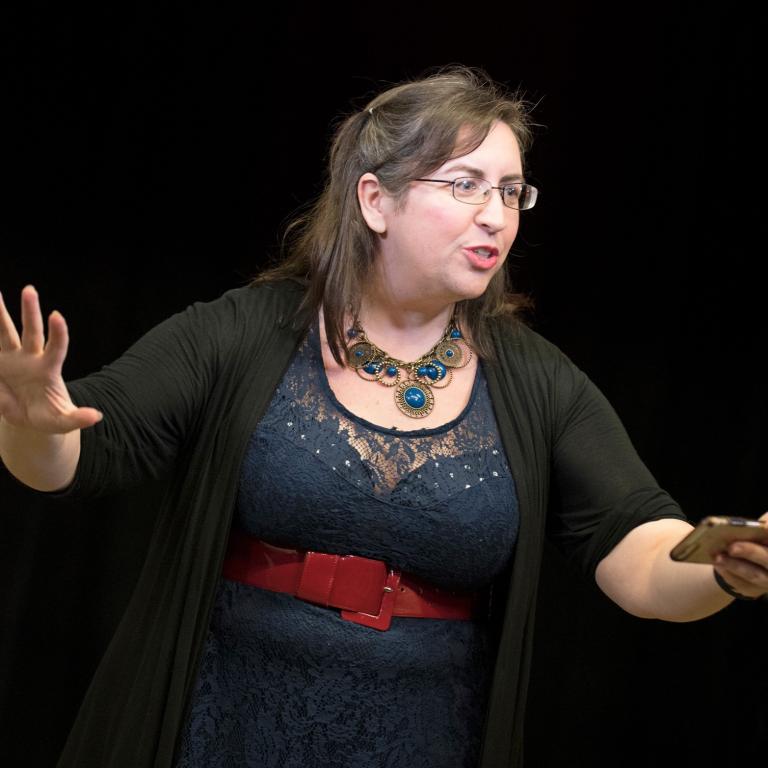
 Photo courtesy of Joel Weber. Pictured: Emily C. A. Snyder at Tale As Old As Time.
Want to read some of Emily’s writings? Become a $5 patron on Patreon today to get early and exclusive access to full scenes, soliloquies, scripts and more!
Next Post

July 7, 2018 Trauma & Repression in FROZEN: The Disney Princess They Almost Wrote
Browse Our Archives
Select a Category #MeToo Art Catholic Artists Catholicism Culture Dating Definitions Fairy Tales Irish Jewish Literature Love & Marriage Meditation Movies Musicals Poetry Pop Feminist Psychology Shakespeare Social Media Story structure Theatre TV Uncategorized Verse Drama Well-Meaning Patriarchy
Select a Month December 2019 June 2019 May 2019 April 2019 March 2019 February 2019 January 2019 December 2018 November 2018 October 2018 September 2018 August 2018 July 2018 June 2018 May 2018 April 2018 March 2018
Follow Us!
TAKE THE
Religious Wisdom Quiz
What is the Christian principle about speaking words?
Select your answer to see how you score.
Speak harshly Speak with love and grace Never speak Always be silent
Support this
Column


Related posts from Pop Feminist
Plotting Surprises: Or How To Ruin Great Shows
With Great Storytelling Comes Great Responsibility - Spider-Man:...

The Good, the Bad, and the Baffling of...
TRENDING AT PATHEOS Catholic

Creation, Preservation, and Teleology in Catholic Theology
As I write this, it is very early Monday morning. Like millions...

The Parable Of The Sower And The Word...
One of Christ’s most famous parables is that of the sower who...

Rejecting Doom: Christian Hope And Human Action
Christianity is a religion of hope. We are to have hope and...

Why I Choose the Eucharist Over the Sermon
Choose the Eucharist, Not the Sermon What are we supposed to get...

5 Design Elements Found in Spiritually Rooted Homes
Putting Spirituality Into Home Decor Our homes are more than our living...

Credo: A Story of God Told with the...
About 10 years ago, I began to imagine a personal "Credo" that...
view all Catholic blogs
Ad-Free & Subscriber Log-In Subscription Support
- About Us
- 2026 Calendar
- Videos
- Podcasts
- Library of World Religions
- Faith In Media Tracker
- Advertise With Us
- Write for Us
- Privacy Policy
- Terms of Service
- Do Not Sell My Data
- Contact Us
- Radiant Digital
- Manage Newsletter Subscriptions
- Unsubscribe From Notifications
- Sitemap
Copyright 2008-2026, Patheos. All rights reserved.
Subscription Support Ad-Free & Subscriber Log-In
Follow Patheos