
BuddhistCatholicContemplativeEvangelicalGeneral ChristianHinduJewishLatter-day SaintMuslimNew VisionsProgressive Christian
Beliefs
- Buddhist
- Catholic
- Contemplative
- Evangelical
- General Christian
- Hindu
- Jewish
- Latter-day Saint
- More Voices
- Muslim
- New Visions
- Pagan
- Progressive Christian
Topics
- Religion News
- Food and Religion
- Sports and Religion
- Religious Art
- Religious Music and Entertainment
- Religious Events
- History and Religion
- Style and Religion
- Politics and Religion
- Women in Religion
- Recreation Outdoors and Religion
- Business Finance and Religion
- Careers Workplace and Religion
- Education and Religion
- Family Parenting and Religion
- Health Fitness and Religion
- Home and Religion
- Relationships and Religion
- Technology and Religion
- Travel and Religion
Columnists
- Buddhist Columnists
- Business Finance and Religion Columnists
- Careers Workplace and Religion Columnists
- Catholic Columnists
- Contemplative Columnists
- Education and Religion Columnists
- Evangelists Columnists
- Family Parenting and Religion Columnists
- General Christian Columnists
- Health Fitness and Religion Columnists
- Hindu Columnists
- History and Religion Columnists
- Home and Religion Columnists
- Jewish Columnists
- More Voices Columnists
- Latter Day Columnists
- Muslim Columnists
- New Visions Columnists
- Nonreligious Columnists
- Pagan Columnists
- Politics and Religion Columnists
- Progressive Columnists
- Recreation Outdoors and Religion Columnists
- Relationships and Religion Columnists
- Religion News Columnists
- Religious Art Columnists
- Religious Events Columnists
- Religious Music and Entertainment Columnists
- Sports and Religion Columnists
- Style and Religion Columnists
- Technology and Religion Columnists
- Travel and Religion Columnists
- Women in Religion Columnists
Resource Library
- 2026 Calendar
- Library of World Religions
- The 100 Most Holy Places on Earth
- Patheos Answers
- Podcasts
- Videos
- Faith Leaders Database
- Anglican Episcopalian
- Bahai
- Baptist
- Buddhism
- Christianity
- Confucianism
- Eastern Orthodoxy
- Hinduism
- Holiness and Pentecostal
- ISKCON
- Islam
- Judaism
- Lutheran
- Methodist
- The Church of Jesus Christ of Latter-day Saints
- New Age
- Paganism
- Presbytarian and Reformed
- Protestantism
- Religion Behind the Scenes
- Roman Catholic
- Scientology
- Shia Islam
- Sikhism
- Sufism
- Sunni Islam
- Taoism
- Zen
- See all religions
Research Tools
 Ad-Free & Subscriber Log-In Subscription Support
Follow Patheos 

- Trending:
- Advent
- |
- Forgiveness
- |
- Thanksgiving
- |
- Election
- |
- Seasonal Holidays
- |
- Marriage
 Ponder Anew
- Home
- Evangelical
- How to Make a Beautiful Hymn Less Beautiful
How to Make a Beautiful Hymn Less Beautiful
Last updated on: June 7, 2021 at 5:50 pm by Jonathan Aigner
How to Make a Beautiful Hymn Less Beautiful 2021-06-07T17:50:29-05:00 Jonathan Aigner
Patheos Explore the world's faith through different perspectives on religion and spirituality! Patheos has the views of the prevalent religions and spiritualities of the world.
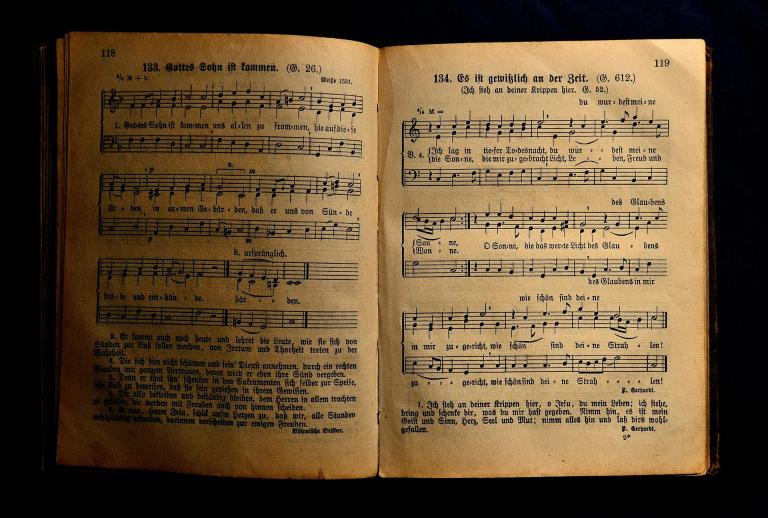
I was going to call this post “How to Make a Beautiful Hymn Ugly,” but I decided to soften it a little. The hack job wielded upon this lovely hymn doesn’t make it ugly, only a little uglier.
I’ve long loved to sing the hymn “Sing Praise to God Who Reigns Above” since I broke away from my pop worship roots in graduate school. I still think ultimate line in each stanza, “To God all praise and glory,” is one of the most thrilling to sing in all of hymnody.
Most hymnals include four stanzas, except most Lutheran hymnals. God love the Lutherans for not being afraid of singing a bunch of stanzas.
As most translated hymns go, there were quite a few variations in the text of this hymn from its first English rendering in the mid-19th century, until around 1950, when the variations became fewer, and we were left with a few more or less standard versions.
Until the past few decades, when heavy-handed hymnal committees began to jack around with beloved hymns to make them sound more modern and inclusive. This is not the most dramatically altered hymn text, but one particular change stood out to me as I was reading through it this week, and it got me thinking about the rest of it.
The hymnal I was using was a newer publication from a mainline Protestant denomination. This is how the first stanza of “Sing Praise to God Who Reigns Above” appeared two hymnal revisions ago, in the mid-1950s, and the changes made in the current revision:
Sing praise to God who reigns above,
The God of all creation,
The God of power, the God of love,
The God of our salvation;
With healing balm my soul He fills is filled,
And every faithless murmur stills stilled:
To God all praise and glory.
I get it, we all use passive voice is used by all of us, but it doesn’t make for beautiful poetry. Quite the opposite, actually. It’s uglier. In this case it’s awkward, it doesn’t sing particularly well, and it obscures the identity of who is performing the action, who happens to be Almighty God. It’s a curious choice, too, considering this hymnal doesn’t eliminate every single masculine pronoun used for God the Father. Many beloved texts remain unchanged, such as this one:
“O my soul, praise him, for he is thy health and salvation!”
So is it because one hymn is more beloved than others? Or was the committee bored with their tedious busywork by the time they considered it? I don’t know. So why would you choose to make one text uglier? Particularly when Jesus himself taught us to pray using the locution “Our Father.”
Consistency aside, this is a classic case of scholars creating problems and doing their best to convince us all that we share those problems. And while I am sympathetic to the pastoral concerns that arise for some by referring to God as Jesus taught, those pastoral concerns do not give us license to rewrite the whole book.
The madness continues in stanza 2:
What God’s almighty power hath has made,
His God’s gracious mercy keepeth;
By morning glow or evening shade
His God’s watchful eye ne’er sleepeth;
Within the kingdom of His God’s might,
Lo! all is just and all is right:
To God all praise and glory.
Everyone knows what “hath” means. Again what are we afraid of exactly? Particularly when “keepeth” and “sleepeth” are kept unaltered.
And then there’s the great pronoun debate that has raged on through the past, um, five minutes, basically. If God is Father, we can use male pronouns with the understanding that such language is, in a sense, metaphorical. God is not male as I am. But the imminence of God as so wonderfully described by this hymn is left incomplete if we neuter Him, especially considering the shortcomings of the English language.
Plus, the edited version sounds ugly and weird. The original repetitions of the word “God” in stanza one are clearly for rhetorical effect: “the God of power, the God of love, the God of our salvation” refers to the God mentioned in the incipit. It is a categorical unpacking of the first use.
The newly added repetitions of “God” in stanza two are different. People don’t talk like this, and they shouldn’t write poetry like this, either. For instance, my dog has been active in the past few minutes while I’ve been writing this post. Let me tell you about it.
My dog ate food and drank water.
Then my dog barked at the back door.
Next my dog went outside to relieve my dog’s self,
And while my dog was out there,
My dog rolled in excrement left by the neighbor’s cat.
My neighbor’s cat is not a very good cat.
My neighbor’s cat likes to leave my neighbor’s cat’s excrement in my backyard for my dog to find.
Now I have to give my dog a bath because my dog has grass and dirt and cat excrement in my dog’s hair.
See. Weird. And awkward.
Stanza three is more of the same:
The Lord is never far away,
But, through all grief distressing,
An everpresent help and stay,
Our peace, and joy, and blessing;
As with a mother’s tender hand,
He God gently leads His own, His the chosen band:
To God all praise and glory.
And finally, stanza four:
Thus, all my toilsome way along,
I sing aloud Thy praises,
That men all may hear the grateful song
My voice unwearied raises;
Be joyful in the Lord, my heart,
Both soul and body bear your part:
To God all praise and glory.
This change doesn’t bother me as much in this particular context. By “men,” it’s clear we mean everyone hearing my voice as I sing God’s praises. In other hymns, such a change, particularly when oft-repeated, can be quite jarring and end up meaning something other than the author intended.
While most of us in the past few decades have been trained to write with inclusive language, and to not say “men” unless we are talking about male persons, it’s okay to acknowledge that this was not always the case, and to preserve the beauty of the poetry. Here is what one woman, Episcopal Priest Fleming Rutledge, says about this predicament in the forward of one of her books:
“I have generally avoided the use of ‘man’ and ‘him’ in my more recent work, but I am not fanatical about it. If I value the cadence of a sentence, or the time-honored use of a term (for instance, ‘the old Adam’), I will retain the old form.”
Maybe we shouldn’t be fanatical about it, either. And it is certainly fanatical when we’re singing to and about a beautiful God to make those hymns distinctively less beautiful.
Photo:
pixabay, creative commons 2.0
Previous Post

June 5, 2021
Liturgical Novelty Defeats the Purpose of Liturgy
Next Post

June 10, 2021 Form and Meaning in Liturgical Art
Browse Our Archives
Select a Category Church of St. YouTube congregational singing congregational song contemporary critiques corporate worship Hymn of the Week hymn singing hymnody and hymnology hymns masturbatory worship Uncategorized worship Worship Quotes
Select a Month February 2023 January 2023 October 2022 September 2022 April 2022 February 2022 January 2022 December 2021 July 2021 June 2021 May 2021 April 2021 January 2021 December 2020 November 2020 July 2020 June 2020 May 2020 April 2020 March 2020 February 2020 January 2020 November 2019 September 2019 July 2019 June 2019 May 2019 April 2019 March 2019 February 2019 January 2019 December 2018 November 2018 October 2018 September 2018 August 2018 July 2018 June 2018 May 2018 April 2018 March 2018 February 2018 January 2018 December 2017 October 2017 September 2017 August 2017 July 2017 June 2017 May 2017 April 2017 March 2017 February 2017 January 2017 December 2016 November 2016 October 2016 September 2016 July 2016 June 2016 May 2016 April 2016 March 2016 February 2016 January 2016 December 2015 November 2015 October 2015 September 2015 August 2015 July 2015 June 2015 May 2015 February 2015 January 2015 December 2014 October 2014 September 2014 August 2014 July 2014
Follow Us!
TAKE THE
Religious Wisdom Quiz
What does "Shiloh" mean in Hebrew?
Select your answer to see how you score.
He whose it is Prince of peace God’s dwelling The chosen one
Related posts from Ponder Anew

Hymn of the Day: Love Divine, All Loves...

Hymn of the Day: Christ, Whose Glory Fills...
Hymn of the Day: Where Cross the Crowded...
Hymn of the Day: Open Now Thy Gates...
TRENDING AT PATHEOS Evangelical

When you hear the word riches, what comes to mind? For most...

Don’t Miss the Parents: A Creative Christmas Meditation
As we enter the Advent Season, I see many people trying to...

Making Stones Into Bread: Choosing the “Right” Work
I was on my online arts ministry Zoom meeting with the International...

Ukraine’s exhausted Christians face fifth winter of war
By Julian Lukins The full-scale war in Ukraine is taking “a serious...

Russell Brand's Conviction is not anti-Christian Persecution
How do we shed the reputation that the Church is OK with...

Have you ever caught yourself saying, “I’ll do it tomorrow,” or “Now...
view all Evangelical blogs
Ad-Free & Subscriber Log-In Subscription Support
- About Us
- 2026 Calendar
- Videos
- Podcasts
- Library of World Religions
- Faith In Media Tracker
- Advertise With Us
- Write for Us
- Privacy Policy
- Terms of Service
- Do Not Sell My Data
- Contact Us
- Radiant Digital
- Manage Newsletter Subscriptions
- Unsubscribe From Notifications
- Sitemap
Copyright 2008-2026, Patheos, part of the Radiant Digital network of media brands. All rights reserved.
Subscription Support Ad-Free & Subscriber Log-In
Follow Patheos