
BuddhistCatholicContemplativeEvangelicalGeneral ChristianHinduJewishLatter-day SaintMuslimNew VisionsProgressive Christian
Beliefs
- Buddhist
- Catholic
- Contemplative
- Evangelical
- General Christian
- Hindu
- Jewish
- Latter-day Saint
- More Voices
- Muslim
- New Visions
- Pagan
- Progressive Christian
Topics
- Religion News
- Food and Religion
- Sports and Religion
- Religious Art
- Religious Music and Entertainment
- Religious Events
- History and Religion
- Style and Religion
- Politics and Religion
- Women in Religion
- Recreation Outdoors and Religion
- Business Finance and Religion
- Careers Workplace and Religion
- Education and Religion
- Family Parenting and Religion
- Health Fitness and Religion
- Home and Religion
- Relationships and Religion
- Technology and Religion
- Travel and Religion
Columnists
- Buddhist Columnists
- Business Finance and Religion Columnists
- Careers Workplace and Religion Columnists
- Catholic Columnists
- Contemplative Columnists
- Education and Religion Columnists
- Evangelists Columnists
- Family Parenting and Religion Columnists
- General Christian Columnists
- Health Fitness and Religion Columnists
- Hindu Columnists
- History and Religion Columnists
- Home and Religion Columnists
- Jewish Columnists
- More Voices Columnists
- Latter Day Columnists
- Muslim Columnists
- New Visions Columnists
- Nonreligious Columnists
- Pagan Columnists
- Politics and Religion Columnists
- Progressive Columnists
- Recreation Outdoors and Religion Columnists
- Relationships and Religion Columnists
- Religion News Columnists
- Religious Art Columnists
- Religious Events Columnists
- Religious Music and Entertainment Columnists
- Sports and Religion Columnists
- Style and Religion Columnists
- Technology and Religion Columnists
- Travel and Religion Columnists
- Women in Religion Columnists
Resource Library
- 2026 Calendar
- Library of World Religions
- The 100 Most Holy Places on Earth
- Patheos Answers
- Podcasts
- Videos
- Faith Leaders Database
- Anglican Episcopalian
- Bahai
- Baptist
- Buddhism
- Christianity
- Confucianism
- Eastern Orthodoxy
- Hinduism
- Holiness and Pentecostal
- ISKCON
- Islam
- Judaism
- Lutheran
- Methodist
- The Church of Jesus Christ of Latter-day Saints
- New Age
- Paganism
- Presbytarian and Reformed
- Protestantism
- Religion Behind the Scenes
- Roman Catholic
- Scientology
- Shia Islam
- Sikhism
- Sufism
- Sunni Islam
- Taoism
- Zen
- See all religions
Research Tools
 Ad-Free & Subscriber Log-In Subscription Support
Ad-Free & Subscriber Log-In Subscription Support
Follow Patheos 

- Trending:
- Forgiveness
- |
- Marriage
- |
- Consciousness
- |
- Death Penalty
- |
- Election
- |
- Halloween
 Ponder Anew
- Home
- Evangelical
- Why Liturgy?
Why Liturgy?
Last updated on: January 14, 2019 at 6:51 pm by Jonathan Aigner
Why Liturgy? 2019-01-14T18:51:05-05:00 Jonathan Aigner
Patheos Explore the world's faith through different perspectives on religion and spirituality! Patheos has the views of the prevalent religions and spiritualities of the world.
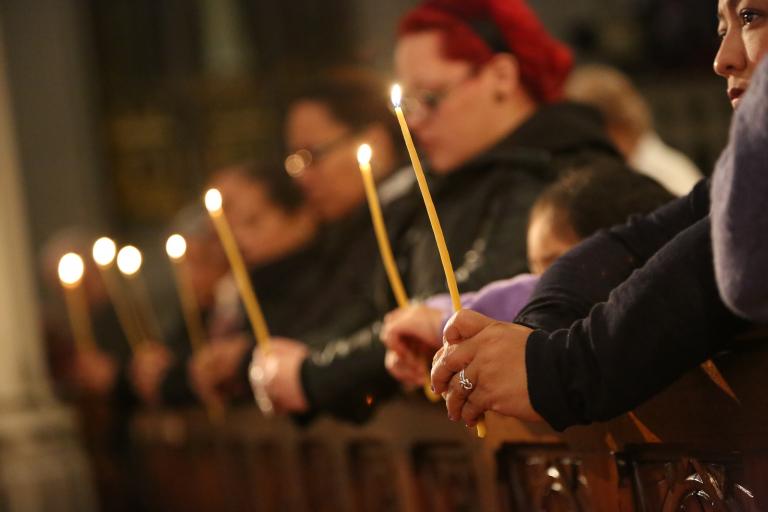
A guest post by Les Lamkin
Why Liturgy?
In my previous guest articles for Ponder Anew, I have maintained that worship is formative, not expressive. God does not need our worship, but desires that we worship Him for our own benefit, rather than for his. The benefit we derive from worship is the formation of Christlikeness in our lives, both individually and corporately as the Body of Christ.
“Whatever, Les,” you are probably thinking. “How does reciting a bunch of Latin mumbo-jumbo form us into the likeness of Christ?”
It’s only mumbo-jumbo if that is your opinion of prayer, scripture reading and communion.
Another blogger responded to one of my articles, “But There’s No Liturgy in the Bible!” and correctly noted that not only does the basis for Christian liturgy appear in the Bible, but the Bible appears, if not directly, then by inference, throughout the liturgy. Judaism had liturgies that are similar to the Catholic liturgy. Jesus participated in the Jewish liturgy multiple times in the gospels. Reading the scrolls—Hebrew Scriptures—was central. Praying as a community was central. The forgiveness of sins on Yom Kippur was the most solemn liturgy of the year. Ancient Christian liturgy—and the modern Christian liturgies that derive from them–was not an invention; it evolved from Jewish liturgy, which is what Christ participated in. Jesus was in the midst of doing the Passover dinner liturgy when he was betrayed. At that dinner, the exodus story was read, prayers were said, bread was broken and blessed, wine was blessed, a meal was shared. To frame this in the language of orthodoxy, they celebrated the Mass.
Contemporary Worship vs. Worship
The Contemporary Worship Movement has abandoned the historic liturgy of the church and in doing so has also succeeded in stripping the church of the public reading of scripture, public prayers and the feast of the Eucharist. The great creeds of the faith, the Nicene and Apostles Creed, have been relegated to the trash heap of yesterday. Just as egregious, our newest batch of hymn writers have no training in theology or doctrine and have postulated a view of God, the Creator of Heaven and Earth, that makes Him little more than an unrequited lover, our “buddy Jesus.” Yes, God is love, but just as frequently, just as importantly, the Bible portrays God as holy.
I recently attended services in a church with an Assemblies of God orientation, but which, in keeping with modern sensibilities, identifies itself with a more generic, less denominational, name. In the previous months, I had also visited, several times, a non-denominational church with a politely Calvinist bent and a Free Methodist church that also goes by a less denominational, more generic name. All used a projector to display song lyrics, announcements and sermon notes. All had a worship band and sang the newest contemporary worship songs.
They dutifully displayed the scripture passages for the sermon. As I recall, someone from the quasi-Calvinist church stood and read a passage of scripture. In all, after the passages were read by the pastor, the PowerPoint moved onto the bulleted outline of the sermon. Thirty minutes later, the preaching ended. Sing. Go home.
What Is Worship Without Scripture?
I find it odd that churches which claim Sola Scriptura as their founding principal spend so little time on the public reading of scripture. I have to hand it to the Catholics on this point: they spend a lot of time publicly reading scripture together. And it’s not just one guy reading aloud. There are generally four individual readers, including the priest who reads the gospel, and all the congregants responses derive from scripture. Catholics read aloud individually, chorally and responsively. And it’s not just one short passage. Every week, Catholics read a passage from the Old Testament, the Psalms, the Epistles and the Gospels. They recite together the Lord’s Prayer (“and Jesus taught them to pray…”) and either the Apostle’s or the Nicene Creed. In short, they seem to take seriously that to which Evangelicals only pay lip service, that which scripture says about itself: “[T]he word of God is alive and active. Sharper than any double-edged sword, it penetrates even to dividing soul and spirit, joints and marrow; it judges the thoughts and attitudes of the heart (Hebrew 4:12).”
I digress. What does all this have to do with the formative nature of worship?
I’m a teacher. I teach English in a small rural school and I’m an adjunct English instructor at the local community college. So, I teach everything from junior high students to undergraduate college students. Educators would almost universally agree that, regardless of the level of the student, repetition is an important part of a student’s education. You can’t have a fourth grader learn the multiplication tables one day and move on to exponents the next: the tables have to be drilled in via a fairly hefty dose of repetition, sometimes silently, sometimes chorally.
Don’t get me wrong. I’m not advocating for worship that sounds like a bunch of fourth graders reciting, “Two times two equals four; two times three equals six, two times….”
However, I would argue that by abandoning the public reading of scripture, public prayers and communion in favor of contemporary worship, in which music is the totality of worship, we have sacrificed the formative aspect of worship. Let’s consider each of these in turn.
Sola Scriptura or Sola “Worship” Music?
Protestants are supposed to have built their doctrines around four solas, the most basic of which, and from which the others flow, is sola scriptura, the belief that Holy Scripture contains all we need to know to live in a right relationship with our creator and confirms the historicity of the life, death and resurrection of Jesus. And yet, it would appear to a casual observer like me that Catholicism places a much higher value on scripture than do many Protestants and certainly more so than the practitioners in the contemporary worship movement.
As I think back on my experiences in the contemporary worship movement, it seems to me that there were only a few minutes of actual scripture read during the entire service. A particularly conscientious preacher might revisit the passages for the day’s sermon, but taken as a percentage whole of the entire service, very little time was typically devoted to the public reading of scripture. Now, compare that to the amount of time spent singing songs of dubious theological value in a contemporary worship service. I’m sure nobody means to, but aren’t we slighting Moses, David, Isaiah, John, Paul and a host of other writers of scripture in favor of singing “God’s Dance Floor”?
If we are serious about scripture, then we should reexamine the passage from Hebrews above: “[T]he word of God is alive and active. Sharper than any double-edged sword, it penetrates even to dividing soul and spirit, joints and marrow; it judges the thoughts and attitudes of the heart.” Thus, the word of God has power to enter us, guide us and form who we are, if we let it. But in a movement that is desperately bereft of the public reading of scripture, how can that happen? If scripture has power, then the public reading of scripture is, really and truly, formative in nature.
Liturgy is formative partly because it does just that; it imparts the Word of God into us through careful attention to its disclosures made public in our churches.
In any liturgical service, scripture is read. You may never get to hear a Chris Tomlin number, but you will hear the lamentations of Jeremiah, the desperate outpourings of David, the expositions of Paul and, most of all, the Good News of Jesus Christ.
Couldn’t Hear Nobody Pray
In a liturgical service, the people pray. Yes, they pray in a contemporary service also, but their prayers are typically off-the-cuff utterances like: “God, we love you and are glad you’re here with us today. Bless us as we worship you. Amen.” My example is a fairly truncated example of what happens in a contemporary worship service, but not by much. The point is that the prayers in a contemporary worship service are typically short, extemporaneous and sound more like Romantic poet William Wordsworth’s definition of poetry— “the spontaneous overflow of powerful feelings”—than they do a prayer. This is great if you’re reading “Lines Composed A Few Miles above Tintern Abbey“; not so great in worship because the focus of the prayer becomes the “powerful feelings” and not God.
Furthermore, I think we need to consider the introduction to the Lord’s Prayer when the Bible says that Jesus “taught them to pray.” Again, Evangelicals in general and the practitioners of contemporary worship in particular do not seem as serious about what scripture tells as do Catholics and other liturgical churches. Why would Jesus need to teach us to pray? Isn’t an off-the-cuff, extemporaneous, heartfelt prayer sufficient?
I don’t think so. Again, don’t get me wrong. I think in our private devotions, such prayers are fine. But when the church gathers in worship, we are not supposed to be just a group of individuals, each engaged in our own private worship, but the Body of Christ engaged in the corporate, life-changing, transformative worship of God.
Liturgical churches recite written prayers and spend far more time praying together that do Evangelical churches. The prayers they recite include prayers of invocation (a call to worship), confession of sin; prayers for the people including our civic and religious leaders and those suffering persecution, illness or calamity; prayers of thanksgiving; a benediction and, most importantly, Eucharistic prayers that thank God for the gift of His dearly beloved son, broken and poured out for our sins and raised from the dead. The prayers are largely taken directly from scripture, and those which are not are treasures of beauty and deep theology. By reciting such prayers, worship again becomes formative, molding us into the likeness and character of Jesus Christ.
The Eucharist Is Not Snack Time
For the purposes of this essay, I’m not interested in arguing the particulars of communion; whether it should be open or closed, whether the hosts are truly the body and blood of Christ or representative of a mystical spiritual reality in which Christ is truly present, but not physically present in the hosts. For me, the importance is simply the regular practice of the Eucharist. Again, Catholics and other liturgical churches seem to take more notice of what scripture actually says that do Evangelicals and especially those in the contemporary worship movement who have attempted to reinvent worship in the name of outreach and relevance. Jesus Christ himself said, in John chapter 6, “Very truly I tell you, unless you eat the flesh of the Son of Man and drink his blood, you have no life in you. 54 Whoever eats my flesh and drinks my blood has eternal life, and I will raise them up at the last day. 55 For my flesh is real food and my blood is real drink. 56 Whoever eats my flesh and drinks my blood remains in me, and I in them.” Evangelicals who slight communion or who relegate it to “juice and crackers” (a description from Hank Hanegraph, the radio “Bible Answer Man” who converted to the Eastern Orthodox Church in response to Evangelicalism’s diminished view of communion) should tremble at such a passage as this. Regardless of your doctrine of communion, Jesus himself claimed, in the passage above, that if we do not eat his flesh and drink his blood, we have no spiritual life. I have, many times, heard the plea that communion should be kept special and that the weekly observance of the Eucharist would make it seem ordinary.
Do you eat once a week? Do you take in nourishment only on special occasions? The Bible never says that communion should be relegated to Christmas and Easter, or a once-a-month, off-the-cuff experience. Justin Martyr, writing in about 150 A.D. and describing a typical Christian service, claims that Communion was a regular part of the gathering and he describes it occurring weekly. Again, if we take Jesus seriously, we must consider the possibility that his statement “For my flesh is real food and my blood real drink” is something more than sentiment or symbolism, but that it truly is spiritual nourishment and that via the hosts the grace of God is imparted to us to strengthen us in the pursuit of a victorious Christian life.
I recently began timing the amount of time that contemporary worship churches spend in the public reading of scripture and prayer. In the Assemblies-style church, less than three minutes is spent publicly reading scripture together. The total time spent praying was less than a minute and a half. I recently attended a contemporary worship style mega-church in the Seattle area and found similar results. About forty minutes was devoted to music, about ten minutes spent on a trivia game about St. Nicholas, and the sermon (a classic example of Moralistic Therapeutic Deism) was about forty-five minutes. Again, less than three minutes were spent reading scripture while prayer received only a couple of minutes. The quasi-Calvinist church fared slightly better, but not by much.
Lex Orandi, Lex Credendi, Lex Vivendi
We lament the declining morality in our churches, are alarmed at increasing divorce rates in our congregations and are befuddled at our apparent capitulation to 21st century sexual ethics, and yet seldom do we evaluate what we are doing in our churches to staunch the moral and spiritual bleeding. Perhaps it should not be a matter of trying to staunch the bleeding, or attempting to make worship sensational and relevant, but getting back to worship that truly glorifies God and in which, every week, the grand story of God and our own salvation is replayed for us in vivid detail through scripture, prayer and the nourishing of our souls through the Ministry of the Table.
Many thanks to Jan Vallone for editing the article and insights about Catholic liturgical practice.
Photo:
Flickr, creative commons 2.0

Next Post
January 23, 2019 “M” Worship and the Contemporary Church
Browse Our Archives
Select a Category Church of St. YouTube congregational singing congregational song contemporary critiques corporate worship Hymn of the Week hymn singing hymnody and hymnology hymns masturbatory worship Uncategorized worship Worship Quotes
Select a Month February 2023 January 2023 October 2022 September 2022 April 2022 February 2022 January 2022 December 2021 July 2021 June 2021 May 2021 April 2021 January 2021 December 2020 November 2020 July 2020 June 2020 May 2020 April 2020 March 2020 February 2020 January 2020 November 2019 September 2019 July 2019 June 2019 May 2019 April 2019 March 2019 February 2019 January 2019 December 2018 November 2018 October 2018 September 2018 August 2018 July 2018 June 2018 May 2018 April 2018 March 2018 February 2018 January 2018 December 2017 October 2017 September 2017 August 2017 July 2017 June 2017 May 2017 April 2017 March 2017 February 2017 January 2017 December 2016 November 2016 October 2016 September 2016 July 2016 June 2016 May 2016 April 2016 March 2016 February 2016 January 2016 December 2015 November 2015 October 2015 September 2015 August 2015 July 2015 June 2015 May 2015 February 2015 January 2015 December 2014 October 2014 September 2014 August 2014 July 2014
Follow Us!
TAKE THE
Religious Wisdom Quiz
True or False: James says that whoever keeps the whole law but stumbles at just one point is guilty of breaking all of it.
Select your answer to see how you score.
FALSE TRUE
Related posts from Ponder Anew

Hymn of the Day: Love Divine, All Loves...

Hymn of the Day: Christ, Whose Glory Fills...
Hymn of the Day: Where Cross the Crowded...
Hymn of the Day: Open Now Thy Gates...
TRENDING AT PATHEOS Evangelical

How the author of the world's best hymn...
I've been working with John Newton for a while now. This makes...

Long before this Lectio Divina, Psalm 130 - the song - started...

What About the Trees? Another Living Parable
After I finished writing the last article about falling leaves as a...

Why Classical Education Is a Conversation, Not a...
Come and Read: Joy in Classical Education When I was a little...

Falling Leaves: A Living Parable on Letting Go
I’ve spent the vast majority of my life in the southeast corner...

Cornell University has received a great deal of negative publicity and intense...
view all Evangelical blogs
Ad-Free & Subscriber Log-In Subscription Support
- About Us
- 2026 Calendar
- Videos
- Podcasts
- Library of World Religions
- Faith In Media Tracker
- Advertise With Us
- Write for Us
- Privacy Policy
- Terms of Service
- Do Not Sell My Data
- Contact Us
- Radiant Digital
- Manage Newsletter Subscriptions
- Unsubscribe From Notifications
- Sitemap
Copyright 2008-2026, Patheos. All rights reserved.
Subscription Support Ad-Free & Subscriber Log-In
Follow Patheos