
BuddhistCatholicContemplativeEvangelicalGeneral ChristianHinduJewishLatter-day SaintMuslimNew VisionsProgressive Christian
Beliefs
- Buddhist
- Catholic
- Contemplative
- Evangelical
- General Christian
- Hindu
- Jewish
- Latter-day Saint
- More Voices
- Muslim
- New Visions
- Pagan
- Progressive Christian
Topics
- Religion News
- Food and Religion
- Sports and Religion
- Religious Art
- Religious Music and Entertainment
- Religious Events
- History and Religion
- Style and Religion
- Politics and Religion
- Women in Religion
- Recreation Outdoors and Religion
- Business Finance and Religion
- Careers Workplace and Religion
- Education and Religion
- Family Parenting and Religion
- Health Fitness and Religion
- Home and Religion
- Relationships and Religion
- Technology and Religion
- Travel and Religion
Columnists
- Buddhist Columnists
- Business Finance and Religion Columnists
- Careers Workplace and Religion Columnists
- Catholic Columnists
- Contemplative Columnists
- Education and Religion Columnists
- Evangelists Columnists
- Family Parenting and Religion Columnists
- General Christian Columnists
- Health Fitness and Religion Columnists
- Hindu Columnists
- History and Religion Columnists
- Home and Religion Columnists
- Jewish Columnists
- More Voices Columnists
- Latter Day Columnists
- Muslim Columnists
- New Visions Columnists
- Nonreligious Columnists
- Pagan Columnists
- Politics and Religion Columnists
- Progressive Columnists
- Recreation Outdoors and Religion Columnists
- Relationships and Religion Columnists
- Religion News Columnists
- Religious Art Columnists
- Religious Events Columnists
- Religious Music and Entertainment Columnists
- Sports and Religion Columnists
- Style and Religion Columnists
- Technology and Religion Columnists
- Travel and Religion Columnists
- Women in Religion Columnists
Resource Library
- 2026 Calendar
- Library of World Religions
- The 100 Most Holy Places on Earth
- Patheos Answers
- Podcasts
- Videos
- Faith Leaders Database
- Anglican Episcopalian
- Bahai
- Baptist
- Buddhism
- Christianity
- Confucianism
- Eastern Orthodoxy
- Hinduism
- Holiness and Pentecostal
- ISKCON
- Islam
- Judaism
- Lutheran
- Methodist
- The Church of Jesus Christ of Latter-day Saints
- New Age
- Paganism
- Presbytarian and Reformed
- Protestantism
- Religion Behind the Scenes
- Roman Catholic
- Scientology
- Shia Islam
- Sikhism
- Sufism
- Sunni Islam
- Taoism
- Zen
- See all religions
Research Tools
 Ad-Free & Subscriber Log-In Subscription Support
Ad-Free & Subscriber Log-In Subscription Support
Follow Patheos 

- Trending:
- Forgiveness
- |
- Marriage
- |
- Consciousness
- |
- Death Penalty
- |
- Election
- |
- Halloween
 Ponder Anew
- Home
- Evangelical
- The Worst Southern Baptist Sins: Dancing, Cardplaying, & 3rd Stanza-ing
The Worst Southern Baptist Sins: Dancing, Cardplaying, & 3rd Stanza-ing
Last updated on: August 2, 2018 at 10:28 pm by Jonathan Aigner
The Worst Southern Baptist Sins: Dancing, Cardplaying, & 3rd Stanza-ing 2018-08-02T22:28:26-05:00 Jonathan Aigner
Patheos Explore the world's faith through different perspectives on religion and spirituality! Patheos has the views of the prevalent religions and spiritualities of the world.
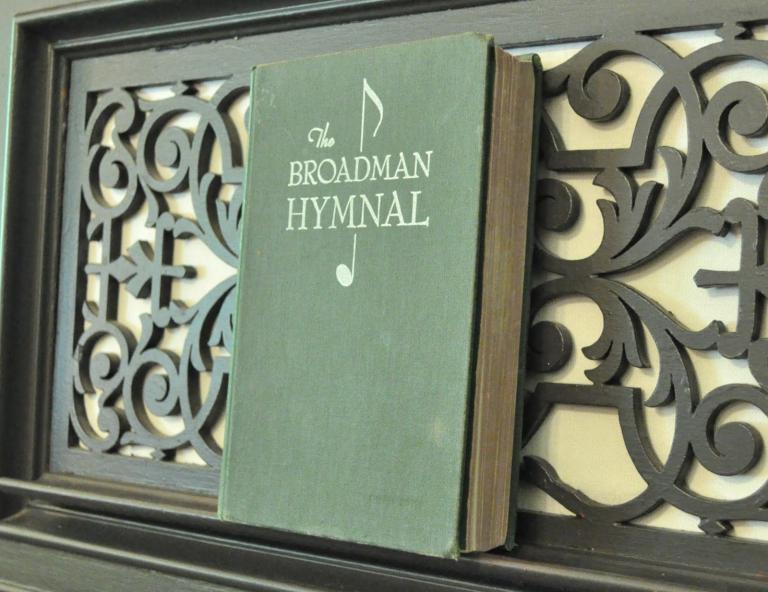
In my last post, I talked about the weird, unnecessary, overly pragmatic reasons we have for omitting stanzas of hymns. Of course, I forgot about my Southern Baptist background and some of their weird idiosyncrasies:
- They think you have to bring a covered dish to heaven with you when you die.
- They think the promised land is in Nashville, Tennessee.
- They think they should abstain from sex, lest it lead to dancing.
- They think it’s in the Bible somewhere that the pastor must remove his or her watch and places it on the pulpit before preaching.
And then there’s that one rule, which to break it would be the worst sin imaginable, and would certainly result in eternal damnation, and worse, arriving at Luby’s after the Methodists:
You must never, ever sing the third stanza to any hymn.
First, second, and last. That’s the rule.
In fact, that’s why the two-stanza hymn 24, “Let All the World in Every Corner Sing” (of course I’m using the ’75 hymnal, because that’s the best one) presents such a conundrum for Baptists. Somebody would have to add another suitable stanza to George Herbert’s 17th century masterpiece, and nobody’s done that yet.
But, my Baptist friends, what treasures you miss. What peace you’ve forfeited, what pain you’ve borne, all because you do not carry the burden of singing the other stanzas.
Just think about it.
It might come in handy when singing a trinitarian hymn, because Baptist churches are usually a no-fly zone for the Holy Spirit. So though it might take some baptistic dissonance, leaving out “Come, Holy Comforter” in hymn 2 or “Holy Spirit, we adore thee!” in hymn 3 is really quite convenient.
But then there’s cases, like in “Praise, My Soul, the King of Heaven” (By the way, can someone tell me how the Baptists’ LAUDA ANIMA can’t be like everyone else’s LAUDA ANIMA?!?!) You have the first stanza, declaring how fitting it is for the congregation to praise its King, the second stanza, lauda anima-ing God’s matchless, unmerited grace, consistency, and lovingkindness. The third stanza perfectly contrasts God’s immutability with the frailty of our own human husk.
Frail as summer’s flow’r we flourish;
Blows the wind and it is gone;
But, while mortals rise and perish,
God endures unchanging on:
Alleluia! Alleluia!
Praise the high eternal one.
That’s a real loss, Baptists. And the same thing happens when we ditch this beauty:
To all, life thou givest to both great and small;
In all life thou livest, the true life of all;
We blossom and flourish as leaves on the tree,
And wither and perish – but naught changeth thee.
And I should mention that the title of this blog wouldn’t mean a thing without the third stanza of hymn 10 “Praise to the Lord, the Almighty.” And I literally have no other ideas for names! Thanks a lot, guys!
Sometimes it completely screws with the coherence of the text. Like in “A Mighty Fortress Is Our God.” the last line of stanza 3 reads, “One little word shall fell him.” And then the first line of stanza 4, “That word above all earthly pow’rs / No thanks to them, abideth.” Without stanza 3, we don’t know what “that word” is, or who “them” is supposed to be.
And seriously, this is, like one of the best hymns of all time. So just sing the whole thing.
Without stanza 3 of hymn 40 (or 41, or 42, but really, how often do good Baptists sing DIADEM or MILES LANE?), we’d never be introduced to the term “terrestrial ball,” and that would just be a tragedy.
Stanza 3 of this hymn never fails to dissolve my heart when extolling Christ’s unattainable beauty:
Fair is the sunshine, fairer still the moonlight
And all the twinkling, starry host;
Jesus shines brighter, Jesus shines purer
Than all the angels heav’n can boast.
Without 2 of the 5 stanzas of hymn 55, the wondrous story would be a bit shorter and, well, we’d get home at a reasonable hour.
Charles Wesley might come out of his grave and bring all the other scary Wesleys with him if we forget stanza 3 of one of his finest:
Come, Almighty to deliver,
Let us all thy grace receive;
Suddenly return, and never,
Never more thy temples leave.
Thee we would be always blessing,
Serve thee as thy hosts above,
Pray, and praise thee without ceasing,
Glory in thy perfect love.
And without stanza 3 of “Ask Ye What Great Thing I Know” we’d be without 3 of the 8 all-important questions:
Who is life in life to me?
Who the death of death will be?
Who will place me on his right
With the countless hosts of light?
Jesus Christ, the crucified.
The great Baptists who gave us the ’75 hymnal committed the grievous sin of only including three stanzas of “Of the Father’s Love Begotten.” Then again, they knew which ones would be sung anyway, I guess.
Is it right to leave out these words?:
He took my sins and my sorrow,
He made them his very own;
He bore the burden to Calv’ry,
And suffered and died alone.
How marvelous, how wonderful….
No. No, it’s not.
There is one exception to the 3 stanza rule. Because we all know that “One Day” should have been included in the canon.
And if I’m ever again blessed to sing the gospel hymn “I Am Resolved,” I want to sing all 5 of those stanzas, because three times just isn’t enough to bellow out the bass line’s “free, has-ten glad and free-hee.”
Now, sometimes, Baptists don’t sing stanza three because they don’t want to admit some bad things about themselves. The third stanza of “Out of My Bondage, Sorrow, and Night” is a bit of a gut-punch:
Out of unrest and arrogant pride,
Jesus, I come, Jesus, I come;
Into thy blessed will to abide,
Jesus, I come to thee;
Out of myself to dwell in thy love,
Out of despair into raptures above,
Upward for aye on wings like a dove.
A number of years back, I was asked to fill in and lead the music at the church that adopted me when I was a Baylor student, First Baptist Waco, and I picked this hymn for no better reason than I just wanted to do it. If you know anything about Southern Baptists, particularly Texas Baptists, you know a thing or two about that church’s history, and what a grace it was to hear those lovely folks sing this stanza 3. One particular chap, not sure who he was, caught my eye as I was doing my best arm-waving Baptist song leader impression. We got to the third stanza, and he sang, hymnal down at his waist, the third stanza by heart. That was worth the trip right there.
To me, stanza 3 of “Savior, Like a Shepherd Lead Us” is far and away the best.
Thou hast promised to receive us,
Poor and sinful thou we be;
Thou has mercy to relieve us,
Grace to cleanse and pow’r to free:
Blessed Jesus, blessed Jesus,
Early let us turn to thee…
Same with “Abide with Me:”
I need thy presence ev’ry passing hour;
What but thy grace can foil the tempter’s pow’r?
Who like thyself my guide and stay can be?
Thro’ cloud and sunshine, O abide with me!
Or what about this one:
My sin – oh, the bliss of this glorious tho’t:
My sin not in part, but the whole
Is nail’d to the cross and I bear it no more,
Praise the Lord, praise the Lord, O my soul!
The beautiful prayer in Fanny Crosby’s “Near the Cross,” would be lost without stanza 3:
Near the cross! O Lamb of God,
Bring its scenes before me;
Help me walk from day to day
With its shadow o’er me.
Speaking of ol’ Fanny, while not being one of her best hymns, the 3rd stanza of “Redeemed” always seemed like the best one:
I think of my blessed Redeemer,
I think of him all the day long;
I sing, for I cannot be silent;
His love is the theme of my song.
The list goes on and on.
Now that we’ve counted the cost of omitting stanzas, Baptist friends, let’s look at the benefits of cutting them out.
- The preacher has more time to preach.
That’s all you need to know.
So, you can keep your rules about dancing, drinking, cardplaying, mixed bathing, and everything else. But let’s rethink this one, okay?


Previous Post

August 2, 2018
It Really Shouldn't Be a Burden to Sing the Whole Hymn
Next Post

August 3, 2018 Rocky Mountain Church Seeks a New Plagiarizing Pastor
Browse Our Archives
Select a Category Church of St. YouTube congregational singing congregational song contemporary critiques corporate worship Hymn of the Week hymn singing hymnody and hymnology hymns masturbatory worship Uncategorized worship Worship Quotes
Select a Month February 2023 January 2023 October 2022 September 2022 April 2022 February 2022 January 2022 December 2021 July 2021 June 2021 May 2021 April 2021 January 2021 December 2020 November 2020 July 2020 June 2020 May 2020 April 2020 March 2020 February 2020 January 2020 November 2019 September 2019 July 2019 June 2019 May 2019 April 2019 March 2019 February 2019 January 2019 December 2018 November 2018 October 2018 September 2018 August 2018 July 2018 June 2018 May 2018 April 2018 March 2018 February 2018 January 2018 December 2017 October 2017 September 2017 August 2017 July 2017 June 2017 May 2017 April 2017 March 2017 February 2017 January 2017 December 2016 November 2016 October 2016 September 2016 July 2016 June 2016 May 2016 April 2016 March 2016 February 2016 January 2016 December 2015 November 2015 October 2015 September 2015 August 2015 July 2015 June 2015 May 2015 February 2015 January 2015 December 2014 October 2014 September 2014 August 2014 July 2014
Follow Us!
TAKE THE
Religious Wisdom Quiz
What did David use to kill Goliath?
Select your answer to see how you score.
Arrow Stone Sword Spear
Related posts from Ponder Anew

Fourth Sunday After the Epiphany: Lord, Speak to...

7 Reasons Hymns are Better than Contemporary Worship...
How To Choose Music For A Funeral
9 Hymns For Christians Who Struggle With Depression
TRENDING AT PATHEOS Evangelical

How the author of the world's best hymn...
I've been working with John Newton for a while now. This makes...

Long before this Lectio Divina, Psalm 130 - the song - started...

What About the Trees? Another Living Parable
After I finished writing the last article about falling leaves as a...

Why Classical Education Is a Conversation, Not a...
Come and Read: Joy in Classical Education When I was a little...

Falling Leaves: A Living Parable on Letting Go
I’ve spent the vast majority of my life in the southeast corner...

Cornell University has received a great deal of negative publicity and intense...
view all Evangelical blogs
Ad-Free & Subscriber Log-In Subscription Support
- About Us
- 2026 Calendar
- Videos
- Podcasts
- Library of World Religions
- Faith In Media Tracker
- Advertise With Us
- Write for Us
- Privacy Policy
- Terms of Service
- Do Not Sell My Data
- Contact Us
- Radiant Digital
- Manage Newsletter Subscriptions
- Unsubscribe From Notifications
- Sitemap
Copyright 2008-2026, Patheos. All rights reserved.
Subscription Support Ad-Free & Subscriber Log-In
Follow Patheos