
BuddhistCatholicContemplativeEvangelicalGeneral ChristianHinduJewishLatter-day SaintMuslimNew VisionsProgressive Christian
Beliefs
- Buddhist
- Catholic
- Contemplative
- Evangelical
- General Christian
- Hindu
- Jewish
- Latter-day Saint
- More Voices
- Muslim
- New Visions
- Pagan
- Progressive Christian
Topics
- Religion News
- Food and Religion
- Sports and Religion
- Religious Art
- Religious Music and Entertainment
- Religious Events
- History and Religion
- Style and Religion
- Politics and Religion
- Women in Religion
- Recreation Outdoors and Religion
- Business Finance and Religion
- Careers Workplace and Religion
- Education and Religion
- Family Parenting and Religion
- Health Fitness and Religion
- Home and Religion
- Relationships and Religion
- Technology and Religion
- Travel and Religion
Columnists
- Buddhist Columnists
- Business Finance and Religion Columnists
- Careers Workplace and Religion Columnists
- Catholic Columnists
- Contemplative Columnists
- Education and Religion Columnists
- Evangelists Columnists
- Family Parenting and Religion Columnists
- General Christian Columnists
- Health Fitness and Religion Columnists
- Hindu Columnists
- History and Religion Columnists
- Home and Religion Columnists
- Jewish Columnists
- More Voices Columnists
- Latter Day Columnists
- Muslim Columnists
- New Visions Columnists
- Nonreligious Columnists
- Pagan Columnists
- Politics and Religion Columnists
- Progressive Columnists
- Recreation Outdoors and Religion Columnists
- Relationships and Religion Columnists
- Religion News Columnists
- Religious Art Columnists
- Religious Events Columnists
- Religious Music and Entertainment Columnists
- Sports and Religion Columnists
- Style and Religion Columnists
- Technology and Religion Columnists
- Travel and Religion Columnists
- Women in Religion Columnists
Resource Library
- 2026 Calendar
- Library of World Religions
- The 100 Most Holy Places on Earth
- Patheos Answers
- Podcasts
- Videos
- Faith Leaders Database
- Anglican Episcopalian
- Bahai
- Baptist
- Buddhism
- Christianity
- Confucianism
- Eastern Orthodoxy
- Hinduism
- Holiness and Pentecostal
- ISKCON
- Islam
- Judaism
- Lutheran
- Methodist
- The Church of Jesus Christ of Latter-day Saints
- New Age
- Paganism
- Presbytarian and Reformed
- Protestantism
- Religion Behind the Scenes
- Roman Catholic
- Scientology
- Shia Islam
- Sikhism
- Sufism
- Sunni Islam
- Taoism
- Zen
- See all religions
Research Tools
 Ad-Free & Subscriber Log-In Subscription Support
Ad-Free & Subscriber Log-In Subscription Support
Follow Patheos 

- Trending:
- Forgiveness
- |
- Marriage
- |
- Consciousness
- |
- Death Penalty
- |
- Election
- |
- Halloween
 Ponder Anew
- Home
- Evangelical
- Why Do Churches Need Good Pipe Organs and Organists?
Why Do Churches Need Good Pipe Organs and Organists?
Last updated on: May 10, 2017 at 7:24 pm by Jonathan Aigner
Why Do Churches Need Good Pipe Organs and Organists? 2017-05-10T19:24:30-05:00 Jonathan Aigner
Patheos Explore the world's faith through different perspectives on religion and spirituality! Patheos has the views of the prevalent religions and spiritualities of the world.
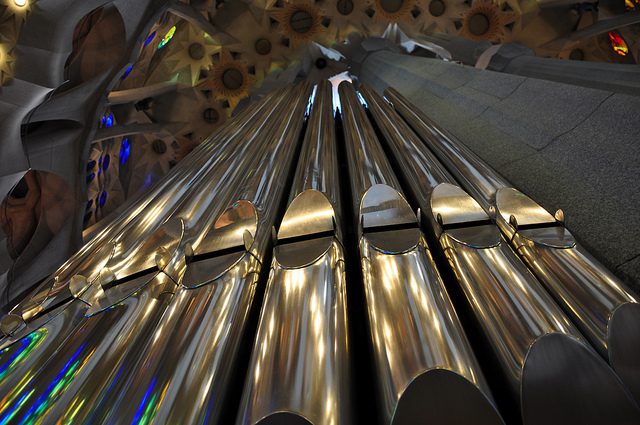
John Blackburn was a classmate of mine at Baylor University. The first time I heard John play a service was the first time I can remember being struck by the incredible versatility of the pipe organ, and the way the instrument can draw the song out of a congregation. I asked John what makes the organ so good at leading congregational singing. This was his answer.
I think the primary benefit of using an organ in worship is the dynamic range and color that one can get out of the instrument. From the softest whispers to the grandest fortes, the organ is the only instrument that is capable of producing the sheer scale of volume that is needed to not only lead a congregation in singing, but also to provide accompaniment to a choir or soloist, and then to stand alone and perform its own solo repertoire. I should add that I mean the only instrument without the need of amplification. A piano must be amplified unless the setting is small. A guitar cannot carry the weight of the congregation in singing unless it is rendered through a sound system. And while an orchestra can lead hymns and anthems, only the organist can be called upon to improvise or render a different harmony on the spur of the moment.
With color we mean the different sounds at the organist’s disposal. The range of pitches available are larger that a piano’s range, even on a small instrument. Coupled with the variety of sound one can garner out of the instrument, the organ in capable hands can sound clean and fresh with each playing. Whereas a piano is one type of sound—a struck wire string—the organ can change sounds, pitch, volume all by selecting a handful of stops. From fiery tuba and trumpets to lush strings, to brilliant flutes and broad diapasons, the organ is a virtual orchestra unto itself.
Another benefit is the organ’s sustaining ability. Rather than constantly having to re-strike a key to sustain long notes or phrases, the organ can provide a long tone or pitch. Think of the benefits of a pedal point in music—what other single instrument can produce that power while, at the same time, playing a hymn or an anthem in accompaniment.
The organ is an instrument that when played correctly (and there are a lot of sub-par organists which is one of our biggest problems) can invoke not only a range of emotions (joy at a bride’s procession, somberness at a funeral), but can also help to weave the portions of the Liturgy together seamlessly. While other instruments are capable of doing that, none can do it with the musical fineness that the can: The crescendo into the doxology; The improvisation at Communion; the voluntary to send the Body of Christ out into the world, the rattle of the church or cathedral at a Tenebrae service.
Yes, in our 21st-century world we have electronic guitar, pianos, even electric drums sets. Yes, we can power up the amplifiers and pipe music into the church at a deafening tone. Yes, we can simulate an organ on a keyboard. But the organ during a hymn only asks one thing of the congregation: Sing with me!
John L. Blackburn is the Organist and Choirmaster at Saint Philip’s Episcopal Church of Beeville, having previously served as Director of Music Ministries at Saint Paul’s Episcopal Church and Organist for Temple Rodef Shalom, both in Waco. Currently, Blackburn is an Adjunct Professor of Music at Coastal Bend College, Beeville Campus. Mr. Blackburn is a graduate of Baylor University, receiving his Bachelor degree in Church Music with Organ Emphasis and a Master of Music in Church Music degree from Baylor. He is a member of the American Guild of Organists, Organ Historical Society, Pi Kappa Lamba, The Hymn Society of the United States and Canada, and The Royal School of Church Musicians.
Mr. Blackburn has also participated in the Doctorate of Musical Arts program from the University of Texas at Austin, where he studied with Judith and Gerre Hancock.
Photo:
Flickr, creative commons 2.0
Previous Post
April 30, 2017
Some Hymns are Terrible, Too
Next Post
May 16, 2017 5 Reasons We Must Stop Doing Traditional Worship
Browse Our Archives
Select a Category Church of St. YouTube congregational singing congregational song contemporary critiques corporate worship Hymn of the Week hymn singing hymnody and hymnology hymns masturbatory worship Uncategorized worship Worship Quotes
Select a Month February 2023 January 2023 October 2022 September 2022 April 2022 February 2022 January 2022 December 2021 July 2021 June 2021 May 2021 April 2021 January 2021 December 2020 November 2020 July 2020 June 2020 May 2020 April 2020 March 2020 February 2020 January 2020 November 2019 September 2019 July 2019 June 2019 May 2019 April 2019 March 2019 February 2019 January 2019 December 2018 November 2018 October 2018 September 2018 August 2018 July 2018 June 2018 May 2018 April 2018 March 2018 February 2018 January 2018 December 2017 October 2017 September 2017 August 2017 July 2017 June 2017 May 2017 April 2017 March 2017 February 2017 January 2017 December 2016 November 2016 October 2016 September 2016 July 2016 June 2016 May 2016 April 2016 March 2016 February 2016 January 2016 December 2015 November 2015 October 2015 September 2015 August 2015 July 2015 June 2015 May 2015 February 2015 January 2015 December 2014 October 2014 September 2014 August 2014 July 2014
Follow Us!
TAKE THE
Religious Wisdom Quiz
What did David take from Saul's camp while he was sleeping?
Select your answer to see how you score.
Sword and scroll Spear and water jug Crown and robe A sack of gold
Related posts from Ponder Anew

Hymn of the Day: Love Divine, All Loves...

Hymn of the Day: Christ, Whose Glory Fills...
Hymn of the Day: Where Cross the Crowded...
Hymn of the Day: Open Now Thy Gates...
TRENDING AT PATHEOS Evangelical

How the author of the world's best hymn...
I've been working with John Newton for a while now. This makes...

Long before this Lectio Divina, Psalm 130 - the song - started...

What About the Trees? Another Living Parable
After I finished writing the last article about falling leaves as a...

Why Classical Education Is a Conversation, Not a...
Come and Read: Joy in Classical Education When I was a little...

Falling Leaves: A Living Parable on Letting Go
I’ve spent the vast majority of my life in the southeast corner...

Cornell University has received a great deal of negative publicity and intense...
view all Evangelical blogs
Ad-Free & Subscriber Log-In Subscription Support
- About Us
- 2026 Calendar
- Videos
- Podcasts
- Library of World Religions
- Faith In Media Tracker
- Advertise With Us
- Write for Us
- Privacy Policy
- Terms of Service
- Do Not Sell My Data
- Contact Us
- Radiant Digital
- Manage Newsletter Subscriptions
- Unsubscribe From Notifications
- Sitemap
Copyright 2008-2026, Patheos. All rights reserved.
Subscription Support Ad-Free & Subscriber Log-In
Follow Patheos