
BuddhistCatholicContemplativeEvangelicalGeneral ChristianHinduJewishLatter-day SaintMuslimNew VisionsProgressive Christian
Beliefs
- Buddhist
- Catholic
- Contemplative
- Evangelical
- General Christian
- Hindu
- Jewish
- Latter-day Saint
- More Voices
- Muslim
- New Visions
- Pagan
- Progressive Christian
Topics
- Religion News
- Food and Religion
- Sports and Religion
- Religious Art
- Religious Music and Entertainment
- Religious Events
- History and Religion
- Style and Religion
- Politics and Religion
- Women in Religion
- Recreation Outdoors and Religion
- Business Finance and Religion
- Careers Workplace and Religion
- Education and Religion
- Family Parenting and Religion
- Health Fitness and Religion
- Home and Religion
- Relationships and Religion
- Technology and Religion
- Travel and Religion
Columnists
- Buddhist Columnists
- Business Finance and Religion Columnists
- Careers Workplace and Religion Columnists
- Catholic Columnists
- Contemplative Columnists
- Education and Religion Columnists
- Evangelists Columnists
- Family Parenting and Religion Columnists
- General Christian Columnists
- Health Fitness and Religion Columnists
- Hindu Columnists
- History and Religion Columnists
- Home and Religion Columnists
- Jewish Columnists
- More Voices Columnists
- Latter Day Columnists
- Muslim Columnists
- New Visions Columnists
- Nonreligious Columnists
- Pagan Columnists
- Politics and Religion Columnists
- Progressive Columnists
- Recreation Outdoors and Religion Columnists
- Relationships and Religion Columnists
- Religion News Columnists
- Religious Art Columnists
- Religious Events Columnists
- Religious Music and Entertainment Columnists
- Sports and Religion Columnists
- Style and Religion Columnists
- Technology and Religion Columnists
- Travel and Religion Columnists
- Women in Religion Columnists
Resource Library
- 2026 Calendar
- Library of World Religions
- The 100 Most Holy Places on Earth
- Patheos Answers
- Podcasts
- Videos
- Faith Leaders Database
- Anglican Episcopalian
- Bahai
- Baptist
- Buddhism
- Christianity
- Confucianism
- Eastern Orthodoxy
- Hinduism
- Holiness and Pentecostal
- ISKCON
- Islam
- Judaism
- Lutheran
- Methodist
- The Church of Jesus Christ of Latter-day Saints
- New Age
- Paganism
- Presbytarian and Reformed
- Protestantism
- Religion Behind the Scenes
- Roman Catholic
- Scientology
- Shia Islam
- Sikhism
- Sufism
- Sunni Islam
- Taoism
- Zen
- See all religions
Research Tools
 Ad-Free & Subscriber Log-In Subscription Support
Ad-Free & Subscriber Log-In Subscription Support
Follow Patheos 

- Trending:
- Forgiveness
- |
- Marriage
- |
- Consciousness
- |
- Death Penalty
- |
- Election
- |
- Halloween
 Ponder Anew
- Home
- Evangelical
- Why Churches Must Stop Feeding Our Screen Addiction
Why Churches Must Stop Feeding Our Screen Addiction
Last updated on: February 25, 2017 at 10:05 am by Jonathan Aigner
Why Churches Must Stop Feeding Our Screen Addiction 2017-02-25T10:05:20-05:00 Jonathan Aigner
Patheos Explore the world's faith through different perspectives on religion and spirituality! Patheos has the views of the prevalent religions and spiritualities of the world.
 Prelude
The increasing speed of TV is a great contributor to the loss of imagination since the mind has no time to recover from the constant bombardment. How does this affect our ability to meditate on God in the necessary silences of worship? Are we able to deal with the ambiguities of God that force our minds to go beyond what is readily apparent?
The loss of imagination is also related to some of the twaddle (Kierkegaard’s word) that characterizes some churches’ worship these days. As William Fore explains, “Trivialization is inevitable in the world of the technological era, with its emphasis upon utilitarian means rather than truthful ends” (32). If we simply want a God that “sells” to the masses, we will invariably reduce the truth of our multi-splendored God. If we want our faith to be developed as fast as problems are solved on sitcoms, we will not have the patience to imagine God’s working in us to grow us when there are no immediate, visible results.
Worship that is filled with splendor, in contrast, will greatly stimulate the imagination – with symbols and other works of art, with a wide variety of musical sounds, with texts and preaching full of images and thought-provoking challenges, with silences that give inspiration free reign.
-Marva Dawn
Call to Think in Worship
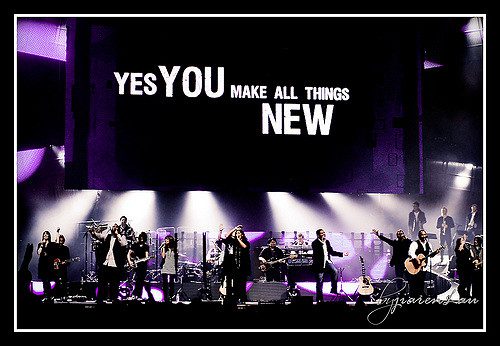
When Marva Dawn first warned us in 1999, contemporary churches were themselves just beginning to embrace extensive media use in corporate worship. Now, fifteen years later, even traditional churches have done so. No more is the Sanctuary a sanctuary from the poison of media saturation.
Just as we’ve come to recognize silence on TV or the radio as someone losing their job, we have become uncomfortable with any open space for meditation and inspiration. We need the media stimulation. Church services are designed to meet the felt needs produced by cultural media saturation, but I wonder if those felt needs are actually the greatest needs.
Maybe it’s not that we need all that stimulation to worship. Maybe it’s all the masses can handle.
I fear that our minds have been conditioned to not be able to do the work that historic corporate worship demands. I fear we’ve become unable to think deeply enough to engage with the call of the Gospel on our lives, and do the important work of corporate worship.
A Mindful Offertory
Here’s what my wife, a respected mental health therapist, says about this:
Emotions give us good information, but we shouldn’t rely on them to interpret reality (think about children – excellent observers, but unreliable interpreters). We have to think through our feelings, and be curious about where they come from. It’s crucial that we use our prefrontal cortex (executive functioning) to keep us safe and enable us to have meaningful and healthy relationships.
This reminds me of the Apostle Paul’s words. “When I was a child, I talked like a child, I thought like a child, I reasoned like a child. When I became a man, I put the ways of childhood behind me.” Maybe this is what he was talking about: to put aside relying on emotional information alone, and intentionally choosing a response through integrating logic, through careful reflection, through consideration of consequence.
Emotion is an undeniably good and important thing, but to leave behind our childish ways, we must also think. We must engage deeply with what’s going on around us.
As a former educator, I’ve seen the effects of media on young minds, and have been a part of education’s vain attempt to recover. Technology is now an expected element in every subject and lesson. Of course there are many things technology can do for us. But when used pervasively and indiscriminately, instead of being an aid, it becomes a crutch. An addiction, even. Sooner or later, students won’t be able to learn without it. Though the attempt is to make learning enjoyable and easier, the result is that minds are not strong enough to grapple with idea and concepts. Instead, they require spoon-feeding.
Cathy, a commenter on my blog, put it this way:
“It bothers me that kids are being “entertained” during worship, and I don’t think it’s a “good” thing or that churches need to “get with the times” and use technology because kids won’t pay attention without it. There’s value in teaching children how to be quiet, still, and meditative. It’s a process, for sure, but kids need to learn how to delay gratification and that life isn’t always about them. (As a teacher, I see this in a different venue as well.)”
In the words of the great American hymnwriter, Billy Joel, “Oh, but you pay for your satisfaction somewhere along the line.”
On a more personal level, I feel this paucity very acutely. From a young age, I used TV as an escape from reality. As a child, I self-medicated emotions with media. As an adult, I have had to learn how to interact with my negative emotions, instead of filling the space with media. Even though I’ve functioned well in my education and professional life, I’m hauntingly aware that this reliance on media may have capped my growth far short of my real potential.
Children’s Sermon (for Grown-Ups)
Remember those old McDonald’s playgrounds with the weird hamburger prison you could climb into?

At one point, you could climb up all the way to the top and look out through that little hat (is it a hat?) at the top. It was a lot of work, but the view was worth it. At some point, maybe it was around the time the old lady spilled coffee on herself, I guess McDonald’s decided that small children eight feet off the ground in a metal cylinder was too much of a liability, so they installed this piece of metal to block you from getting all the way to the top. The best that you could do was crawl around inside this fake hamburger and look through the prison bars that held you in.
That’s a lot like what media saturation does to us. It keeps us from fully engaging our intellect and imagination in worship. It teaches us to vegetate. We struggle to get to the “upstairs part” of our brain (prefrontal cortex/executive functioning). And instead of letting corporate worship challenge us with new perspectives, we’ve installed our own emotional barricades. We’ve replaced symbols, themselves impetus for imagination, wonder, and mindful reflection, instead often substituting flashy, shiny visual entertainment, to which of course we will far too quickly become desensitized and look for something bigger, flashier, and shinier.
Going Forth
So what do we do? The answer has become increasingly unpopular, but I think it’s inescapable. We must stop spoon-feeding. We must stop over-stimulating. We have to be honest that the very presence of visual media can limit intellectual engagement, stifle creativity, and worst of all, enslave us to its use.
I invite you to begin to assess the way we use media in corporate worship. I’ve heard good arguments for throwing it all out. Just getting rid of it. But at the very least, we have to be judicious in what we use, and make sure it inspires thought and creativity, rather than catering to laziness and impatience often found in our culture. After all, loving the Lord our God with our minds requires us to think.
Maybe it’s time we bring mindfulness and imagination back into our worship services.
- Maybe we only use electronic visual media in very rare instances, if at all.
- Maybe we should use artistic, live music with limited amplification.
- Maybe we should use hymnals. Dawn puts it this way: “Our culture is becoming less and less able to discern the ‘one-step-removedness’ of their screen addictions. Since screens are connected in daily life with activities that are bodiless, will their use in worship begin to make us less aware of the Body and of our own bodies, which otherwise could touch the hymnal and see more fully the more lasting evidence of the Church’s communal song?”
- Maybe the tastes and textures of Holy Communion should be offered weekly. The Eucharist is the natural culmination of Christian worship, and by its very nature draws us out of our screen-induced stupor into participation in the life of Christ.
- Maybe we say “no” to segregating and over-stimulating children in their own “worship experiences.” With what we now know regarding how visual media harms young minds, continuing to subject them to such environments is a willful act of violence against our youngest worshipers.
- Maybe we rediscover good preaching. No more of the easy self-help crap where God and the Bible and the Christian life are simple, debt-free, and can be wrapped up neatly in three bullet points and a take-home.
- Maybe we help our congregations rediscover self-discipline and anticipation in corporate worship. We can’t keep amping them up emotionally and letting them think they’ve worshiped. They must be thoughtfully engaged in sacred storytelling.
The fear exists that we may lose butts in the seats if we require too much. To be sure, this kind of mindful engagement requires much more from our congregations, but it can do wonders in grounding us in the sacrament of the present moment and engaging our minds in the work of the people.
Otherwise, the doors to beautiful and meaningful Christian worship may continue to close.
Lift up your hearts. And your brains.


Photos:
Flickr, creative commons 2.0
Wikipedia
Previous Post

February 23, 2017
Lectionary Hymn of the Week: O Wondrous Sight, O Vision Fair


Browse Our Archives
Select a Category Church of St. YouTube congregational singing congregational song contemporary critiques corporate worship Hymn of the Week hymn singing hymnody and hymnology hymns masturbatory worship Uncategorized worship Worship Quotes
Select a Month February 2023 January 2023 October 2022 September 2022 April 2022 February 2022 January 2022 December 2021 July 2021 June 2021 May 2021 April 2021 January 2021 December 2020 November 2020 July 2020 June 2020 May 2020 April 2020 March 2020 February 2020 January 2020 November 2019 September 2019 July 2019 June 2019 May 2019 April 2019 March 2019 February 2019 January 2019 December 2018 November 2018 October 2018 September 2018 August 2018 July 2018 June 2018 May 2018 April 2018 March 2018 February 2018 January 2018 December 2017 October 2017 September 2017 August 2017 July 2017 June 2017 May 2017 April 2017 March 2017 February 2017 January 2017 December 2016 November 2016 October 2016 September 2016 July 2016 June 2016 May 2016 April 2016 March 2016 February 2016 January 2016 December 2015 November 2015 October 2015 September 2015 August 2015 July 2015 June 2015 May 2015 February 2015 January 2015 December 2014 October 2014 September 2014 August 2014 July 2014
Follow Us!
TAKE THE
Religious Wisdom Quiz
What Christian group follows the "Westminster Confession of Faith"?
Select your answer to see how you score.
Catholics Presbyterians Lutherans Baptists
Related posts from Ponder Anew

Hymn of the Day: Love Divine, All Loves...

Hymn of the Day: Christ, Whose Glory Fills...
Hymn of the Day: Where Cross the Crowded...
Hymn of the Day: Open Now Thy Gates...
TRENDING AT PATHEOS Evangelical

The REST of Your Life: A Creative Wrestles...
This week I had a conversation with a good friend from church....

How the author of the world's best hymn...
I've been working with John Newton for a while now. This makes...

Long before this Lectio Divina, Psalm 130 - the song - started...

What About the Trees? Another Living Parable
After I finished writing the last article about falling leaves as a...

Why Classical Education Is a Conversation, Not a...
Come and Read: Joy in Classical Education When I was a little...

Cornell University has received a great deal of negative publicity and intense...
view all Evangelical blogs
Ad-Free & Subscriber Log-In Subscription Support
- About Us
- 2026 Calendar
- Videos
- Podcasts
- Library of World Religions
- Faith In Media Tracker
- Advertise With Us
- Write for Us
- Privacy Policy
- Terms of Service
- Do Not Sell My Data
- Contact Us
- Radiant Digital
- Manage Newsletter Subscriptions
- Unsubscribe From Notifications
- Sitemap
Copyright 2008-2026, Patheos. All rights reserved.
Subscription Support Ad-Free & Subscriber Log-In
Follow Patheos