
BuddhistCatholicContemplativeEvangelicalGeneral ChristianHinduJewishLatter-day SaintMuslimNew VisionsProgressive Christian
Beliefs
- Buddhist
- Catholic
- Contemplative
- Evangelical
- General Christian
- Hindu
- Jewish
- Latter-day Saint
- More Voices
- Muslim
- New Visions
- Pagan
- Progressive Christian
Topics
- Religion News
- Food and Religion
- Sports and Religion
- Religious Art
- Religious Music and Entertainment
- Religious Events
- History and Religion
- Style and Religion
- Politics and Religion
- Women in Religion
- Recreation Outdoors and Religion
- Business Finance and Religion
- Careers Workplace and Religion
- Education and Religion
- Family Parenting and Religion
- Health Fitness and Religion
- Home and Religion
- Relationships and Religion
- Technology and Religion
- Travel and Religion
Columnists
- Buddhist Columnists
- Business Finance and Religion Columnists
- Careers Workplace and Religion Columnists
- Catholic Columnists
- Contemplative Columnists
- Education and Religion Columnists
- Evangelists Columnists
- Family Parenting and Religion Columnists
- General Christian Columnists
- Health Fitness and Religion Columnists
- Hindu Columnists
- History and Religion Columnists
- Home and Religion Columnists
- Jewish Columnists
- More Voices Columnists
- Latter Day Columnists
- Muslim Columnists
- New Visions Columnists
- Nonreligious Columnists
- Pagan Columnists
- Politics and Religion Columnists
- Progressive Columnists
- Recreation Outdoors and Religion Columnists
- Relationships and Religion Columnists
- Religion News Columnists
- Religious Art Columnists
- Religious Events Columnists
- Religious Music and Entertainment Columnists
- Sports and Religion Columnists
- Style and Religion Columnists
- Technology and Religion Columnists
- Travel and Religion Columnists
- Women in Religion Columnists
Resource Library
- 2026 Calendar
- Library of World Religions
- The 100 Most Holy Places on Earth
- Patheos Answers
- Podcasts
- Videos
- Faith Leaders Database
- Anglican Episcopalian
- Bahai
- Baptist
- Buddhism
- Christianity
- Confucianism
- Eastern Orthodoxy
- Hinduism
- Holiness and Pentecostal
- ISKCON
- Islam
- Judaism
- Lutheran
- Methodist
- The Church of Jesus Christ of Latter-day Saints
- New Age
- Paganism
- Presbytarian and Reformed
- Protestantism
- Religion Behind the Scenes
- Roman Catholic
- Scientology
- Shia Islam
- Sikhism
- Sufism
- Sunni Islam
- Taoism
- Zen
- See all religions
Research Tools
 Ad-Free & Subscriber Log-In Subscription Support
Ad-Free & Subscriber Log-In Subscription Support
Follow Patheos 

- Trending:
- Forgiveness
- |
- Marriage
- |
- Consciousness
- |
- Death Penalty
- |
- Election
- |
- Halloween
 Ponder Anew
- Home
- Evangelical
- Andy Stanley’s Apology, and Some Mega-questions for the Megachurch
Andy Stanley’s Apology, and Some Mega-questions for the Megachurch
Last updated on: March 11, 2016 at 1:09 am by Jonathan Aigner
Andy Stanley’s Apology, and Some Mega-questions for the Megachurch 2016-03-11T01:09:53-05:00 Jonathan Aigner
Patheos Explore the world's faith through different perspectives on religion and spirituality! Patheos has the views of the prevalent religions and spiritualities of the world.
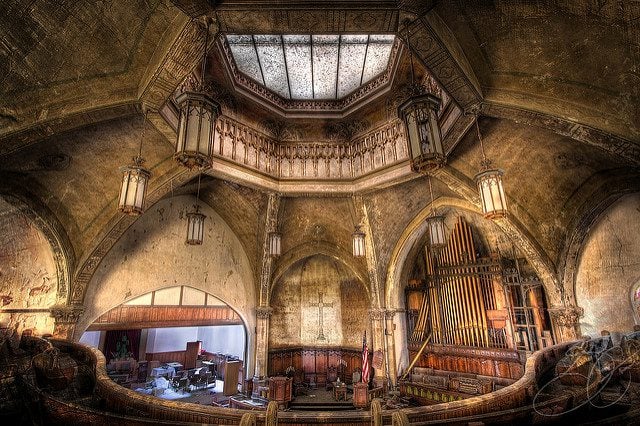
Almost immediately after I published my last post on Andy Stanley’s unfortunate choice of words in a recent sermon, comments and messages came pouring in, informing me that he apologized, and that we should all just forgive him.
So, he apologized. Good. But his apology does nothing beyond admitting his rant was offensive and insensitive. For that insensitivity, we should be willing to forgive him, yes. But there’s a deeper problem, a greater offense. The issue isn’t that he painted with a broad brush, but that he’s unabashedly committed to the superiority of the megachurch model. That’s the really, really bad thing.
I can already hear the comments coming in. “What’s so wrong with a big church?” Nothing, not necessarily. The problem doesn’t lie in the size of the church as much as the methods the biggest of the big (like North Point) become so freaking huge.
To borrow some common megachurch jargon, he’s got to “go deeper.” I would challenge Andy and other megachurch pastors like him to take a look at what they perceive as ecclesiological success to ask themselves a few tough questions.
Are we running a business and calling it a church? Have we made numerical growth the ultimate indicator of success. I don’t believe there is a perfect size of church. As I said before, I’ve spent the last 16 years of my life in churches that have ranged from very small to relatively large. But as Stanley let slip in his comments, the modern megachurch is a different animal. It’s not just a large church, but is seemingly a church with a bit of a complex. It finds its value in being “mega.” It’s set up to be a business, and it’s willing to reinvent itself in order to be successful. So, the Pastor must abdicate his ordained role of shepherd and assume a place at the top of the hierarchical scheme
Are we connected to the historical church? A better question might be, “Do we preach the Word and administer the Sacraments?” Look at the biggest churches on this list. How many of them feature robustly biblical and theological preaching? Seriously, most of them have sermons on their websites. Listen to a few of them. You’ll find topical sermon series, self-help messages, three-points-and-a-take-home group counseling sessions. Little bits of Holy Scripture preached. But there’s simply not much gospel there. Even those that use more God-speak and religious jargon, well, there’s not a whole lot of grappling, wrestling, 1st-century-eyes-and-21st-century-questions kind of preaching. What would happen to those numbers if that changed? Would they remain the same? We have to wonder. And sacraments? Andy Stanley, meet Robert Webber.
Are we sacrificing a healthy liturgical theology by commercializing worship? On the surface, it seems that worship is rarely informed by the theology and history of the Christian tradition; instead, it’s driven by popular entertainment forms, at the expense of most traditional elements of liturgy. If there is a vaguely liturgical option, it’s marketed as preference, not the necessity for worship to be the work of the people. The advertisements generally read like a list of cable TV packages. “Don’t like the band? Desire more traditional music? Prefer a little more structure to your worship experience? We’ve got just the option for you.” That’s not liturgy in a real sense, because it’s molded to fit our story, rather than God’s.
Have we made worship too easy? We need to expect worshipers to participate, to work, to follow their script, to sit (reasonably) still for a little while, to say the words and sing the notes with discipline and resolve. Even 17th-century hymns. Even tough biblical language. Even communal prayers that have tough words, like “slavery,” “resurrection,” and “covenant.” The megachurch model says, “But then they won’t come!!” Maybe not, but we don’t really have a choice. It’s a matter of ethics, of identity, of mission. If we continue to make worship easy, we’ll be too weak to be the church we need to be in the world. Again, we need liturgy, not entertainment and one-way jesusy conversations.
Have we failed to preach salvation beyond the personal faith commitment? The salvation found in the gospel of Christ is not fully found in the classic evangelistic invitation, the “moment of decision,” or the sinner’s prayer, not because it’s entirely wrong, but because it’s woefully incomplete. Salvation is a cosmic idea, way bigger than you and me, and its message is that God through God’s mighty acts in Jesus Christ will make everything right in the end. The call for us, then, isn’t to pray a prayer and one day join a happy angel band in the sky, but to say yes to joining God’s work of love in our lives and in the rest of the cosmos, making it more on earth as it is in heaven, until all is made right in the glorious day of resurrection. That’s why the liturgical pattern is so important, as it invites our participation into this story week after week, year after year. That’s why we need to be about social justice and Christian ethics, not just personal morality.
Are we building silos, or fostering an intergenerational fellowship? Just take a look at North Point’s Sunday schedule.
Should we stop calling ourselves “seeker sensitive?” It’s interesting to me that most of the comments I’ve received in defense of the megachurch have all been from people who had been involved in other churches, not the seekers these churches swear they’re trying to reach. I’ve seen this in every megachurch I’ve ever been a part of. As a recent comment said, “What we win people with, we win them to.” The megachurch has certainly succeeded in winning a lot of churchgoing people to itself. Sure, some folks came that were previously unchurched. It’s been in every regular church that I’ve been a part of, too, both mainline and evangelical. Can’t we just stop with the “seeker sensitive” business and finally admit that the non-seekers are really the ones reached by the megachurch model?
Besides, if we were truly seeker sensitive, we wouldn’t rely on the holy bait-and-switch. We would simply be the church. You know, that place where the Word is preached and the Sacraments administered. We would be a refuge for the weary, a sacred Sunday asylum. Instead, we’ve tried to dazzle everyone in Jesus’ name. And the time is coming when it will take something brighter, shinier, and more over-stimulating to keep those butts in our seats.
Have we let ourselves become celebrities? The fact that anyone really paid attention to Stanley’s remarks would indicate that it’s already happened. As a recent article highlighted, megachurches make up 1% of North American churches, so why are we all turning to their pastors as authorities on ministry? Why do we think Andy Stanley or Rick Warren or Bill Hybels can teach us any more than the average small church pastor about ministry? Of course, as tends to be the case with celebrities, they often fall, and fall hard. Just look at the recent spectacle from Mars Hill Seattle, and their former pastor. But even if they never sabotage themselves like Driscoll, pastors are called to be shepherds, not celebrities, not CEOs. Can these Senior Pastors still claim that title?
I don’t think Andy Stanley’s a bad guy. I think a lot of these men are genuinely trying to do the right thing. I don’t think they’re all slimy, money-grubbing, fame-seekers. But their model is broken. It was broken thirty years ago, and it’s still broken today. It can get butts in the seats, but can it grow a healthy church?
If the answer to any of these is “yes,” it’s time for more apologies, and not just from Andy, but from the rest of us, as well.
It’s time to get rid of the marketing strategy.
It’s time to quit catering to the numbed appetites of the masses.
It’s time to worship as if our lives depended on it.
It’s time to preach a fuller, more radical salvation.
It’s time to free ourselves from the world’s fallen success indicators.
And though our steeples may fall and our spires crumble, our call must still go out: Come, and find rest.
It’s time to be the church.

Flickr, Shane Gorski, creative commons 2.0


Previous Post
March 3, 2016
Don't Take Your Kids to a Megachurch: An Open Letter to Andy Stanley
Next Post

March 13, 2016 Killing the Church with Sunday School
Browse Our Archives
Select a Category Church of St. YouTube congregational singing congregational song contemporary critiques corporate worship Hymn of the Week hymn singing hymnody and hymnology hymns masturbatory worship Uncategorized worship Worship Quotes
Select a Month February 2023 January 2023 October 2022 September 2022 April 2022 February 2022 January 2022 December 2021 July 2021 June 2021 May 2021 April 2021 January 2021 December 2020 November 2020 July 2020 June 2020 May 2020 April 2020 March 2020 February 2020 January 2020 November 2019 September 2019 July 2019 June 2019 May 2019 April 2019 March 2019 February 2019 January 2019 December 2018 November 2018 October 2018 September 2018 August 2018 July 2018 June 2018 May 2018 April 2018 March 2018 February 2018 January 2018 December 2017 October 2017 September 2017 August 2017 July 2017 June 2017 May 2017 April 2017 March 2017 February 2017 January 2017 December 2016 November 2016 October 2016 September 2016 July 2016 June 2016 May 2016 April 2016 March 2016 February 2016 January 2016 December 2015 November 2015 October 2015 September 2015 August 2015 July 2015 June 2015 May 2015 February 2015 January 2015 December 2014 October 2014 September 2014 August 2014 July 2014
Follow Us!
TAKE THE
Religious Wisdom Quiz
What happened to Lot’s wife when she looked back at Sodom?
Select your answer to see how you score.
She turned into a pillar of salt She went blind She was swallowed by the earth She was struck by lightning
Related posts from Ponder Anew

Hymn of the Day: Love Divine, All Loves...

Hymn of the Day: Christ, Whose Glory Fills...
Hymn of the Day: Where Cross the Crowded...
Hymn of the Day: Open Now Thy Gates...
TRENDING AT PATHEOS Evangelical

How the author of the world's best hymn...
I've been working with John Newton for a while now. This makes...

Long before this Lectio Divina, Psalm 130 - the song - started...

What About the Trees? Another Living Parable
After I finished writing the last article about falling leaves as a...

Why Classical Education Is a Conversation, Not a...
Come and Read: Joy in Classical Education When I was a little...

Falling Leaves: A Living Parable on Letting Go
I’ve spent the vast majority of my life in the southeast corner...

Cornell University has received a great deal of negative publicity and intense...
view all Evangelical blogs
Ad-Free & Subscriber Log-In Subscription Support
- About Us
- 2026 Calendar
- Videos
- Podcasts
- Library of World Religions
- Faith In Media Tracker
- Advertise With Us
- Write for Us
- Privacy Policy
- Terms of Service
- Do Not Sell My Data
- Contact Us
- Radiant Digital
- Manage Newsletter Subscriptions
- Unsubscribe From Notifications
- Sitemap
Copyright 2008-2026, Patheos. All rights reserved.
Subscription Support Ad-Free & Subscriber Log-In
Follow Patheos