
BuddhistCatholicContemplativeEvangelicalGeneral ChristianHinduJewishLatter-day SaintMuslimNew VisionsProgressive Christian
Beliefs
- Buddhist
- Catholic
- Contemplative
- Evangelical
- General Christian
- Hindu
- Jewish
- Latter-day Saint
- More Voices
- Muslim
- New Visions
- Pagan
- Progressive Christian
Topics
- Religion News
- Food and Religion
- Sports and Religion
- Religious Art
- Religious Music and Entertainment
- Religious Events
- History and Religion
- Style and Religion
- Politics and Religion
- Women in Religion
- Recreation Outdoors and Religion
- Business Finance and Religion
- Careers Workplace and Religion
- Education and Religion
- Family Parenting and Religion
- Health Fitness and Religion
- Home and Religion
- Relationships and Religion
- Technology and Religion
- Travel and Religion
Columnists
- Buddhist Columnists
- Business Finance and Religion Columnists
- Careers Workplace and Religion Columnists
- Catholic Columnists
- Contemplative Columnists
- Education and Religion Columnists
- Evangelists Columnists
- Family Parenting and Religion Columnists
- General Christian Columnists
- Health Fitness and Religion Columnists
- Hindu Columnists
- History and Religion Columnists
- Home and Religion Columnists
- Jewish Columnists
- More Voices Columnists
- Latter Day Columnists
- Muslim Columnists
- New Visions Columnists
- Nonreligious Columnists
- Pagan Columnists
- Politics and Religion Columnists
- Progressive Columnists
- Recreation Outdoors and Religion Columnists
- Relationships and Religion Columnists
- Religion News Columnists
- Religious Art Columnists
- Religious Events Columnists
- Religious Music and Entertainment Columnists
- Sports and Religion Columnists
- Style and Religion Columnists
- Technology and Religion Columnists
- Travel and Religion Columnists
- Women in Religion Columnists
Resource Library
- 2026 Calendar
- Library of World Religions
- The 100 Most Holy Places on Earth
- Patheos Answers
- Podcasts
- Videos
- Faith Leaders Database
- Anglican Episcopalian
- Bahai
- Baptist
- Buddhism
- Christianity
- Confucianism
- Eastern Orthodoxy
- Hinduism
- Holiness and Pentecostal
- ISKCON
- Islam
- Judaism
- Lutheran
- Methodist
- The Church of Jesus Christ of Latter-day Saints
- New Age
- Paganism
- Presbytarian and Reformed
- Protestantism
- Religion Behind the Scenes
- Roman Catholic
- Scientology
- Shia Islam
- Sikhism
- Sufism
- Sunni Islam
- Taoism
- Zen
- See all religions
Research Tools
 Ad-Free & Subscriber Log-In Subscription Support
Ad-Free & Subscriber Log-In Subscription Support
Follow Patheos 

- Trending:
- Forgiveness
- |
- Marriage
- |
- Consciousness
- |
- Death Penalty
- |
- Election
- |
- Halloween
 Ponder Anew
- Home
- Evangelical
- How to Move Away from the Worship Industry
How to Move Away from the Worship Industry
Last updated on: February 25, 2016 at 4:00 pm by Jonathan Aigner
How to Move Away from the Worship Industry 2016-02-25T16:00:10-05:00 Jonathan Aigner
Patheos Explore the world's faith through different perspectives on religion and spirituality! Patheos has the views of the prevalent religions and spiritualities of the world.
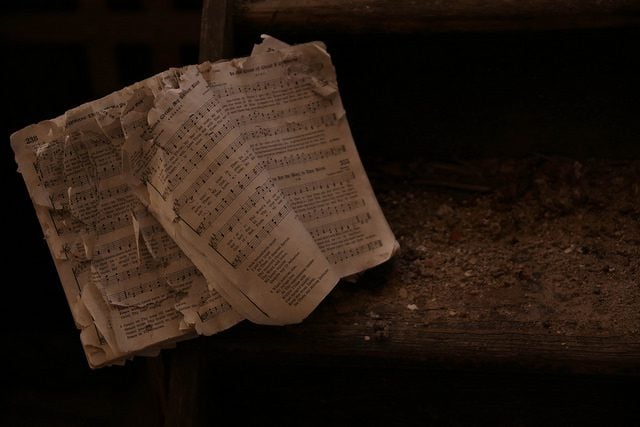
My recent post calling for a boycott of the worship industry seems to have struck a chord. It looks like it may soon become the most successful Ponder Anew post of all time, which I’m thrilled about. It was great to have over half a million people read my post about hymnals, but this one cuts closer to the heart of what it means to be a worshiping church, and the idea of gathered worship as the church’s ethical responsibility.
I’m certainly not against new music. Quite the contrary – I think there’s something drastically wrong if we’re not singing new music, both chronologically recent music and music that is new to us. I’m not against people making a living as a church musician or being compensated for the things they create. I am against the church’s worship being controlled by an industry, and I’m concerned about how that industry contributes to the continued withering of created beauty in gathered worship, and the overall loss of liturgical purpose.
A number of the comments I received on this post (before I ultimately had to shut them down) indicated that disarming the worship industry was a great goal, but that there seemed to be no alternatives other than a return to strictly hymn-based worship, which even if it were possible, it would cost careers and incite anger.
For those of us who already don’t rely heavily on the worship industry, a boycott isn’t going to be that difficult. Perhaps we refrain from buying its music for personal enjoyment, and we work diligently to maintain a strong tradition of congregational music-making. But for others of you, breaking free from the worship industry will take time, and in many cases, a complete boycott just isn’t immediately practical.
In that case, think of some practical steps you can take to move away from the pervasiveness of the worship industry. After all, at the core of this issue is allowing the people to be the primary voice in congregational singing. Step by step, help your congregation break its reliance on a Hillsongized method of doing music, where singing is something done to the people in the way of the commercial recording, instead of done by the people in enriching and varied ways. Here are a few suggestions.
Diversify Your Accompaniment
In other words, move away from the cover band and find ways to pull more confident and musical singing out of the congregation. Look for more acoustic options that are present in your congregation. In all but the smallest of churches, you likely have untapped resources.
Maybe you’re one of those fortunate congregations that still meets in a sanctuary with an organ. Dust off the console, and find ways to integrate the king of instruments. It’s palatte of sounds is immense and diverse, and it’s versatile enough to find a place in nearly every musical style.
Perhaps you have string players. You could use piano accompaniment in place of guitars or synthesizer. Maybe add brass and timpani, or a wind ensemble.
Scale down the percussion from time to time. The trap set does little to encourage good singing.
Try singing acappella. Yep. No band, no amplification. Just a congregation of voices proclaiming the sacred story through song.
Look for Other Streams of Congregational Song
Whatever instrumentation you use, help your congregation rediscover the riches available in the hymn tradition. Add one hymn on a Sunday, and occasionally choose one that most who attend commercial worship services won’t know. There are plenty of great choices on this list.
But you don’t have to stop there.
Sing new hymns. People are still writing them all the time, but because they’re produced outside of the worship industry, they haven’t found widespread appeal.
You can sing gospel and Sunday School hymns.
You can sing folk hymns.
You can sing Catholic renewal hymns.
You can sing songs from the Taize and Iona communities.
You can (and should) sing Psalms.
You can sing chant. It’s not really all that hard, and the results can be glorious.
You can sing African-American spirituals.
You can sing world music.
You can write our own songs in any of these styles.
You could even extemporize new songs among ourselves (like the spiritual songs Paul was talking about).
Vary Your Method of Singing
Sing loudly. Sing softly.
Alternate men and women singing stanzas themselves. Or maybe children. Or sing antiphonally. Or have a solo vocalist sing one. Or have a choral stanza. Or an instrumental stanza. Or an interlude.
You can sing unison. You can sing harmony. You can sing with a soprano descant. Or an instrumental obbligato.
You can crescendo to a full, robust, earth-shaking final stanza. Or decrescendo to a prayerful whisper.
You can vary the harmonization. We can modulate. Hillsongized bands can too, of course, be we can do so in so many different ways.
Above all, break the dependence on the worship leader lead singer. Singing into a microphone with affected vocals and a strained look on your face (my friend Miguel Ruiz describes it as being somewhere between sex and constipation) isn’t really helpful. If possible, get away from singing into a microphone as a soloist would. If amplification is necessary, sing with good diction and a pure tone to set an example. Think of the congregation as a choir, not an audience, and it’s the leader’s job to get them to sing as well as possible. And yes, singing well counts. It’s in and of itself an act of worship. Congregational singing was never about giving people the illusion of a mystical Jesus connection. It’s a formative, didactic, proclamatory discipline, and we have a responsibility to help the people do it well.
We never become worship superstars. We may not get rich. But in the end, after lots of growth and practice, we’ll have something so much more enduring. We’ll know how to sing. We’ll know better why we sing. We’ll have a balanced repertoire from which to sing. The suggestion that we need commercial worship for the sake of diversity, innovation, or freshness just doesn’t make sense. Our options for vital, varied, diverse music-making extend way outside the bounds of what the industry thinks is marketable.


Previous Post
February 23, 2016
100 Hymns Everyone Should Learn
Next Post

March 1, 2016 But Contemporary Worship Brings People to Jesus! Right...?
Browse Our Archives
Select a Category Church of St. YouTube congregational singing congregational song contemporary critiques corporate worship Hymn of the Week hymn singing hymnody and hymnology hymns masturbatory worship Uncategorized worship Worship Quotes
Select a Month February 2023 January 2023 October 2022 September 2022 April 2022 February 2022 January 2022 December 2021 July 2021 June 2021 May 2021 April 2021 January 2021 December 2020 November 2020 July 2020 June 2020 May 2020 April 2020 March 2020 February 2020 January 2020 November 2019 September 2019 July 2019 June 2019 May 2019 April 2019 March 2019 February 2019 January 2019 December 2018 November 2018 October 2018 September 2018 August 2018 July 2018 June 2018 May 2018 April 2018 March 2018 February 2018 January 2018 December 2017 October 2017 September 2017 August 2017 July 2017 June 2017 May 2017 April 2017 March 2017 February 2017 January 2017 December 2016 November 2016 October 2016 September 2016 July 2016 June 2016 May 2016 April 2016 March 2016 February 2016 January 2016 December 2015 November 2015 October 2015 September 2015 August 2015 July 2015 June 2015 May 2015 February 2015 January 2015 December 2014 October 2014 September 2014 August 2014 July 2014
Follow Us!
TAKE THE
Religious Wisdom Quiz
Which parable teaches its listener to "Love your neighbor as yourself"?
Select your answer to see how you score.
The Talents The Good Samaritan The Lost Sheep The Mustard Seed
Related posts from Ponder Anew

Hymn of the Day: Love Divine, All Loves...

Hymn of the Day: Christ, Whose Glory Fills...
Hymn of the Day: Where Cross the Crowded...
Hymn of the Day: Open Now Thy Gates...
TRENDING AT PATHEOS Evangelical

The REST of Your Life: A Creative Wrestles...
This week I had a conversation with a good friend from church....

How the author of the world's best hymn...
I've been working with John Newton for a while now. This makes...

Long before this Lectio Divina, Psalm 130 - the song - started...

What About the Trees? Another Living Parable
After I finished writing the last article about falling leaves as a...

Why Classical Education Is a Conversation, Not a...
Come and Read: Joy in Classical Education When I was a little...

Cornell University has received a great deal of negative publicity and intense...
view all Evangelical blogs
Ad-Free & Subscriber Log-In Subscription Support
- About Us
- 2026 Calendar
- Videos
- Podcasts
- Library of World Religions
- Faith In Media Tracker
- Advertise With Us
- Write for Us
- Privacy Policy
- Terms of Service
- Do Not Sell My Data
- Contact Us
- Radiant Digital
- Manage Newsletter Subscriptions
- Unsubscribe From Notifications
- Sitemap
Copyright 2008-2026, Patheos. All rights reserved.
Subscription Support Ad-Free & Subscriber Log-In
Follow Patheos