
BuddhistCatholicContemplativeEvangelicalGeneral ChristianHinduJewishLatter-day SaintMuslimNew VisionsProgressive Christian
Beliefs
- Buddhist
- Catholic
- Contemplative
- Evangelical
- General Christian
- Hindu
- Jewish
- Latter-day Saint
- More Voices
- Muslim
- New Visions
- Pagan
- Progressive Christian
Topics
- Religion News
- Food and Religion
- Sports and Religion
- Religious Art
- Religious Music and Entertainment
- Religious Events
- History and Religion
- Style and Religion
- Politics and Religion
- Women in Religion
- Recreation Outdoors and Religion
- Business Finance and Religion
- Careers Workplace and Religion
- Education and Religion
- Family Parenting and Religion
- Health Fitness and Religion
- Home and Religion
- Relationships and Religion
- Technology and Religion
- Travel and Religion
Columnists
- Buddhist Columnists
- Business Finance and Religion Columnists
- Careers Workplace and Religion Columnists
- Catholic Columnists
- Contemplative Columnists
- Education and Religion Columnists
- Evangelists Columnists
- Family Parenting and Religion Columnists
- General Christian Columnists
- Health Fitness and Religion Columnists
- Hindu Columnists
- History and Religion Columnists
- Home and Religion Columnists
- Jewish Columnists
- More Voices Columnists
- Latter Day Columnists
- Muslim Columnists
- New Visions Columnists
- Nonreligious Columnists
- Pagan Columnists
- Politics and Religion Columnists
- Progressive Columnists
- Recreation Outdoors and Religion Columnists
- Relationships and Religion Columnists
- Religion News Columnists
- Religious Art Columnists
- Religious Events Columnists
- Religious Music and Entertainment Columnists
- Sports and Religion Columnists
- Style and Religion Columnists
- Technology and Religion Columnists
- Travel and Religion Columnists
- Women in Religion Columnists
Resource Library
- 2026 Calendar
- Library of World Religions
- The 100 Most Holy Places on Earth
- Patheos Answers
- Podcasts
- Videos
- Faith Leaders Database
- Anglican Episcopalian
- Bahai
- Baptist
- Buddhism
- Christianity
- Confucianism
- Eastern Orthodoxy
- Hinduism
- Holiness and Pentecostal
- ISKCON
- Islam
- Judaism
- Lutheran
- Methodist
- The Church of Jesus Christ of Latter-day Saints
- New Age
- Paganism
- Presbytarian and Reformed
- Protestantism
- Religion Behind the Scenes
- Roman Catholic
- Scientology
- Shia Islam
- Sikhism
- Sufism
- Sunni Islam
- Taoism
- Zen
- See all religions
Research Tools
 Ad-Free & Subscriber Log-In Subscription Support
Ad-Free & Subscriber Log-In Subscription Support
Follow Patheos 

- Trending:
- Forgiveness
- |
- Marriage
- |
- Consciousness
- |
- Death Penalty
- |
- Election
- |
- Halloween
 Ponder Anew
- Home
- Evangelical
- A United Methodist Team Examines the CCLI Top 100 List
A United Methodist Team Examines the CCLI Top 100 List
Last updated on: February 8, 2016 at 2:47 pm by Jonathan Aigner
A United Methodist Team Examines the CCLI Top 100 List 2016-02-08T14:47:08-05:00 Jonathan Aigner
Patheos Explore the world's faith through different perspectives on religion and spirituality! Patheos has the views of the prevalent religions and spiritualities of the world.
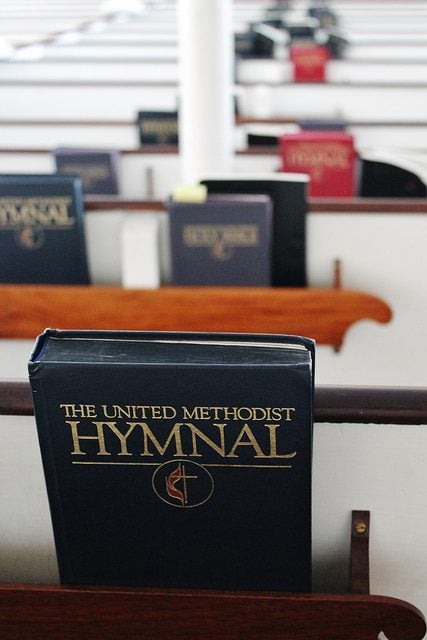
A committee working on behalf of the Discipleship Ministries of the United Methodist Church has released a list, vetting the CCLI top 100 for theology and singability. Having married a United Methodist, and having served a United Methodist congregation for a number of years, this project was of interest to me. In the end, they have commended, some freely and some with reservation, approximately half the songs of the top 100 list. See their list and explanation here.
From the introduction:
The corpus of hymns and worship songs keeps expanding. We hope our work to generate these lists and the fuller detail that will appear on our website will be a useful toolset that helps you, our pastors, musicians and worship planners and leaders, discover and evaluate and help your congregations sing old and new songs that are both true to our United Methodist commitments and most appropriate for your particular contexts.
Because of the largely “contemporary” emphasis of the denomination in my area, I expected to largely reject the findings. In the end, I was pleasantly surprised at both the results and the care in their methodology. While I don’t agree with them at every point, and would personally trim the list even further, I think this is an important and frankly overdue step for the denomination.
Here are a few things I believe this team did particularly well.
Attention to theology, especially trinitarian language. Christian worship is fundamentally a trinitarian exercise, and that emphasis is vital to preserve a concrete and understanding of God’s character and work throughout human history. It keeps us honestly balanced in our approach, when we often would rather worship the God we want instead of the one true God. Contemporary songwriters have too often allowed themselves to be clumsy in their word choices, particularly with unclear and seemingly interchangeable use of divine titles.
I also appreciate the comments about the 20th-century gospel hymn “Victory in Jesus,” which, despite its catchy tune, puts forth a quite confusing and thoroughly unbiblical eschatology.
It’s not good enough that a song has happy words about Jesus. It’s not enough that there is no plain and obvious error to the music director or worship leader. We’ve got to be willing to give up our favorites when they don’t jive with what we, and more importantly, our denomination or faith tradition, believes about core theological doctrines.
Vetting by a qualified team. It’s not enough for a well-meaning but theologically untrained musician to pick songs that he or she likes. Theological vetting of the texts we proclaim in worship is imperative, and is a job that should be shared by theologians, biblical scholars, hymnal committees, church musicians, and seminary-trained pastors. That’s the kind of team at work here.
Attention to the sources of these songs. As the article points on, albeit in one paragraph, most of the CCLI songs (excepting the neo-Calvinist influence) come from a charismatic or Pentecostal tradition. While I have known and appreciate many great people from these traditions, there are reasons I’m not charismatic, and why I don’t worship like a charismatic. This is essential for us to consider when we choose songs, particularly new and untested ones, for use in worship. Blind use of texts originating outside our faith tradition, whether out of laziness or a misplaced, juvenile eclecticism (As in the angsty question, “Why can’t we all just be Christian?!?”)
There are a few implications I see in their choices that I believe need further examination and discussion.
The problem of the performance genre. Most of the songs the committee approved are not written for congregational singing, and as a result are quite difficult for a church to sing well. Listen to a few YouTube clips of these, and you’ll hear excessive syncopation, common ad-libbing from the “worship leaders” (performers? soloists?), and jumping octaves to avoid issues of range and tessitura. There are generally no standard notations of these songs, rendering them difficult for a congregation to follow. Most obviously, they are written for performance, and unless careful choices are made in regard to vocal and instrumental leadership, the congregation’s voice will be secondary to what’s happening on the platform (stage?).
Of course, a few of these songs are more traditional, vocally-driven, congregational hymns that are still under copyright (“How Great Thou Art,” “Great Is Thy Faithfulness”). “Before the Throne of God Above” is an older hymn text paired with a newer melody by Vikki Cook, which easily translates to a congregational-friendly style (It’s fantastic with organ accompaniment!).
The problem of the commercial worship industry. This market is driven by mass appeal, not musical or theological quality. Plainly put, the top priority of the worship industry is, of course, to sell stuff to as many people as possible, which, of course, creates plenty of problems. See this post for more on the trouble with the worship industry.
The problem of the small number of songs. 100 songs is simply not enough to choose from, and they have pared the list down even further. We need the witness of previous generations in our corporate worship for many reasons, not the least of which is because there are simply not enough good choices. Whichever of these songs we deem appropriate, whether one or fifty or a hundred, I would argue that these they shouldn’t be used exclusively, but should be added to the centuries-worth of great hymns, which have already been vetted time and time again, along with new contributions to the hymn tradition. Perhaps the team agrees, but I would have liked for it to be stated explicitly.
These critiques aside, this is the kind of work that needs to be done regularly in every denomination or faith tradition, so that we’re not so blinded by the new, the cool, and the current that we forget how much theology matters.


Photos:
Flickr, Charles Clegg, creative commons 2.0
Flickr, Glendale United Methodist, creative commons 2.0
Stay in touch! Like Ponder Anew on Facebook:

Next Post

February 8, 2016 10 Worship Songs We Should Stop Singing
Browse Our Archives
Select a Category Church of St. YouTube congregational singing congregational song contemporary critiques corporate worship Hymn of the Week hymn singing hymnody and hymnology hymns masturbatory worship Uncategorized worship Worship Quotes
Select a Month February 2023 January 2023 October 2022 September 2022 April 2022 February 2022 January 2022 December 2021 July 2021 June 2021 May 2021 April 2021 January 2021 December 2020 November 2020 July 2020 June 2020 May 2020 April 2020 March 2020 February 2020 January 2020 November 2019 September 2019 July 2019 June 2019 May 2019 April 2019 March 2019 February 2019 January 2019 December 2018 November 2018 October 2018 September 2018 August 2018 July 2018 June 2018 May 2018 April 2018 March 2018 February 2018 January 2018 December 2017 October 2017 September 2017 August 2017 July 2017 June 2017 May 2017 April 2017 March 2017 February 2017 January 2017 December 2016 November 2016 October 2016 September 2016 July 2016 June 2016 May 2016 April 2016 March 2016 February 2016 January 2016 December 2015 November 2015 October 2015 September 2015 August 2015 July 2015 June 2015 May 2015 February 2015 January 2015 December 2014 October 2014 September 2014 August 2014 July 2014
Follow Us!
TAKE THE
Religious Wisdom Quiz
In what city was Jesus born?
Select your answer to see how you score.
Bethlehem Rome Jerusalem Nazareth
Related posts from Ponder Anew

Hymn of the Day: Love Divine, All Loves...

Hymn of the Day: Christ, Whose Glory Fills...
Hymn of the Day: Where Cross the Crowded...
Hymn of the Day: Open Now Thy Gates...
TRENDING AT PATHEOS Evangelical

The REST of Your Life: A Creative Wrestles...
This week I had a conversation with a good friend from church....

How the author of the world's best hymn...
I've been working with John Newton for a while now. This makes...

Long before this Lectio Divina, Psalm 130 - the song - started...

What About the Trees? Another Living Parable
After I finished writing the last article about falling leaves as a...

Why Classical Education Is a Conversation, Not a...
Come and Read: Joy in Classical Education When I was a little...

Cornell University has received a great deal of negative publicity and intense...
view all Evangelical blogs
Ad-Free & Subscriber Log-In Subscription Support
- About Us
- 2026 Calendar
- Videos
- Podcasts
- Library of World Religions
- Faith In Media Tracker
- Advertise With Us
- Write for Us
- Privacy Policy
- Terms of Service
- Do Not Sell My Data
- Contact Us
- Radiant Digital
- Manage Newsletter Subscriptions
- Unsubscribe From Notifications
- Sitemap
Copyright 2008-2026, Patheos. All rights reserved.
Subscription Support Ad-Free & Subscriber Log-In
Follow Patheos