
BuddhistCatholicContemplativeEvangelicalGeneral ChristianHinduJewishLatter-day SaintMuslimNew VisionsProgressive Christian
Beliefs
- Buddhist
- Catholic
- Contemplative
- Evangelical
- General Christian
- Hindu
- Jewish
- Latter-day Saint
- More Voices
- Muslim
- New Visions
- Pagan
- Progressive Christian
Topics
- Religion News
- Food and Religion
- Sports and Religion
- Religious Art
- Religious Music and Entertainment
- Religious Events
- History and Religion
- Style and Religion
- Politics and Religion
- Women in Religion
- Recreation Outdoors and Religion
- Business Finance and Religion
- Careers Workplace and Religion
- Education and Religion
- Family Parenting and Religion
- Health Fitness and Religion
- Home and Religion
- Relationships and Religion
- Technology and Religion
- Travel and Religion
Columnists
- Buddhist Columnists
- Business Finance and Religion Columnists
- Careers Workplace and Religion Columnists
- Catholic Columnists
- Contemplative Columnists
- Education and Religion Columnists
- Evangelists Columnists
- Family Parenting and Religion Columnists
- General Christian Columnists
- Health Fitness and Religion Columnists
- Hindu Columnists
- History and Religion Columnists
- Home and Religion Columnists
- Jewish Columnists
- More Voices Columnists
- Latter Day Columnists
- Muslim Columnists
- New Visions Columnists
- Nonreligious Columnists
- Pagan Columnists
- Politics and Religion Columnists
- Progressive Columnists
- Recreation Outdoors and Religion Columnists
- Relationships and Religion Columnists
- Religion News Columnists
- Religious Art Columnists
- Religious Events Columnists
- Religious Music and Entertainment Columnists
- Sports and Religion Columnists
- Style and Religion Columnists
- Technology and Religion Columnists
- Travel and Religion Columnists
- Women in Religion Columnists
Resource Library
- 2026 Calendar
- Library of World Religions
- The 100 Most Holy Places on Earth
- Patheos Answers
- Podcasts
- Videos
- Faith Leaders Database
- Anglican Episcopalian
- Bahai
- Baptist
- Buddhism
- Christianity
- Confucianism
- Eastern Orthodoxy
- Hinduism
- Holiness and Pentecostal
- ISKCON
- Islam
- Judaism
- Lutheran
- Methodist
- The Church of Jesus Christ of Latter-day Saints
- New Age
- Paganism
- Presbytarian and Reformed
- Protestantism
- Religion Behind the Scenes
- Roman Catholic
- Scientology
- Shia Islam
- Sikhism
- Sufism
- Sunni Islam
- Taoism
- Zen
- See all religions
Research Tools
 Ad-Free & Subscriber Log-In Subscription Support
Ad-Free & Subscriber Log-In Subscription Support
Follow Patheos 

- Trending:
- Forgiveness
- |
- Marriage
- |
- Consciousness
- |
- Death Penalty
- |
- Election
- |
- Halloween
 Ponder Anew
- Home
- Evangelical
- 8 Reasons the Worship Industry Is Killing Worship
8 Reasons the Worship Industry Is Killing Worship
Last updated on: February 15, 2017 at 8:12 pm by Jonathan Aigner
8 Reasons the Worship Industry Is Killing Worship 2017-02-15T20:12:01-05:00 Jonathan Aigner
Patheos Explore the world's faith through different perspectives on religion and spirituality! Patheos has the views of the prevalent religions and spiritualities of the world.
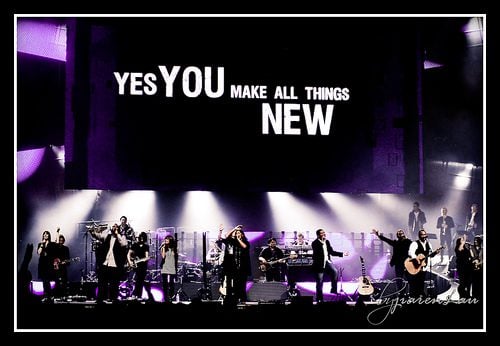
(Photo: Flickr: by Jiaren Lau, creative commons license)
I grew up listening to contemporary Christian music. I’ve still got the Michael W. Smith cassette tapes to prove it. For a Baptist homeschooler, there was really no other option, it seemed. Our church was also contemporary, but in the late 80s and early 90s, that meant we sang little choruses, a few early CCM songs (think Keith Green, Maranatha, that sort of thing) and some gospel hymn medleys, not the stuff we heard on the radio. That’s not the case anymore. While there may not be complete overlap, there is virtually no difference between “church” music and “radio” music.
I’m not sure that’s a good thing.
In a recent post about the decline of contemporary worship, I suggested that it might be time for Christians, particularly those who recognize the importance of worship, to kill the worship industry before it kills worship. Here are some reasons why I think this is the case.
1. It’s sole purpose is to make us feel something. The industry, as with the mainstream music industry, must engage us on a purely sensory level to find widespread appeal in an entertainment-addicted culture. It must make us feel something on a purely emotional level. It strikes a match for the initial excitement of the spark. It must hook us in to be profitable. And so, the quality of theology, poetry, and music suffers accordingly. And we trade the beauty of God’s story for the initial excitement of sensory stimulation. Singing love songs to Jesus is not the point of gathered worship. I find Robert Webber’s definition helpful: Worship is doing God’s story.
2. The industry hijacks worship. When the mind is disengaged and worship is reduced to an emotional experience, worship descends into narcissistic and self-referential meaninglessness. It becomes, to borrow a term from my experience in evangelical culture, “unchristian.” It turns us inward. How many times have we heard people say, “I can’t worship with that kind of music!” or “I really felt like I could worship today!” What they mean is, “I didn’t feel it” or “I was entertained.” True Christian worship happens when we engage with the Christian story through Word and Sacrament. When it’s done well, the only possible response is one that looks outside the self to the goodness of God and God’s work in human history, and searches for our place in God’s story.
3. It says that music IS worship. For the industry, the “worship” is the music part of the service. It uses the old revival meeting order, with a long singing block followed by a long preaching block. In most instances, the invitation is replaced by a another singing block. The singing is the “worship,” the preaching is…well, we’re not sure. It’s not really worship. No corporate prayer, no creeds, no confession. No more gathering, proclaiming, thanksgiving, and The industry’s “worship” music, “worship” albums, and “worship” leaders have helped solidify the contemporary church’s departure from historic liturgy.
4. It’s a derivative of mainstream commercial music. In the 1960s, Leonard Bernstein said that perhaps five percent of the pop music explosion had something of value to say, giving this Brian Wilson masterpiece as an example. After fifty years, that percentage is undoubtedly lower, because of the exponential increase in output. And because the industry is committed to creating christianized versions of popular forms, there is little creativity. It just copies the marketable sounds and adds jesusy words.
5. It perpetuates an awkward contemporary Christian media subculture. It occurred to me recently that mainstream cinema produces better Christian movies than any “Christian” production company can do because they are fully committed to telling a story, while Christian movies are trying to preach a self-help sermon without using any salty language. Disney gave us “The Chronicles of Narnia.” Christian culture gave us “Fireproof” and the “Left Behind” franchise. Case in point right there. Christian music is much the same. It can’t possibly find itself in Bernstein’s five percent because it’s too busy talking about how “Christian” it is, instead of telling the story.
6. It spreads bad theology. Mostly because it comes from the wrong sources. The best of the church’s hymnody was written by pastors and theologians. It was crafted by poets and scholars. The result are texts of high quality. But the industry in its quest to be marketable only has room for marketable people who write marketable songs. It entrusts sacred storytelling to many with dubious credentials as artists, poets, or theologians.
7. It creates worship superstars. I don’t think all artists and worship leaders are purely seeking fame. I think most of them would eschew the label. But this is what they become. They can’t help it. Entertainment begets fandom. They sound the part, they look the part, they dress the part. Their existence demands it. Because their craft mimics that of mainstream music stars, so does our reaction to them. We the church become an audience. Groupies. Screaming teenagers for Jesus.
8. It’s made music into a substitute Eucharist. Most evangelicals, along with the mainline Protestants who are looking to commercial Christian music as an institutional life preserver, use music as if it were a sacrament. Through their music, they allow themselves to be carried away on an emotional level into a perceived sensory connection with the divine. Music is their bread and wine. Don’t believe me? Try telling your church, your pastor even, that we should make a switch. Let’s have Communion ever week, and music once a month (or where I come from, once a quarter). It probably won’t go over well.
I think this is one reason why most evangelicals (not just Zwingli’s faith descendants) devalue Holy Communion so much. They don’t really see the point. They don’t feel anything. For them, no stimulation equals no worship. But for the historic church, there was no worship without the Eucharist. It was the natural culmination of the liturgy. We take in the bread and wine, and we are poured out into a dry, thirsty creation as participants in the gospel story. Jesus invites us, saying, “Here are my body and blood.” Music adds a valuable dimension, but it doesn’t usher us into God’s presence.
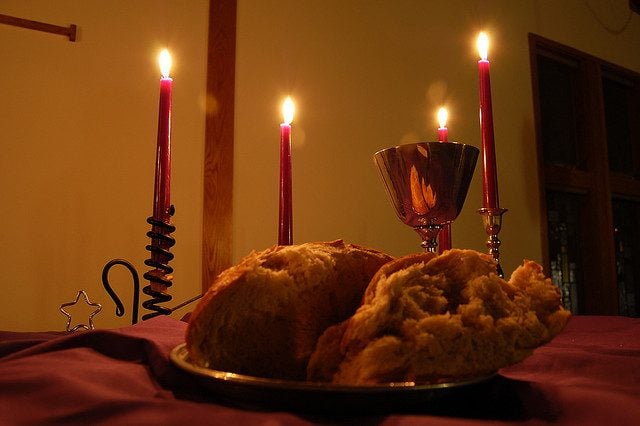
(Photo: Flickr: by Cathy Stanley-Erickson, creative commons license)
“But then nobody would come to our worship services! It wouldn’t be fun! It would be boring!”
Just like good art, Christian worship demands our engagement. In a sense, worship should be exceedingly boring in that it doesn’t offer that over-stimulation that the masses crave. But to those who really give themselves in participation, it is more entertaining than the anything media (mainstream or Christian) can offer, because it offers something so radically alternative to fallen mundanity.
So what can we do? I think we all have to decide for ourselves. For me personally, with very rare exception, I will not support the worship industry. I won’t pay for the music. I won’t go to concerts. I won’t listen to commercial Christian radio. I just can’t. This isn’t about starting a revolution. It’s not a matter of preference. This is a matter of conscience for me. While I will still listen to various forms of mainstream popular music, both old and new, I won’t support the christianized version subverting the essentials of Christian worship.
This is not a curmudgeonly rant against new music. There is good sacred music being written, but in most cases, we’ve got to look outside the worship machine to find it.
It’s about freeing worship from the stranglehold of the industry.
It’s about reconsidering how we the church interact with music.
It’s about rejecting the artistic poverty of the commercial and enriching our worship with creativity.
It’s about using our brains in worship, not just waiting for emotional stimulation.
It’s about not being so drunk with the box wine of commercial music that we never learn to savor the Bordeaux of grace that’s freely offered to us.
True Christian worship isn’t about creating a spark. It’s about lighting candles to be carried out into the darkness.
Maybe it’s time we stopped playing with matches.



Next Post

October 31, 2015 The Ultimate "Christian" Halloween Celebration
Browse Our Archives
Select a Category Church of St. YouTube congregational singing congregational song contemporary critiques corporate worship Hymn of the Week hymn singing hymnody and hymnology hymns masturbatory worship Uncategorized worship Worship Quotes
Select a Month February 2023 January 2023 October 2022 September 2022 April 2022 February 2022 January 2022 December 2021 July 2021 June 2021 May 2021 April 2021 January 2021 December 2020 November 2020 July 2020 June 2020 May 2020 April 2020 March 2020 February 2020 January 2020 November 2019 September 2019 July 2019 June 2019 May 2019 April 2019 March 2019 February 2019 January 2019 December 2018 November 2018 October 2018 September 2018 August 2018 July 2018 June 2018 May 2018 April 2018 March 2018 February 2018 January 2018 December 2017 October 2017 September 2017 August 2017 July 2017 June 2017 May 2017 April 2017 March 2017 February 2017 January 2017 December 2016 November 2016 October 2016 September 2016 July 2016 June 2016 May 2016 April 2016 March 2016 February 2016 January 2016 December 2015 November 2015 October 2015 September 2015 August 2015 July 2015 June 2015 May 2015 February 2015 January 2015 December 2014 October 2014 September 2014 August 2014 July 2014
Follow Us!
TAKE THE
Religious Wisdom Quiz
What city is considered holy by Christians, Jews, and Muslims alike?
Select your answer to see how you score.
Antioch Rome Paris Jerusalem
Related posts from Ponder Anew

Hymn of the Day: Love Divine, All Loves...

Hymn of the Day: Christ, Whose Glory Fills...
Hymn of the Day: Where Cross the Crowded...
Hymn of the Day: Open Now Thy Gates...
TRENDING AT PATHEOS Evangelical

How the author of the world's best hymn...
I've been working with John Newton for a while now. This makes...

Long before this Lectio Divina, Psalm 130 - the song - started...

What About the Trees? Another Living Parable
After I finished writing the last article about falling leaves as a...

Why Classical Education Is a Conversation, Not a...
Come and Read: Joy in Classical Education When I was a little...

Falling Leaves: A Living Parable on Letting Go
I’ve spent the vast majority of my life in the southeast corner...

Cornell University has received a great deal of negative publicity and intense...
view all Evangelical blogs
Ad-Free & Subscriber Log-In Subscription Support
- About Us
- 2026 Calendar
- Videos
- Podcasts
- Library of World Religions
- Faith In Media Tracker
- Advertise With Us
- Write for Us
- Privacy Policy
- Terms of Service
- Do Not Sell My Data
- Contact Us
- Radiant Digital
- Manage Newsletter Subscriptions
- Unsubscribe From Notifications
- Sitemap
Copyright 2008-2026, Patheos. All rights reserved.
Subscription Support Ad-Free & Subscriber Log-In
Follow Patheos