
BuddhistCatholicContemplativeEvangelicalGeneral ChristianHinduJewishLatter-day SaintMuslimNew VisionsProgressive Christian
Beliefs
- Buddhist
- Catholic
- Contemplative
- Evangelical
- General Christian
- Hindu
- Jewish
- Latter-day Saint
- More Voices
- Muslim
- New Visions
- Pagan
- Progressive Christian
Topics
- Religion News
- Food and Religion
- Sports and Religion
- Religious Art
- Religious Music and Entertainment
- Religious Events
- History and Religion
- Style and Religion
- Politics and Religion
- Women in Religion
- Recreation Outdoors and Religion
- Business Finance and Religion
- Careers Workplace and Religion
- Education and Religion
- Family Parenting and Religion
- Health Fitness and Religion
- Home and Religion
- Relationships and Religion
- Technology and Religion
- Travel and Religion
Columnists
- Buddhist Columnists
- Business Finance and Religion Columnists
- Careers Workplace and Religion Columnists
- Catholic Columnists
- Contemplative Columnists
- Education and Religion Columnists
- Evangelists Columnists
- Family Parenting and Religion Columnists
- General Christian Columnists
- Health Fitness and Religion Columnists
- Hindu Columnists
- History and Religion Columnists
- Home and Religion Columnists
- Jewish Columnists
- More Voices Columnists
- Latter Day Columnists
- Muslim Columnists
- New Visions Columnists
- Nonreligious Columnists
- Pagan Columnists
- Politics and Religion Columnists
- Progressive Columnists
- Recreation Outdoors and Religion Columnists
- Relationships and Religion Columnists
- Religion News Columnists
- Religious Art Columnists
- Religious Events Columnists
- Religious Music and Entertainment Columnists
- Sports and Religion Columnists
- Style and Religion Columnists
- Technology and Religion Columnists
- Travel and Religion Columnists
- Women in Religion Columnists
Resource Library
- 2026 Calendar
- Library of World Religions
- The 100 Most Holy Places on Earth
- Patheos Answers
- Podcasts
- Videos
- Faith Leaders Database
- Anglican Episcopalian
- Bahai
- Baptist
- Buddhism
- Christianity
- Confucianism
- Eastern Orthodoxy
- Hinduism
- Holiness and Pentecostal
- ISKCON
- Islam
- Judaism
- Lutheran
- Methodist
- The Church of Jesus Christ of Latter-day Saints
- New Age
- Paganism
- Presbytarian and Reformed
- Protestantism
- Religion Behind the Scenes
- Roman Catholic
- Scientology
- Shia Islam
- Sikhism
- Sufism
- Sunni Islam
- Taoism
- Zen
- See all religions
Research Tools
 Ad-Free & Subscriber Log-In Subscription Support
Ad-Free & Subscriber Log-In Subscription Support
Follow Patheos 

- Trending:
- Forgiveness
- |
- Marriage
- |
- Consciousness
- |
- Death Penalty
- |
- Election
- |
- Halloween
 Ponder Anew
- Home
- Evangelical
- This is the last post you will ever need to read on why they don’t sing in church anymore.
This is the last post you will ever need to read on why they don’t sing in church anymore.
Last updated on: December 28, 2015 at 1:33 am by Jonathan Aigner
This is the last post you will ever need to read on why they don’t sing in church anymore. 2015-12-28T01:33:01-05:00 Jonathan Aigner
Patheos Explore the world's faith through different perspectives on religion and spirituality! Patheos has the views of the prevalent religions and spiritualities of the world.
An Inaudible Introit
Churches don’t sing anymore.
We know, already! For the love…
A quick trip down Google’s memory lane reveals that the internet has been talking about this regularly since at least 2012.
And everyone seems to know why.
Because nobody knows the songs.
Because it makes men uncomfortable.
Because it’s just a performance.
Because we don’t love Jesus enough.
There is truth to some of these points, none to others, but most of them miss the foundational problem.
There is one basic, fundamental reason that congregations no longer sing.
Nobody sings anymore.
A Closemouthed Call to Worship
Okay, so there are folks that sing here and there. But by and large, we are no longer a culture of music-makers. Nope, instead of making music, we consume music. We might croon along with our favorite jams, but we don’t really, make the music ourselves anymore. While appreciating music once meant developing the ability to “do” music, it now means that we obsessively listen to recorded music, possibly of a few various popular genres.
We listen to a semi-musical product, but most of us don’t ever do any real music-making, except for attempts to reproduce what we hear on our favorite recordings.
My friend Richard, a professional musician and Ponder Anew reader, recently told me this:
Born in 1951, we had songbooks along with reading, arithmetic, and spelling books. We were singing Stephen Foster’s “Nelly Bly” in second grade. Our fourth grade teacher handed out small booklets and we learned “Love Lifted Me.” The 5th/6th grade elementary chorus in our very rural school district sang the Mozart “Alleluia.” Men’s clubs like Rotary had songbooks and songleaders and sang at every meeting. Hymns were a part of Sunday School as well as church. We sang at summer camp—not just church camp, but Scout camp as well. Things have changed!!! I suspect singing is no longer heard in many of those venues.
I suspect it isn’t, and if it is, it’s probably poor imitations of popular music, which suffice it to say, isn’t a genre brimming with natural vocal expression.
Now, more than ever, people just claim that they can’t sing at all.
Any music teacher realizes, of course, that this is pure crap. Anyone with a functioning voice can learn to sing. Some will sing better than others, but anyone can learn to sing. In my previous career teaching K-4 students in a public school, I taught over a thousand kids, and I never had a student with a mustard seed of willingness that I couldn’t teach to sing pleasantly and on pitch. But if they grow up never hearing anyone actually sing live, if no one in their family can sing apart from a recording, if they don’t have an encounter with singing in school or church, they won’t know this. We can do better.
It royally hacks me off when I hear a pastor or so-called “worship leader” say things like, “Some of us can sing, and others of us just make a joyful noise” or “Even if you can’t carry a tune in a bucket, just do your best.” I’ve heard this nonsense in most churches I’ve belonged to, and I get that its intended as encouragement, but it doesn’t work. If you’ve never been even informally taught to sing, you’re likely going to believe you’re one of those tone-deaf folks. And are you going to try? Not likely. And you’re certainly never going to come away with the idea that your singing is of any value in corporate worship.
Instead, churches must begin assuming that everyone CAN sing, teaching them they can sing, and setting good examples of singing. Only then will we begin to change our mute Christian culture.
A Sonorous Sermon
This is NOT, however, the last post you will ever need to read on how to get churches to sing once again. We desperately need ongoing, long-term conversations on this. I’ve written more in-depth on this subject in a previous post, but here is a brief summary of steps that should be taken in every congregation.
Do music that is meant to be sung, and in a way that encourages healthy, hearty singing. Most of the music churches are now attempting to sing is instrumentally-driven music in a vernacular style that was written for a solo artist recording. Replicating that style of music, with its syncopation, affected vocals, aimless melodies, and awkward vocal ranges, is impossible congregational task. There are new songs and hymns being written that are excellent for a congregation, but you won’t usually hear them on Christian radio.
Stop the Hillsongization of congregational singing. (Thanks to Michael Raiter for the pertinent description.) Along those lines, musical leadership in most contemporary settings is basically a cover band making an attempt to recreate a commercial “worship” recording. The quality, therefore, of each congregation’s “worship” is directly determined by how good their cover band is. We’ve probably heard this story from family, friends, or former congregants: “I used to go to this church, but my family really enjoys the powerful worship over at this other church.” From what I’ve seen and heard, they usually mean, even if they don’t realize it: “The cover band at my new church is better than the cover band at my old church.” We’re left with churches that pretty much all want to sound the same singing mostly the same songs. And cover bands are not usually very adept at drawing the song out of a congregation.
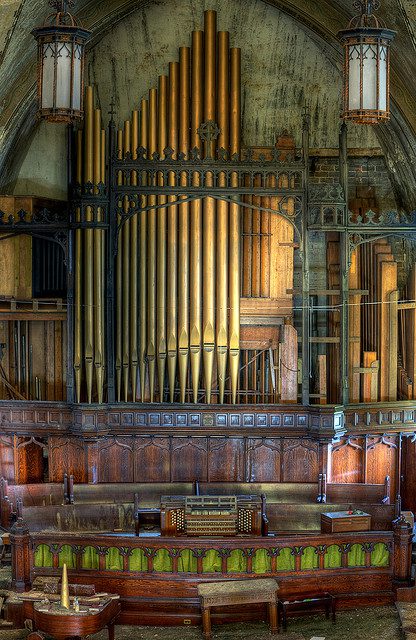
You know, there used to be these big instruments. Most churches had one, you know, back when churches sang. They had all these different sounds and seemingly limitless combinations. They could really sustain and enhance congregational singing. Forget what they were called…
I’ve even heard this sad story from my friends in the a cappella tradition. I don’t necessarily agree with their theological basis for not using instruments, but the effects are wonderful. Generations have grown up learning to sing, and learning to sing well, read music, and worship in song with confident singing and rich harmonies that is entirely vocally led. But even these denominations and groups are debating whether to bring instruments into their singing, you know, guitars, percussion, that sort of thing. Unfortunately, if they keep it up, they’ll eventually find themselves like everyone else, with their cover band in front of a tentative, muted congregation.
Recognize that singing is, in and of itself, a sacred duty. Singing is important. Not just hearing the music playing, not just being taken emotionally to a place where we enjoy cuddle time with a comfy Creator God, but the actual act of singing. Most of us believe and our churches confirm the ridiculous notion that worship is the musical part of the service. And since most of us aren’t singing with any intentionality or seriousness, the really worshipful part is letting the music that other people are do create these happy, positive, weighty, Jesusy feelings inside of us. Yes, we’ve decided that music’s job in worship is to lead us into the presence of God.
But there are some things that music just can’t do. This is one of them. For all of its strengths, music has no sacramental power.
If we want our churches to keep singing, and for that matter, to keep worshiping through song, we’ve got to put this idea to rest.
A Robust Recessional
When it’s time to sing, sing. Just sing.
Sing your faith.
Sing your theology.
Sing to help proclamation take hold in your hearts and minds.
Sing, even when you don’t feel like it.
Sing, even when you don’t mean it.
Sing when you don’t like the song.
Sing when the words are more convicting than uplifting.
Sing with no expectations of being carried away into an affective experience.
Sing, and teach your congregations to sing with you, especially your children.
We may not be able to turn the tide in the rest of our culture, but with intentionality over the next generations, we can change the culture of singing in the church. This is not a non-essential of faith. This is not adiaphora. This is important stuff. If the ancient principal of lex orandi, lex credendi is true, if how we believe is determined by how we worship, then we must learn to sing well, just as we must learn to preach well and to pray well.
If we don’t, we may just stop singing altogether. And we’ll be all the poorer for it.
For further reading, click on one of the images below.


Next Post

July 23, 2015 6 Reasons We Shouldn't Use Hymnals Anymore
Browse Our Archives
Select a Category Church of St. YouTube congregational singing congregational song contemporary critiques corporate worship Hymn of the Week hymn singing hymnody and hymnology hymns masturbatory worship Uncategorized worship Worship Quotes
Select a Month February 2023 January 2023 October 2022 September 2022 April 2022 February 2022 January 2022 December 2021 July 2021 June 2021 May 2021 April 2021 January 2021 December 2020 November 2020 July 2020 June 2020 May 2020 April 2020 March 2020 February 2020 January 2020 November 2019 September 2019 July 2019 June 2019 May 2019 April 2019 March 2019 February 2019 January 2019 December 2018 November 2018 October 2018 September 2018 August 2018 July 2018 June 2018 May 2018 April 2018 March 2018 February 2018 January 2018 December 2017 October 2017 September 2017 August 2017 July 2017 June 2017 May 2017 April 2017 March 2017 February 2017 January 2017 December 2016 November 2016 October 2016 September 2016 July 2016 June 2016 May 2016 April 2016 March 2016 February 2016 January 2016 December 2015 November 2015 October 2015 September 2015 August 2015 July 2015 June 2015 May 2015 February 2015 January 2015 December 2014 October 2014 September 2014 August 2014 July 2014
Follow Us!
TAKE THE
Religious Wisdom Quiz
What tree were Adam and Eve told not to eat from?
Select your answer to see how you score.
Tree of Knowledge of Good and Evil Tree of Life Olive Tree Fig Tree
Related posts from Ponder Anew
A Simple Way to Improve Congregational Singing: Get...
Are we expecting too much out of music...
Why You Should Stop Leading the Worship Music...
Finding Hymns and Songs that are "Good"
TRENDING AT PATHEOS Evangelical

How the author of the world's best hymn...
I've been working with John Newton for a while now. This makes...

Long before this Lectio Divina, Psalm 130 - the song - started...

What About the Trees? Another Living Parable
After I finished writing the last article about falling leaves as a...

Why Classical Education Is a Conversation, Not a...
Come and Read: Joy in Classical Education When I was a little...

Falling Leaves: A Living Parable on Letting Go
I’ve spent the vast majority of my life in the southeast corner...

Cornell University has received a great deal of negative publicity and intense...
view all Evangelical blogs
Ad-Free & Subscriber Log-In Subscription Support
- About Us
- 2026 Calendar
- Videos
- Podcasts
- Library of World Religions
- Faith In Media Tracker
- Advertise With Us
- Write for Us
- Privacy Policy
- Terms of Service
- Do Not Sell My Data
- Contact Us
- Radiant Digital
- Manage Newsletter Subscriptions
- Unsubscribe From Notifications
- Sitemap
Copyright 2008-2026, Patheos. All rights reserved.
Subscription Support Ad-Free & Subscriber Log-In
Follow Patheos