
BuddhistCatholicContemplativeEvangelicalGeneral ChristianHinduJewishLatter-day SaintMuslimNew VisionsProgressive Christian
Beliefs
- Buddhist
- Catholic
- Contemplative
- Evangelical
- General Christian
- Hindu
- Jewish
- Latter-day Saint
- More Voices
- Muslim
- New Visions
- Pagan
- Progressive Christian
Topics
- Religion News
- Food and Religion
- Sports and Religion
- Religious Art
- Religious Music and Entertainment
- Religious Events
- History and Religion
- Style and Religion
- Politics and Religion
- Women in Religion
- Recreation Outdoors and Religion
- Business Finance and Religion
- Careers Workplace and Religion
- Education and Religion
- Family Parenting and Religion
- Health Fitness and Religion
- Home and Religion
- Relationships and Religion
- Technology and Religion
- Travel and Religion
Columnists
- Buddhist Columnists
- Business Finance and Religion Columnists
- Careers Workplace and Religion Columnists
- Catholic Columnists
- Contemplative Columnists
- Education and Religion Columnists
- Evangelists Columnists
- Family Parenting and Religion Columnists
- General Christian Columnists
- Health Fitness and Religion Columnists
- Hindu Columnists
- History and Religion Columnists
- Home and Religion Columnists
- Jewish Columnists
- More Voices Columnists
- Latter Day Columnists
- Muslim Columnists
- New Visions Columnists
- Nonreligious Columnists
- Pagan Columnists
- Politics and Religion Columnists
- Progressive Columnists
- Recreation Outdoors and Religion Columnists
- Relationships and Religion Columnists
- Religion News Columnists
- Religious Art Columnists
- Religious Events Columnists
- Religious Music and Entertainment Columnists
- Sports and Religion Columnists
- Style and Religion Columnists
- Technology and Religion Columnists
- Travel and Religion Columnists
- Women in Religion Columnists
Resource Library
- 2026 Calendar
- Library of World Religions
- The 100 Most Holy Places on Earth
- Patheos Answers
- Podcasts
- Videos
- Faith Leaders Database
- Anglican Episcopalian
- Bahai
- Baptist
- Buddhism
- Christianity
- Confucianism
- Eastern Orthodoxy
- Hinduism
- Holiness and Pentecostal
- ISKCON
- Islam
- Judaism
- Lutheran
- Methodist
- The Church of Jesus Christ of Latter-day Saints
- New Age
- Paganism
- Presbytarian and Reformed
- Protestantism
- Religion Behind the Scenes
- Roman Catholic
- Scientology
- Shia Islam
- Sikhism
- Sufism
- Sunni Islam
- Taoism
- Zen
- See all religions
Research Tools
 Ad-Free & Subscriber Log-In Subscription Support
Ad-Free & Subscriber Log-In Subscription Support
Follow Patheos 

- Trending:
- Forgiveness
- |
- Marriage
- |
- Consciousness
- |
- Death Penalty
- |
- Election
- |
- Halloween
 Poisoner's Apothecary
- Home
- Pagan
- Philosophia Toxicum: A Discourse on the Poison Path
Philosophia Toxicum: A Discourse on the Poison Path
Last updated on: February 8, 2022 at 11:01 am by Coby Michael Ward
Philosophia Toxicum: A Discourse on the Poison Path 2022-02-08T11:01:37-04:00 Coby Michael Ward
Patheos Explore the world's faith through different perspectives on religion and spirituality! Patheos has the views of the prevalent religions and spiritualities of the world.
The Poison Path According to One Poisoner
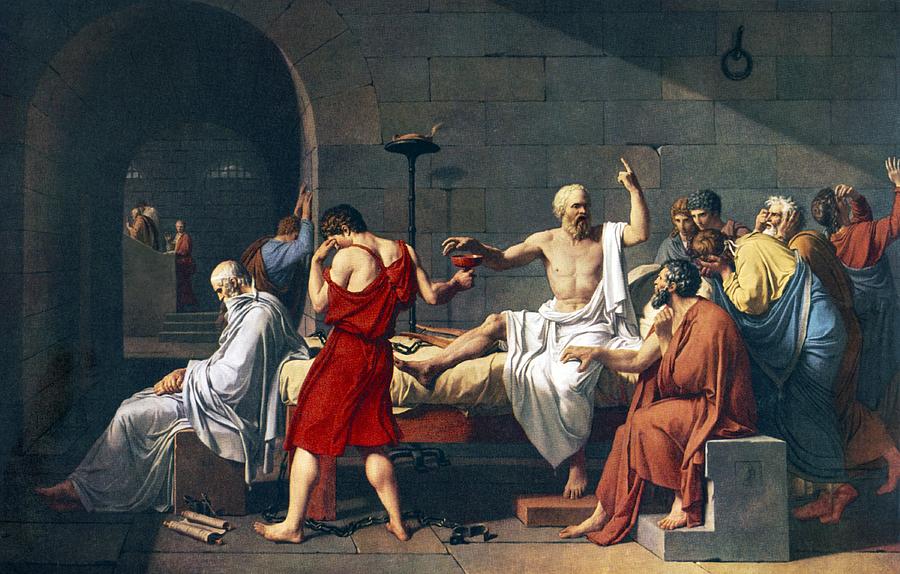
Death of Socrates. Jacques-Louis David. 1787.
I have been writing and teaching about my experiences as a practitioner of poison path witchcraft since 2016. I have had the opportunity to get to know numerous other practitioners, each with their own way of working; their own perspective from which they approach this path. Few people will choose to completely dedicate their occult pursuits to working with spiritual and physical poisons, for obvious reasons. The term, The Poison Path was coined by author Dale Pendell in the 1970s, in his Pharmako trilogy. It was used to describe the alchemical extraction of entheogenic substances from potentially poisonous plants, specifically for their use in magic, ritual and spiritual practice. Pendell artistically presents the philosophies that make the framework of this path, as well as a system of categorization showing the wide spectrum of entheogenic experience.
The Poison Path is animistic in nature and recognizes the spiritual forces alive inside plants and fungi. It is usually woven into an existing spiritual framework, and used to supplement one’s own unique practices. Poison Path practitioners are all varieties of witches, alchemists, occultists and plant-based spiritualists. There is no right or wrong way to explore the Poison Path and calling it a Path makes it sound like a closed tradition with clear boundaries. It is not. It is a “path,” in that we choose to follow this pursuit wherever it may lead. It is not the only path for the verdant practitioner, and you cannot understand poisonous plants without first understanding their healing counterparts.
Although the Poison Path is focused on the occult nature of poisonous plants, it is a path of balance. There is as much emphasis on the antidote and panacea as there is on the toxin. This is why it is often called the Crooked Path. One must travel both the way of balm and bane because staying on either side for too long has its detrimental effects. To heal we must go through our own ordeals, illnesses and initiations to transmute our own spiritual poisons into power so that we can continue to heal ourselves and others. The poison garden also includes other baneful herbs, which have an otherworldy, adversarial, or pernicious nature, but aren’t psychoactive or poisonous. The plant’s of the devil’s garden, and all form of briar and bramble all contain their own wisdom.
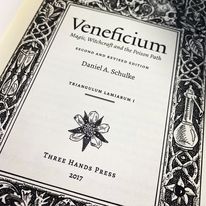
Veneficium Photo by Coby Michael
Practitioners of the Poison Path seek out those plants that have been ostracized or forgotten by most people. The Poison Path is the way of the occultist and the witch, and while there are powerful physical forces at play, including a plant’s toxic and visionary effects, the focus for the Poison Path is on the esoteric applications for these potent forces. In short it is the study and application of poisonous, baneful, invasive, and demonized plants for their occult virtues and to connect with them as familiar spirits. This is to develop a deeper understanding of the toxikon or pharmakon, and its transmutational power. It is a kind of plant alchemy, that demonstrates that these master plant spirits work on many levels at once in a synergy that allows for their spiritual and magical effects.
“Poison is a glyph for magical power itself.” – Daniel Schulke, Veneficium 2017
Much of the preparation and study of the Poison Path involves the study of toxicology and its history. In the ancient world the mechanism of poison was not understood on a chemical level. This did not stop people from using poisonous substances for medicine, murder and magic. A large body of folk knowledge and legal discourse involving the idea of poison shows us this original understanding. Poison was a deadly and invisible force to ancient people. It could travel through the air, emanate from the evil eye and contaminate anything nearby. The plants that were known to contain these malefic substances were thought to draw their poisonous nature directly from the underworld, or the dead. Poison is the great opposer. The antithesis of life force, but also sometimes its savior.
“As Paracelsus noted, poison is both omnipresent and absent in nature.” – Daniel Schulke, Veneficium 2017
Poison and witchcraft are synonymous. It is the original transgression, the intoxication of humankind through the Apple of Knowledge. It is the transmission of angelic knowledge to human beings to create something wholly different. Poison is that which is Other, and that is exactly what the witch seeks to connect with. Contagion, miasma, and plague are all concepts related to the Poison Path. Accusations put towards many an accused witch. The Church views witchcraft as a spiritual contagion, a toxin, infecting society with its maleficia. The Poison Path is an inherently rebellious path of self-discovery through trial, initiatory death and shamanic visions.
The poison path witch is allied to the Promethean archetype, the light-bringers cast into darkness for stealing what was designated as only for the gods. We can also play this role, climbing into the branches of the world tree or descending into its roots to discover knowledge and to interact with non-human intelligences. The practitioner of the poison path achieves this through acts of opposition and entheogenic experience, both are a means of generating altered states of consciousness that result in spiritual experiences.
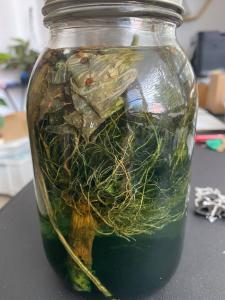
Plant Spirit Vessel. Courtesy of Coby Michael.
The Entheogenic Sacrament
These altered states are achieved through the use of entheogens, plants and fungi ritually prepared for their psychoactive effects. When honed through ritual action and clear purpose, these entheogenic states of consciousness confer deep trance states, otherworld travel, and communication with the spirit world. This is one of many ways used throughout the world to achieve altered consciousness, and like all of the other modalities it is often paired with more than one technique.
The study of entheogens and how they have been used throughout history is the study of ethnobotany. Ethnobotanists study how indigenous people use the plants native to their land for medicine, ritual and magic. The use of entheogens in spiritual practice is a large part of the study involved in walking the Poison Path, this is the path of pharmakeía, an ancient Greek term for knowledge of pharmaka. Pharmaka or pharmakon were potent plant-based preparations that were medicinal, intoxicating and often potentially poisonous.
This is slightly different from the approach of the venefica or poison witch. Veneficium is a Latin term that is synonymous with poisoning and witchcraft. The poison witch seeks to connect with the same forces previously mentioned. The focus here is more on the plant’s baneful nature than its psychoactive properties, and can be achieved without ingesting any plant material. This technique of traditional witchcraft is atavistic, in this way poison is used in ritual transgression or opposition to connect with numinous forces.
The Poisoned Chalice
The ultimate act of opposition, the poisoning of oneself*, even in a symbolic way creates a powerful stir in the most primal parts of our mind. It is against our instincts of self-preservation to come into contact with toxic substances. (*I am by no means suggesting that anyone ingest anything poisonous. There are certain ways that this is achieved and it is unique to the practitioner and the plant ally. This is information comes through study, experience, and plant spirit communion.) Doing so creates a point of liminality which we can utilize when in trance to travel in spirit, communicate with other beings, cast powerful spells and access knowledge through divination.
This could be something as innocuous as floating a deadly nightshade (Atropa belladonna) flower in a ritual chalice full of water or wine, while you are not in any actual danger, it sends a powerful ripple into the spirit world. It says that this person is willing to approach death on its own terms.
The goal here is not actual death, but ego death. Death of the Self frees one from the constraints of their present state of mind, situation and personality so that deeper wells of consciousness can be accessed. This is the realm of the Witches’ Sabbath, the Wild Hunt, and the new perspective gained from hanging oneself on the world tree. There are other traditions as well that work with the energies of death, toxin and contagion for its spiritual alchemy. The most commonly used example are the Aghori, devotees of the god Shiva Vishpan, the poison-drinker. Their practices include ingesting toxic plants like Aconitum ferox and Datura metel with Cannabis spp. Their way of working with the spirit world is similar to the thought behind the Poison Path.
There are concepts of spiritual poison, evil air and flying venom that show up in other cultures as well. Poison is a spiritual force as much as a physical compound, and here is where the occult wisdom in the Poison Path lies. It is at the intersection of medicine and murder. Somewhere in the realm between death and dreaming, and in the knowledge that poison is everywhere and nowhere. The Poison Path, as a path of exploration takes many different directions.
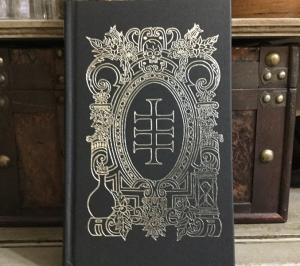
Veneficium. First Edition. Courtesy of Coby Michael.
Concluding Words
I don’t presume to define anyone’s path for them, nor am I under the impression that I have encountered everything the Poison Path has to teach me. All I can do is share what I see from where I stand and hope that others do the same. In short, the Poison Path is about connecting to the Otherness that we all seek as magical practitioners. The plants that populate the Poison Path are an intermediary to that otherness, acting as its representative in this world. The path of the poisoner is to seek these spirits out for what they can teach us.
Poison is an alchemical force, and through its contemplation we become vessels for the venomous nectar, the forbidden fruit of knowledge. Through the art of in-toxication we break the chains that hold us to our physical bodies and descend to the Earth’s mysterious depths, as well as deep within ourselves. It is in our own darkness that we find illumination. It is through transmuting our own personal poisons that we can claim sovereignty.
People often warn of the spiritual implications of working with poisonous and baneful plants. The concern is that the practitioner is somehow contaminated or tainted. They fear the darkness, and that if the Sun sets it will not return. Many of us found this practice as wounded healers, already carrying our own dark toxins. It is our affinity with these forces that calls us to this work.
“What is food to one, is to another bitter poison.” – Lucretius
For more information on the Poison Path, check out these resources.
Check out The Poison Path tab at the top of my blog for my other articles on this topic!
Visit thepoisonersapothecary.com
Veneficium: Magic, Witchcraft and the Poison Path, Daniel Schulke, Three Hands Press
Pharmako Dynamis, Pharmako Poeia, and Pharmako Gnosis by Dale Pendell, North Atlantic Books
The Poison Path Herbal: Baneful Herbs, Medicinal Nightshades, & Ritual Entheogens by Coby Michael, Park Street Press
Psychedelic Mystery Traditions: Spirit Plants, Magical Practices and Ecstatic States by Thomas Hatsis, Park Street Press
The Witching Herbs: 13 Magickal Herbs from the Witches Garden, Harold Roth, Weiser Books
Previous Post
January 14, 2022
The Witches' Sabbath by Kelden
Next Post
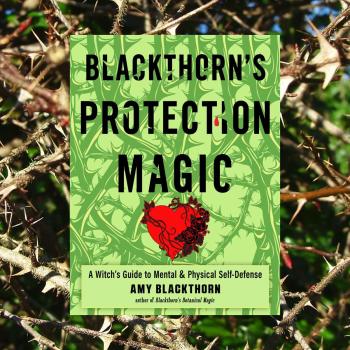
February 27, 2022 Blackthorn's Protection Magic
Browse Our Archives
Select a Category alchemy astrology Community Outreach and Events Current Events Featured Practitioners Gods and Goddesses green magic Green Witchcraft herbalism History of the Devil luciferian tradition Magic Magic and Ritual Magic and Witchcraft in History Magical Community magical herbalism Medieval Herbalism Metaphysics Modern Witchcraft natal charts natural magic Northern Traditions Occult Art Occult Artifacts Occultism pagan authors Pagan Community Pagan Holidays pagan philosophy Pagan Sightseeing Paganism Personal Practice planetary glyphs planetary symbols Recommended Reading Sabbatic Witchcraft samhain satanism Spells The Armchair The Poison Path Traditional Witchcraft Uncategorized Veneficium wicca witch's practice Witchcraft witches' sabbats
Select a Month December 2022 September 2022 August 2022 July 2022 March 2022 February 2022 January 2022 December 2021 October 2021 September 2021 August 2021 July 2021 May 2021 April 2021 March 2021 January 2021 December 2020 October 2020 September 2020 July 2020 June 2020 May 2020 April 2020 March 2020 February 2020 January 2020 December 2019 November 2019 October 2019 September 2019 August 2019 July 2019 June 2019 May 2019 April 2019 March 2019 February 2019 January 2019 December 2018 November 2018 October 2018 September 2018 August 2018 July 2018 June 2018 May 2018 April 2018 March 2018 February 2018 January 2018 December 2017 November 2017 October 2017 September 2017 August 2017 July 2017 June 2017 May 2017 April 2017 March 2017 February 2017 January 2017 December 2016 November 2016 October 2016 September 2016 August 2016 July 2016 June 2016 May 2016 March 2016 February 2016
Follow Us!
TAKE THE
Religious Wisdom Quiz
What does the Bible say is better than gold?
Select your answer to see how you score.
Wisdom Wine Bread Strength
Related posts from Poisoner's Apothecary

Christian Rätsch, Undying Contributions to the Poison Path
Smoke Divination: The Art of Capnomancy
Flower Essences from the Witch's Garden
TRENDING AT PATHEOS Pagan

I was recently chatting with someone on Instagram. She asked me what...

While there are many people who share their results, the end of...

On July 23, I saw Christopher Nolan's The Odyssey which is Homer’s...

As I write this two big events have just finished up. One...

Restoring the Watershed of Divine Love
Perhaps cooperation is not something we manufacture through legislation, ideology, or moral...

Many UUs don’t pray because of bad experiences in a previous religion,...
view all Pagan blogs
Ad-Free & Subscriber Log-In Subscription Support
- About Us
- 2026 Calendar
- Videos
- Podcasts
- Library of World Religions
- Faith In Media Tracker
- Advertise With Us
- Write for Us
- Privacy Policy
- Terms of Service
- Do Not Sell My Data
- Contact Us
- Radiant Digital
- Manage Newsletter Subscriptions
- Unsubscribe From Notifications
- Sitemap
Copyright 2008-2026, Patheos. All rights reserved.
Subscription Support Ad-Free & Subscriber Log-In
Follow Patheos