
BuddhistCatholicContemplativeEvangelicalGeneral ChristianHinduJewishLatter-day SaintMuslimNew VisionsProgressive Christian
Beliefs
- Buddhist
- Catholic
- Contemplative
- Evangelical
- General Christian
- Hindu
- Jewish
- Latter-day Saint
- More Voices
- Muslim
- New Visions
- Pagan
- Progressive Christian
Topics
- Religion News
- Food and Religion
- Sports and Religion
- Religious Art
- Religious Music and Entertainment
- Religious Events
- History and Religion
- Style and Religion
- Politics and Religion
- Women in Religion
- Recreation Outdoors and Religion
- Business Finance and Religion
- Careers Workplace and Religion
- Education and Religion
- Family Parenting and Religion
- Health Fitness and Religion
- Home and Religion
- Relationships and Religion
- Technology and Religion
- Travel and Religion
Columnists
- Buddhist Columnists
- Business Finance and Religion Columnists
- Careers Workplace and Religion Columnists
- Catholic Columnists
- Contemplative Columnists
- Education and Religion Columnists
- Evangelists Columnists
- Family Parenting and Religion Columnists
- General Christian Columnists
- Health Fitness and Religion Columnists
- Hindu Columnists
- History and Religion Columnists
- Home and Religion Columnists
- Jewish Columnists
- More Voices Columnists
- Latter Day Columnists
- Muslim Columnists
- New Visions Columnists
- Nonreligious Columnists
- Pagan Columnists
- Politics and Religion Columnists
- Progressive Columnists
- Recreation Outdoors and Religion Columnists
- Relationships and Religion Columnists
- Religion News Columnists
- Religious Art Columnists
- Religious Events Columnists
- Religious Music and Entertainment Columnists
- Sports and Religion Columnists
- Style and Religion Columnists
- Technology and Religion Columnists
- Travel and Religion Columnists
- Women in Religion Columnists
Resource Library
- 2026 Calendar
- Library of World Religions
- The 100 Most Holy Places on Earth
- Patheos Answers
- Podcasts
- Videos
- Faith Leaders Database
- Anglican Episcopalian
- Bahai
- Baptist
- Buddhism
- Christianity
- Confucianism
- Eastern Orthodoxy
- Hinduism
- Holiness and Pentecostal
- ISKCON
- Islam
- Judaism
- Lutheran
- Methodist
- The Church of Jesus Christ of Latter-day Saints
- New Age
- Paganism
- Presbytarian and Reformed
- Protestantism
- Religion Behind the Scenes
- Roman Catholic
- Scientology
- Shia Islam
- Sikhism
- Sufism
- Sunni Islam
- Taoism
- Zen
- See all religions
Research Tools
 Ad-Free & Subscriber Log-In Subscription Support
Ad-Free & Subscriber Log-In Subscription Support
Follow Patheos 

- Trending:
- Forgiveness
- |
- Marriage
- |
- Consciousness
- |
- Death Penalty
- |
- Election
- |
- Halloween
 Poisoner's Apothecary
- Home
- Pagan
- The Poison Path Herbal: Baneful herbs, medicinal nightshades and ritual entheogens
The Poison Path Herbal: Baneful herbs, medicinal nightshades and ritual entheogens
Last updated on: July 14, 2021 at 6:45 pm by Coby Michael Ward
The Poison Path Herbal: Baneful herbs, medicinal nightshades and ritual entheogens 2021-07-14T18:45:22-04:00 Coby Michael Ward
Patheos Explore the world's faith through different perspectives on religion and spirituality! Patheos has the views of the prevalent religions and spiritualities of the world.
The Poison Path Herbal
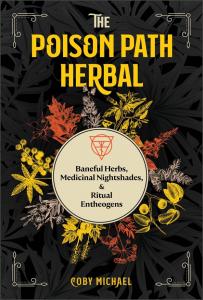
The Poison Path Herbal by Coby Michael
The Poison Path is not about poisoning people, or being spooky by working with dark and dangerous herbs. It is about the exploration of and eventual understanding, that all plants have something to teach us. The ethnobotanical lore that has been maintained in other parts of the world has been lost or demonized through the Christianization and modernization of the western world, especially regarding those plants that are intoxicating and potentially poisonous. The Church and the educated physicians were at odd when rational thought began to take over, however they had a common enemy: the village wise woman, the cunning person & the folk witch. This book seeks to revive some of that lore, and combine it with what we now know about ethnobotany and phytochemistry. The Poison Path Herbal combines traditional lore and modern witchcraft, drawing inspiration from alchemy, mythology and astrology. The avenues of exploration when it comes to humanity’s magical use of plants is endless, and I am so thrilled to finally be sharing this excerpt from my forthcoming book! It has been many years in the making. It is being published by Inner Traditions/Bear & Company and is set for release on October 5th, 2021. It is available for pre-order CLICK HERE.
Chapter 6.
The Book of Saturn: Baneful Herbs and Dark Workings Deadly Nightshade, the Devil’s Berry
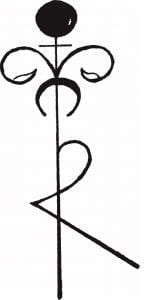
Atropa belladonna Plant Spirit Glyph by Coby Michael
One of the first plants that initially attracted me to the study of herbs connected to witches and magic was Atropa belladonna, Deadly Nightshade. The air of mystery and intrigue that surrounds this plant is seductive. Her dark green foliage and deep purple flowers give her a shadowy appeal. Her shiny black berries whisper temptingly that they have many secrets for those willing to risk her deadly kiss. Her influence has spread across cultures, she has fought and won many battles and has many names. Belladonna, as she is commonly called today, was known as Banewort, Devil’s Herb, Great Morel, and Tolkirsche. Belladonna was also known as Dwale Berry. The English word dwale comes from a Scandinavian root word meaning trance and was also a synonym for a sleeping potion made using Atropa belladonna. In the medical community her name underwent changes as well. She was known as Solanum lethale until 1788 and was reintroduced as Belladonna folia in 1809.
Belladonna, the beautiful lady, was an infamous herb used in the middle ages by physicians and magicians alike. It is mentioned in many obscure and well-known manuscripts on medicine and medieval books on magic. The plant was used in common medicinal preparations into the 1800s eventually fading into obscurity, its medicinal and magical valued remembered by herbalists and cunning folk. Today she is reclaiming her infamy in the lore of classical witchcraft and modern entheogenic study. Her name was once known across Europe, and she went by many sinister titles.
Hildegarde von Bingen (1098-1179CE) in an effort to demonize the former heathen ritual plants, wrote of the plant’s sinister nature in Physica.
“The Deadly Nightshade has coldness in it, and this coldness also holds evil and barrenness, and in the earth and at the place where it grows, a diabolic influence has some share and participation in its craft. And it is dangerous for a man to eat or drink, for it destroys his spirit as if he were dead.” (Physica, 1:52)
Giambattista della Porta lists Belladonna as an herb used to shapeshift into an animal, referring to the plant as Solanum somniferum (sleeping nightshade).
Her relatives, the Mandrake, Henbane, and Thorn Apple comprise the family of great Witching Herbs. These plants have shown up throughout antiquity as powerful medicines, and in the apothecaries of the oldest witches of legend. The family of Solanaceae were known for their sedative and pain-relieving properties and also for their powers of vision and spirit flight.
There are other less common varieties of the Nightshade family, such as the more potent Yellow Belladonna (Atropa belladonna var. Lutea) and the devilish looking “Russian Belladonna” also known as Henbane bell (Scopolia carniolica). These beautiful varietals have a most other worldly look and are coveted by enthusiasts of baneful herbs.
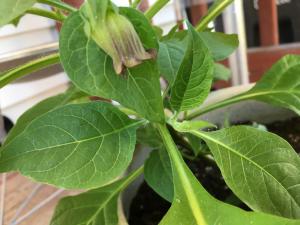
Belladonna. Photo by the author.
The Devil’s Herb, as she is sometimes called is an ally to those on the Crooked Path, but make no mistake, she is a harsh teacher to those bold enough to explore her mysteries. As an ally to the Witch her gifts are many if you can pass her tests to determine your merit.
Chemically the plant has a high alkaloid content, her main compounds are Atropine (dl-hyoscyamine), Solanine and Scopolamine. These tropane alkaloids are the active components for which the plant is known, acting on the human nervous system. Ingestion of this plant causes dilation of the pupils and blurred vision, sleep plagued by strange dreams, delusions in the waking state in which one is unaware that they are under its effects due to the amnesic effects of scopolamine. The effects of this plant vary widely depending on dosage, individual biochemistry, and the method of ingestion. The unpredictability of the plant’s alkaloids makes it dangerous to ingest orally.
The leaves have been smoked and were once used in cigarettes to help with asthma. One treatment used up until the early 1900s was called Asthmador. A preparation made by the R. Schiffman Company comprised of Belladonna, Stramonium, and potassium perchlorate. It was sold in the form of a powder that was burned as an incense, and as cigarettes. When ingested the powder would cause hallucinations. Infusions of the plant when ingested are sure to cause the uncomfortable drying up of the body’s fluids, resulting in extremely dry mouth and inability to urinate which lasts long after the plant has been ingested.
Historically the plant material was used in plasters, poultices, and ointments for pain and is a safer way of working with this plant. The seductive and hypnotic quality of this plant has been used in tinctures and alcohol infusions of the berries to induce trance and act as aphrodisiacs that inhibit the senses. The classical lore of Italian women using the tincture to dilate their pupils is well-known and was used to make them look more receptive to amorous affairs.
Some sources say that the berries may be added to wine, which can be taken in small amounts for its trance inducing effects, for those desiring prophetic visions and contact with the spirit world. It is said that 1-2 berries will cause minor perceptual changes when ingested, while 3-4 berries act as a psychoactive with aphrodisiac effects. A hallucinogenic dose would be 4-9 berries while anything higher would be fatal in an adult. There are accounts of children being accidentally poisoned after eating just two or three berries.
Great care should be taken with any entheogenic preparation and should be prepared with Her relatives, the Mandrake, Henbane, and Thorn Apple comprise the family of great Witching Herbs. These plants have shown up throughout antiquity as powerful medicines, and in the apothecaries of the oldest witches of legend. The family of Solanaceae were known for their sedative and pain-relieving properties and also for their powers of vision and spirit flight.
There are other less common varieties of the Nightshade family, such as the more potent Yellow Belladonna (Atropa belladonna var. Lutea) and the devilish looking “Russian Belladonna” also known as Henbane bell (Scopolia carniolica). These beautiful varietals have a most other worldly look and are coveted by enthusiasts of baneful herbs.
The Devil’s Herb, as she is sometimes called is an ally to those on the Crooked Path, but make no mistake, she is a harsh teacher to those bold enough to explore her mysteries. As an ally to the Witch her gifts are many if you can pass her tests to determine your merit.
Chemically the plant has a high alkaloid content, her main compounds are Atropine (dl-hyoscyamine), Solanine and Scopolamine. These tropane alkaloids are the active components for which the plant is known, acting on the human nervous system. Ingestion of this plant causes dilation of the pupils and blurred vision, sleep plagued by strange dreams, delusions in the waking state in which one is unaware that they are under its effects due to the amnesic effects of scopolamine. The effects of this plant vary widely depending on dosage, individual biochemistry, and the method of ingestion. The unpredictability of the plant’s alkaloids makes it dangerous to ingest orally.
The leaves have been smoked and were once used in cigarettes to help with asthma. One treatment used up until the early 1900s was called Asthmador. A preparation made by the R. Schiffman Company comprised of Belladonna, Stramonium, and potassium perchlorate. It was sold in the form of a powder that was burned as an incense, and as cigarettes. When ingested the powder would cause hallucinations. Infusions of the plant when ingested are sure to cause the uncomfortable drying up of the body’s fluids, resulting in extremely dry mouth and inability to urinate which lasts long after the plant has been ingested.
Historically the plant material was used in plasters, poultices, and ointments for pain and is a safer way of working with this plant. The seductive and hypnotic quality of this plant has been used in tinctures and alcohol infusions of the berries to induce trance and act as aphrodisiacs that inhibit the senses. The classical lore of Italian women using the tincture to dilate their pupils is well-known and was used to make them look more receptive to amorous affairs.
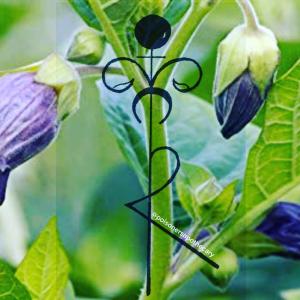
Some sources say that the berries may be added to wine, which can be taken in small amounts for its trance inducing effects, for those desiring prophetic visions and contact with the spirit world. It is said that 1-2 berries will cause minor perceptual changes when ingested, while 3-4 berries act as a psychoactive with aphrodisiac effects. A hallucinogenic dose would be 4-9 berries while anything higher would be fatal in an adult. There are accounts of children being accidentally poisoned after eating just two or three berries.Great care should be taken with any entheogenic preparation and should be prepared withreverence for the powerful plants being invoked, this is especially true for plants of a sinister Saturnian nature. Dilution and gradual increase of dosage starting with a very small amount is the safest way to determine the effects the plant will have on one’s unique body chemistry. Tropane alkaloids can build up in the tissues of the heart, resulting in health when used too frequently. There are much safer ways of employing this plant in ritual, and that is the focus of this work. Ingesting any plant containing poisonous alkaloids is not recommended, and the dosages given are strictly for research purposes. The belladonna alkaloids were responsible for the death of Robert Cochrane a practitioner who devoted much study to this plant.
Belladonna and other solanaceous plants were used to treat many conditions before modern advances in medicine. These plants have also been used for centuries in eastern herbalism before making their way into medieval Europe. For example, Indian Ayurvedic medicine, which has been in practice for thousands of years, utilizes many of these plants. Ayurvedic tradition suggests that a daily dose of Atropa belladonna can be taken medicinally when properly prepared. The suggested daily dosage for powdered leaves is 50-100 mg/day and the powdered root is 25-100 mg. Juice from the leaves may be administered in doses of 1-4 drops taken 2-3 times a day under the instruction of a professional herbalist.
Dioscorides, a Greek physician and pharmacologist whose work De Materia Medica had been the leading pharmacological text for over 1,000 years, wrote extensively on these plants. He recorded that one drachm (3.4 g) of the root infused in wine was enough to bring about hallucinations. Four grams or more would cause death.
This gives us an idea of the unpredictable nature of this plant. On one hand it could be used as an effective analgesic pain reliever and anesthetic, while on the other hand it could easily take one’s life. There are many factors that can cause the alkaloids in this plant to increase, and certain methods of preparation will extract them more effectively than others.
Belladonna’s martial qualities are evidenced in her connection to her namesake Bellona, the Roman goddess of war, and reflected in the plant’s unpredictability. Her Latin name refers to Atropos, one of the three Fates believed responsible for cutting the thread connecting one to the web of life.
Her martial associations with goddesses of war and berserker rage ensure success in offensive magic. In this aspect she is the warrior goddess, Sovereign of the battlefield, the Morrigan who flies above like a Valkyrie collecting souls of the fallen. Belladonna was known as Walkerbeeren (Valkyrie Berry) or Walkerbaum (Valkyrie Tree) in the North. Atropa can be fashioned into a powerful fetish of protection in spiritual warfare and used to empower weapons for physical protection and spiritual battle.
As one of the patron herbs of witchcraft and sorcery, the gifts that this plant has to share are manifold, given only to those who approach her with the reverence and respect that she commands. The powers that her spirit has collected over the centuries take many forms; powers gained from both Pagan practice and medieval folklore. The diabolism perpetuated in the Middle Ages has only served to expand her already vast repertoire of legendary powers. If there was one plant spirit marked as a witch, it would be the spirit of Atropa belladonna. She is a quintessential representation of what it is to be a Witch; marked as an outsider, feared for her dangerous nature and sought out for her powers of glamour and seduction.
The aid of this plant as a magical catalyst is unmatched by few, perhaps only rivaled by her sister Nightshades the Mandrake, Thorn Apple, and Henbane. She is sacred to the goddess Hecate who was so feared and respected as a Titan goddess that when the gods took over Mount Olympus Zeus gave her rule over the sea, sky, and underworld. Like the Queen of Witches, Belladonna holds a similar status as one of the ruling herbs of the poison path.

Coby Michael
About the Author: Coby Michael is a practitioner of the Poison Path of occult herbalism and a cultivator of entheogenic herbs. He contributes to the Pagan Archives at Valdosta University, writes regularly for The House of Twigs, and maintains a blog, Poisoner’s Apothecary, on Patheos Pagan. He teaches classes and online workshops on plant magic, baneful herbs, and traditional witchcraft. He lives in Fort Wayne, Indiana.
https://www.patheos.com/blogs/poisonersapothecary/
The Poison Path Herbal by Coby Michael © 2021 Park Street Press. Printed with permission from the publisher Inner Traditions International. www.InnerTraditions.com
Previous Post

May 28, 2021
The Four Elements of the Wise
Next Post

July 26, 2021 Witch City Tarot & Divination Gathering
Browse Our Archives
Select a Category alchemy astrology Community Outreach and Events Current Events Featured Practitioners Gods and Goddesses green magic Green Witchcraft herbalism History of the Devil luciferian tradition Magic Magic and Ritual Magic and Witchcraft in History Magical Community magical herbalism Medieval Herbalism Metaphysics Modern Witchcraft natal charts natural magic Northern Traditions Occult Art Occult Artifacts Occultism pagan authors Pagan Community Pagan Holidays pagan philosophy Pagan Sightseeing Paganism Personal Practice planetary glyphs planetary symbols Recommended Reading Sabbatic Witchcraft samhain satanism Spells The Armchair The Poison Path Traditional Witchcraft Uncategorized Veneficium wicca witch's practice Witchcraft witches' sabbats
Select a Month December 2022 September 2022 August 2022 July 2022 March 2022 February 2022 January 2022 December 2021 October 2021 September 2021 August 2021 July 2021 May 2021 April 2021 March 2021 January 2021 December 2020 October 2020 September 2020 July 2020 June 2020 May 2020 April 2020 March 2020 February 2020 January 2020 December 2019 November 2019 October 2019 September 2019 August 2019 July 2019 June 2019 May 2019 April 2019 March 2019 February 2019 January 2019 December 2018 November 2018 October 2018 September 2018 August 2018 July 2018 June 2018 May 2018 April 2018 March 2018 February 2018 January 2018 December 2017 November 2017 October 2017 September 2017 August 2017 July 2017 June 2017 May 2017 April 2017 March 2017 February 2017 January 2017 December 2016 November 2016 October 2016 September 2016 August 2016 July 2016 June 2016 May 2016 March 2016 February 2016
Follow Us!
TAKE THE
Religious Wisdom Quiz
True or False: 2 Peter warns that false teachers will secretly introduce destructive heresies.
Select your answer to see how you score.
FALSE TRUE
Related posts from Poisoner's Apothecary

Interview with a Vampyre Witch: Alexis Pharae

Christian Rätsch, Undying Contributions to the Poison Path
Smoke Divination: The Art of Capnomancy
Witch City Tarot Gathering Re-Cap
TRENDING AT PATHEOS Pagan

I was recently chatting with someone on Instagram. She asked me what...

While there are many people who share their results, the end of...

On July 23, I saw Christopher Nolan's The Odyssey which is Homer’s...

As I write this two big events have just finished up. One...

Restoring the Watershed of Divine Love
Perhaps cooperation is not something we manufacture through legislation, ideology, or moral...

Many UUs don’t pray because of bad experiences in a previous religion,...
view all Pagan blogs
Ad-Free & Subscriber Log-In Subscription Support
- About Us
- 2026 Calendar
- Videos
- Podcasts
- Library of World Religions
- Faith In Media Tracker
- Advertise With Us
- Write for Us
- Privacy Policy
- Terms of Service
- Do Not Sell My Data
- Contact Us
- Radiant Digital
- Manage Newsletter Subscriptions
- Unsubscribe From Notifications
- Sitemap
Copyright 2008-2026, Patheos. All rights reserved.
Subscription Support Ad-Free & Subscriber Log-In
Follow Patheos