
BuddhistCatholicContemplativeEvangelicalGeneral ChristianHinduJewishLatter-day SaintMuslimNew VisionsProgressive Christian
Beliefs
- Buddhist
- Catholic
- Contemplative
- Evangelical
- General Christian
- Hindu
- Jewish
- Latter-day Saint
- More Voices
- Muslim
- New Visions
- Pagan
- Progressive Christian
Topics
- Religion News
- Food and Religion
- Sports and Religion
- Religious Art
- Religious Music and Entertainment
- Religious Events
- History and Religion
- Style and Religion
- Politics and Religion
- Women in Religion
- Recreation Outdoors and Religion
- Business Finance and Religion
- Careers Workplace and Religion
- Education and Religion
- Family Parenting and Religion
- Health Fitness and Religion
- Home and Religion
- Relationships and Religion
- Technology and Religion
- Travel and Religion
Columnists
- Buddhist Columnists
- Business Finance and Religion Columnists
- Careers Workplace and Religion Columnists
- Catholic Columnists
- Contemplative Columnists
- Education and Religion Columnists
- Evangelists Columnists
- Family Parenting and Religion Columnists
- General Christian Columnists
- Health Fitness and Religion Columnists
- Hindu Columnists
- History and Religion Columnists
- Home and Religion Columnists
- Jewish Columnists
- More Voices Columnists
- Latter Day Columnists
- Muslim Columnists
- New Visions Columnists
- Nonreligious Columnists
- Pagan Columnists
- Politics and Religion Columnists
- Progressive Columnists
- Recreation Outdoors and Religion Columnists
- Relationships and Religion Columnists
- Religion News Columnists
- Religious Art Columnists
- Religious Events Columnists
- Religious Music and Entertainment Columnists
- Sports and Religion Columnists
- Style and Religion Columnists
- Technology and Religion Columnists
- Travel and Religion Columnists
- Women in Religion Columnists
Resource Library
- 2026 Calendar
- Library of World Religions
- The 100 Most Holy Places on Earth
- Patheos Answers
- Podcasts
- Videos
- Faith Leaders Database
- Anglican Episcopalian
- Bahai
- Baptist
- Buddhism
- Christianity
- Confucianism
- Eastern Orthodoxy
- Hinduism
- Holiness and Pentecostal
- ISKCON
- Islam
- Judaism
- Lutheran
- Methodist
- The Church of Jesus Christ of Latter-day Saints
- New Age
- Paganism
- Presbytarian and Reformed
- Protestantism
- Religion Behind the Scenes
- Roman Catholic
- Scientology
- Shia Islam
- Sikhism
- Sufism
- Sunni Islam
- Taoism
- Zen
- See all religions
Research Tools
 Ad-Free & Subscriber Log-In Subscription Support
Follow Patheos 

- Trending:
- Advent
- |
- Forgiveness
- |
- Thanksgiving
- |
- Election
- |
- Seasonal Holidays
- |
- Marriage
 Poisoner's Apothecary
- Home
- Pagan
- Nightshades: Ointments, Oils and Tinctures
Nightshades: Ointments, Oils and Tinctures
Last updated on: December 31, 2020 at 2:55 pm by Coby Michael Ward
Nightshades: Ointments, Oils and Tinctures 2020-12-31T14:55:36-04:00 Coby Michael Ward
Patheos Explore the world's faith through different perspectives on religion and spirituality! Patheos has the views of the prevalent religions and spiritualities of the world.
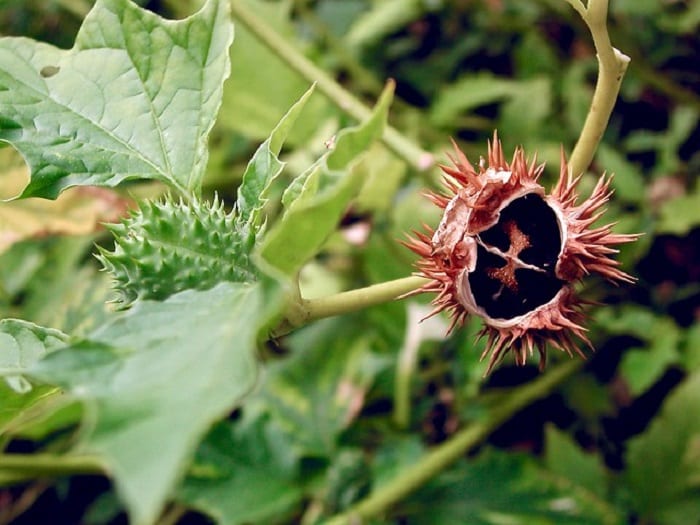
Thornapple. Flickr image.
The Nightshade Family
***DISCLAIMER***The information contained in this article comes from my own personal practice and research. What works for some people will not necessarily work for others. Variations in the chemical makeup of nightshades and the humans using them all contribute to the unpredictable nature of this practice. This information is for research purposes only and should only be enacted upon by those with a familiarity with herbalism, poisonous plants, and safety practices. By putting any of this information into practice you are acknowledging that you are willingly working with plants that are known to be poisonous and understand the risks.
Meet the Cousins
Nightshades are a large and common group of plants. We are almost always nearb one nightshade or another. Ketchup, French fries, eggplant and even cigarettes all contain a member of the Nightshade family. All nightshades are technically poisonous, and this is a VERY loaded term. Poisonous does not always mean deadly, although in the case of Deadly Nightshade, Datura and other more powerful members of the family, it certainly can.
Irritation, stomach upset, and other uncomfortable side effects can be caused by these plants. Some people have what is known as a Nightshade sensitivity similar to gluten intolerance. This requires dietary changes that will improve a person’s quality of life, but means avoiding all foods containing tomatoes, potatoes, etc.
Nightshades have a wide range of physiological effects on the human body. They have been part of the herbal healer’s pharmacopoeia since the most ancient of days. As medicines can relieve pain, act as sedatives and/or stimulants and relieve digestive issues. Plants from the nightshade family have been used to treat things from Parkinson’s to hair loss.

Dangerous Family
The Nightshades that we are interested in contain more power and potential than a tomato. However, they also have the potential to cause much more harm if not used properly. They are plants whose reputations precede them. Deadly Nightshade, Henbane, Datura and Mandrake are known around the world. Stories of their foreboding powers can be found wherever these plants grow.
Interestingly, these plants that are potentially deadly were also some of the most powerful medicines available in the ancient world. Knowledge of their use circulated widely for centuries prior to modern medicine. Plants like this had an elevated status. They were feared for their dark side, valued as medicines and respected as religious tools.
Preparation and administration determine whether they will act as poison, medicine or spiritual ally. This includes the environment, ritual preparations, and whether or not the plant is ingested. Ingesting even small amounts of these plants can be dangerous. Topical application is a safe and effective way to utilize nightshades and avoid some of their more uncomfortable side effects.
It is important, as herbalists, that we are aware of all the options available to us so that we may tailor our formulas to optimize the desired effects of each plant. Certain chemicals extract better in alcohol than in oil. Some chemicals absorb better through the skin, others through ingestion. As witches and alchemists, we also want to take energetics into consideration. The vehicles into which we infuse our herbal preparations also have their own energetics that can aligned with out purpose. Some extractions are more energetically alive, and others inert. All these factors are part of the process of coming to understand these plants along the Poison Path.

Photo from the author. Working with magical inks
Herbal Preparations
One of the first techniques you will learn as an herbalist is an oil infusion. This is one of the simplest and most widely used herbal preparations, where dry plant material is allowed to infuse in a carrier oil over a period of time. Infused oils are easy to make and use, and they have a long shelf life. If you can make an infused oil you can make an ointment.
An ointment is basically an infused oil with beeswax, carnuba wax or animal fat added to create a more solid consistency. It is through these commonly used herbal preparations that the idea of a witches’ originates. Ointments are easy to carry with you and are not as messy as an oil.
An alcohol extraction or tincture is another method that can be employed. Tinctures are made in the same way as an oil infusion. Either fresh or dry plant material (solute) is left to macerate in alcohol (solvent) to fully extract the herb’s chemical constituents.
These are all viable options, each having its benefits and drawbacks. Here are some of the benefits of working with each one as well as precautions and other things to take into consideration when choosing your means of administration.
Oils & Ointments
Oils and ointments are essentially the same creature, the difference being consistency. An infused oil is the basis of any ointment, and they are a little more versatile than ointments which are typically meant for topical application. Oils have a lower viscosity and thus are applied more liberally. The liquid nature of oils is the reason for their versatility. They can be applied topically for their entheogenic effects or they can be used in the manner of a ritual oil. They can also be added to candles or other herbal preparations when making charm bags. Oils can also be incorporated into recipes for sacramental foods taken for their entheogenic properties during ritual.
Ointments allow for a more controlled application and can be made more concentrated than oils allowing for smaller amounts to be applied. Natural pigments can be added to tint the ointment drawing symbols on the body, while simultaneously applying the ointment. This also serves the purpose of showing where the ointment is applied. The same amount of ointment applied to a larger surface area will have more absorption and more effect. For example, rubbing a small amount of ointment all over the chest will be more effective that rubbing it on the inner wrists because the surface area is larger.
Infused oils are the go-to preparation for topical application. Most herbs will easily infuse the oil with their properties when given enough time. This process can also be sped up by using heat. However, the chemicals (alkaloids) that we want to extract from our herbs do not extract into oil as easily as others. This doesn’t mean that infused oils containing nightshades are ineffective! These are very powerful plants and I have made effective oil infusions using just the double boiler method.
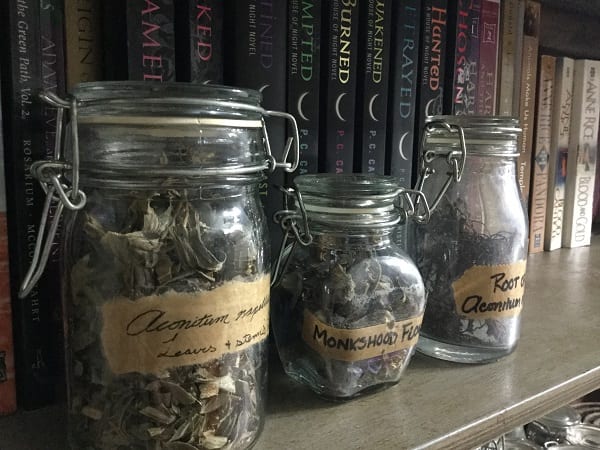
There are other methods that can be incorporated that will allow the alkaloids to be extracted more easily. Adding a small amount of high proof alcohol to dried herbs before adding oil will help to facilitate this process. This is known as the alcohol intermediary method.
Tinctures or alcohol extracts, which will be discussed in the next section can also be added to oils. By using this method we are able to create a more concentrated product, and also get more accurate dosing. By doing this we get the desired qualities of an oil with the potency of a tincture.
All four of the nightshades do well as an infused oil. Mandrake and Henbane make especially good candidates for an oil infusion because they are safer when used topically than other nightshades. They also make wonderful massage oils that are warming and aphrodisiac.
Datura is another herb that is suited for oils and ointments. The main alkaloid in Datura is scopolamine, which is absorbed trans dermally (through the skin) more effectively than other nightshade alkaloids. So through application and chemistry acting in synergy we are able to choose the best option for each herb.

Wikimedia commons.
Tinctures
Tincture making creates powerful botanical extracts using alcohol as a solvent to draw out the plant’s chemical components. Tinctures have an almost indefinite shelf life. They are typically administered by the drop allowing for small amounts of powerful plant medicine to be taken. Interestingly, tinctures can be applied to the skin just like an oil. The alcohol will evaporate, and the plant constituents are absorbed. The ability to administer the tincture drop by drop allows for micro-dosing, and gradually exploring the plant spirit medicine without going overboard.
There is also the option with alcohol extracts to use either fresh or dry plant material. Fresh plant material is more desirable in spagyric alchemy when making tinctures because it retains the life for of the plant.
The tropane alkaloids found in nightshades will extract readily into alcohol. Additional changes to pH can also be made to improve the end result. While tinctures are versatile and effective, they can also be the most dangerous. This is because they are more concentrated and are taken orally.
Alkaloids go through different chemical processes as they are extracted. These chemical processes can also occur when the plant material is dried. Some plants like Henbane and Belladonna may be preferred to be used fresh in the case of tincture making. This is because there are certain alkaloids in the fresh plant material that are more desirable.
In conclusion
Nightshades are powerful spiritual allies regardless of how you incorporate them into your practice. Different preparations are more appropriate at different times of the year, and some may resonate more with you than others. Listen to the plants and your own intuition and do as much research as you possibly can! Physically working with the plants in this way and experiencing how they manifest themselves in these different forms can be a great learning experience.
occult herbalism. green witchcraft
Previous Post

October 6, 2020
The Healing Properties of Baneful Herbs
Next Post

January 4, 2021 Devil's Conjure
Browse Our Archives
Select a Category alchemy astrology Community Outreach and Events Current Events Featured Practitioners Gods and Goddesses green magic Green Witchcraft herbalism History of the Devil luciferian tradition Magic Magic and Ritual Magic and Witchcraft in History Magical Community magical herbalism Medieval Herbalism Metaphysics Modern Witchcraft natal charts natural magic Northern Traditions Occult Art Occult Artifacts Occultism pagan authors Pagan Community Pagan Holidays pagan philosophy Pagan Sightseeing Paganism Personal Practice planetary glyphs planetary symbols Recommended Reading Sabbatic Witchcraft samhain satanism Spells The Armchair The Poison Path Traditional Witchcraft Uncategorized Veneficium wicca witch's practice Witchcraft witches' sabbats
Select a Month December 2022 September 2022 August 2022 July 2022 March 2022 February 2022 January 2022 December 2021 October 2021 September 2021 August 2021 July 2021 May 2021 April 2021 March 2021 January 2021 December 2020 October 2020 September 2020 July 2020 June 2020 May 2020 April 2020 March 2020 February 2020 January 2020 December 2019 November 2019 October 2019 September 2019 August 2019 July 2019 June 2019 May 2019 April 2019 March 2019 February 2019 January 2019 December 2018 November 2018 October 2018 September 2018 August 2018 July 2018 June 2018 May 2018 April 2018 March 2018 February 2018 January 2018 December 2017 November 2017 October 2017 September 2017 August 2017 July 2017 June 2017 May 2017 April 2017 March 2017 February 2017 January 2017 December 2016 November 2016 October 2016 September 2016 August 2016 July 2016 June 2016 May 2016 March 2016 February 2016
Follow Us!
TAKE THE
Religious Wisdom Quiz
Who died at the end of Genesis?
Select your answer to see how you score.
Joseph Reuben Simeon Jacob
Related posts from Poisoner's Apothecary

Interview with a Vampyre Witch: Alexis Pharae

Christian Rätsch, Undying Contributions to the Poison Path
Smoke Divination: The Art of Capnomancy
Flower Essences from the Witch's Garden
TRENDING AT PATHEOS Pagan

To help with the upcoming holiday season, I'm introducing the Holiday Helper...

10 years of the Power Sigil & Moving...
Last week while reorganizing my studio space, I found the sketchbook that...

Why are younger seekers drawn to Paganism and...
One of the things I've noticed the most is that I'm far...

When we talk about Greek religion, we often begin with the dodekatheion—the...

I was recently chatting with someone on Instagram. She asked me what...

On July 23, I saw Christopher Nolan's The Odyssey which is Homer’s...
view all Pagan blogs
Ad-Free & Subscriber Log-In Subscription Support
- About Us
- 2026 Calendar
- Videos
- Podcasts
- Library of World Religions
- Faith In Media Tracker
- Advertise With Us
- Write for Us
- Privacy Policy
- Terms of Service
- Do Not Sell My Data
- Contact Us
- Radiant Digital
- Manage Newsletter Subscriptions
- Unsubscribe From Notifications
- Sitemap
Copyright 2008-2026, Patheos, part of the Radiant Digital network of media brands. All rights reserved.
Subscription Support Ad-Free & Subscriber Log-In
Follow Patheos