
BuddhistCatholicContemplativeEvangelicalGeneral ChristianHinduJewishLatter-day SaintMuslimNew VisionsProgressive Christian
Beliefs
- Buddhist
- Catholic
- Contemplative
- Evangelical
- General Christian
- Hindu
- Jewish
- Latter-day Saint
- More Voices
- Muslim
- New Visions
- Pagan
- Progressive Christian
Topics
- Religion News
- Food and Religion
- Sports and Religion
- Religious Art
- Religious Music and Entertainment
- Religious Events
- History and Religion
- Style and Religion
- Politics and Religion
- Women in Religion
- Recreation Outdoors and Religion
- Business Finance and Religion
- Careers Workplace and Religion
- Education and Religion
- Family Parenting and Religion
- Health Fitness and Religion
- Home and Religion
- Relationships and Religion
- Technology and Religion
- Travel and Religion
Columnists
- Buddhist Columnists
- Business Finance and Religion Columnists
- Careers Workplace and Religion Columnists
- Catholic Columnists
- Contemplative Columnists
- Education and Religion Columnists
- Evangelists Columnists
- Family Parenting and Religion Columnists
- General Christian Columnists
- Health Fitness and Religion Columnists
- Hindu Columnists
- History and Religion Columnists
- Home and Religion Columnists
- Jewish Columnists
- More Voices Columnists
- Latter Day Columnists
- Muslim Columnists
- New Visions Columnists
- Nonreligious Columnists
- Pagan Columnists
- Politics and Religion Columnists
- Progressive Columnists
- Recreation Outdoors and Religion Columnists
- Relationships and Religion Columnists
- Religion News Columnists
- Religious Art Columnists
- Religious Events Columnists
- Religious Music and Entertainment Columnists
- Sports and Religion Columnists
- Style and Religion Columnists
- Technology and Religion Columnists
- Travel and Religion Columnists
- Women in Religion Columnists
Resource Library
- 2026 Calendar
- Library of World Religions
- The 100 Most Holy Places on Earth
- Patheos Answers
- Podcasts
- Videos
- Faith Leaders Database
- Anglican Episcopalian
- Bahai
- Baptist
- Buddhism
- Christianity
- Confucianism
- Eastern Orthodoxy
- Hinduism
- Holiness and Pentecostal
- ISKCON
- Islam
- Judaism
- Lutheran
- Methodist
- The Church of Jesus Christ of Latter-day Saints
- New Age
- Paganism
- Presbytarian and Reformed
- Protestantism
- Religion Behind the Scenes
- Roman Catholic
- Scientology
- Shia Islam
- Sikhism
- Sufism
- Sunni Islam
- Taoism
- Zen
- See all religions
Research Tools
 Ad-Free & Subscriber Log-In Subscription Support
Ad-Free & Subscriber Log-In Subscription Support
Follow Patheos 

- Trending:
- Forgiveness
- |
- Marriage
- |
- Consciousness
- |
- Death Penalty
- |
- Election
- |
- Halloween
 Poisoner's Apothecary
- Home
- Pagan
- Spellcrafting with Baneful Herbs
Spellcrafting with Baneful Herbs
Last updated on: August 20, 2021 at 12:59 pm by Coby Michael Ward
Spellcrafting with Baneful Herbs 2021-08-20T12:59:10-04:00 Coby Michael Ward
Patheos Explore the world's faith through different perspectives on religion and spirituality! Patheos has the views of the prevalent religions and spiritualities of the world.
What are Baneful Herbs?
First and foremost baneful herbs are known for their potential for poisoning. They contain powerful chemicals known as alkaloids that have a powerful effect on human physiology. When used properly they are some of our most powerful medicines, but in the wrong hands; as history has shown, they can be used for the most nefarious of purposes. These powerful botanical toxins are the herb’s defense mechanism against predation, and many myths surround the origins and creation of their baneful natures. However, from a magical perspective there is much more to their oftentimes sinister nature. Plants associated with the shadowy underworld of witches and sorcerers, calling upon their daemonic forces as familiar spirits to do their bidding can be found in cultures around the world.
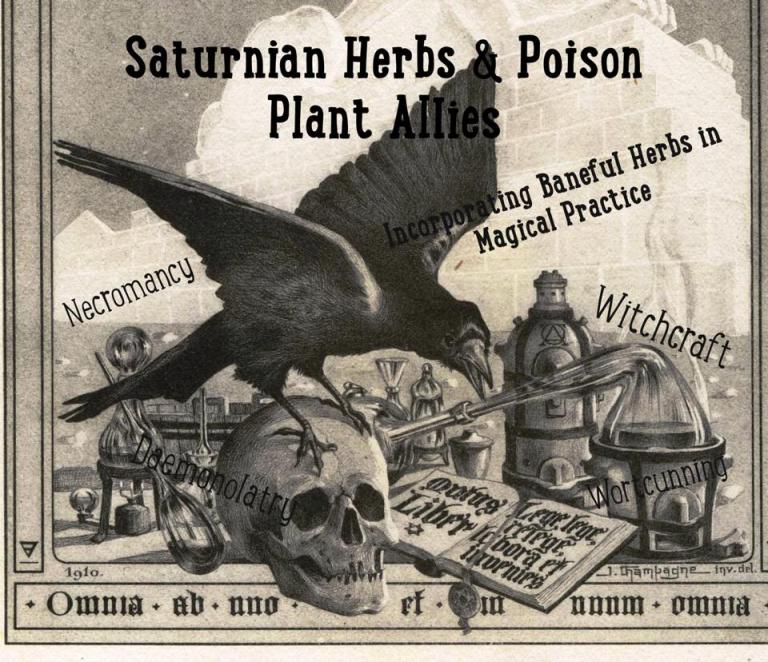
Black Crow. Wikimedia Commons.
Through an understanding of the herbs’ histories, correspondences and folk lore we can engineer more practical applications for enhancing spell craft. There is always an aura of mystery and of danger when working with these allies so closely connected to the Other. Many of them are gatekeepers allowing us to pierce the veil and access eldritch powers for our spells and rituals. Historically these herbs gained their infamous reputations due to their association with poison and witchcraft, which in the ancient world was viewed as one and the same. Many of them can have mind altering properties, and those willing to use them in this way can test their Fate. Those who approach these herbs from a place of reverence are often rewarded with some of the most powerful albeit unsettling experiences.
The daemonic spirits of plants like Mandrake and Deadly Nightshade also make powerful allies and teachers; oftentimes delivering the harshest of lessons. Under the rulership of Saturn they can teach us about resilience and survival, biding our time. As we allow them to work within our lives they slowly but effectively cause the harmful and infectious influences in our lives to rot and fall away. Working with the living plants and their powerful spirits is a long term endeavor, only revealing themselves over time.
However, from a practical perspective; as ingredients for spell work and catalysts for magic these baneful allies can be of immediate use to the green witch or wortcunner. All plants have their specific area of expertise, unique ways in which they can lend a hand in our magical endeavors. Then there are those herbs so steeped in the occult and otherworld, that they are powerful workers of magic independent of our human agenda. Not all magical potentiators are baneful in nature for example Dragon’s Blood, Vervain and Lady’s Mantle are three powerful magical catalysts that are willing to assist us in a wide variety of workings.
There are certain types of magic that call for these powerful allies in particular. Their association with death and their very real potential for poisoning create a powerful paradigm within the human psyche. Those practices most associated with witchcraft such as: speaking to the dead, traveling to the Underworld, hexing, cursing and even love magic are all areas of expertise for baleful spirits of the pharmakon. They are medicine, poison and magic all wrapped into one.
Saturnian Herbs & Poison Plant Allies Online Video Course
I have been working with plants of this sort for nearly ten years and have been teaching physical classes on their chemistry, history and magic. For the first time after multiple requests for an online class I have finally decided to oblige. This class will introduce attendees to some of my favorite plants in this interesting category and will go over some of their history. The main scope of this particular class is the use of Saturnian herbs and Poison Plant allies in spell work, and I will be sharing many of my personal discoveries for their application that I have uncovered over the years that I have worked with these herbs.
Some of the topics covered in this course are as follows:
~Beyond the Greater Malefic an exploration of Saturnian influences
~Poison Plant Allies: forming a relationship with the living plant and it’s daemon
~Mirror Scrying And Spirit Communication
~Activating Second Sight
~Herbs of Wrath: Cursing, Blasting and Contagion Magic
~Astral Weaponry, Invisibility, And Shapeshifting
~Vampiric Plants
~Occultation: Hiding things under Saturnian influence
All of these topics and more will feature the particular plants which are most suited to each category and their practical uses.
Course Access Can be Purchased HERE
Previous Post

December 10, 2019
Saturnian Plants: Defining Boundaries and Defining Boundaries
Next Post

January 29, 2020 Illumination, Inspiration and Imbolc
Browse Our Archives
Select a Category alchemy astrology Community Outreach and Events Current Events Featured Practitioners Gods and Goddesses green magic Green Witchcraft herbalism History of the Devil luciferian tradition Magic Magic and Ritual Magic and Witchcraft in History Magical Community magical herbalism Medieval Herbalism Metaphysics Modern Witchcraft natal charts natural magic Northern Traditions Occult Art Occult Artifacts Occultism pagan authors Pagan Community Pagan Holidays pagan philosophy Pagan Sightseeing Paganism Personal Practice planetary glyphs planetary symbols Recommended Reading Sabbatic Witchcraft samhain satanism Spells The Armchair The Poison Path Traditional Witchcraft Uncategorized Veneficium wicca witch's practice Witchcraft witches' sabbats
Select a Month December 2022 September 2022 August 2022 July 2022 March 2022 February 2022 January 2022 December 2021 October 2021 September 2021 August 2021 July 2021 May 2021 April 2021 March 2021 January 2021 December 2020 October 2020 September 2020 July 2020 June 2020 May 2020 April 2020 March 2020 February 2020 January 2020 December 2019 November 2019 October 2019 September 2019 August 2019 July 2019 June 2019 May 2019 April 2019 March 2019 February 2019 January 2019 December 2018 November 2018 October 2018 September 2018 August 2018 July 2018 June 2018 May 2018 April 2018 March 2018 February 2018 January 2018 December 2017 November 2017 October 2017 September 2017 August 2017 July 2017 June 2017 May 2017 April 2017 March 2017 February 2017 January 2017 December 2016 November 2016 October 2016 September 2016 August 2016 July 2016 June 2016 May 2016 March 2016 February 2016
Follow Us!
TAKE THE
Religious Wisdom Quiz
Which letter encourages believers to "be quick to listen, slow to speak, and slow to anger"?
Select your answer to see how you score.
2 Peter James Romans 1 John
Related posts from Poisoner's Apothecary

Interview with a Vampyre Witch: Alexis Pharae

Christian Rätsch, Undying Contributions to the Poison Path

Smoke Divination: The Art of Capnomancy
Witch City Tarot Gathering Re-Cap
TRENDING AT PATHEOS Pagan

I was recently chatting with someone on Instagram. She asked me what...

While there are many people who share their results, the end of...

On July 23, I saw Christopher Nolan's The Odyssey which is Homer’s...

As I write this two big events have just finished up. One...

Restoring the Watershed of Divine Love
Perhaps cooperation is not something we manufacture through legislation, ideology, or moral...

Many UUs don’t pray because of bad experiences in a previous religion,...
view all Pagan blogs
Ad-Free & Subscriber Log-In Subscription Support
- About Us
- 2026 Calendar
- Videos
- Podcasts
- Library of World Religions
- Faith In Media Tracker
- Advertise With Us
- Write for Us
- Privacy Policy
- Terms of Service
- Do Not Sell My Data
- Contact Us
- Radiant Digital
- Manage Newsletter Subscriptions
- Unsubscribe From Notifications
- Sitemap
Copyright 2008-2026, Patheos. All rights reserved.
Subscription Support Ad-Free & Subscriber Log-In
Follow Patheos