
BuddhistCatholicContemplativeEvangelicalGeneral ChristianHinduJewishLatter-day SaintMuslimNew VisionsProgressive Christian
Beliefs
- Buddhist
- Catholic
- Contemplative
- Evangelical
- General Christian
- Hindu
- Jewish
- Latter-day Saint
- More Voices
- Muslim
- New Visions
- Pagan
- Progressive Christian
Topics
- Religion News
- Food and Religion
- Sports and Religion
- Religious Art
- Religious Music and Entertainment
- Religious Events
- History and Religion
- Style and Religion
- Politics and Religion
- Women in Religion
- Recreation Outdoors and Religion
- Business Finance and Religion
- Careers Workplace and Religion
- Education and Religion
- Family Parenting and Religion
- Health Fitness and Religion
- Home and Religion
- Relationships and Religion
- Technology and Religion
- Travel and Religion
Columnists
- Buddhist Columnists
- Business Finance and Religion Columnists
- Careers Workplace and Religion Columnists
- Catholic Columnists
- Contemplative Columnists
- Education and Religion Columnists
- Evangelists Columnists
- Family Parenting and Religion Columnists
- General Christian Columnists
- Health Fitness and Religion Columnists
- Hindu Columnists
- History and Religion Columnists
- Home and Religion Columnists
- Jewish Columnists
- More Voices Columnists
- Latter Day Columnists
- Muslim Columnists
- New Visions Columnists
- Nonreligious Columnists
- Pagan Columnists
- Politics and Religion Columnists
- Progressive Columnists
- Recreation Outdoors and Religion Columnists
- Relationships and Religion Columnists
- Religion News Columnists
- Religious Art Columnists
- Religious Events Columnists
- Religious Music and Entertainment Columnists
- Sports and Religion Columnists
- Style and Religion Columnists
- Technology and Religion Columnists
- Travel and Religion Columnists
- Women in Religion Columnists
Resource Library
- 2026 Calendar
- Library of World Religions
- The 100 Most Holy Places on Earth
- Patheos Answers
- Podcasts
- Videos
- Faith Leaders Database
- Anglican Episcopalian
- Bahai
- Baptist
- Buddhism
- Christianity
- Confucianism
- Eastern Orthodoxy
- Hinduism
- Holiness and Pentecostal
- ISKCON
- Islam
- Judaism
- Lutheran
- Methodist
- The Church of Jesus Christ of Latter-day Saints
- New Age
- Paganism
- Presbytarian and Reformed
- Protestantism
- Religion Behind the Scenes
- Roman Catholic
- Scientology
- Shia Islam
- Sikhism
- Sufism
- Sunni Islam
- Taoism
- Zen
- See all religions
Research Tools
 Ad-Free & Subscriber Log-In Subscription Support
Ad-Free & Subscriber Log-In Subscription Support
Follow Patheos 

- Trending:
- Forgiveness
- |
- Marriage
- |
- Consciousness
- |
- Death Penalty
- |
- Election
- |
- Halloween
 Poisoner's Apothecary
- Home
- Pagan
- Nightshades All Around Us
Nightshades All Around Us
Last updated on: July 23, 2019 at 9:21 am by Coby Michael Ward
Nightshades All Around Us 2019-07-23T09:21:09-04:00 Coby Michael Ward
Patheos Explore the world's faith through different perspectives on religion and spirituality! Patheos has the views of the prevalent religions and spiritualities of the world.
Personally, there is no group of plants that is more interesting both magickally and chemically than the Nightshades. The Solanaceae are a large and diverse group of plants that provide us with things like tomatoes, peppers, potatoes and eggplant. Even tobacco is a member of the Nightshade family. Nightshades are used by people every day without them even knowing it.
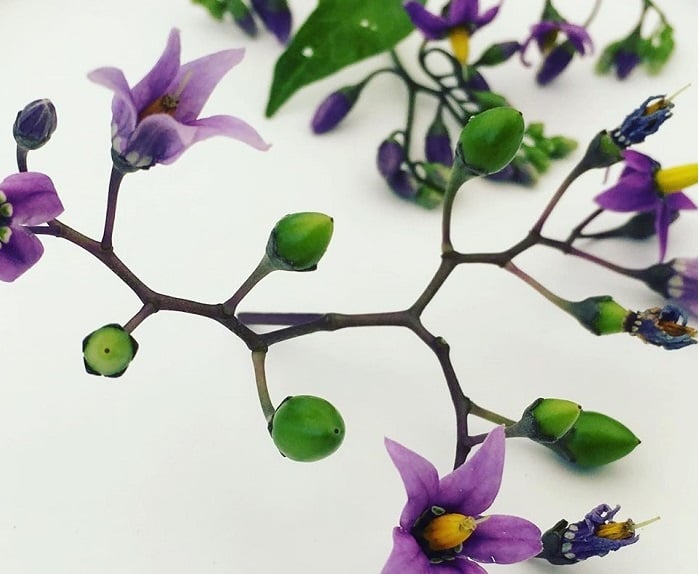
Solanum dulcamara flowers and immature berries Photo by the author
All of the plants within the Nightshade family contain some kind of active alkaloids. Even less poisonous ones like tomatine, solanine and nicotine are in tomato plants, potato plants and tobacco. The more dangerous nightshades like Belladonna, Datura, Henbane and Mandrake contain more potent alkaloids like scopolamine and atropine, which have resulted in death, hospitalization and unpleasant hallucinations. Although they can be poisonous, they are also very valuable medicinally. They are very effective at relieving pain when used topically. They help with gastro-intestinal issues, are effective sedatives and are used as anesthetics.
Nightshades Grow Everywhere!
While the more infamous Nightshades, like Belladonna and Mandrake are very interesting and fun to grow they are either not native to North America or difficult to find, often popping up in unexpected places. They typically are found across central Europe and the Mediterranean, with the exception of Datura, which seems to make its home everywhere.
There are some varieties in the Nightshade family that are widely distributed across North America. You have probably passed them hundreds of times without even realizing it. Plants like Silverleaf Nightshade, Black Nightshade and Woody Nightshade like to grow along fences, in the cracks of side walks, and in the case of Woody (Creeping) Nightshade, inside bushes, hedgerows and other trees.
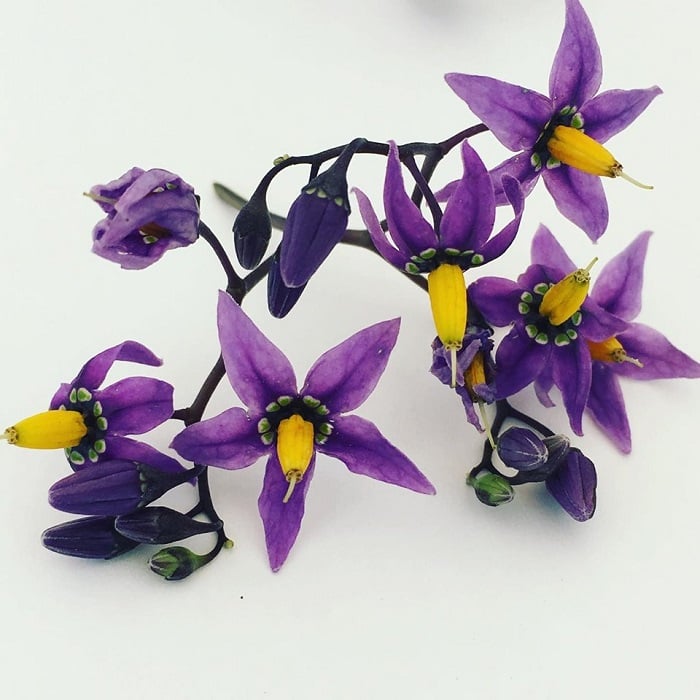
Solanum dulcamara flowers by the author.
Woody Nightshade (Solanum dulcamara)
Solanum dulcamara, is also known as , bittersweet nightshade, bitter nightshade, blue bindweed, Amara Dulcis, climbing nightshade, fellenwort, felonwood, poisonberry, poisonflower, scarlet berry, snakeberry, trailing bittersweet, trailing nightshade, or violet bloom. It is a perennial woodland herb that grows on a semi-woody vine. It can reach up to 12 feet when there is available support. Generally you won’t find this Nightshade growing out in the open by itself.
The roots of this plant spread under ground sending up new plants that quickly take over an area. As the plant matures the stems turn dark, eventually hardening and developing a woody bark, hence the name Woody Nightshade. The mature twigs can be cut and used for magical purposes just like the rest of the plant. They grow rather long giving one the option to cut a wand length stem or shorter pieces for bundles. I love harvesting roots and using them as altar pieces because they maintain the essence of the plant the longest and hold its spirit when regular offerings are maintained. Woody Nightshade is a great herb for binding, but it also helps to integrate the shadow and work with our own spiritual development.
The leaves of this plant are arrowhead shaped and are often, but not always lobed at the base. While the plant is mainly saturnian in nature, it does have some martial qualities to it as well, making it useful in defensive and offensive magick. The berries when unripe are green, and contain the highest concentrations of alkaloids. They contain steroidal alkaloids and saponins. Although, technically poisonous they are not as deadly as berries from Atropa belladonna.
The stems are used medicinally and can be collected in the spring or autumn. They can be used in preparations that are immune suppressive. The steroidal alkaloids have effects which are like cortisone. The plant is also anti-inflammatory, and is known for its use as a skin tonic. Infusions can be made to treat chronic skin conditions such as dermatitis and psoriasis.
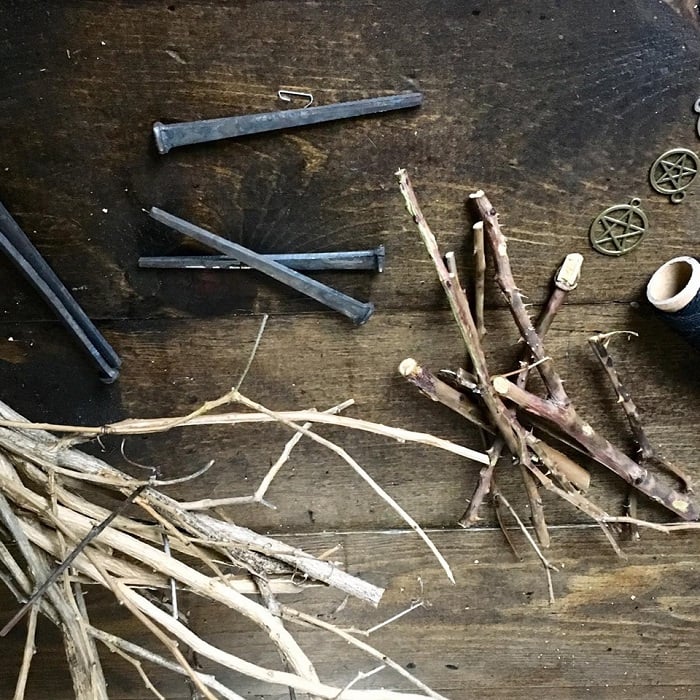
Making protection bundles with woody nightshade, rosewood and iron nails.
Magickal Properties
Woody Nightshade is a great plant to introduce oneself to baneful herbs, as it shares their saturnian influence. The plant was traditionally used to protect against sorcery, lightning and the evil eye. Its long stems can be woven into circlets or garlands. They were once hung around animals necks or placed above doorways for protection. It is considered a fairy herb, and its ripe red fruits can be given as offerings to nature spirits and chthonic female deities.
Since it is a vining plant it is good for binding. The fresh stems are flexible and long enough that they can be used as a cord to bind objects for sympathetic magick. It can be included in incenses and formulas where the more chemically potent witching herbs would be prohibitive.
Solanum dulcamara 1-2-1 Plants
Previous Post
July 2, 2019
Foxglove: Digitalis and the Faery Realm
Next Post

August 1, 2019 Lughnasadh, Lammastide and Sacrificed Gods
Browse Our Archives
Select a Category alchemy astrology Community Outreach and Events Current Events Featured Practitioners Gods and Goddesses green magic Green Witchcraft herbalism History of the Devil luciferian tradition Magic Magic and Ritual Magic and Witchcraft in History Magical Community magical herbalism Medieval Herbalism Metaphysics Modern Witchcraft natal charts natural magic Northern Traditions Occult Art Occult Artifacts Occultism pagan authors Pagan Community Pagan Holidays pagan philosophy Pagan Sightseeing Paganism Personal Practice planetary glyphs planetary symbols Recommended Reading Sabbatic Witchcraft samhain satanism Spells The Armchair The Poison Path Traditional Witchcraft Uncategorized Veneficium wicca witch's practice Witchcraft witches' sabbats
Select a Month December 2022 September 2022 August 2022 July 2022 March 2022 February 2022 January 2022 December 2021 October 2021 September 2021 August 2021 July 2021 May 2021 April 2021 March 2021 January 2021 December 2020 October 2020 September 2020 July 2020 June 2020 May 2020 April 2020 March 2020 February 2020 January 2020 December 2019 November 2019 October 2019 September 2019 August 2019 July 2019 June 2019 May 2019 April 2019 March 2019 February 2019 January 2019 December 2018 November 2018 October 2018 September 2018 August 2018 July 2018 June 2018 May 2018 April 2018 March 2018 February 2018 January 2018 December 2017 November 2017 October 2017 September 2017 August 2017 July 2017 June 2017 May 2017 April 2017 March 2017 February 2017 January 2017 December 2016 November 2016 October 2016 September 2016 August 2016 July 2016 June 2016 May 2016 March 2016 February 2016
Follow Us!
TAKE THE
Religious Wisdom Quiz
What does the name "Jacob" mean?
Select your answer to see how you score.
Friend of God Full of light Supplanter Justified
Related posts from Poisoner's Apothecary

Christian Rätsch, Undying Contributions to the Poison Path

Smoke Divination: The Art of Capnomancy
Flower Essences from the Witch's Garden

TRENDING AT PATHEOS Pagan

I was recently chatting with someone on Instagram. She asked me what...

While there are many people who share their results, the end of...

On July 23, I saw Christopher Nolan's The Odyssey which is Homer’s...

As I write this two big events have just finished up. One...

Restoring the Watershed of Divine Love
Perhaps cooperation is not something we manufacture through legislation, ideology, or moral...

Many UUs don’t pray because of bad experiences in a previous religion,...
view all Pagan blogs
Ad-Free & Subscriber Log-In Subscription Support
- About Us
- 2026 Calendar
- Videos
- Podcasts
- Library of World Religions
- Faith In Media Tracker
- Advertise With Us
- Write for Us
- Privacy Policy
- Terms of Service
- Do Not Sell My Data
- Contact Us
- Radiant Digital
- Manage Newsletter Subscriptions
- Unsubscribe From Notifications
- Sitemap
Copyright 2008-2026, Patheos. All rights reserved.
Subscription Support Ad-Free & Subscriber Log-In
Follow Patheos