
BuddhistCatholicContemplativeEvangelicalGeneral ChristianHinduJewishLatter-day SaintMuslimNew VisionsProgressive Christian
Beliefs
- Buddhist
- Catholic
- Contemplative
- Evangelical
- General Christian
- Hindu
- Jewish
- Latter-day Saint
- More Voices
- Muslim
- New Visions
- Pagan
- Progressive Christian
Topics
- Religion News
- Food and Religion
- Sports and Religion
- Religious Art
- Religious Music and Entertainment
- Religious Events
- History and Religion
- Style and Religion
- Politics and Religion
- Women in Religion
- Recreation Outdoors and Religion
- Business Finance and Religion
- Careers Workplace and Religion
- Education and Religion
- Family Parenting and Religion
- Health Fitness and Religion
- Home and Religion
- Relationships and Religion
- Technology and Religion
- Travel and Religion
Columnists
- Buddhist Columnists
- Business Finance and Religion Columnists
- Careers Workplace and Religion Columnists
- Catholic Columnists
- Contemplative Columnists
- Education and Religion Columnists
- Evangelists Columnists
- Family Parenting and Religion Columnists
- General Christian Columnists
- Health Fitness and Religion Columnists
- Hindu Columnists
- History and Religion Columnists
- Home and Religion Columnists
- Jewish Columnists
- More Voices Columnists
- Latter Day Columnists
- Muslim Columnists
- New Visions Columnists
- Nonreligious Columnists
- Pagan Columnists
- Politics and Religion Columnists
- Progressive Columnists
- Recreation Outdoors and Religion Columnists
- Relationships and Religion Columnists
- Religion News Columnists
- Religious Art Columnists
- Religious Events Columnists
- Religious Music and Entertainment Columnists
- Sports and Religion Columnists
- Style and Religion Columnists
- Technology and Religion Columnists
- Travel and Religion Columnists
- Women in Religion Columnists
Resource Library
- 2026 Calendar
- Library of World Religions
- The 100 Most Holy Places on Earth
- Patheos Answers
- Podcasts
- Videos
- Faith Leaders Database
- Anglican Episcopalian
- Bahai
- Baptist
- Buddhism
- Christianity
- Confucianism
- Eastern Orthodoxy
- Hinduism
- Holiness and Pentecostal
- ISKCON
- Islam
- Judaism
- Lutheran
- Methodist
- The Church of Jesus Christ of Latter-day Saints
- New Age
- Paganism
- Presbytarian and Reformed
- Protestantism
- Religion Behind the Scenes
- Roman Catholic
- Scientology
- Shia Islam
- Sikhism
- Sufism
- Sunni Islam
- Taoism
- Zen
- See all religions
Research Tools
 Ad-Free & Subscriber Log-In Subscription Support
Ad-Free & Subscriber Log-In Subscription Support
Follow Patheos 

- Trending:
- Forgiveness
- |
- Marriage
- |
- Consciousness
- |
- Death Penalty
- |
- Election
- |
- Halloween
 Poisoner's Apothecary
- Home
- Pagan
- On the Nature of Plants: Ramblings of a Poisoner
On the Nature of Plants: Ramblings of a Poisoner
Last updated on: March 11, 2019 at 10:35 pm by Coby Michael Ward
On the Nature of Plants: Ramblings of a Poisoner 2019-03-11T22:35:38-04:00 Coby Michael Ward
Patheos Explore the world's faith through different perspectives on religion and spirituality! Patheos has the views of the prevalent religions and spiritualities of the world.
Mankind has always depended on Nature, turning to the natural world for sustenance, medicine and wisdom. Even in today’s modern world where there is the illusion of human autonomy; without the delicate balance of our ecosystem we are doomed. Ancient man, wanting to understand Nature’s mysteries, was in awe and fear of the world he lived in. One wrong turn and he would be lost in the wilderness. The wrong step would lead him to becoming the prey of a fierce predator. A hand full of the wrong berries would spell his end. The natural world became detrimental to mankind as soon as we no longer viewed ourselves as a part of it. For millennia man lived alongside the rest of the animal kingdom. We have spent most of human history trying to subdue, master and exploit Nature. Taking what she has to offer and using it to benefit ourselves without thinking of the world around us. We created cities and walls of steel and glass to feign our superiority, knowing that if the playing field were equal, we would be overcome by our weakness.
 wood elf. pixnio.com
The wise remember that we are still part of Nature. They know that we are here as caretakers, partners and that through human ingenuity and spirit, we can work together to create a paradise. Plants and fungi were some of the first organisms to populate the Earth, covering the land with primordial forests. There are trees that have lived since the beginning of human civilization. Forests that have seen the rise and fall of empires, are cut down to make room for a growing population. Animistic cultures believe that plants and all things have a spirit. Whether spiritual or genetic, the consciousness that plants have accumulated is spread across the land, remembering a time before human intrusion. Trees, plants and fungi are the wise stewards of the Earth, silently watching, interacting with the animal and mineral kingdoms. Plants communicate in their own way via unseen subterranean networks that we are only just beginning to understand.
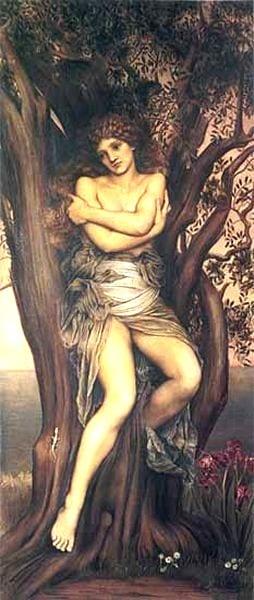
The Dryad. Wikipedia Commons.
The Kingdom Plantae
Plants respond to energy and intention, absorbing subtle currents from their environment. They take in celestial energy from solar rays and the light of the moon, influenced by the stars dancing overhead. Through their roots they are connected to the deepest currents pulsing within the Earth, combining this dark and fertile energy with the great fires of the sky. Plants are Nature’s alchemists, taking light and darkness and transmuting them into life. Through their synthesis this life force is passed on to humans and animals via food and oxygen.
Plants and their characteristics are just as diverse as human beings, if not more so. According to a report from the Royal Botanic Gardens, there are approximately 391,000 species of known plants, not counting algae, lichens and mosses. There are plants that follow the movement of the Sun, plants that feed on decomposing matter and even plants that are carnivorous or parasitic in nature. Plants are neither good nor bad, like anything else in Nature. They perform a specific function, fulfilling their role in the web of life.
Plants are often categorized as those that heal and those that harm. However, plants that are considered poisonous contain some of our most powerful medicines when used properly. The discovery of chemicals such as Atropine from Deadly Nightshade and Digitoxin from Foxglove are still used in medicine today. Even though these plants are poisonous, they can be utilized to heal. It is all about understanding how to harness the particular qualities of a certain plant. They can be great teachers, but they can all cause great suffering.
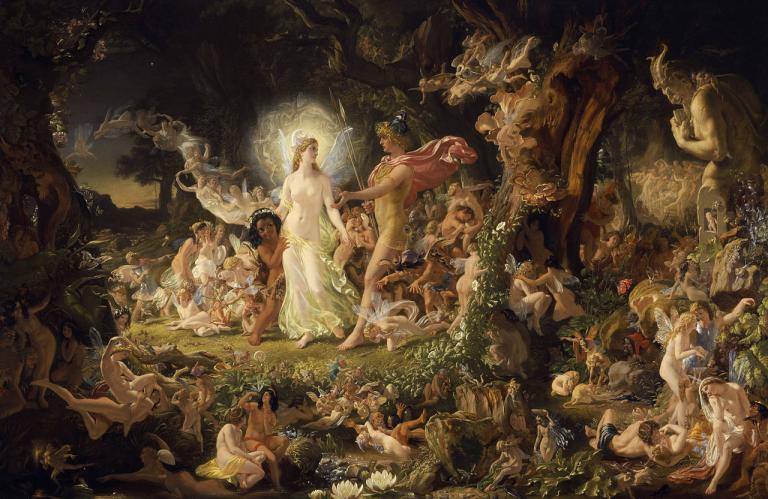
The Quarrel of Oberon and Titania. Sir Joseph Noel Patton. Wikipedia commons.
Poisonous Plants in Magical Herbalism
In magical herbalism many of the plants most associated with witchcraft and the spirit world are overlooked because of their poisonous nature. Authors often focus only on safer alternatives, barely mentioning these important plants. It they are deemed worthy of mention it is only to say “stay away” or to discredit their lore as supertition. These are the infamous plants of the devil and witching herbs, having some of the most pertinent legends and lore for the magical practitioner.
The study of these plants has been pursued by a handful of individuals over the years, and most recently their work is being pursued by others. Entheology and ethnopharmacology are experiencing their own renaissance within the magical community. Commonly referred to as the Poison Path, a term coined by author Dale Pendell, many witches, heathens and modern shamanic practitioners are seeking out these plants and their mysteries. Plants like Mandrake and Wolfsbane, once only showing up in overly complex medieval recipes are now being grown by modern practitioners.
The creation of tinctures, ointments and other herbal formulae are incorporated into rituals for their trance inducing effects. As we continue to work with these plants, we learn more about their spirits. They become spiritual allies and teachers. The Poison Path is a part of the witch’s herbal repetoire, and when applied with reverence and understanding these plants yield powerful results.
As Poisoners we explore the many turns on the Crooked Path of wortcunning and botanical sorcery. By looking at the history, legends and lore of these plants we come to understand them more intimately. Through understanding we can learn new ways to apply them in our spiritual and magical practices as they become indispensable tools of the arte magical.
Previous Post

March 4, 2019
Baneful Herbs & Venefic Witchcraft
Next Post

March 16, 2019 Of the Nightshades: Interview with Ian Vertel
Browse Our Archives
Select a Category alchemy astrology Community Outreach and Events Current Events Featured Practitioners Gods and Goddesses green magic Green Witchcraft herbalism History of the Devil luciferian tradition Magic Magic and Ritual Magic and Witchcraft in History Magical Community magical herbalism Medieval Herbalism Metaphysics Modern Witchcraft natal charts natural magic Northern Traditions Occult Art Occult Artifacts Occultism pagan authors Pagan Community Pagan Holidays pagan philosophy Pagan Sightseeing Paganism Personal Practice planetary glyphs planetary symbols Recommended Reading Sabbatic Witchcraft samhain satanism Spells The Armchair The Poison Path Traditional Witchcraft Uncategorized Veneficium wicca witch's practice Witchcraft witches' sabbats
Select a Month December 2022 September 2022 August 2022 July 2022 March 2022 February 2022 January 2022 December 2021 October 2021 September 2021 August 2021 July 2021 May 2021 April 2021 March 2021 January 2021 December 2020 October 2020 September 2020 July 2020 June 2020 May 2020 April 2020 March 2020 February 2020 January 2020 December 2019 November 2019 October 2019 September 2019 August 2019 July 2019 June 2019 May 2019 April 2019 March 2019 February 2019 January 2019 December 2018 November 2018 October 2018 September 2018 August 2018 July 2018 June 2018 May 2018 April 2018 March 2018 February 2018 January 2018 December 2017 November 2017 October 2017 September 2017 August 2017 July 2017 June 2017 May 2017 April 2017 March 2017 February 2017 January 2017 December 2016 November 2016 October 2016 September 2016 August 2016 July 2016 June 2016 May 2016 March 2016 February 2016
Follow Us!
TAKE THE
Religious Wisdom Quiz
Which prophet's father was a priest named Buzi?
Select your answer to see how you score.
Ezekiel Daniel Hosea Joel
Related posts from Poisoner's Apothecary

Interview with a Vampyre Witch: Alexis Pharae

Christian Rätsch, Undying Contributions to the Poison Path

Smoke Divination: The Art of Capnomancy
Flower Essences from the Witch's Garden
TRENDING AT PATHEOS Pagan

I was recently chatting with someone on Instagram. She asked me what...

While there are many people who share their results, the end of...

On July 23, I saw Christopher Nolan's The Odyssey which is Homer’s...

As I write this two big events have just finished up. One...

Restoring the Watershed of Divine Love
Perhaps cooperation is not something we manufacture through legislation, ideology, or moral...

Many UUs don’t pray because of bad experiences in a previous religion,...
view all Pagan blogs
Ad-Free & Subscriber Log-In Subscription Support
- About Us
- 2026 Calendar
- Videos
- Podcasts
- Library of World Religions
- Faith In Media Tracker
- Advertise With Us
- Write for Us
- Privacy Policy
- Terms of Service
- Do Not Sell My Data
- Contact Us
- Radiant Digital
- Manage Newsletter Subscriptions
- Unsubscribe From Notifications
- Sitemap
Copyright 2008-2026, Patheos. All rights reserved.
Subscription Support Ad-Free & Subscriber Log-In
Follow Patheos