
BuddhistCatholicContemplativeEvangelicalGeneral ChristianHinduJewishLatter-day SaintMuslimNew VisionsProgressive Christian
Beliefs
- Buddhist
- Catholic
- Contemplative
- Evangelical
- General Christian
- Hindu
- Jewish
- Latter-day Saint
- More Voices
- Muslim
- New Visions
- Pagan
- Progressive Christian
Topics
- Religion News
- Food and Religion
- Sports and Religion
- Religious Art
- Religious Music and Entertainment
- Religious Events
- History and Religion
- Style and Religion
- Politics and Religion
- Women in Religion
- Recreation Outdoors and Religion
- Business Finance and Religion
- Careers Workplace and Religion
- Education and Religion
- Family Parenting and Religion
- Health Fitness and Religion
- Home and Religion
- Relationships and Religion
- Technology and Religion
- Travel and Religion
Columnists
- Buddhist Columnists
- Business Finance and Religion Columnists
- Careers Workplace and Religion Columnists
- Catholic Columnists
- Contemplative Columnists
- Education and Religion Columnists
- Evangelists Columnists
- Family Parenting and Religion Columnists
- General Christian Columnists
- Health Fitness and Religion Columnists
- Hindu Columnists
- History and Religion Columnists
- Home and Religion Columnists
- Jewish Columnists
- More Voices Columnists
- Latter Day Columnists
- Muslim Columnists
- New Visions Columnists
- Nonreligious Columnists
- Pagan Columnists
- Politics and Religion Columnists
- Progressive Columnists
- Recreation Outdoors and Religion Columnists
- Relationships and Religion Columnists
- Religion News Columnists
- Religious Art Columnists
- Religious Events Columnists
- Religious Music and Entertainment Columnists
- Sports and Religion Columnists
- Style and Religion Columnists
- Technology and Religion Columnists
- Travel and Religion Columnists
- Women in Religion Columnists
Resource Library
- 2026 Calendar
- Library of World Religions
- The 100 Most Holy Places on Earth
- Patheos Answers
- Podcasts
- Videos
- Faith Leaders Database
- Anglican Episcopalian
- Bahai
- Baptist
- Buddhism
- Christianity
- Confucianism
- Eastern Orthodoxy
- Hinduism
- Holiness and Pentecostal
- ISKCON
- Islam
- Judaism
- Lutheran
- Methodist
- The Church of Jesus Christ of Latter-day Saints
- New Age
- Paganism
- Presbytarian and Reformed
- Protestantism
- Religion Behind the Scenes
- Roman Catholic
- Scientology
- Shia Islam
- Sikhism
- Sufism
- Sunni Islam
- Taoism
- Zen
- See all religions
Research Tools
 Ad-Free & Subscriber Log-In Subscription Support
Ad-Free & Subscriber Log-In Subscription Support
Follow Patheos 

- Trending:
- Forgiveness
- |
- Marriage
- |
- Consciousness
- |
- Death Penalty
- |
- Election
- |
- Halloween
 Poisoner's Apothecary
- Home
- Pagan
- Understanding the Language of Spirit
Understanding the Language of Spirit
Last updated on: January 20, 2019 at 2:44 pm by Coby Michael Ward
Understanding the Language of Spirit 2019-01-20T14:44:25-04:00 Coby Michael Ward
Patheos Explore the world's faith through different perspectives on religion and spirituality! Patheos has the views of the prevalent religions and spiritualities of the world.
Telepathic vs Linguistic Communication
As humans we often imagine how amazing it would be to communicate with one another mentally, using images and emotions to convey our thoughts. Perhaps it would help us to understand one another on a deeper level. Instead of just hearing the words of spoken language and taking them at face value, we would gain deeper insight into the underlying emotions attached to the ideas being expressed. Perhaps its would make communication faster and more efficient.
Instead of having to set the stage to prove a point or tell a story, the details could be communicated in one all encompassing sense of knowing, transmitted instantaneously. This would be amazing, and if it were the norm we would not be the creatures we are now. There would be no poetry and no great masters of the written word. The use of metaphor, meter, and other linguistic tools would never have developed, nor would the works of Shakespeare. If we could communicate with each other instantaneously, using language to paint a picture would be obsolete. Theatre would serve no purpose, as there would be no need to act anything out. There would be no reason for storytelling, as the entirety of it could be communicated in a flash of images and feelings. The sense of completion that we feel when finishing a book or a movie could be automatically conveyed and beginning, middle and end would be one and the same.
 Pixabay
What would seem as an inefficient means of communication compared to telepathy is actually a complex and deeply layered way of connecting with another individual that would otherwise be lost if we communicated solely through our thoughts. Language holds they key to understanding the nuance, history and identity of the culture that speaks it. Its etymology is a trail of breadcrumbs that shows where a group of people comes from, the places they have been, and the other cultures that have come in contact with it. The idea that we have devised a way of conveying the abstract thoughts, emotions and ideas that arise within our psyches is, in my opinion, a much more amazing feat.
We all think in our native language, our dreams are narrated by the language we are most fluent in. The words that we hear before we are born begin to shape the way that we think, and as we grow and become more fluent our language and our thoughts become one and the same. Learning a new language is like learning a new way of thinking. It teaches us to arrange our thoughts in a different way, and allows us to relate to other individuals more intimately. The way things are described, the relationships between one word and another, and the alphabets used create within us new connections that enhance how we communicate in any language.
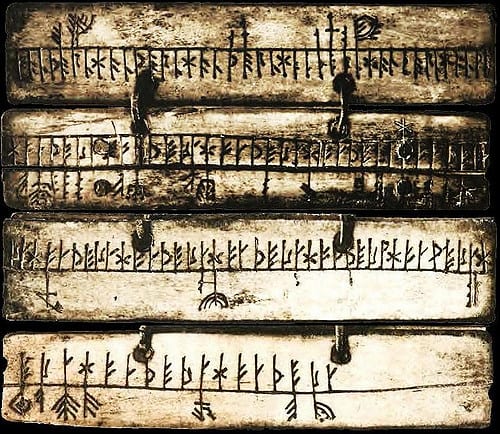 Sami Runic Calendar. Flickr
The Language of the All
I have always been intrigued by different languages. As a young boy I was enchanted by Ancient Egyptian hieroglyphics, seeing the beauty in their mystery and complexity. I would try and invent my own languages or codes, devising new symbols for the English alphabet. In school, I picked up new languages quickly, almost effortlessly. The first foreign language that I learned was Spanish. I also dabbled in German and Russian, but never gained any proficiency. I admired people that could speak multiple languages, switching from one to another. Being able to do so would open so many doors, allowing the individual to move from one place to another without being lost or feeling helpless. I was also interested in symbolism, learning where certain symbols came from and how they came to mean what they do.
As an occultist or student of world religions, you are really both a student of language and history. The two are interwoven and one cannot be understood without the other. Studying different philosophies and religious traditions naturally exposes you to different languages, and rich symbolic traditions. After studying a number of different traditions one begins to see similarities; certain concepts and symbols are repeated. While on the surface they are separated geographically and temporally, their symbolic languages convey many of the same ideas.
There are certain universal truths that are found in these traditions, similar rites of passage and human experience that are shared by us all. While different in language and myth, many of the world’s spiritual philosophies come to the same realizations independently. The principles of creation and destruction; the cycle of life, death and rebirth; the nature of the divine; human inspiration, illumination, and the afterlife can be found in all of the world’s spiritual pursuits. The realization that we all experience the Divine in similar ways, asking similar questions and coming to similar conclusions points to a universal guiding principle. This principle and its different manifestations are contained in the sacred languages of mankind, and the occult symbols that represent these qualities. By learning to understand and “read” these symbols we become more fluent in the language of “the All.”
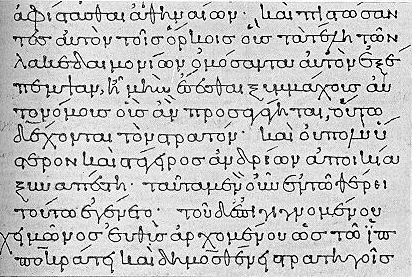 Greek Manuscript Wikipedia Common License.
Magical Symbolism
The traditions of Western Occultism, Witchcraft and pagan religions are rich with symbols and images that make up pieces of this spiritual language. There is not one alphabet but many, not one culture but all cultures that contribute to the tongue of magical language. In magical practice, we are communicating with the spirit world or those divine forces that set our Universe into motions. When we cast spells or do rituals we are weaving the fabric of Fate, working with the very field of existence that holds our reality. The more symbols we can add to our vocabulary the more proficient we become at communicating with the forces that animate our world.
Looking to the oldest languages of Western Civilization we see that the written alphabets of Greek, Hebrew, and Latin; as well as the Germanic and Celtic languages of Europe are not just arbitrary symbols that represent different mouth sounds. They are repositories for esoteric lore. It is not by chance that the letters in these languages are also connected to numbers, which also share a complex relationship with one another. Each letter represents a different idea, and these ideas correspond to one another in varying ways depending on their combination. Words represent some of these combinations, representing more than the sum of their individual parts. Herein, lies the magic.
Various methods are available to creating meaningful combinations of these powerful symbolic associations that can be used to activate certain forces within ourselves and the wider Universe. Numerology, bind-runes, sigils and ideograms are some of the methods that may be employed to communicate complex concepts instantaneously with our psyche and the mind of “the All.” Magical circles, alchemical glyphs and astrological symbols combine to synthesize these concepts like a computer program that can be uploaded to perform a specific task. The beauty is in the many layers of meaning that these symbols contain. Their shape, sound and placement in relation to the rest of the alphabet shows that these are more than just symbols but conscious forces operating in the background at all times.
The more layers of symbolism we can place in our own magical symbols, the more powerful they become. The more complex their associations and the more profound their meaning, the better we are able to integrate them into our subconscious. It is within the subconscious, the void containing all potential that these forces manifest. It is here that we become like the Divine, using “the Word” to create.
Austin Osman Spare, was an adept at creating magical sigils, using his alphabet at desire he created beautiful symbolic works of art. Austin Osman Spare: An introduction to his psycho-magical philosophy
Decoding the Hidden Meanings of the Ancient Greek Alphabet
Previous Post
January 12, 2019
Principles of Correspondence in Plant Magick
Next Post
January 23, 2019 Saturnus: The Old One
Browse Our Archives
Select a Category alchemy astrology Community Outreach and Events Current Events Featured Practitioners Gods and Goddesses green magic Green Witchcraft herbalism History of the Devil luciferian tradition Magic Magic and Ritual Magic and Witchcraft in History Magical Community magical herbalism Medieval Herbalism Metaphysics Modern Witchcraft natal charts natural magic Northern Traditions Occult Art Occult Artifacts Occultism pagan authors Pagan Community Pagan Holidays pagan philosophy Pagan Sightseeing Paganism Personal Practice planetary glyphs planetary symbols Recommended Reading Sabbatic Witchcraft samhain satanism Spells The Armchair The Poison Path Traditional Witchcraft Uncategorized Veneficium wicca witch's practice Witchcraft witches' sabbats
Select a Month December 2022 September 2022 August 2022 July 2022 March 2022 February 2022 January 2022 December 2021 October 2021 September 2021 August 2021 July 2021 May 2021 April 2021 March 2021 January 2021 December 2020 October 2020 September 2020 July 2020 June 2020 May 2020 April 2020 March 2020 February 2020 January 2020 December 2019 November 2019 October 2019 September 2019 August 2019 July 2019 June 2019 May 2019 April 2019 March 2019 February 2019 January 2019 December 2018 November 2018 October 2018 September 2018 August 2018 July 2018 June 2018 May 2018 April 2018 March 2018 February 2018 January 2018 December 2017 November 2017 October 2017 September 2017 August 2017 July 2017 June 2017 May 2017 April 2017 March 2017 February 2017 January 2017 December 2016 November 2016 October 2016 September 2016 August 2016 July 2016 June 2016 May 2016 March 2016 February 2016
Follow Us!
TAKE THE
Religious Wisdom Quiz
True or False: Samson's strength came from his long hair.
Select your answer to see how you score.
FALSE TRUE
Related posts from Poisoner's Apothecary

Interview with a Vampyre Witch: Alexis Pharae

Smoke Divination: The Art of Capnomancy
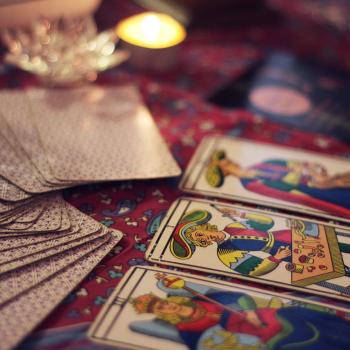
Witch City Tarot Gathering Re-Cap

The Satyr's Kiss by Storm Faerywolf
TRENDING AT PATHEOS Pagan

I was recently chatting with someone on Instagram. She asked me what...

While there are many people who share their results, the end of...

On July 23, I saw Christopher Nolan's The Odyssey which is Homer’s...

As I write this two big events have just finished up. One...

Restoring the Watershed of Divine Love
Perhaps cooperation is not something we manufacture through legislation, ideology, or moral...

Many UUs don’t pray because of bad experiences in a previous religion,...
view all Pagan blogs
Ad-Free & Subscriber Log-In Subscription Support
- About Us
- 2026 Calendar
- Videos
- Podcasts
- Library of World Religions
- Faith In Media Tracker
- Advertise With Us
- Write for Us
- Privacy Policy
- Terms of Service
- Do Not Sell My Data
- Contact Us
- Radiant Digital
- Manage Newsletter Subscriptions
- Unsubscribe From Notifications
- Sitemap
Copyright 2008-2026, Patheos. All rights reserved.
Subscription Support Ad-Free & Subscriber Log-In
Follow Patheos