
BuddhistCatholicContemplativeEvangelicalGeneral ChristianHinduJewishLatter-day SaintMuslimNew VisionsProgressive Christian
Beliefs
- Buddhist
- Catholic
- Contemplative
- Evangelical
- General Christian
- Hindu
- Jewish
- Latter-day Saint
- More Voices
- Muslim
- New Visions
- Pagan
- Progressive Christian
Topics
- Religion News
- Food and Religion
- Sports and Religion
- Religious Art
- Religious Music and Entertainment
- Religious Events
- History and Religion
- Style and Religion
- Politics and Religion
- Women in Religion
- Recreation Outdoors and Religion
- Business Finance and Religion
- Careers Workplace and Religion
- Education and Religion
- Family Parenting and Religion
- Health Fitness and Religion
- Home and Religion
- Relationships and Religion
- Technology and Religion
- Travel and Religion
Columnists
- Buddhist Columnists
- Business Finance and Religion Columnists
- Careers Workplace and Religion Columnists
- Catholic Columnists
- Contemplative Columnists
- Education and Religion Columnists
- Evangelists Columnists
- Family Parenting and Religion Columnists
- General Christian Columnists
- Health Fitness and Religion Columnists
- Hindu Columnists
- History and Religion Columnists
- Home and Religion Columnists
- Jewish Columnists
- More Voices Columnists
- Latter Day Columnists
- Muslim Columnists
- New Visions Columnists
- Nonreligious Columnists
- Pagan Columnists
- Politics and Religion Columnists
- Progressive Columnists
- Recreation Outdoors and Religion Columnists
- Relationships and Religion Columnists
- Religion News Columnists
- Religious Art Columnists
- Religious Events Columnists
- Religious Music and Entertainment Columnists
- Sports and Religion Columnists
- Style and Religion Columnists
- Technology and Religion Columnists
- Travel and Religion Columnists
- Women in Religion Columnists
Resource Library
- 2026 Calendar
- Library of World Religions
- The 100 Most Holy Places on Earth
- Patheos Answers
- Podcasts
- Videos
- Faith Leaders Database
- Anglican Episcopalian
- Bahai
- Baptist
- Buddhism
- Christianity
- Confucianism
- Eastern Orthodoxy
- Hinduism
- Holiness and Pentecostal
- ISKCON
- Islam
- Judaism
- Lutheran
- Methodist
- The Church of Jesus Christ of Latter-day Saints
- New Age
- Paganism
- Presbytarian and Reformed
- Protestantism
- Religion Behind the Scenes
- Roman Catholic
- Scientology
- Shia Islam
- Sikhism
- Sufism
- Sunni Islam
- Taoism
- Zen
- See all religions
Research Tools
 Ad-Free & Subscriber Log-In Subscription Support
Ad-Free & Subscriber Log-In Subscription Support
Follow Patheos 

- Trending:
- Forgiveness
- |
- Marriage
- |
- Consciousness
- |
- Death Penalty
- |
- Election
- |
- Halloween
 Poisoner's Apothecary
- Home
- Pagan
- Individualistic Witchcraft: Is the Craft Atheistic?
Individualistic Witchcraft: Is the Craft Atheistic?
Last updated on: October 1, 2018 at 8:17 pm by Coby Michael Ward
Individualistic Witchcraft: Is the Craft Atheistic? 2018-10-01T20:17:59-04:00 Coby Michael Ward
Patheos Explore the world's faith through different perspectives on religion and spirituality! Patheos has the views of the prevalent religions and spiritualities of the world.
Putting the “I” in W(I)tchcraft
Witchcraft is highly individualistic. Is it more practitioner centered than we give ourselves credit for? Pagan devotional practices are centered around the gods, and are closely aligned with magical practices, one often being called the other. However, the actual craft and art of sorcery is a skill unique to the practitioner like any other artform. This is the individualistic witchcraft that I am talking about. Of course there are those practices that call upon the aid of spirits, deities and other non-physical entities, but are they in fact the real power behind these rituals? I’m not so sure.
The witch and the sorcerer are the initiators of such encounters. We make the call and act as the beacon, providing these beings with a means of manifestation. While spiritual powers can manifest independently of human evocation they are bound to the laws of the spiritual world. Aside from theurgical rites of divine communion, sacrificial offerings and reverence, where the gods are the focal point; operations of sorcerous power hold the gods as witnesses on the periphery. They interact if they so choose, but the impetus for such interactions is initiated by the witch.
Witchcraft, by its traditional definition, is inherently individualistic, as seen in the nature of the Master of Witches, the Horned God and the various luciferian and mercurial spirits of the Craft. Wisdom and power are gained through self-sacrifice and rebirth, whether it be hanging on the World Tree, a Fall from Grace, or any number of shamanic deaths by spiritual fire or reducing oneself to skeleton in the chthonic realms. it is the fierce individual spirit, the desire for power, and for knowledge that drives the work of the traditional witch. We seek liberation through the elevation of the self, not through a code of morals and ethics, but by honing our true will through many symbolic deaths and resurrections.
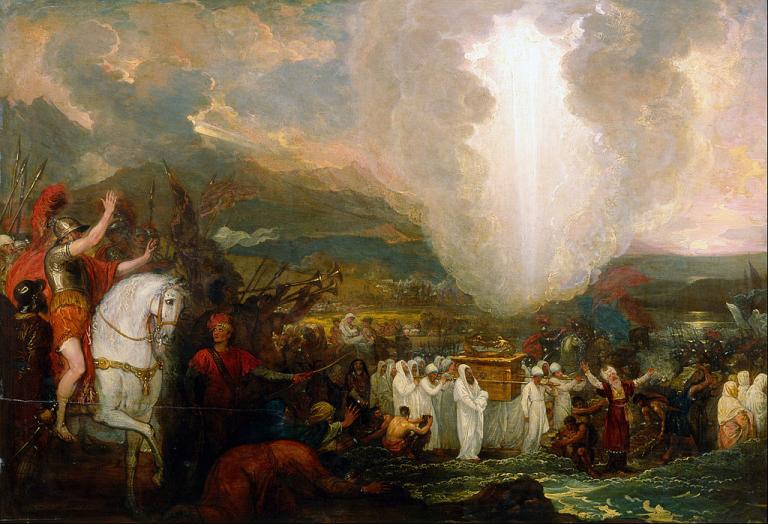 Joshua Crossing the Jordan River With the Ark of the Covenant. Public Domain.
Of Gods, Heroes and Men
Christian doctrine states that man was created in the image of God. Again, I’m not so sure. In the Old Testament we see God appearing in his wrathful glory, as a pillar of fire in the sky and sending plagues upon mankind. As Christianity developed into the political tool of the patriarchal Roman Empire, the writers of the New Testament five him more human-like attributes. He is described as a father, an architect, and a watchmaker. he is described as a lord and king, ruling over his feudal kingdom like the monarchs that embraced him.
In pagan traditions the boundary between men and gods is less easily defined. There are demi-gods and deified ancestors as well as interactions between the gods and humans, Sexual encounters between the two were even commonplace. The gods themselves were known to take human forms. In their stories they are lovers, healers, tricksters and warriors. They have roles as blacksmiths, scribes and huntresses. The gods of pagandom depict the sacred nature of humanity. They represent us at our apex, through our arts and sciences, and embody our darkest and most primal parts.
We are beings of a spiritual nature. We have consciousness, the original and eternal state of the Universe, but we are also physical creatures. We are vessels of this spiritual force, bound up in blood and bone. We are the axiom, “as above, so below,” and we contain the macrocosm. We are intermediary beings, standing at the threshold of spirit and matter, capable of acting in both worlds.
 Cloud Nebula. Goodfreephotos.com
Creators of our Craft
Symbols and rituals contain power because of the meaning we give them. While nature is inherently sacred, we make our own sacred spaces because we are of both worlds and during ritual we are uniting the two so that we make work in them simultaneously, thereby acting in our true nature. Our tools are an extension of our power, representations of the currents that flow within us. They are physical manifestations of what we already carry within. While these forces exist independently of us, we are the ones that shape them, creating new forms.
The ebb and flow of the seasons, the waxing and waning tides of the Sun and Moon are eternal and undeniable. However, the emphasis placed on specific days of the week and their planetary correspondence is based on an arbitrary set of symbolic associations that only exist because we deem it so. The succession of days named for the seven planets of the ancient world are the same cycle of light and darkness that follows the greater cycle of the solar year. The ancient Celts began their day when the Sun set. Beginning each day in darkness just as the Universe itself began.
The calendars of the ancient world were based on the phases of the Moon. Each month began with the waxing crescent. The lunar year was usually 10 or 11 days short of the solar year, and would quickly become misaligned with the seasons. There were different techniques of adjusting to this fluctuation. The first Roman Calendars followed a lunar model, and in 46 BCE the Julian calendar, named for Julius Caesar was proposed. It was later replaced by the Gregorian calendar that we still use today. Adopted in 1582 during the papacy of Pope Gregory XIII. Currently, the Julian calendar is 13 days behind the Gregorian calendar and the disparity will only continue to increase. Not only is the calendar very different than it was during pre-Christian times; the sun’s movement through the signs of the zodiac is also changing. Some astrologers have even adopted the use of a 13th sign, and planets not discovered until the modern period.
The naming of dates is a human concept used to measure the relationship between events that occurred in the past with the present age, and gives us a point of perspective as we progress through time. This is how we measure our place in the cosmos. It has been discovered that we live in a relative Universe, and that even space and time are subjectively based on velocity, distance and gravity.
Whatever the case, our Craft is an intimate and personal thing often kept secret or shared only with a few close individuals. We are the source of our power, the spark that ignites our magical world, and we must reach deeply into ourselves and into the spirit world and hang on to that which we hold sacred. Our power and our belief is something that no one else can diminish or take from us. We should remember that we are the one’s who chose to stray from the flock of mainstream thought and strike out on a journey of individual discovery and empowerment.
Previous Post

September 17, 2018
Halegmonath: the "Holy Month" of Mabon
Next Post

October 15, 2018 Samhain: Honoring Ancestors of Craft and Tradition
Browse Our Archives
Select a Category alchemy astrology Community Outreach and Events Current Events Featured Practitioners Gods and Goddesses green magic Green Witchcraft herbalism History of the Devil luciferian tradition Magic Magic and Ritual Magic and Witchcraft in History Magical Community magical herbalism Medieval Herbalism Metaphysics Modern Witchcraft natal charts natural magic Northern Traditions Occult Art Occult Artifacts Occultism pagan authors Pagan Community Pagan Holidays pagan philosophy Pagan Sightseeing Paganism Personal Practice planetary glyphs planetary symbols Recommended Reading Sabbatic Witchcraft samhain satanism Spells The Armchair The Poison Path Traditional Witchcraft Uncategorized Veneficium wicca witch's practice Witchcraft witches' sabbats
Select a Month December 2022 September 2022 August 2022 July 2022 March 2022 February 2022 January 2022 December 2021 October 2021 September 2021 August 2021 July 2021 May 2021 April 2021 March 2021 January 2021 December 2020 October 2020 September 2020 July 2020 June 2020 May 2020 April 2020 March 2020 February 2020 January 2020 December 2019 November 2019 October 2019 September 2019 August 2019 July 2019 June 2019 May 2019 April 2019 March 2019 February 2019 January 2019 December 2018 November 2018 October 2018 September 2018 August 2018 July 2018 June 2018 May 2018 April 2018 March 2018 February 2018 January 2018 December 2017 November 2017 October 2017 September 2017 August 2017 July 2017 June 2017 May 2017 April 2017 March 2017 February 2017 January 2017 December 2016 November 2016 October 2016 September 2016 August 2016 July 2016 June 2016 May 2016 March 2016 February 2016
Follow Us!
TAKE THE
Religious Wisdom Quiz
Who was the first Nazarite?
Select your answer to see how you score.
Samson Samuel Eli David
Related posts from Poisoner's Apothecary

Interview with a Vampyre Witch: Alexis Pharae
Smoke Divination: The Art of Capnomancy
Witch City Tarot Gathering Re-Cap

The Satyr's Kiss by Storm Faerywolf
TRENDING AT PATHEOS Pagan

I was recently chatting with someone on Instagram. She asked me what...

While there are many people who share their results, the end of...

On July 23, I saw Christopher Nolan's The Odyssey which is Homer’s...

As I write this two big events have just finished up. One...

Restoring the Watershed of Divine Love
Perhaps cooperation is not something we manufacture through legislation, ideology, or moral...

Many UUs don’t pray because of bad experiences in a previous religion,...
view all Pagan blogs
Ad-Free & Subscriber Log-In Subscription Support
- About Us
- 2026 Calendar
- Videos
- Podcasts
- Library of World Religions
- Faith In Media Tracker
- Advertise With Us
- Write for Us
- Privacy Policy
- Terms of Service
- Do Not Sell My Data
- Contact Us
- Radiant Digital
- Manage Newsletter Subscriptions
- Unsubscribe From Notifications
- Sitemap
Copyright 2008-2026, Patheos. All rights reserved.
Subscription Support Ad-Free & Subscriber Log-In
Follow Patheos