
BuddhistCatholicContemplativeEvangelicalGeneral ChristianHinduJewishLatter-day SaintMuslimNew VisionsProgressive Christian
Beliefs
- Buddhist
- Catholic
- Contemplative
- Evangelical
- General Christian
- Hindu
- Jewish
- Latter-day Saint
- More Voices
- Muslim
- New Visions
- Pagan
- Progressive Christian
Topics
- Religion News
- Food and Religion
- Sports and Religion
- Religious Art
- Religious Music and Entertainment
- Religious Events
- History and Religion
- Style and Religion
- Politics and Religion
- Women in Religion
- Recreation Outdoors and Religion
- Business Finance and Religion
- Careers Workplace and Religion
- Education and Religion
- Family Parenting and Religion
- Health Fitness and Religion
- Home and Religion
- Relationships and Religion
- Technology and Religion
- Travel and Religion
Columnists
- Buddhist Columnists
- Business Finance and Religion Columnists
- Careers Workplace and Religion Columnists
- Catholic Columnists
- Contemplative Columnists
- Education and Religion Columnists
- Evangelists Columnists
- Family Parenting and Religion Columnists
- General Christian Columnists
- Health Fitness and Religion Columnists
- Hindu Columnists
- History and Religion Columnists
- Home and Religion Columnists
- Jewish Columnists
- More Voices Columnists
- Latter Day Columnists
- Muslim Columnists
- New Visions Columnists
- Nonreligious Columnists
- Pagan Columnists
- Politics and Religion Columnists
- Progressive Columnists
- Recreation Outdoors and Religion Columnists
- Relationships and Religion Columnists
- Religion News Columnists
- Religious Art Columnists
- Religious Events Columnists
- Religious Music and Entertainment Columnists
- Sports and Religion Columnists
- Style and Religion Columnists
- Technology and Religion Columnists
- Travel and Religion Columnists
- Women in Religion Columnists
Resource Library
- 2026 Calendar
- Library of World Religions
- The 100 Most Holy Places on Earth
- Patheos Answers
- Podcasts
- Videos
- Faith Leaders Database
- Anglican Episcopalian
- Bahai
- Baptist
- Buddhism
- Christianity
- Confucianism
- Eastern Orthodoxy
- Hinduism
- Holiness and Pentecostal
- ISKCON
- Islam
- Judaism
- Lutheran
- Methodist
- The Church of Jesus Christ of Latter-day Saints
- New Age
- Paganism
- Presbytarian and Reformed
- Protestantism
- Religion Behind the Scenes
- Roman Catholic
- Scientology
- Shia Islam
- Sikhism
- Sufism
- Sunni Islam
- Taoism
- Zen
- See all religions
Research Tools
 Ad-Free & Subscriber Log-In Subscription Support
Ad-Free & Subscriber Log-In Subscription Support
Follow Patheos 

- Trending:
- Forgiveness
- |
- Marriage
- |
- Consciousness
- |
- Death Penalty
- |
- Election
- |
- Halloween
 Poisoner's Apothecary
- Home
- Pagan
- The Astrological Importance of Lughnasadh
The Astrological Importance of Lughnasadh
Last updated on: August 1, 2019 at 10:29 pm by Coby Michael Ward
The Astrological Importance of Lughnasadh 2019-08-01T22:29:50-04:00 Coby Michael Ward
Patheos Explore the world's faith through different perspectives on religion and spirituality! Patheos has the views of the prevalent religions and spiritualities of the world.
The Fire Festival of Summer
The festival of Lughnasadh, later known as Lammas, is one of the four grand sabbats of witchcraft traditions, and one of the four sacred fire festivals of the Celtic peoples also celebrated by modern Pagans. The four festivals all have fire playing a central role in some way. Beltane and Samhain, the high holy days of modern witchcraft were traditionally centered around large bonfires or balefires of a sacrificial or celebratory nature. During Imbolc, or Candlemas one of the only festivals frequently celebrated indoors we see the great fire and coming sun represented by candle flame. Lughnasadh is directly across the wheel from Imbolc and during the hot-dry summer the fire of the Sun is already manifest in the sky above. Sun disks or fire wheels were also used to symbolize the solar rays of the sun, often rolled downhill in representation of the Sun’s descent over the horizon.
Summer begins with the sign of Cancer, one of the four cardinal signs that initiate each season. The sun moves in to Cancer around June 21st-22nd and remains until moving in to Leo around July 22nd. Leo is the fixed sign of the summertime, falling between cardinal Cancer and mutable Virgo. As a fixed sign, Leo is one of four pillars or elemental foundations around which the zodiac is structured. As the mid-point of the season it represents the peak of that season’s energy.
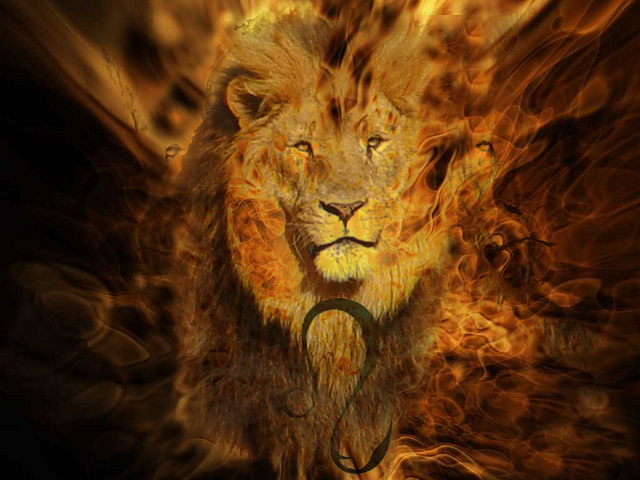 Leo. Kenyell Walker. Flickr.com
The Holy Days as Elemental Gateways
The equinoxes and solstices represent the climax and descent of the Sun’s power over the course of the year while the seasons represent the ebb and flow of elemental energy within that year. When the Sun moves in to Leo it begins the mid-point of the three summer signs. Lughnasadh marks the mid-point within a mid-point, at 15 degrees Leo it is the halfway point between the 30 degrees of the Sign.
Midpoints or in-between times have always had special significance to esoteric belief systems and nature based traditions. They are just as significant to the practice of magic and astrology. The solstices and equinoxes are gateways of solar energy affecting effecting the spiritual tides on planet Earth. We can look at the four gateways of the fixed signs as gateways of elemental energy. While the Sun occupies each elemental gateway in its fixed sign we can access the purest manifestation of that energy. In Vedic astrology the mid-point at each of the four fixed signs is known as the avatar point. Avatars are advanced celestial beings, one named for each of the visible planets and the Sun and Moon. When a planet or the Sun occupies and avatar point it gives us an opportunity to connect with and activate that particular energy.
The Creative Energy of the Sun
When the Sun occupies this point in its ruling Sign Leo we have access to the powerful creative forces of creativity and inspiration that are activated by this double fire combination. The Sun represents our individuality and personality represented by how we show ourselves to the world. Leo is a sign of creativity, vitality, the arts, and self-confidence.
By connecting with the god Lugh, whom this holy day is named for we can draw inspiration and energy that can be channeled into our creative endeavors. Lugh is the master of all arts and is part of an archetype of deities that were seen as teachers of mankind. There are many gods and goddesses that fit within this category of divine inspiration and illumination, who acted as patrons of mankind bringing us their own unique talents.
It is interesting that this time of year is a popular time for outdoor festivals, art shows, concerts and carnivals. In the middle ages this was an opportunity for the artisan guilds to display their talents and showcase their wares. Just like we see today with the popular farmer’s markets, and artisans who get together and set up booths to sell their handmade crafts; the craftsmen of the middle ages would get together and decorate their shops and stalls to present their handiwork.
The Tree of Fire and Inspiration
This is a time of knowledge, inspiration and illumination. Odin sought such knowledge when he hung himself from Yggdrasil, the World Tree, and Ash tree. The Ash is a sacred tree to a number of Celtic, Germanic and Nordic traditions, associated with the creation of mankind. It is connected to fire and the Sun, and appropriately a sacred tree of the god Lugh. Working with the Ash is appropriate this time of year. It was known for its strength and durability and was used to make many tools and weapons. It was said to be the wood used to make Odin’s spear and was also used to fashion the staffs of druids who used it as a portable representation of the World Tree. These staffs would be used to travel to the realms of earth and sky. It is also a superior word for building fires, its Latin name Fraxinus means “firelight.”
During this time of year, honor the sacred fire and the Ash tree. Thank the gods of Arte and inspiration for their many gifts, and channel the fiery energy of this time of year into your own creative endeavors. The practice of magic is an art and its patrons also fall within this category.

About Coby Michael Ward
I am a scholar by nature, ever curious, my studies continue to lead me into new and exciting directions. I consider my spiritual path that of a Modern Pagan, the definition of which is constantly evolving. I majored in Religious Studies with a focus on the pre-Christian traditions of Europe and the history of Christianity in its relation to the evolution of magic. My main area of interest has always been magic, witchcraft and occultism, and the historical sources that have contributed to its development in western esoteric traditions. My personal practice is a land-centered animistic practice rooted in European Paganism, including an exploration of classical witchcraft. The various branches of what has come to be known as "traditional witchcraft" includes imagery of the medieval witches' Sabbath, the folk practices of country-dwelling people, and the application of plants traditionally associated with witches and the spirits that ally themselves with them. The use of these plants in spirit work, soul flight, trance and spell craft has been called the Crooked Way, the Poison Path, and Esoteric Herbalism; and it consists of a collection of historical folk lore combined with modern occult practices and medieval alchemy producing a potent synthesis of practice. One cannot walk the Path of the Poisoner without coming into contact with the Old One, who is the horned master of the wild, teacher of the arcane arts and his partner the Witch Queen ruler of the other side and embodiment of the sovereignty of the Land. You can read more about the author here.
Previous Post

July 23, 2018
This Is Witchcraft: That Which Cannot Be Named
Next Post
August 10, 2018 The Practice of Esoteric Herbalism
Browse Our Archives
Select a Category alchemy astrology Community Outreach and Events Current Events Featured Practitioners Gods and Goddesses green magic Green Witchcraft herbalism History of the Devil luciferian tradition Magic Magic and Ritual Magic and Witchcraft in History Magical Community magical herbalism Medieval Herbalism Metaphysics Modern Witchcraft natal charts natural magic Northern Traditions Occult Art Occult Artifacts Occultism pagan authors Pagan Community Pagan Holidays pagan philosophy Pagan Sightseeing Paganism Personal Practice planetary glyphs planetary symbols Recommended Reading Sabbatic Witchcraft samhain satanism Spells The Armchair The Poison Path Traditional Witchcraft Uncategorized Veneficium wicca witch's practice Witchcraft witches' sabbats
Select a Month December 2022 September 2022 August 2022 July 2022 March 2022 February 2022 January 2022 December 2021 October 2021 September 2021 August 2021 July 2021 May 2021 April 2021 March 2021 January 2021 December 2020 October 2020 September 2020 July 2020 June 2020 May 2020 April 2020 March 2020 February 2020 January 2020 December 2019 November 2019 October 2019 September 2019 August 2019 July 2019 June 2019 May 2019 April 2019 March 2019 February 2019 January 2019 December 2018 November 2018 October 2018 September 2018 August 2018 July 2018 June 2018 May 2018 April 2018 March 2018 February 2018 January 2018 December 2017 November 2017 October 2017 September 2017 August 2017 July 2017 June 2017 May 2017 April 2017 March 2017 February 2017 January 2017 December 2016 November 2016 October 2016 September 2016 August 2016 July 2016 June 2016 May 2016 March 2016 February 2016
Follow Us!
TAKE THE
Religious Wisdom Quiz
Who cried at the tomb of Lazarus?
Select your answer to see how you score.
John Jesus Peter David
Related posts from Poisoner's Apothecary

Interview with a Vampyre Witch: Alexis Pharae
Christian Rätsch, Undying Contributions to the Poison Path
Smoke Divination: The Art of Capnomancy
Witch City Tarot Gathering Re-Cap
TRENDING AT PATHEOS Pagan

When we talk about Greek religion, we often begin with the dodekatheion—the...

I was recently chatting with someone on Instagram. She asked me what...

While there are many people who share their results, the end of...

On July 23, I saw Christopher Nolan's The Odyssey which is Homer’s...

As I write this two big events have just finished up. One...

Restoring the Watershed of Divine Love
Perhaps cooperation is not something we manufacture through legislation, ideology, or moral...
view all Pagan blogs
Ad-Free & Subscriber Log-In Subscription Support
- About Us
- 2026 Calendar
- Videos
- Podcasts
- Library of World Religions
- Faith In Media Tracker
- Advertise With Us
- Write for Us
- Privacy Policy
- Terms of Service
- Do Not Sell My Data
- Contact Us
- Radiant Digital
- Manage Newsletter Subscriptions
- Unsubscribe From Notifications
- Sitemap
Copyright 2008-2026, Patheos. All rights reserved.
Subscription Support Ad-Free & Subscriber Log-In
Follow Patheos