
BuddhistCatholicContemplativeEvangelicalGeneral ChristianHinduJewishLatter-day SaintMuslimNew VisionsProgressive Christian
Beliefs
- Buddhist
- Catholic
- Contemplative
- Evangelical
- General Christian
- Hindu
- Jewish
- Latter-day Saint
- More Voices
- Muslim
- New Visions
- Pagan
- Progressive Christian
Topics
- Religion News
- Food and Religion
- Sports and Religion
- Religious Art
- Religious Music and Entertainment
- Religious Events
- History and Religion
- Style and Religion
- Politics and Religion
- Women in Religion
- Recreation Outdoors and Religion
- Business Finance and Religion
- Careers Workplace and Religion
- Education and Religion
- Family Parenting and Religion
- Health Fitness and Religion
- Home and Religion
- Relationships and Religion
- Technology and Religion
- Travel and Religion
Columnists
- Buddhist Columnists
- Business Finance and Religion Columnists
- Careers Workplace and Religion Columnists
- Catholic Columnists
- Contemplative Columnists
- Education and Religion Columnists
- Evangelists Columnists
- Family Parenting and Religion Columnists
- General Christian Columnists
- Health Fitness and Religion Columnists
- Hindu Columnists
- History and Religion Columnists
- Home and Religion Columnists
- Jewish Columnists
- More Voices Columnists
- Latter Day Columnists
- Muslim Columnists
- New Visions Columnists
- Nonreligious Columnists
- Pagan Columnists
- Politics and Religion Columnists
- Progressive Columnists
- Recreation Outdoors and Religion Columnists
- Relationships and Religion Columnists
- Religion News Columnists
- Religious Art Columnists
- Religious Events Columnists
- Religious Music and Entertainment Columnists
- Sports and Religion Columnists
- Style and Religion Columnists
- Technology and Religion Columnists
- Travel and Religion Columnists
- Women in Religion Columnists
Resource Library
- 2026 Calendar
- Library of World Religions
- The 100 Most Holy Places on Earth
- Patheos Answers
- Podcasts
- Videos
- Faith Leaders Database
- Anglican Episcopalian
- Bahai
- Baptist
- Buddhism
- Christianity
- Confucianism
- Eastern Orthodoxy
- Hinduism
- Holiness and Pentecostal
- ISKCON
- Islam
- Judaism
- Lutheran
- Methodist
- The Church of Jesus Christ of Latter-day Saints
- New Age
- Paganism
- Presbytarian and Reformed
- Protestantism
- Religion Behind the Scenes
- Roman Catholic
- Scientology
- Shia Islam
- Sikhism
- Sufism
- Sunni Islam
- Taoism
- Zen
- See all religions
Research Tools
 Ad-Free & Subscriber Log-In Subscription Support
Ad-Free & Subscriber Log-In Subscription Support
Follow Patheos 

- Trending:
- Forgiveness
- |
- Marriage
- |
- Consciousness
- |
- Death Penalty
- |
- Election
- |
- Halloween
 Poisoner's Apothecary
- Home
- Pagan
- Tredara: A Place for Spirits
Tredara: A Place for Spirits
Last updated on: February 4, 2018 at 10:48 am by Coby Michael Ward
Tredara: A Place for Spirits 2018-02-04T10:48:05-04:00 Coby Michael Ward
Patheos Explore the world's faith through different perspectives on religion and spirituality! Patheos has the views of the prevalent religions and spiritualities of the world.
A Sanctuary for Pagans and Polytheists
The grounds of Tredara, is not only home to many local land spirits and sacred sites, but also the home of friends and colleagues Ian Corrigan and Liafal. Both longtime members of the wider Pagan community, specifically Ár nDraíocht Féin: A Druid Fellowship. The site of Tredara is located inconspicuously in Northeastern Ohio near Lake Erie. It is a private and wooded 17-acres of land dedicated to the practice of nature worship, magic and honoring the gods. The 17-acre piece of land is located in a town called Madison, which has a population just over 3,000 as of 2016.
The Tredara Hearth Society is a collection of volunteers and other dedicated individuals who have worked to bring this sacred space to the wider Pagan community. They are an organization committed to modern Neo-Paganism and natural religion. Through their work they have succeeded in bringing this Pagan Worship and Cultural Center to manifestation. We are blessed to live in a time again where we can come together and worship outdoors without fear of being accused of heresy or worse. For decades leaders in our movement have fought to dispel negative stereotypes surrounding nature based religion through education and outreach. With the advent of the internet and so many amazing publications over the past 40 years have added new layers of depth to our practice, and have given us the tools to better define who we are.
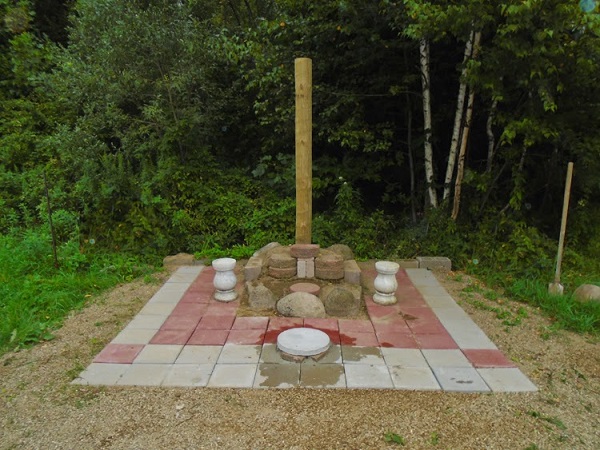
Completed Nemeton and Capstone. Photo used with permission intothemound.blogspot.com
The Shrines of Tredara
In Mr. Corrigan’s particular branch of druidry a conventional triadic cosmology is used to divide the types of spirits that are honored. Very similar to the divisions within other cosmologies, this triune categorization of ancestors, gods, and land spirits is common and instinctual to many practitioners. Thus, the shrines of Tredara are designated by the same distinctions, resulting in a mound shrine for the dead, a classical nemeton for the gods, and a Tricephallic spirit totem for the landwights.
Tredara is a spiritual retreat and a natural sanctuary. Well kept glades, groves and greenery line paths that intersect at various crossroads and lead to the shrines around the site. The land itself being pre-conscecrated and blessed through ritual preparations is a haven for nature’s multitude of beings. Each sacred site is a place of power placed with intention and intuition, further ritual and ceremony prepares each plot for the shrine to be built. Using traditional designs and classical techniques of construction these places of devotion and reflection have that eldritch pagan feel, as if they had always been part of the land. These altar spaces are not only build on the land, but into it as well. Capstones hide the openings of offering shafts built into the ground below so that the spirits of the Underworld will better receive our offerings and arcane secrets are held buried below the land. Lots of planning and traditional building techniques were utilized in the construction of these ritual spaces. By interring sacred objects and offerings in the ground during the building process they follow in the footsteps of our ancestors.
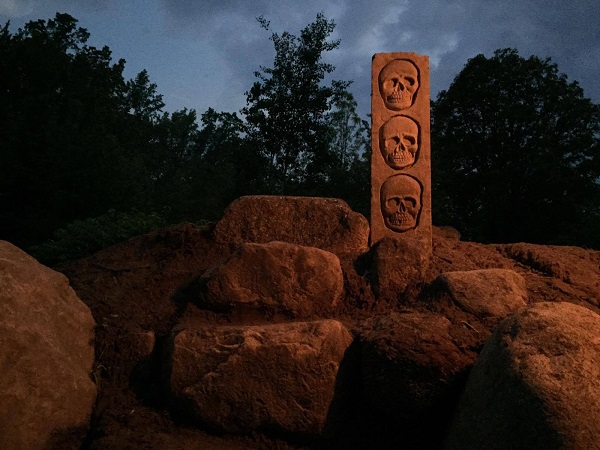
Mound Shrine for the Ancestors. Photo used with permission. Statuary by Sidney Bolam of Bohemian Hobbit Studio.
The Mound at Wellspring
Also, known as the Mound Shrine for the Ancestors, the Mound at Well Spring is in the style of a pre-historic burial mound like those used by the Celts, Germans and Norse tribes of Western Europe among others. There have been discoveries of burial mounds all over the world, including the Americas. These burial mounds were not just simple piles of stones and dirt, they were intricate layers of intentionally placed materials which stood the test of time and erosion becoming part of the landscape. Just like a traditional burial mound, the Mound at Wellspring was started with a hole, since this is a shrine for the ancestors and not the burial of a specific person the objects interred were of a sacrificial and offeratory nature. Interred in the depths of the mound was a beautifully made wooden coffin that was filled with sacred objects, magical tools and a multitude of arcane talismans. A funerary ritual was of course part of its internment ceremony, gifting these objects to the ancestors asking for their blessings and guidance.
Large boulders set in a circle, smaller stones and soil were meticulously layered over the tomb as the mound was formed. The builders also included an offering shaft that would lead to the depths of the mound so that libations and other sacrifices could be sent down to the spirits. By stacking hollow blocks and filling in the mound around them they were able to ingeniously create a long dark shaft that would run all the way to the heart of the mound. After its completion the last layer of soil was ceremonially stomped down by many individual feet as people were invited to dance upon and walk the mount, eventually creating a flat surface on its top large enough to hold rituals.
The final offering to the ancestral spirits of our traditions was a gorgeous stone obelisk carved with three skulls. This piece was created for Tredara by Sidney Bolam of Bohemian Hobbit Studio, in honor of the spirits and the work being done at Tredara.
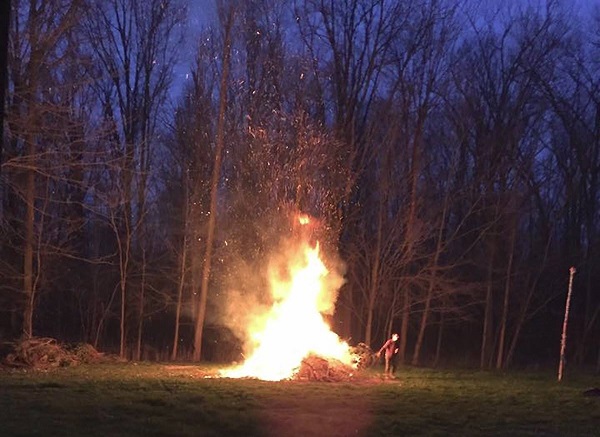
Fire at Tredara. April 2017. Used with permission. intothemound.blogspot.com
The Spirit of the Land
Tredara has become a special place to many people. It is near and dear to many individuals hearts after having worked to make it what it is today. With all of the love and devotion that goes into bringing something like this to fruition it will no doubt continue to grow eventually becoming an indispensable place of pilgrimage for Pagans, polytheists, and all those who wish to honor nature.
“Tredara is not only my church, but my solace, my healing place, my serenity. The land is blessed, sacred, and spiritual. The owners and other people are what makes this place full of positive energy; laughter, education, and great story telling. This is my special place.” – Cathy McCoy
The Pagan gods of old, and the spirits of the land known as the genus loci are present at Tredara. Honoring these spirits and divinities is a central part of Pagan spiritual practice. The Nemeton Shrine is the place at Tredara that is dedicated to the old gods. A nemeton is inspired by celtic ritual spaces, which may also have origins in the fire altars of ancient Greece and Rome. It is comprised of the pillar, which represents the axis mundi connecting us to the gods, the offering shaft and nemeton fire. Archaeological finds tell us that Celtic peoples used large scale offering shafts for larger sacrifices. The offering shaft is part of the symbolic “well” complex seen as the shaft that receives the offerings of the Underworld. This is the reason that bogs, marshes and caves were seen as sacred entrances into the depths of the under realms of ancestors and sprits. The nemeton fire which serves as one of the focal points of the altar also follows traditional European proscriptions. The fire altar being made of brick or stone is then filled with sand or soil so that the fire itself is raised above the ground. This is where burned offerings are sent up to the celestial gods and libations are fed down to those chthonic earthly beings.
The third and most recent addition to the shrine complex at Tredara, is the Shrine for the Landspirits. It is a traditional tricephalus like those of the three-faced Hekataion placed at the crossroads to receive offerings to the goddess Hecate. This tricephalus or three-headed pole bears the visages of the green-man, the owl and the bear all sacred to the tradition and local area itself. The striking images of the Landwight’s Shrine was carved by local chainsaw carver, Bob Anderson of Rock Creek Ohio.
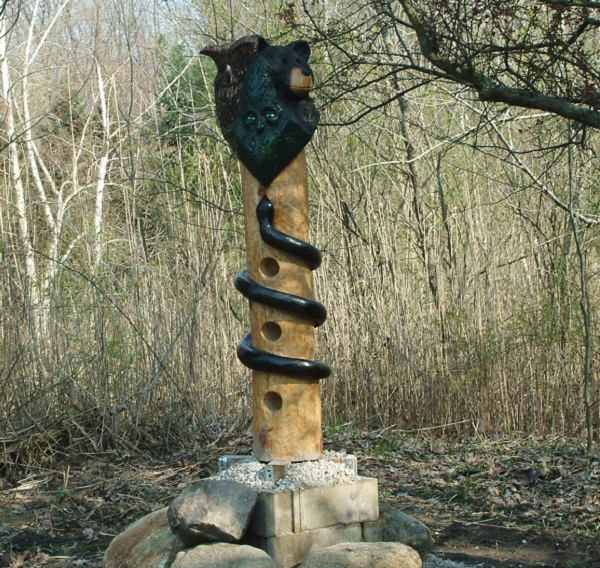
Shrine for the Landspirits, tricephalus. Carved by Bob Anderson. Used with permission.
Tredara looks like it would be a breathtaking place to visit any time of the year. Attending one of their larger rituals on one of the Pagan Holy Days would be an amazing experience in itself, or simply walking the land and individually connecting with the spirit of this place. As Tredara continues its existence I’m sure more shrines will be built and more spirits will seek refuge in this sanctuary away from modern society. I consider myself very lucky to only be a few hours away from this place, and hope to make the drive very soon so that I may experience this first hand.
Previous Post
January 30, 2018
Candlemas, Imbolc, and Serpent Fire
Next Post
February 10, 2018 The Benign Aspects of Saturn in the Dead of Winter
Browse Our Archives
Select a Category alchemy astrology Community Outreach and Events Current Events Featured Practitioners Gods and Goddesses green magic Green Witchcraft herbalism History of the Devil luciferian tradition Magic Magic and Ritual Magic and Witchcraft in History Magical Community magical herbalism Medieval Herbalism Metaphysics Modern Witchcraft natal charts natural magic Northern Traditions Occult Art Occult Artifacts Occultism pagan authors Pagan Community Pagan Holidays pagan philosophy Pagan Sightseeing Paganism Personal Practice planetary glyphs planetary symbols Recommended Reading Sabbatic Witchcraft samhain satanism Spells The Armchair The Poison Path Traditional Witchcraft Uncategorized Veneficium wicca witch's practice Witchcraft witches' sabbats
Select a Month December 2022 September 2022 August 2022 July 2022 March 2022 February 2022 January 2022 December 2021 October 2021 September 2021 August 2021 July 2021 May 2021 April 2021 March 2021 January 2021 December 2020 October 2020 September 2020 July 2020 June 2020 May 2020 April 2020 March 2020 February 2020 January 2020 December 2019 November 2019 October 2019 September 2019 August 2019 July 2019 June 2019 May 2019 April 2019 March 2019 February 2019 January 2019 December 2018 November 2018 October 2018 September 2018 August 2018 July 2018 June 2018 May 2018 April 2018 March 2018 February 2018 January 2018 December 2017 November 2017 October 2017 September 2017 August 2017 July 2017 June 2017 May 2017 April 2017 March 2017 February 2017 January 2017 December 2016 November 2016 October 2016 September 2016 August 2016 July 2016 June 2016 May 2016 March 2016 February 2016
Follow Us!
TAKE THE
Religious Wisdom Quiz
Who was the major prophet during King Hezekiah's reign in Judah?
Select your answer to see how you score.
Jeremiah Isaiah Daniel Ezekiel
Related posts from Poisoner's Apothecary

Interview with a Vampyre Witch: Alexis Pharae
Christian Rätsch, Undying Contributions to the Poison Path
Smoke Divination: The Art of Capnomancy
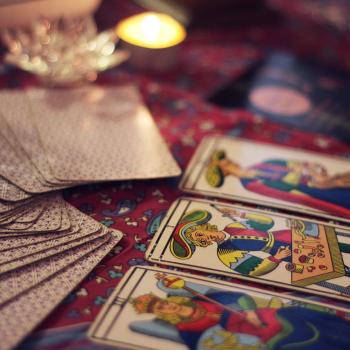
Witch City Tarot Gathering Re-Cap
TRENDING AT PATHEOS Pagan

I was recently chatting with someone on Instagram. She asked me what...

While there are many people who share their results, the end of...

On July 23, I saw Christopher Nolan's The Odyssey which is Homer’s...

As I write this two big events have just finished up. One...

Restoring the Watershed of Divine Love
Perhaps cooperation is not something we manufacture through legislation, ideology, or moral...

Many UUs don’t pray because of bad experiences in a previous religion,...
view all Pagan blogs
Ad-Free & Subscriber Log-In Subscription Support
- About Us
- 2026 Calendar
- Videos
- Podcasts
- Library of World Religions
- Faith In Media Tracker
- Advertise With Us
- Write for Us
- Privacy Policy
- Terms of Service
- Do Not Sell My Data
- Contact Us
- Radiant Digital
- Manage Newsletter Subscriptions
- Unsubscribe From Notifications
- Sitemap
Copyright 2008-2026, Patheos. All rights reserved.
Subscription Support Ad-Free & Subscriber Log-In
Follow Patheos