
BuddhistCatholicContemplativeEvangelicalGeneral ChristianHinduJewishLatter-day SaintMuslimNew VisionsProgressive Christian
Beliefs
- Buddhist
- Catholic
- Contemplative
- Evangelical
- General Christian
- Hindu
- Jewish
- Latter-day Saint
- More Voices
- Muslim
- New Visions
- Pagan
- Progressive Christian
Topics
- Religion News
- Food and Religion
- Sports and Religion
- Religious Art
- Religious Music and Entertainment
- Religious Events
- History and Religion
- Style and Religion
- Politics and Religion
- Women in Religion
- Recreation Outdoors and Religion
- Business Finance and Religion
- Careers Workplace and Religion
- Education and Religion
- Family Parenting and Religion
- Health Fitness and Religion
- Home and Religion
- Relationships and Religion
- Technology and Religion
- Travel and Religion
Columnists
- Buddhist Columnists
- Business Finance and Religion Columnists
- Careers Workplace and Religion Columnists
- Catholic Columnists
- Contemplative Columnists
- Education and Religion Columnists
- Evangelists Columnists
- Family Parenting and Religion Columnists
- General Christian Columnists
- Health Fitness and Religion Columnists
- Hindu Columnists
- History and Religion Columnists
- Home and Religion Columnists
- Jewish Columnists
- More Voices Columnists
- Latter Day Columnists
- Muslim Columnists
- New Visions Columnists
- Nonreligious Columnists
- Pagan Columnists
- Politics and Religion Columnists
- Progressive Columnists
- Recreation Outdoors and Religion Columnists
- Relationships and Religion Columnists
- Religion News Columnists
- Religious Art Columnists
- Religious Events Columnists
- Religious Music and Entertainment Columnists
- Sports and Religion Columnists
- Style and Religion Columnists
- Technology and Religion Columnists
- Travel and Religion Columnists
- Women in Religion Columnists
Resource Library
- 2026 Calendar
- Library of World Religions
- The 100 Most Holy Places on Earth
- Patheos Answers
- Podcasts
- Videos
- Faith Leaders Database
- Anglican Episcopalian
- Bahai
- Baptist
- Buddhism
- Christianity
- Confucianism
- Eastern Orthodoxy
- Hinduism
- Holiness and Pentecostal
- ISKCON
- Islam
- Judaism
- Lutheran
- Methodist
- The Church of Jesus Christ of Latter-day Saints
- New Age
- Paganism
- Presbytarian and Reformed
- Protestantism
- Religion Behind the Scenes
- Roman Catholic
- Scientology
- Shia Islam
- Sikhism
- Sufism
- Sunni Islam
- Taoism
- Zen
- See all religions
Research Tools
 Ad-Free & Subscriber Log-In Subscription Support
Ad-Free & Subscriber Log-In Subscription Support
Follow Patheos 

- Trending:
- Forgiveness
- |
- Marriage
- |
- Consciousness
- |
- Death Penalty
- |
- Election
- |
- Halloween
 Poisoner's Apothecary
- Home
- Pagan
- The Devil is in the Details: Lucifer, the Devil, and Satan
The Devil is in the Details: Lucifer, the Devil, and Satan
Last updated on: November 14, 2017 at 12:47 pm by Coby Michael Ward
The Devil is in the Details: Lucifer, the Devil, and Satan 2017-11-14T12:47:01-04:00 Coby Michael Ward
Patheos Explore the world's faith through different perspectives on religion and spirituality! Patheos has the views of the prevalent religions and spiritualities of the world.
A Pagan’s Perception of the Concept of the Devil
My opinion is one of many infinite opinions that influence our perception of this entity/entities. The cultural and historic associations that have accumulated over the past 2000 years influence contemporary society’s concept of what and who the Devil actually is. An amalgam of diverse archetypes that have syncretized over the centuries, while the Christian concept of the Devil/Satan as an adversary to mankind is all encompassing; it is my feeling that this archetypal figure is actually a collective of many similar spiritual beings that wear this mantle of power.
“There is no Devil in the Craft” – Sally Owens, Practical Magic
We have heard this time and time again. Modern witchcraft and Wicca including many of the historical Pagan belief systems do not centralize their spiritual practices around an entity called the Devil. However, more and more witches under the umbrella of traditional witchcraft, sabbatic witchcraft and other magical traditions with roots in the middle ages are embracing this horned figure as a powerful patron. To say definitively that there is “No Devil in the Craft,” is to deny a nascent part of the History of Magic and Witchcraft. Whether this figure is embraced or not, the influence that it has had on all world religions and spiritual traditions is undeniable.
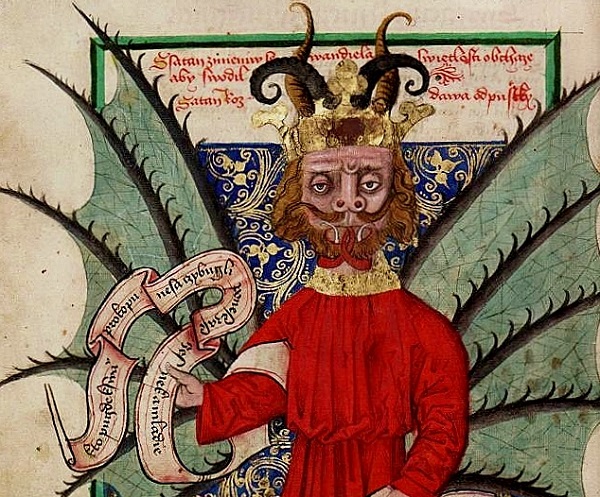
Kodex Satan Prodava Odputsky. Wikipedia Creative Commons.
Why I Wanted to Write this Article…
The concept of the Devil as fallen angel, teacher of the arcane arts, and promethean champion of life on Earth has always been fascinating to me. Perhaps since it was such a taboo topic in my childhood, a household name to be feared, but not completely understood I felt the need to explore it in my academic studies. We can learn just as much about a religion from its demons and adversaries as we can from its saints and martyrs; the former often giving us deeper insight.
It has come to my realization that there are some misconceptions surrounding my study and interest in the collective figure that I refer to as the Devil. Satan, Lucifer, Lumiel, Baphomet, the Horned One, and the many masks and names he goes by can all be brought to mind by this single nomenclature. Each individual name has its own cultural and historic symbols and mythology, however when I use the term the Devil it is to evoke this collective concept of embracing all of these diverse facets.
I consider myself a contemporary Pagan/polytheist/animist/magical practitioner/academic. I offer worship to the ancestors of both blood and tradition, as well as the eldritch spirits of the natural world honored as the gods of old. I will observe Sabbaths and astrological events focusing on the natural cycles of the Universe. There are many horned entities and nature spirits of a sylvan nature from pre-Christian times. The symbolism of being crowned in horns can be traced back to antiquity. However, I do not worship or act as one under the patronage of such an entity as the Devil.
Sometimes it can be tricky balancing academic interests with spiritual beliefs, and many things I figure out along the way as they are presented to me. From an academic perspective the history and mythology of this being, and the many cultural interpretation has always intrigued me. There was a time when I did have fear of this entity. The Satanic Panic of the 90s corresponded to my childhood, and the beliefs I picked up from the people around me were my initial source of understanding this figure, albeit from a Christian perspective. An in-depth study of this and various other theological topics regarding early Christian history and the Roman Catholic Church have helped me build a less biased understanding of this figure. A lot of the fear and guilt that comes with being told “we are all sinners and we don’t deserve to go to Heaven” was assuaged by gathering as much information as possible on the topic from as many different sources. Enter Elaine Pagels, an award winning historian whose books shed much needed light on the concepts of Satan. Pagels is able to really build up the foundation for understanding where the idea of Satan comes from, how it has changed over the years, and also how Western Christianity has influenced our collective perceptions and whether Christian or not many of us carry the bias of growing up in a Christianized area.

Kodex Satan Prodava Odpustky. Jensky. Wikipedia Creative Commons.
The Benefits of Study: For your consideration
Through an academic investigation of this topic. I have gained a unique perspective from both sides of this influential topic. The Pagan/polytheistic understanding of the evolution and transformation of these originally diverse entities fits neatly into our polytheistic metaphysics. The egregore formed by the collective experiences and interpretations of countless people is capable of acting as one but also capable of infinite transformations. The mythos of the Nephilim, Grigori, the Watchers provide pagans and witches with a more contiguous tapestry of lore stretching as far back as the murky origins of Judaic mysticism and the spiritual practices of the ancients.
Many of the gods and goddesses and spirits of magic and witchcraft, which have made themselves our allies share much in common with the Promethean archetype. Messenger and teacher to humanity, the fallen archangel Lumiel or Lucifer was the first to make the descent to the physical plane. The Pagan Gods of old, the nameless spirits of the forest and grove, revere the symbol of horns and those who wear their crown. In the ancient world horns depicted a person of great wisdom.
Previous Post

November 7, 2017
An Evening With Deadly Nightshade
Next Post

December 8, 2017 Finding My Tribe and Re-Claiming Sovreignty
Browse Our Archives
Select a Category alchemy astrology Community Outreach and Events Current Events Featured Practitioners Gods and Goddesses green magic Green Witchcraft herbalism History of the Devil luciferian tradition Magic Magic and Ritual Magic and Witchcraft in History Magical Community magical herbalism Medieval Herbalism Metaphysics Modern Witchcraft natal charts natural magic Northern Traditions Occult Art Occult Artifacts Occultism pagan authors Pagan Community Pagan Holidays pagan philosophy Pagan Sightseeing Paganism Personal Practice planetary glyphs planetary symbols Recommended Reading Sabbatic Witchcraft samhain satanism Spells The Armchair The Poison Path Traditional Witchcraft Uncategorized Veneficium wicca witch's practice Witchcraft witches' sabbats
Select a Month December 2022 September 2022 August 2022 July 2022 March 2022 February 2022 January 2022 December 2021 October 2021 September 2021 August 2021 July 2021 May 2021 April 2021 March 2021 January 2021 December 2020 October 2020 September 2020 July 2020 June 2020 May 2020 April 2020 March 2020 February 2020 January 2020 December 2019 November 2019 October 2019 September 2019 August 2019 July 2019 June 2019 May 2019 April 2019 March 2019 February 2019 January 2019 December 2018 November 2018 October 2018 September 2018 August 2018 July 2018 June 2018 May 2018 April 2018 March 2018 February 2018 January 2018 December 2017 November 2017 October 2017 September 2017 August 2017 July 2017 June 2017 May 2017 April 2017 March 2017 February 2017 January 2017 December 2016 November 2016 October 2016 September 2016 August 2016 July 2016 June 2016 May 2016 March 2016 February 2016
Follow Us!
TAKE THE
Religious Wisdom Quiz
How did Nehemiah respond to threats and ridicule while rebuilding the wall?
Select your answer to see how you score.
Gave up Bribed enemies Fled Jerusalem Prayed and posted guards
Related posts from Poisoner's Apothecary
Christian Rätsch, Undying Contributions to the Poison Path

Witch City Tarot Gathering Re-Cap

The Satyr's Kiss by Storm Faerywolf
The Fairy Godmother of Occult Publishing
TRENDING AT PATHEOS Pagan

I was recently chatting with someone on Instagram. She asked me what...

While there are many people who share their results, the end of...

On July 23, I saw Christopher Nolan's The Odyssey which is Homer’s...

As I write this two big events have just finished up. One...

Restoring the Watershed of Divine Love
Perhaps cooperation is not something we manufacture through legislation, ideology, or moral...

Many UUs don’t pray because of bad experiences in a previous religion,...
view all Pagan blogs
Ad-Free & Subscriber Log-In Subscription Support
- About Us
- 2026 Calendar
- Videos
- Podcasts
- Library of World Religions
- Faith In Media Tracker
- Advertise With Us
- Write for Us
- Privacy Policy
- Terms of Service
- Do Not Sell My Data
- Contact Us
- Radiant Digital
- Manage Newsletter Subscriptions
- Unsubscribe From Notifications
- Sitemap
Copyright 2008-2026, Patheos. All rights reserved.
Subscription Support Ad-Free & Subscriber Log-In
Follow Patheos