
BuddhistCatholicContemplativeEvangelicalGeneral ChristianHinduJewishLatter-day SaintMuslimNew VisionsProgressive Christian
Beliefs
- Buddhist
- Catholic
- Contemplative
- Evangelical
- General Christian
- Hindu
- Jewish
- Latter-day Saint
- More Voices
- Muslim
- New Visions
- Pagan
- Progressive Christian
Topics
- Religion News
- Food and Religion
- Sports and Religion
- Religious Art
- Religious Music and Entertainment
- Religious Events
- History and Religion
- Style and Religion
- Politics and Religion
- Women in Religion
- Recreation Outdoors and Religion
- Business Finance and Religion
- Careers Workplace and Religion
- Education and Religion
- Family Parenting and Religion
- Health Fitness and Religion
- Home and Religion
- Relationships and Religion
- Technology and Religion
- Travel and Religion
Columnists
- Buddhist Columnists
- Business Finance and Religion Columnists
- Careers Workplace and Religion Columnists
- Catholic Columnists
- Contemplative Columnists
- Education and Religion Columnists
- Evangelists Columnists
- Family Parenting and Religion Columnists
- General Christian Columnists
- Health Fitness and Religion Columnists
- Hindu Columnists
- History and Religion Columnists
- Home and Religion Columnists
- Jewish Columnists
- More Voices Columnists
- Latter Day Columnists
- Muslim Columnists
- New Visions Columnists
- Nonreligious Columnists
- Pagan Columnists
- Politics and Religion Columnists
- Progressive Columnists
- Recreation Outdoors and Religion Columnists
- Relationships and Religion Columnists
- Religion News Columnists
- Religious Art Columnists
- Religious Events Columnists
- Religious Music and Entertainment Columnists
- Sports and Religion Columnists
- Style and Religion Columnists
- Technology and Religion Columnists
- Travel and Religion Columnists
- Women in Religion Columnists
Resource Library
- 2026 Calendar
- Library of World Religions
- The 100 Most Holy Places on Earth
- Patheos Answers
- Podcasts
- Videos
- Faith Leaders Database
- Anglican Episcopalian
- Bahai
- Baptist
- Buddhism
- Christianity
- Confucianism
- Eastern Orthodoxy
- Hinduism
- Holiness and Pentecostal
- ISKCON
- Islam
- Judaism
- Lutheran
- Methodist
- The Church of Jesus Christ of Latter-day Saints
- New Age
- Paganism
- Presbytarian and Reformed
- Protestantism
- Religion Behind the Scenes
- Roman Catholic
- Scientology
- Shia Islam
- Sikhism
- Sufism
- Sunni Islam
- Taoism
- Zen
- See all religions
Research Tools
 Ad-Free & Subscriber Log-In Subscription Support
Ad-Free & Subscriber Log-In Subscription Support
Follow Patheos 

- Trending:
- Forgiveness
- |
- Marriage
- |
- Consciousness
- |
- Death Penalty
- |
- Election
- |
- Halloween
 Poisoner's Apothecary
- Home
- Pagan
- The Peculiar Powers of Poison
The Peculiar Powers of Poison
Last updated on: August 20, 2017 at 1:31 pm by Coby Michael Ward
The Peculiar Powers of Poison 2017-08-20T13:31:11-04:00 Coby Michael Ward
Patheos Explore the world's faith through different perspectives on religion and spirituality! Patheos has the views of the prevalent religions and spiritualities of the world.
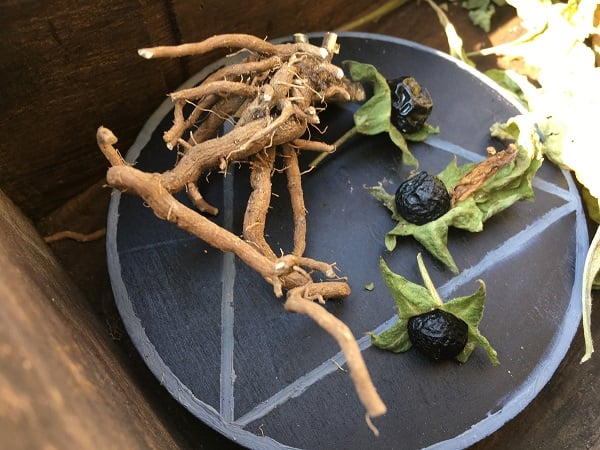
Belladonna in Triangle. Photo by the author.
Poison, Politics and Paranoia
Poisons have played a pivotal role in shaping human history. Since ancient times early humans made use of the power plant and animal toxins, discovered by chance or experimentation. The ability to have such a powerful effect would elevate many of these substances to a mythical status. Tribal communities, and hunter-gatherer societies had been using poison tipped arrows to take down large game. They were eventually used in warfare against human enemies. The Scythians in particular were well known for their poison tipped arrows. Their special formula was obtained by milking the venom of vipers, mixing it with blood and dung allowing it to putrefy underground. This created a powerful toxin. The technique used by the tribes of the Black Sea region for milking vipers was also employed to make medicine.
Political life was a major aspect of being a citizen of Ancient Greece and Rome. Aristocratic families and those with senatorial positions met on a regular basis to discuss governmental concerns. Politicians fought for power using eloquence and logic, in start comparison to those tribal warlords of the Northern Territories. Under the guise of civilized government politicians found more subversive means of eliminating opponents. Assassination was a common tactic, especially within the Roman Empire. Members of the aristocracy attempting to advance their own positions would employ the help of a poisoner-assassin to eliminate those standing in their way. This was often achieved in close proximity under the pretense of trust. The nature of poisoning is secretive and discreet, often making use of deceiving illusions. The relationship to the victim may be a close friend or family member will bad intentions.
Many have theorized that it is this unseen and secretive nature of the power of poison is what has associated it with harmful witchcraft. The word poison, for example, was used in English in the 12th century derived from the French word for drink, eventually taking on medicinal and later magical characteristics. This real fear of the existence of poisoners/witches, often one and the same, resulted in outlawing practices of maleficia.
Mithridatium
So great was the fear of being poisoned, that rulers in antiquity went to extreme measures to protect themselves. It wasn’t uncommon for a monarch to have a servant test his food for poison before eating it himself. Apothecaries could be employed to create antidotes and poisons. One ruler is known for the extreme measures that he took to protect himself from his predecessor’s fate. Mithridates VI, king of Pontus from 120-63 BCE, was one of the Roman Republic’s most formidable enemies. With such a big target on his back, Mithridates went to extreme measures to protect himself from assassination by poison.
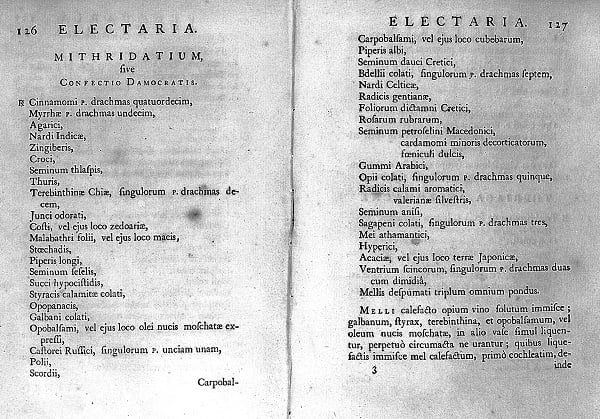
L0004950 Mithridatium. Wikimedia Commons. Wellcome Images
Under the instruction of the Agari, a group of Scythian shamans, Mithridates attempted to immunize himself by ingesting small amounts of various poisons on a regular basis. According to legend and history, this semi-mythical account was a success. This process became known as Mithridatism, and has been employed in other instances of immunization as well. This technique depends on how the body metabolizes certain toxins. For example, toxins such as atropine, which are found in the herbs of traditional witchcraft can build up in the tissue of the heart eventually leading to poisoning. The technique of immunization was dangerous, and often resulted in the death on an innocent bystander.
On the other end of the spectrum of poison and antidotes, there was a legendary cure all that was known as Mithridatium. This Panacea was sought after from antiquity into the Middle Ages. It was known as theriac or Venice Treacle where it was made. This medicine was only available to those who could afford it because of the number of ingredients needed and the long amount of time it takes to produce made it cost prohibitive. It allegedly consisted of around 65 ingredients, and it would take months to gather and prepare all of the necessary components. The treacle would then need to be fermented for at least a year before being used. The coveted compound under the name Theriac Andromacchi was made primarily in Venice during the Middle Ages. The famous French apothecary, Moyse Charas published the formula in 1669 to help put an end to the Venetian monopoly on the theriac.
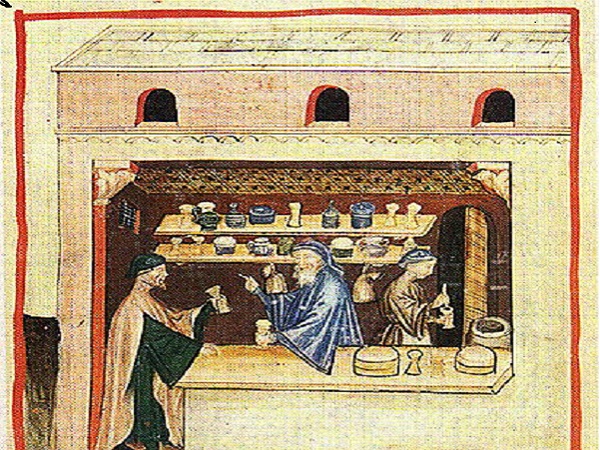
Preparation of Theriac Tacuinum sanitatis. Public domain.
Deception, Contagion and Witchcraft
Another individual from history is known for his unique use of poison to create a special type of assassin. The Visha Kanyas of Chandragupta Maurya (320-298 BCE) were known as “Poison Maidens.” These women were specially prepared from a young age to become assassin seductresses that would be given to enemies as gifts. The poisonous maidens killed their victims by their poisonous natures alone. These women ingested small amounts of various poisons over time, which eventually rendered their bodily fluids toxic to normal individuals. These women were not simply administers of poison through food and drink; they were the poison. Using their sexual charms, these women would lull victims into a sense of safety realizing only to late what had been done to them.
Another notion of tainted gift giving that arrives from the East is the notion of poisoned garments. It was a common practice in antiquity to give gifts of fabric or garments. The idea of exchanging garments to bestow honor is an ancient theme. Throughout history gifts of clothing are given to literally or figuratively confer conditions of authority, protection, and honor. There was also the real fear that garments carry disease. This led to strict taboos of cleanliness and contamination.
To cover someone with a mantle is to bestow upon them the blessings symbolized therein. In the myth of King Arthur, Morgan le Fay gives him a mantle which is meant to immolate him. Here we see a common theme where garments can be used to bestow blessings and/or harm. The poisoning of garments is a peculiar practice based on traditions of gift giving. Again, with poisoning there is a certain degree of trust under the pretense of safety. Foreign monarchs have unknowingly accepted these contaminated gifts out of fear of insulting the gift giver.
This practice was also carried out when Europeans arrived in North America; settlers offered to Native Americans gifts of fabrics. The native people already familiar with traditional gift giving accepted these items not knowing that they were infected by smallpox. The native people had no immunity to this foreign disease and it devastated many indigenous populations.
Concepts of contamination and contagion are part of many religious and spiritual practices. Traditions of taboo have developed around purification and cleanliness with both spiritual and physical components. The secretive nature of poisoning and its unseen effects on the body align it closely with classical ideas of witchcraft. Ironically, witches became the Pharmakos or “scapegoat” of Christianized society. The poisoning of body and mind was sorcery to ancient societies. The plants that were used for their toxic and mind altering qualities became associated with the Witch’s Garden. These plants serve as allies of power and progress to those on the Poison Path.
Resources:
Adrienne Mayor: The Poison King: the life and legend of Mithradates, Rome’s deadliest enemy
Next Post

August 24, 2017 Devil's Breath: A Trick of the Nightshades
Browse Our Archives
Select a Category alchemy astrology Community Outreach and Events Current Events Featured Practitioners Gods and Goddesses green magic Green Witchcraft herbalism History of the Devil luciferian tradition Magic Magic and Ritual Magic and Witchcraft in History Magical Community magical herbalism Medieval Herbalism Metaphysics Modern Witchcraft natal charts natural magic Northern Traditions Occult Art Occult Artifacts Occultism pagan authors Pagan Community Pagan Holidays pagan philosophy Pagan Sightseeing Paganism Personal Practice planetary glyphs planetary symbols Recommended Reading Sabbatic Witchcraft samhain satanism Spells The Armchair The Poison Path Traditional Witchcraft Uncategorized Veneficium wicca witch's practice Witchcraft witches' sabbats
Select a Month December 2022 September 2022 August 2022 July 2022 March 2022 February 2022 January 2022 December 2021 October 2021 September 2021 August 2021 July 2021 May 2021 April 2021 March 2021 January 2021 December 2020 October 2020 September 2020 July 2020 June 2020 May 2020 April 2020 March 2020 February 2020 January 2020 December 2019 November 2019 October 2019 September 2019 August 2019 July 2019 June 2019 May 2019 April 2019 March 2019 February 2019 January 2019 December 2018 November 2018 October 2018 September 2018 August 2018 July 2018 June 2018 May 2018 April 2018 March 2018 February 2018 January 2018 December 2017 November 2017 October 2017 September 2017 August 2017 July 2017 June 2017 May 2017 April 2017 March 2017 February 2017 January 2017 December 2016 November 2016 October 2016 September 2016 August 2016 July 2016 June 2016 May 2016 March 2016 February 2016
Follow Us!
TAKE THE
Religious Wisdom Quiz
Who baptized Jesus?
Select your answer to see how you score.
John the Baptist Paul Peter James
Related posts from Poisoner's Apothecary

Christian Rätsch, Undying Contributions to the Poison Path
Flower Essences from the Witch's Garden
Philosophia Toxicum: A Discourse on the Poison Path
The Big Book of Magical Incense
TRENDING AT PATHEOS Pagan

When we talk about Greek religion, we often begin with the dodekatheion—the...

I was recently chatting with someone on Instagram. She asked me what...

While there are many people who share their results, the end of...

On July 23, I saw Christopher Nolan's The Odyssey which is Homer’s...

As I write this two big events have just finished up. One...

Restoring the Watershed of Divine Love
Perhaps cooperation is not something we manufacture through legislation, ideology, or moral...
view all Pagan blogs
Ad-Free & Subscriber Log-In Subscription Support
- About Us
- 2026 Calendar
- Videos
- Podcasts
- Library of World Religions
- Faith In Media Tracker
- Advertise With Us
- Write for Us
- Privacy Policy
- Terms of Service
- Do Not Sell My Data
- Contact Us
- Radiant Digital
- Manage Newsletter Subscriptions
- Unsubscribe From Notifications
- Sitemap
Copyright 2008-2026, Patheos. All rights reserved.
Subscription Support Ad-Free & Subscriber Log-In
Follow Patheos