
BuddhistCatholicContemplativeEvangelicalGeneral ChristianHinduJewishLatter-day SaintMuslimNew VisionsProgressive Christian
Beliefs
- Buddhist
- Catholic
- Contemplative
- Evangelical
- General Christian
- Hindu
- Jewish
- Latter-day Saint
- More Voices
- Muslim
- New Visions
- Pagan
- Progressive Christian
Topics
- Religion News
- Food and Religion
- Sports and Religion
- Religious Art
- Religious Music and Entertainment
- Religious Events
- History and Religion
- Style and Religion
- Politics and Religion
- Women in Religion
- Recreation Outdoors and Religion
- Business Finance and Religion
- Careers Workplace and Religion
- Education and Religion
- Family Parenting and Religion
- Health Fitness and Religion
- Home and Religion
- Relationships and Religion
- Technology and Religion
- Travel and Religion
Columnists
- Buddhist Columnists
- Business Finance and Religion Columnists
- Careers Workplace and Religion Columnists
- Catholic Columnists
- Contemplative Columnists
- Education and Religion Columnists
- Evangelists Columnists
- Family Parenting and Religion Columnists
- General Christian Columnists
- Health Fitness and Religion Columnists
- Hindu Columnists
- History and Religion Columnists
- Home and Religion Columnists
- Jewish Columnists
- More Voices Columnists
- Latter Day Columnists
- Muslim Columnists
- New Visions Columnists
- Nonreligious Columnists
- Pagan Columnists
- Politics and Religion Columnists
- Progressive Columnists
- Recreation Outdoors and Religion Columnists
- Relationships and Religion Columnists
- Religion News Columnists
- Religious Art Columnists
- Religious Events Columnists
- Religious Music and Entertainment Columnists
- Sports and Religion Columnists
- Style and Religion Columnists
- Technology and Religion Columnists
- Travel and Religion Columnists
- Women in Religion Columnists
Resource Library
- 2026 Calendar
- Library of World Religions
- The 100 Most Holy Places on Earth
- Patheos Answers
- Podcasts
- Videos
- Faith Leaders Database
- Anglican Episcopalian
- Bahai
- Baptist
- Buddhism
- Christianity
- Confucianism
- Eastern Orthodoxy
- Hinduism
- Holiness and Pentecostal
- ISKCON
- Islam
- Judaism
- Lutheran
- Methodist
- The Church of Jesus Christ of Latter-day Saints
- New Age
- Paganism
- Presbytarian and Reformed
- Protestantism
- Religion Behind the Scenes
- Roman Catholic
- Scientology
- Shia Islam
- Sikhism
- Sufism
- Sunni Islam
- Taoism
- Zen
- See all religions
Research Tools
 Ad-Free & Subscriber Log-In Subscription Support
Ad-Free & Subscriber Log-In Subscription Support
Follow Patheos 

- Trending:
- Forgiveness
- |
- Marriage
- |
- Consciousness
- |
- Death Penalty
- |
- Election
- |
- Halloween
 Poisoner's Apothecary
- Home
- Pagan
- Individual Components of a Witch’s Practice
Individual Components of a Witch’s Practice
Last updated on: June 29, 2017 at 9:11 pm by Coby Michael Ward
Individual Components of a Witch’s Practice 2017-06-29T21:11:11-04:00 Coby Michael Ward
Patheos Explore the world's faith through different perspectives on religion and spirituality! Patheos has the views of the prevalent religions and spiritualities of the world.
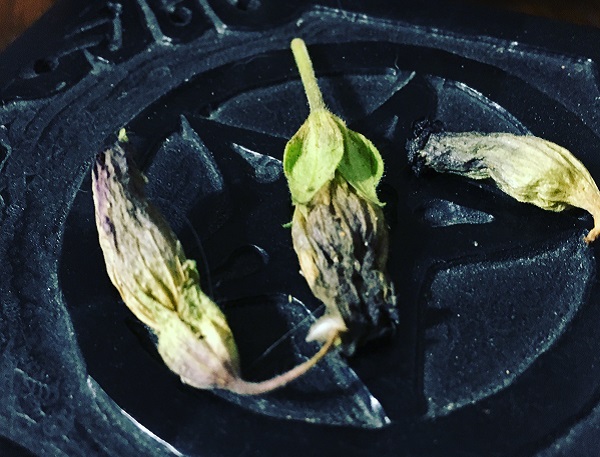
Belladonna Flowers. Photo by Coby Michael Ward.
Ethos, Aesthetic and Praxis
I have just recently finished reading the newly released title from Three Hands Press, Thirteen Pathways of Occult Herbalism written by Daniel A. Schulke. A nice little book providing an insightful introduction into the realm of occult herbalism or “phytognosis” a term coined by Schulke. Having read some of his other work: Ars Philtron, Viridarium Umbris, and Veneficium; all three detailing the arcane tradition of witch medicine, I was looking forward to this new release as well. The language that is unique to his work comes through eloquently in this latest tome as well, reminiscent of classical academic occultism. The occult knowledge collected over the years from within hidden traditions and green gnosis from the direct communion with plant spirits fills these volumes with quintessential witch lore. These publications along with work by the late Andrew D. Chumbley and the Cultus Sabbati have influenced modern witchcraft traditions emphasizing medieval witchcraft practices based on the symbolism of the widely known Witches’ Sabbath. As the Verdelet, keeper of plant lore for the Cultus Sabbati, Schulke is a well-known authority on these practices.
Many of the terms used in his writing are explained in easy to understand language, laying ground work for this traditional current of magic. This book would serve as a great prequel for some of his earlier publications, which go into great depth. An important term explained in Thirteen Pathways that is commonly referenced in many other books and articles coming from Schulke and the Cultus Sabbati is Ethos.”presently defined as the character, sentiment or disposition of an individual or a group considered as a natural endowment.” Schulke goes on to explain that every artifact, book or individual, “radiates an ethos to those who may rightly discern it.” (Thirteen Pathways, p. 100-101) Ethos is that deep down feeling that informs our practice. It is what guides us, pulling us in the direction of certain currents that resonate with our individual nature. It is our own conception of what it is to be a witch, magician, sorcerer or occultist. Some practitioners use titles like green witch or sea witch to designate their area of practice. This is common among many modern practitioners. There is a widespread diversity online of practitioners specializing in areas like “space witchcraft” or “elemental magic” with as many varieties as there are practitioners. To some such a public display of occult practices goes against their very nature of being hidden. However, with our society being so visually oriented especially when it comes to the internet, it is unsurprising to find in the magical community as well.
By using symbols, concepts and images witches are able to convey to others their own personal Ethos. For example, abstract ideas like death, rebirth and ancestral knowledge combine with images of spirit familiars and witch’s herbs to form one of the infinite combinations of magical currents. Important esoteric concepts including one’s metaphysical beliefs form the framework for their ethos. The actual magical activity or spiritual action of the practitioner is known as Praxis. We can see the similarity here to the word practice. One’s ethos informs their praxis. According to Schulke, it is “the regular devotion of magical word, deed and numen to the spirits.” (Thirteen Pathways, p.107) Anything that we do in a magical context is part of our Praxis, and represented through our Ethos.
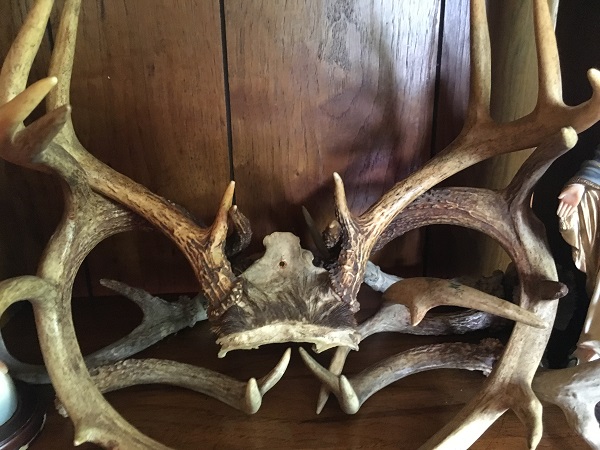
Bone Altar. Photo by Coby Michael.
After reading this book and gushing over Daniel Schulke’s words and allowing them to marinate in my mind; I came to a realization. Another similarly used term in modern witchcraft communities, specifically online, is aesthetic. According to Merriam-Webster’s Online Dictionary, aesthetic is a theory or conception of the particular nature of beauty or art. It has a more superficial meaning relating to the sense of sight as something with aesthetic quality being visually pleasing. In online communities the term aesthetic refers to the visual symbolism that one uses to present themselves. Another new term that relates literally to this visual representation is the “witchsona,” which is an artistic rendition of one’s magical practice through the creation of an avatar that displays the symbols of one’s practice. Both of these relatively new terms are used by modern practitioners to capture what I believe to be their Ethos.
There are certain rituals that feel innately powerful to certain people and to others they may not. While one group of witches may focus on fertility rites or drawing down the moon another group of practitioners may prefer a more ceremonial approach or work strictly with a certain deity. All of the many diverse types of magic hold their own sway, drawing those with a predisposition to a specific magical current. These currents shape our ideas and guide our practices as we travel down the Crooked Path.
Schulke, Daniel. Thirteen Pathways of Occult Herbalism. Three Hands Press. 2017.
Magic and Witchcraft in History
Previous Post

June 20, 2017
Changing Perceptions of Spirit Boards
Next Post
July 6, 2017 Children of Earth and Moon
Browse Our Archives
Select a Category alchemy astrology Community Outreach and Events Current Events Featured Practitioners Gods and Goddesses green magic Green Witchcraft herbalism History of the Devil luciferian tradition Magic Magic and Ritual Magic and Witchcraft in History Magical Community magical herbalism Medieval Herbalism Metaphysics Modern Witchcraft natal charts natural magic Northern Traditions Occult Art Occult Artifacts Occultism pagan authors Pagan Community Pagan Holidays pagan philosophy Pagan Sightseeing Paganism Personal Practice planetary glyphs planetary symbols Recommended Reading Sabbatic Witchcraft samhain satanism Spells The Armchair The Poison Path Traditional Witchcraft Uncategorized Veneficium wicca witch's practice Witchcraft witches' sabbats
Select a Month December 2022 September 2022 August 2022 July 2022 March 2022 February 2022 January 2022 December 2021 October 2021 September 2021 August 2021 July 2021 May 2021 April 2021 March 2021 January 2021 December 2020 October 2020 September 2020 July 2020 June 2020 May 2020 April 2020 March 2020 February 2020 January 2020 December 2019 November 2019 October 2019 September 2019 August 2019 July 2019 June 2019 May 2019 April 2019 March 2019 February 2019 January 2019 December 2018 November 2018 October 2018 September 2018 August 2018 July 2018 June 2018 May 2018 April 2018 March 2018 February 2018 January 2018 December 2017 November 2017 October 2017 September 2017 August 2017 July 2017 June 2017 May 2017 April 2017 March 2017 February 2017 January 2017 December 2016 November 2016 October 2016 September 2016 August 2016 July 2016 June 2016 May 2016 March 2016 February 2016
Follow Us!
TAKE THE
Religious Wisdom Quiz
In Revelation, what is the correct order of the first four seals opened by the Lamb?
Select your answer to see how you score.
Pale horse, red horse, white horse, black horse White horse, black horse, red horse, pale horse White horse, red horse, black horse, pale horse Red horse, white horse, pale horse, black horse
Related posts from Poisoner's Apothecary

Interview with a Vampyre Witch: Alexis Pharae
Smoke Divination: The Art of Capnomancy
Witch City Tarot Gathering Re-Cap

The Satyr's Kiss by Storm Faerywolf
TRENDING AT PATHEOS Pagan

I was recently chatting with someone on Instagram. She asked me what...

While there are many people who share their results, the end of...

On July 23, I saw Christopher Nolan's The Odyssey which is Homer’s...

As I write this two big events have just finished up. One...

Restoring the Watershed of Divine Love
Perhaps cooperation is not something we manufacture through legislation, ideology, or moral...

Many UUs don’t pray because of bad experiences in a previous religion,...
view all Pagan blogs
Ad-Free & Subscriber Log-In Subscription Support
- About Us
- 2026 Calendar
- Videos
- Podcasts
- Library of World Religions
- Faith In Media Tracker
- Advertise With Us
- Write for Us
- Privacy Policy
- Terms of Service
- Do Not Sell My Data
- Contact Us
- Radiant Digital
- Manage Newsletter Subscriptions
- Unsubscribe From Notifications
- Sitemap
Copyright 2008-2026, Patheos. All rights reserved.
Subscription Support Ad-Free & Subscriber Log-In
Follow Patheos