
BuddhistCatholicContemplativeEvangelicalGeneral ChristianHinduJewishLatter-day SaintMuslimNew VisionsProgressive Christian
Beliefs
- Buddhist
- Catholic
- Contemplative
- Evangelical
- General Christian
- Hindu
- Jewish
- Latter-day Saint
- More Voices
- Muslim
- New Visions
- Pagan
- Progressive Christian
Topics
- Religion News
- Food and Religion
- Sports and Religion
- Religious Art
- Religious Music and Entertainment
- Religious Events
- History and Religion
- Style and Religion
- Politics and Religion
- Women in Religion
- Recreation Outdoors and Religion
- Business Finance and Religion
- Careers Workplace and Religion
- Education and Religion
- Family Parenting and Religion
- Health Fitness and Religion
- Home and Religion
- Relationships and Religion
- Technology and Religion
- Travel and Religion
Columnists
- Buddhist Columnists
- Business Finance and Religion Columnists
- Careers Workplace and Religion Columnists
- Catholic Columnists
- Contemplative Columnists
- Education and Religion Columnists
- Evangelists Columnists
- Family Parenting and Religion Columnists
- General Christian Columnists
- Health Fitness and Religion Columnists
- Hindu Columnists
- History and Religion Columnists
- Home and Religion Columnists
- Jewish Columnists
- More Voices Columnists
- Latter Day Columnists
- Muslim Columnists
- New Visions Columnists
- Nonreligious Columnists
- Pagan Columnists
- Politics and Religion Columnists
- Progressive Columnists
- Recreation Outdoors and Religion Columnists
- Relationships and Religion Columnists
- Religion News Columnists
- Religious Art Columnists
- Religious Events Columnists
- Religious Music and Entertainment Columnists
- Sports and Religion Columnists
- Style and Religion Columnists
- Technology and Religion Columnists
- Travel and Religion Columnists
- Women in Religion Columnists
Resource Library
- 2026 Calendar
- Library of World Religions
- The 100 Most Holy Places on Earth
- Patheos Answers
- Podcasts
- Videos
- Faith Leaders Database
- Anglican Episcopalian
- Bahai
- Baptist
- Buddhism
- Christianity
- Confucianism
- Eastern Orthodoxy
- Hinduism
- Holiness and Pentecostal
- ISKCON
- Islam
- Judaism
- Lutheran
- Methodist
- The Church of Jesus Christ of Latter-day Saints
- New Age
- Paganism
- Presbytarian and Reformed
- Protestantism
- Religion Behind the Scenes
- Roman Catholic
- Scientology
- Shia Islam
- Sikhism
- Sufism
- Sunni Islam
- Taoism
- Zen
- See all religions
Research Tools
 Ad-Free & Subscriber Log-In Subscription Support
Ad-Free & Subscriber Log-In Subscription Support
Follow Patheos 

- Trending:
- Forgiveness
- |
- Marriage
- |
- Consciousness
- |
- Death Penalty
- |
- Election
- |
- Halloween
 Poisoner's Apothecary
- Home
- Pagan
- Altar Bones: More Than Decoration
Altar Bones: More Than Decoration
Last updated on: July 11, 2017 at 12:34 pm by Coby Michael Ward
Altar Bones: More Than Decoration 2017-07-11T12:34:21-04:00 Coby Michael Ward
Patheos Explore the world's faith through different perspectives on religion and spirituality! Patheos has the views of the prevalent religions and spiritualities of the world.
The mysterious beauty of bones is undeniable. As symbols of life, death and transformation they are a mystery and paradox with many occult secrets gathered over the millennia.
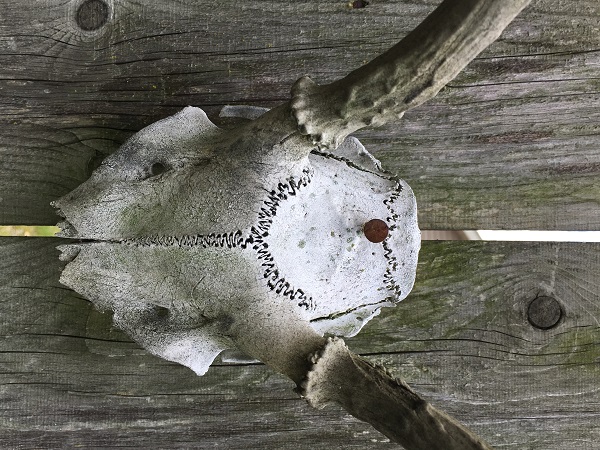
Found-Skull Collection at Stone Lake. Photo by Coby Michael Ward.
Skeletal Remains Used as Ritual Tools
Since the Paleolithic period, mankind has utilized the osteological remains of animals and fellow humans for utilitarian needs and also as ceremonial tools for ritual. Bones, which are the dense mineral remains of many living creatures resemble in texture and strength the stone found in the earth. Minerals were also seen as the bones of the Earth, giving precious metals like iron, gold and silver special significance. Other mineral formations were significant as well, such as sea shells, crystals, and petrified organic materials which all held spiritual importance to many early civilizations. These artifacts formed without the influence of human hands were prized for their beauty, rarity, and value. Horns, skulls, and other naturally formed vessels and containers could be used to receive and hold offerings or serve as a home for the spirits themselves. Many ancestral altars will feature osteological remains for their connection to the spirit world, and their property as a spirit vessel. When used on an altar as the focal point for spirit allies; bones and skulls are often taken at face value for their aesthetic qualities. Some seem to shy away from using bones because of their darker associations and environmental implications.
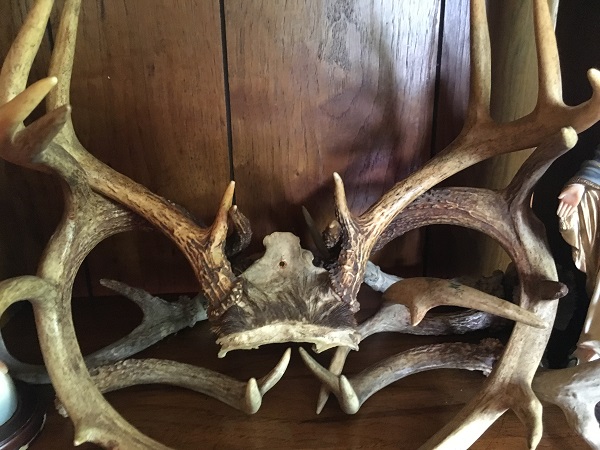
Antler Collection at Stone Lake. Photograph by Coby Michael Ward.
It hasn’t helped that in the past few years stories of grave robbers have come out dealing with individuals who associate themselves with the magical community stealing and selling skeletal remains taken from New Orleans’ cemeteries. These people attempt to sell these stolen remains to other practitioners. These individuals often novices themselves are dangerous to our community at large. By exploiting the dead they invite retribution from both sides of the veil.
Altars and Ritual
An indoor altar or devotional space serves as a proxy for the energies and spirits of nature; the true altar being the Earth herself outdoors. Symbols, tools, and reminders of our Craft stay on the altar, changing seasons like its outside counterpart. I believe there is much to be gained through making regular offerings and devotional trips to the outdoor altar. Tending to the same plot of land and the spirits therein is quintessential to classical witchcraft. Our relationship to familiar spirits is paramount to our practice as witches.
Bones symbolize life, death and rebirth holding the fertile potential of the dark earth from which all life rises. This chthonic fertility is an important aspect of earth energy, embodied by the Dark Goddess, not only the enlivening spark from above but the pulsing emerald glow of internal phosphorescence. Keeping a skull on one’s altar is a common traditional practice often misunderstood in a modern context. However, these sacred vessels are a focal point allowing us to strengthen our connection to ancestral spirits, familiars, the earth and the Horned One himself. The skulls used are generally a horned animal and on a rare occasion a coven may have a ceremonial human skull. These vessels of divine light and promethean illumination are a quintessential aspect of traditional witchcraft seeking to restore the Luciferian stream of consciousness that religious institutions have cut us off from. Often symbolizing the “light betwixt the horns” of the Sabbatic Goat, a candle is usually placed between the horns of the vessel itself or symbolized by the two-pronged stang. The symbol of horns or an upright crescent is a symbol of ancient providence that can be traced back to the lunar and solar religions of Mesopotamia and Egypt where they originated as symbols of divine knowledge.
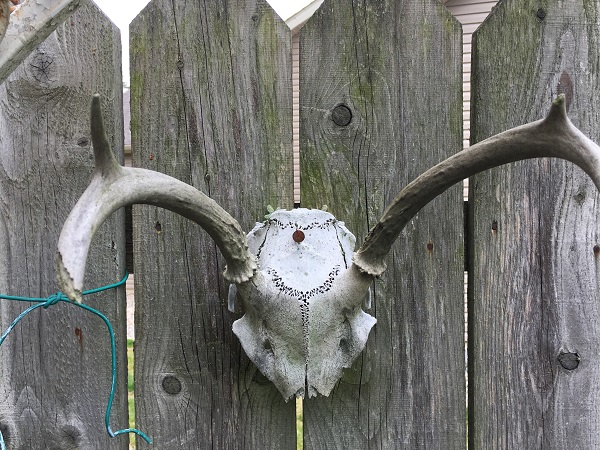
Found-Skull Collection at Stone Lake. Photographed by Coby Michael Ward.
Rituals of preparation are performed over a new vessel, including the using censing with smoke and purification through the elements. The skull is then enlivened through rituals of breath, breathing spirit fire into this once empty vessel. The process known as reddening is an ancient rite, using a red ochre paste to coat the bones. This enlivening process symbolizes blood and vital force being absorbed into the vessel. Smaller bones used for divination and various other charms are common.
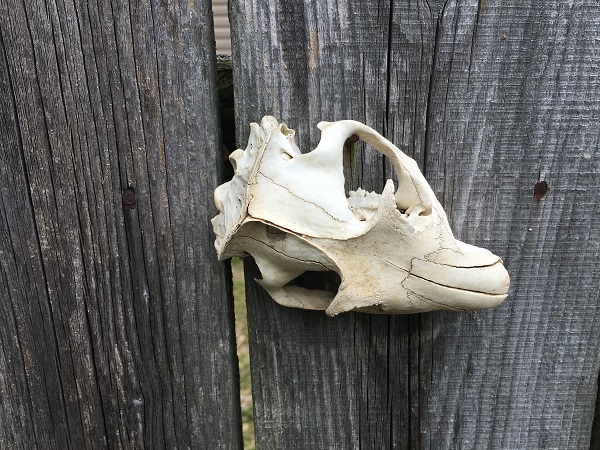
Found-Skull Collection at Stone Lake. Photographed by Coby Michael Ward.
I have always been fascinated by the gifts of nature. Stones, roots, and special sticks would be collected by me an fashioned into tiny charms and trinkets as a child. These little treasures always held a sense of wonder, leading to many collections of mineral and botanical specimen. I often felt that I was not the only one appreciating the small treasures that I would leave out in the gardens at my grandparent’s house. When modern people see bones on an altar the first thing that comes to mind is often sacrifice. in our modern society, unless living as a subsistence farmer, animal sacrifice is inappropriate because it lacks any traditional or cultural necessity that would make such an act appropriate. In modern society this would be akin to sacrificing one’s cat or dog, or totaling your car on purpose. It wouldn’t be practical or appropriate to do such a thing.
First and foremost, as an animist I revere all life as sacred, having its own spirit. In my practice an animal would never be harmed to achieve any end. Some old rituals call for a bit of blood here and there, which holds its own ancient power. Blood drawn and offered from oneself will always hold more power than that which is taken.
Magic and Witchcraft in History
Previous Post
May 22, 2017
The Occvlta Interview
Next Post

June 6, 2017 A Vessel for Elder Gods
Browse Our Archives
Select a Category alchemy astrology Community Outreach and Events Current Events Featured Practitioners Gods and Goddesses green magic Green Witchcraft herbalism History of the Devil luciferian tradition Magic Magic and Ritual Magic and Witchcraft in History Magical Community magical herbalism Medieval Herbalism Metaphysics Modern Witchcraft natal charts natural magic Northern Traditions Occult Art Occult Artifacts Occultism pagan authors Pagan Community Pagan Holidays pagan philosophy Pagan Sightseeing Paganism Personal Practice planetary glyphs planetary symbols Recommended Reading Sabbatic Witchcraft samhain satanism Spells The Armchair The Poison Path Traditional Witchcraft Uncategorized Veneficium wicca witch's practice Witchcraft witches' sabbats
Select a Month December 2022 September 2022 August 2022 July 2022 March 2022 February 2022 January 2022 December 2021 October 2021 September 2021 August 2021 July 2021 May 2021 April 2021 March 2021 January 2021 December 2020 October 2020 September 2020 July 2020 June 2020 May 2020 April 2020 March 2020 February 2020 January 2020 December 2019 November 2019 October 2019 September 2019 August 2019 July 2019 June 2019 May 2019 April 2019 March 2019 February 2019 January 2019 December 2018 November 2018 October 2018 September 2018 August 2018 July 2018 June 2018 May 2018 April 2018 March 2018 February 2018 January 2018 December 2017 November 2017 October 2017 September 2017 August 2017 July 2017 June 2017 May 2017 April 2017 March 2017 February 2017 January 2017 December 2016 November 2016 October 2016 September 2016 August 2016 July 2016 June 2016 May 2016 March 2016 February 2016
Follow Us!
TAKE THE
Religious Wisdom Quiz
Who preached the first sermon in Acts?
Select your answer to see how you score.
Paul James John Peter
Related posts from Poisoner's Apothecary

Interview with a Vampyre Witch: Alexis Pharae
Smoke Divination: The Art of Capnomancy
Witch City Tarot Gathering Re-Cap
Flower Essences from the Witch's Garden
TRENDING AT PATHEOS Pagan

I was recently chatting with someone on Instagram. She asked me what...

While there are many people who share their results, the end of...

On July 23, I saw Christopher Nolan's The Odyssey which is Homer’s...

As I write this two big events have just finished up. One...

Restoring the Watershed of Divine Love
Perhaps cooperation is not something we manufacture through legislation, ideology, or moral...

Many UUs don’t pray because of bad experiences in a previous religion,...
view all Pagan blogs
Ad-Free & Subscriber Log-In Subscription Support
- About Us
- 2026 Calendar
- Videos
- Podcasts
- Library of World Religions
- Faith In Media Tracker
- Advertise With Us
- Write for Us
- Privacy Policy
- Terms of Service
- Do Not Sell My Data
- Contact Us
- Radiant Digital
- Manage Newsletter Subscriptions
- Unsubscribe From Notifications
- Sitemap
Copyright 2008-2026, Patheos. All rights reserved.
Subscription Support Ad-Free & Subscriber Log-In
Follow Patheos