
BuddhistCatholicContemplativeEvangelicalGeneral ChristianHinduJewishLatter-day SaintMuslimNew VisionsProgressive Christian
Beliefs
- Buddhist
- Catholic
- Contemplative
- Evangelical
- General Christian
- Hindu
- Jewish
- Latter-day Saint
- More Voices
- Muslim
- New Visions
- Pagan
- Progressive Christian
Topics
- Religion News
- Food and Religion
- Sports and Religion
- Religious Art
- Religious Music and Entertainment
- Religious Events
- History and Religion
- Style and Religion
- Politics and Religion
- Women in Religion
- Recreation Outdoors and Religion
- Business Finance and Religion
- Careers Workplace and Religion
- Education and Religion
- Family Parenting and Religion
- Health Fitness and Religion
- Home and Religion
- Relationships and Religion
- Technology and Religion
- Travel and Religion
Columnists
- Buddhist Columnists
- Business Finance and Religion Columnists
- Careers Workplace and Religion Columnists
- Catholic Columnists
- Contemplative Columnists
- Education and Religion Columnists
- Evangelists Columnists
- Family Parenting and Religion Columnists
- General Christian Columnists
- Health Fitness and Religion Columnists
- Hindu Columnists
- History and Religion Columnists
- Home and Religion Columnists
- Jewish Columnists
- More Voices Columnists
- Latter Day Columnists
- Muslim Columnists
- New Visions Columnists
- Nonreligious Columnists
- Pagan Columnists
- Politics and Religion Columnists
- Progressive Columnists
- Recreation Outdoors and Religion Columnists
- Relationships and Religion Columnists
- Religion News Columnists
- Religious Art Columnists
- Religious Events Columnists
- Religious Music and Entertainment Columnists
- Sports and Religion Columnists
- Style and Religion Columnists
- Technology and Religion Columnists
- Travel and Religion Columnists
- Women in Religion Columnists
Resource Library
- 2026 Calendar
- Library of World Religions
- The 100 Most Holy Places on Earth
- Patheos Answers
- Podcasts
- Videos
- Faith Leaders Database
- Anglican Episcopalian
- Bahai
- Baptist
- Buddhism
- Christianity
- Confucianism
- Eastern Orthodoxy
- Hinduism
- Holiness and Pentecostal
- ISKCON
- Islam
- Judaism
- Lutheran
- Methodist
- The Church of Jesus Christ of Latter-day Saints
- New Age
- Paganism
- Presbytarian and Reformed
- Protestantism
- Religion Behind the Scenes
- Roman Catholic
- Scientology
- Shia Islam
- Sikhism
- Sufism
- Sunni Islam
- Taoism
- Zen
- See all religions
Research Tools
 Ad-Free & Subscriber Log-In Subscription Support
Ad-Free & Subscriber Log-In Subscription Support
Follow Patheos 

- Trending:
- Forgiveness
- |
- Marriage
- |
- Consciousness
- |
- Death Penalty
- |
- Election
- |
- Halloween
 Poisoner's Apothecary
- Home
- Pagan
- Mastering Herbalism: A Practical Guide (to Traditional Herbal Practice)
Mastering Herbalism: A Practical Guide (to Traditional Herbal Practice)
Last updated on: February 6, 2017 at 10:35 pm by Coby Michael Ward
Mastering Herbalism: A Practical Guide (to Traditional Herbal Practice) 2017-02-06T22:35:10-04:00 Coby Michael Ward
Patheos Explore the world's faith through different perspectives on religion and spirituality! Patheos has the views of the prevalent religions and spiritualities of the world.
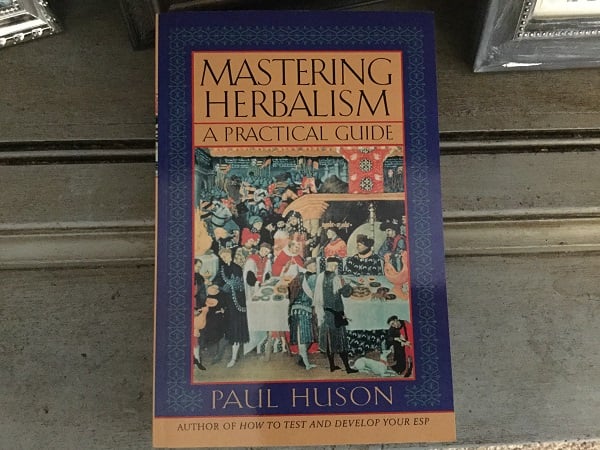
My Copy of Mastering Herbalism, Photo by Coby Michael.
***A Complete Guide of Historical Plant-Based Practices-*Science, Medicine and the Occult
Paul Huson, British-born author and artist residing in the U.S. Huson has also worked extensively in the television and film making industry. Born in 1942, Huson entered the Slade School of Fine Art at the University of London, until 1963. While attending Slade, Huson studied Qabalah and the Western Esoteric tradition with Dion Fortune’s Society of Inner Light. His influential work Mastering Witchcraft was published in 1970. Mastering Herbalism begins with a brief history of herbal practice; describing the details of botanical knowledge beginning with antiquity up to present day. The knowledge and use of botanical medicines has been widespread throughout human history continuing to be a detailed science, taking years of study to master.
The three-hundred page book is organized in categories based on practical use; health, cooking, perfumes, and incense, cultivation and witchcraft to name a few. The corresponding plants are listed within each category. Unlike many of the countless other herbals out there, Mastering Herbalism, goes into detail that few others do. This book is very well researched. Huson shares traditional herbal lore, collecting information from numerous primary sources and also obscure concepts found in other herbals. He provides recipes from the Middle Ages and local cures from the 18th and 19th century describing their medicinal properties and offering various formulas for simples, infusions, and basic medical preparations.
The section on cooking has some great wholesome recipes, and also instructions on wine and beer making. It is just as in depth as the previous chapter on medicines, and would be a fruitful resource for kitchen witches. Huson does not waste any ink by re-explaining common knowledge, going right into the details. Each page is packed with original information. The book continues on in this manner, beginning the next section on herbal perfumes and incense. This chapter gives directions for making herbal sachets and potpourris, using techniques of old-fashioned perfumery. There is also information on making perfumes and other liquid aromatics using traditional recipes, and a most detailed guide to preparing incense. It includes which resins and gums to use, and a multitude of ways incense can be burned. Huson also lists traditional incense recipes given y Culpepper for astrological and planetary fumigations.
A lovely chapter on herbal beauty secrets and aphrodisiacs leads the book into a more esoteric direction. There are many useful organic beauty preparations for skin and hair. Pomanders, wet potpourri, and aromatic vinegars are a few of the time tested methods included here.
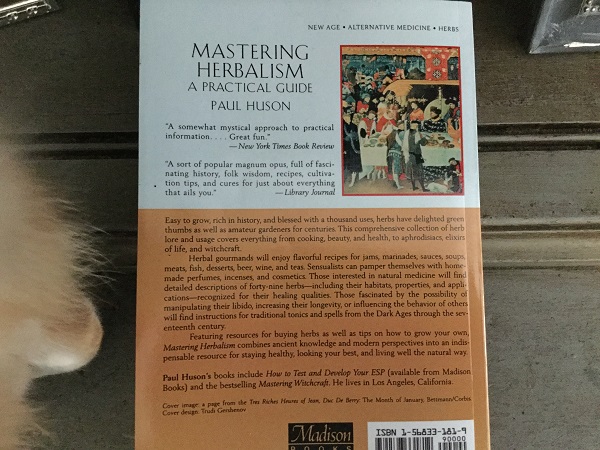
Back cover of Mastering Herbalism. Photo by Coby Michael.
Witchcraft and Wortcunning
Although the first half of the book is dedicated to medical and mundane herbalism, it is still a valuable resource for the practitioner of herbal magic. The chapter on Witchcraft and Wortcunning makes up a small portion of this large guidebook, but is one of the most important chapters. The information contained therein provides more detail on traditional herbal practices than many other entire books devoted to the topic. Herb gathering and the Nine Herb Charm of Saxon Wortcunning begins the chapter which continues with section on Herb magic divided by time period, starting with the Middle Ages and the 17th century. The majority of herbal lore comes from the early modern period instead of modern sources.
In the section on Witchcraft, Huson describes which plants were traditionally used for what purpose, and gives examples of how people have used them. Discussing herbs for exorcism, love and divination and other magical pursuits such as scrying. The culmination of the chapter, and book, in my opinion, is the section on witches’ ointments. Huson doesn’t hesitate to discuss the m in detail, analyzing some old recipes, and the solanaceous plants of the witch’s garden.
The book also serves as a resource for further study. The tables of weights and measures and glossary will continue to be useful. The bibliography is most considerate. Also divided by category, Huson lists numerous resources for continued studies. Categories like the Old Herbalists, Medicine and Formulas, and Witchcraft and Wortcunning are topics of interest for anyone looking to continue studying traditional herbal practices.
Magic and Witchcraft in History
Previous Post
February 3, 2017
The Popularity of Magic in Renaissance Europe
Browse Our Archives
Select a Category alchemy astrology Community Outreach and Events Current Events Featured Practitioners Gods and Goddesses green magic Green Witchcraft herbalism History of the Devil luciferian tradition Magic Magic and Ritual Magic and Witchcraft in History Magical Community magical herbalism Medieval Herbalism Metaphysics Modern Witchcraft natal charts natural magic Northern Traditions Occult Art Occult Artifacts Occultism pagan authors Pagan Community Pagan Holidays pagan philosophy Pagan Sightseeing Paganism Personal Practice planetary glyphs planetary symbols Recommended Reading Sabbatic Witchcraft samhain satanism Spells The Armchair The Poison Path Traditional Witchcraft Uncategorized Veneficium wicca witch's practice Witchcraft witches' sabbats
Select a Month December 2022 September 2022 August 2022 July 2022 March 2022 February 2022 January 2022 December 2021 October 2021 September 2021 August 2021 July 2021 May 2021 April 2021 March 2021 January 2021 December 2020 October 2020 September 2020 July 2020 June 2020 May 2020 April 2020 March 2020 February 2020 January 2020 December 2019 November 2019 October 2019 September 2019 August 2019 July 2019 June 2019 May 2019 April 2019 March 2019 February 2019 January 2019 December 2018 November 2018 October 2018 September 2018 August 2018 July 2018 June 2018 May 2018 April 2018 March 2018 February 2018 January 2018 December 2017 November 2017 October 2017 September 2017 August 2017 July 2017 June 2017 May 2017 April 2017 March 2017 February 2017 January 2017 December 2016 November 2016 October 2016 September 2016 August 2016 July 2016 June 2016 May 2016 March 2016 February 2016
Follow Us!
TAKE THE
Religious Wisdom Quiz
How many years did it take Solomon to build his palace?
Select your answer to see how you score.
13 years 10 years 15 years 7 years
Related posts from Poisoner's Apothecary

Christian Rätsch, Undying Contributions to the Poison Path

The Satyr's Kiss by Storm Faerywolf
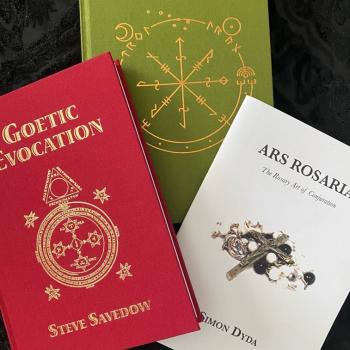
The Fairy Godmother of Occult Publishing
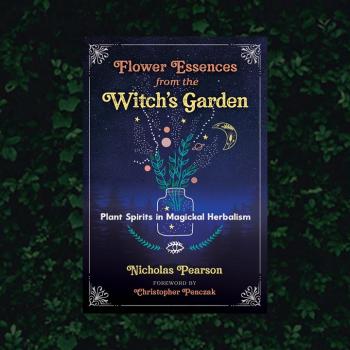
Flower Essences from the Witch's Garden
TRENDING AT PATHEOS Pagan

I was recently chatting with someone on Instagram. She asked me what...

While there are many people who share their results, the end of...

On July 23, I saw Christopher Nolan's The Odyssey which is Homer’s...

As I write this two big events have just finished up. One...

Restoring the Watershed of Divine Love
Perhaps cooperation is not something we manufacture through legislation, ideology, or moral...

Many UUs don’t pray because of bad experiences in a previous religion,...
view all Pagan blogs
Ad-Free & Subscriber Log-In Subscription Support
- About Us
- 2026 Calendar
- Videos
- Podcasts
- Library of World Religions
- Faith In Media Tracker
- Advertise With Us
- Write for Us
- Privacy Policy
- Terms of Service
- Do Not Sell My Data
- Contact Us
- Radiant Digital
- Manage Newsletter Subscriptions
- Unsubscribe From Notifications
- Sitemap
Copyright 2008-2026, Patheos. All rights reserved.
Subscription Support Ad-Free & Subscriber Log-In
Follow Patheos