
BuddhistCatholicContemplativeEvangelicalGeneral ChristianHinduJewishLatter-day SaintMuslimNew VisionsProgressive Christian
Beliefs
- Buddhist
- Catholic
- Contemplative
- Evangelical
- General Christian
- Hindu
- Jewish
- Latter-day Saint
- More Voices
- Muslim
- New Visions
- Pagan
- Progressive Christian
Topics
- Religion News
- Food and Religion
- Sports and Religion
- Religious Art
- Religious Music and Entertainment
- Religious Events
- History and Religion
- Style and Religion
- Politics and Religion
- Women in Religion
- Recreation Outdoors and Religion
- Business Finance and Religion
- Careers Workplace and Religion
- Education and Religion
- Family Parenting and Religion
- Health Fitness and Religion
- Home and Religion
- Relationships and Religion
- Technology and Religion
- Travel and Religion
Columnists
- Buddhist Columnists
- Business Finance and Religion Columnists
- Careers Workplace and Religion Columnists
- Catholic Columnists
- Contemplative Columnists
- Education and Religion Columnists
- Evangelists Columnists
- Family Parenting and Religion Columnists
- General Christian Columnists
- Health Fitness and Religion Columnists
- Hindu Columnists
- History and Religion Columnists
- Home and Religion Columnists
- Jewish Columnists
- More Voices Columnists
- Latter Day Columnists
- Muslim Columnists
- New Visions Columnists
- Nonreligious Columnists
- Pagan Columnists
- Politics and Religion Columnists
- Progressive Columnists
- Recreation Outdoors and Religion Columnists
- Relationships and Religion Columnists
- Religion News Columnists
- Religious Art Columnists
- Religious Events Columnists
- Religious Music and Entertainment Columnists
- Sports and Religion Columnists
- Style and Religion Columnists
- Technology and Religion Columnists
- Travel and Religion Columnists
- Women in Religion Columnists
Resource Library
- 2026 Calendar
- Library of World Religions
- The 100 Most Holy Places on Earth
- Patheos Answers
- Podcasts
- Videos
- Faith Leaders Database
- Anglican Episcopalian
- Bahai
- Baptist
- Buddhism
- Christianity
- Confucianism
- Eastern Orthodoxy
- Hinduism
- Holiness and Pentecostal
- ISKCON
- Islam
- Judaism
- Lutheran
- Methodist
- The Church of Jesus Christ of Latter-day Saints
- New Age
- Paganism
- Presbytarian and Reformed
- Protestantism
- Religion Behind the Scenes
- Roman Catholic
- Scientology
- Shia Islam
- Sikhism
- Sufism
- Sunni Islam
- Taoism
- Zen
- See all religions
Research Tools
 Ad-Free & Subscriber Log-In Subscription Support
Ad-Free & Subscriber Log-In Subscription Support
Follow Patheos 

- Trending:
- Forgiveness
- |
- Marriage
- |
- Consciousness
- |
- Death Penalty
- |
- Election
- |
- Halloween
 Poisoner's Apothecary
- Home
- Pagan
- Persecution in Pursuit of Knowledge
Persecution in Pursuit of Knowledge
Last updated on: January 29, 2017 at 11:28 am by Coby Michael Ward
Persecution in Pursuit of Knowledge 2017-01-29T11:28:25-04:00 Coby Michael Ward
Patheos Explore the world's faith through different perspectives on religion and spirituality! Patheos has the views of the prevalent religions and spiritualities of the world.
Science, Occultism, and Heresy
During the time of the Inquisition, free thinkers of all kinds were put on trial for various forms of heresy. Numerous men and women were tried and put to death for their crimes. By the 16th and 17th centuries the Church’s fear of heresy had reached a peak. Not only were they concerned about heretics within diverse Christian groups, they also had to contend with the growing number of educated free thinkers. Many books and ideas were put on a church-sanctioned forbidden list. Those books that contradicted the approved Church doctrine were banned specifically to prevent these ideas from spreading. If these ideas were allowed to spread to the masses it would damage Christianity’s reputation. Science and medicine were also new areas of study that were on the rise during this time period. New discoveries were being made in different areas, posing new philosophical questions.
Through empirical science concrete evidence supporting alternate views of the Universe would anger Church officials who adhered to the Holy Scriptures as the infallible truth. It was during this period of the Inquisition that a war was going on between science and religion. New evidence proving the heliocentric model of the solar system challenged the infallibility of the Bible, and this infuriated church officials. Their goal was to silence these free thinking scientists in whatever way they could.
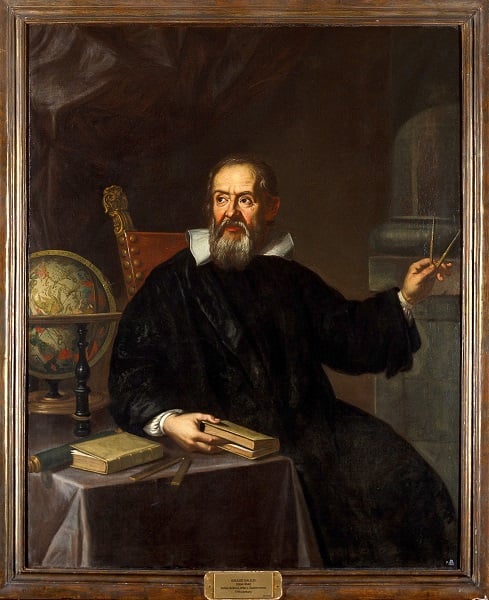
Galileo Galilei (1564-1642). Oil painting by an Italian painter. (Wikimedia Commons)
Galileo, Copernicus, and the Scientific Revolution
Galileo Galilei and Nicolaus Copernicus are two of the most well-known examples of scientific revolutionaries who were eventually accused of heresy. Both of these men of science supported the heliocentric view of the solar system, which had already been theorized in antiquity. Isaac Newton is another prominent example. Known for his theory of gravity, Newton had other ideas that were condemned by the Church as well. Newton was also an occultist who studied extensively the subject of alchemy. The occult sciences held as much interest for these men of science as the natural sciences, and a study of both would show that they are more connected to one another than one would initially think.
The Scientific Revolution secured science a permanent foothold in Western Civilization, encouraging the practice of skepticism. Seventeenth century philosophers like Descartes, Bacon, Galileo, and Kepler, all refused to rely on existing knowledge, depending on knowledge gained from observation and experimentation. This methodology of skepticism was used to challenged the doctrine of both Judaism and Orthodox Christianity. This new way of interpreting information about the world posed two major threats to traditional Christian belief as perceived by Church officials. The issues caused by the contradiction of the heliocentric model of the solar system raised more questions about the scripture’s literal interpretation. Another challenge was raised by the idea that the Universe was like a machine that operated on a predetermined set of rules. This implies that God was not as active in the physical movements of the celestial bodies, acting as Creator and setting the Universe in motion to continue operating based on its natural laws. The Church was threatened because their infallible nature was called into question. However, many scientists insisted that there was no conflict, and many theologians also agreed. They argued that religion and science have different concerns, and can therefore coexist. According to Galileo scripture was not meant to explain natural phenomenon, but to convey religious truths that human reason could not grasp.
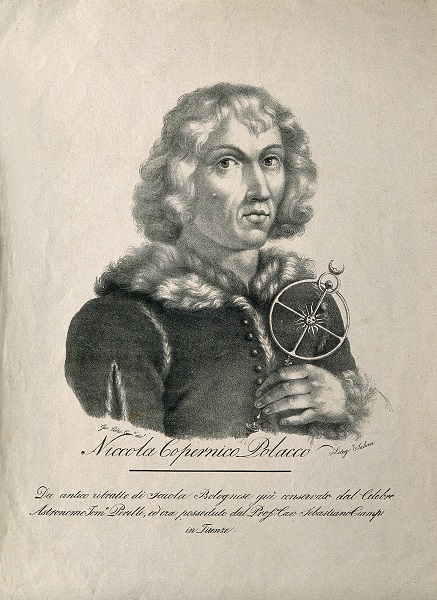
Nicolaus Copernicus. Lithograph by Salucci after G. Colzi. (Wikimedia Creative Commons.)
Protestantism and the Age of Reason
As the new sciences become more widely accepted, many theologians, especially Protestants, accommodated scientific knowledge along with religious beliefs. Welcoming these new principles of reason, Protestant officials hoped that this reason would purify Christian religion from superstition, magic and ignorance, which they accused the Catholic Church of Promoting. By 1700 theology has lost its dominant position in University curriculum and religion lost much of its influence on secular matters. However, it remained a vital force in European communities. Although various types of indigenous folk magic were maintained by people, the drew on Christian imagery and symbolism. Folk magic was the practical tool chest of the laity. In elite circles where literacy and education were more prominent; academics also studied classic medieval grimoires, magical alphabets and various rituals of ceremonial magic, combining European folk practices with more complex esoteric concepts.
Today, many modern magical practitioners, especially within modern traditional witchcraft revivals, combine the archetype of the wild hedge witch with the intellectual pursuit of occult studies and ceremonial practices. Thus creating a well-rounded magical practitioner. With the accessibility and many translations of these one rare tomes, new hybrids of academic occultism and witchcraft are on the rise. One of the main defining features of modern traditional witchcraft is the combination of various indigenous European folk practices, and an in-depth study of medieval grimoires, Renaissance occultism, and both Jewish and Christian esotericism. Schools of traditional European witchcraft recognize the influences that Jewish mysticism and Christian imagery play in shaping the witchcraft paradigm.
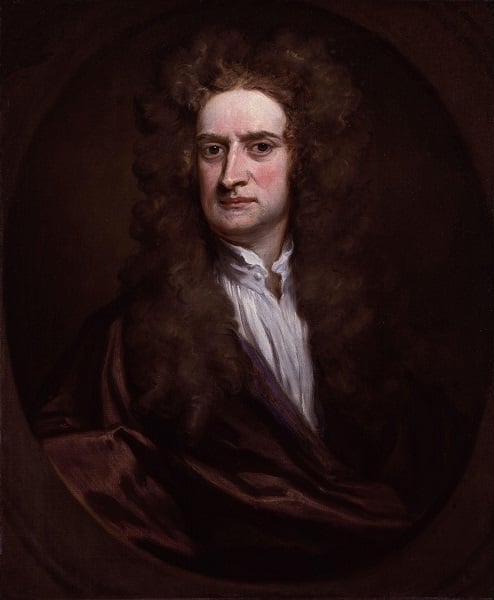
Sir Isaac Newton by Sir Godfrey Kneller. (Wikimedia commons)
Science and Magic, Two Old Friends.
Alchemy eventually was transmuted into Chemistry and astrology led to astronomy and sacred geometry can be found in mathematics. Together science and magic can compliment one another. Witchcraft itself is an art and science of the Unseen World, seeking to uncover and understand the inner workings of the Universe. With the rapid advances in scientific theory, quantum physics, and discoveries like the god particle; science often comes very close to sounding like esotericism. In modern witchcraft revivals that draw from the grimoire traditions, using tables of correspondence, astrological associations, and the Hermetic Principles, which act as a kind of Scientific Method. We realize that magic and witchcraft can become very precise and scientific in nature as one delves into deeper occult concepts.
Scientists and magical practitioners walk a similar path in pursuit of knowledge, both seeking answers, illumination, and gnosis. It is in their nature to question that which is “normal” or “mainstream.” This puts them perpetually on the outside looking in. As an outsider, we are able to get a better look at the bigger picture by witnessing those interactions that would otherwise go unnoticed. Society teaches us not to question, but to conform. It is not in the nature of these individuals to take another’s authority as infallible truth, focusing more on individual experience. Individualism is a threat to the authoritarian institutions of orthodox religion. As history tells us, those who were a threat to the institution were condemned of heresy, and either imprisoned or put to death to prevent spreading new ideas.
The American Inquisition
Four hundred years ago in 1616 Pope Paul V made the Papal Decree Against Heliocentrism, which banned the works on this topic until corrected to match the views of the Church. Other similar works were forbidden completely. There existed an entire Index of Forbidden Books that was compiled by the Catholic Church to prevent the spread of damaging ideas.
“This congregation has also learned of the spreading and acceptance by many of the false Pythagorean doctrine, altogether contrary to the Holy Scripture, that the Earth moves and the Sun is motionless, which is also taught by Nicolaus Copernicus.” – Papal Decree Against Heliocentrism
The recent censorship of the scientific community ordered by the Trump administration is eerily similar when we take into consideration the influence the Religious Right has had in recent years, and an attempt by officials to stop potentially damaging ideas from spreading. The oppression of scientific information is a characteristic of an authoritarian power, that wants to keep its public ignorant and be the sole source of information so they may create their own reality. This was a similar tactic used by the Roman Catholic Church to maintain its power and authority during the Inquisition and Reformation.
As Pagans, witches and magical practitioners it is important that we make our voice known, and stand with our brothers and sisters in science. Our presence is important and we must ally ourselves to be on the correct side of history. We claim to worship nature and honor our ancestors, these are the times that count when we must come together and stand with conviction. We are a diverse group of people consisting of many minority backgrounds and members of the LGBTQ community. Although in years past we have been labeled as privileged new age hobbyists, this is definitely not the case. Modern witches like the freethinking men and women of the past stand in opposition to oppression by these institutions that would keep us ignorant.
References:
Are Great Scientists Always Heretics? By Dr, Stuart Clark. www.bbc.co.uk/science/0/22078983
Three Things You Need to Know About the Science Rebellion Against Trump. By: Laura Parker and Craig Welch. news.nationalgeographic.com/2017/01/scientists-march-on-Washington-national-parks-twitter-war-climate-science-donald-trump/#close
The West: Encounters and Transformations Volume 1: To 1715. Levack, Brian. Muir, & Veldman. Pearson Education, Inc.
Magic and Witchcraft in History

Next Post
February 3, 2017 The Popularity of Magic in Renaissance Europe
Browse Our Archives
Select a Category alchemy astrology Community Outreach and Events Current Events Featured Practitioners Gods and Goddesses green magic Green Witchcraft herbalism History of the Devil luciferian tradition Magic Magic and Ritual Magic and Witchcraft in History Magical Community magical herbalism Medieval Herbalism Metaphysics Modern Witchcraft natal charts natural magic Northern Traditions Occult Art Occult Artifacts Occultism pagan authors Pagan Community Pagan Holidays pagan philosophy Pagan Sightseeing Paganism Personal Practice planetary glyphs planetary symbols Recommended Reading Sabbatic Witchcraft samhain satanism Spells The Armchair The Poison Path Traditional Witchcraft Uncategorized Veneficium wicca witch's practice Witchcraft witches' sabbats
Select a Month December 2022 September 2022 August 2022 July 2022 March 2022 February 2022 January 2022 December 2021 October 2021 September 2021 August 2021 July 2021 May 2021 April 2021 March 2021 January 2021 December 2020 October 2020 September 2020 July 2020 June 2020 May 2020 April 2020 March 2020 February 2020 January 2020 December 2019 November 2019 October 2019 September 2019 August 2019 July 2019 June 2019 May 2019 April 2019 March 2019 February 2019 January 2019 December 2018 November 2018 October 2018 September 2018 August 2018 July 2018 June 2018 May 2018 April 2018 March 2018 February 2018 January 2018 December 2017 November 2017 October 2017 September 2017 August 2017 July 2017 June 2017 May 2017 April 2017 March 2017 February 2017 January 2017 December 2016 November 2016 October 2016 September 2016 August 2016 July 2016 June 2016 May 2016 March 2016 February 2016
Follow Us!
TAKE THE
Religious Wisdom Quiz
Which book is the largest by chapters in the Bible?
Select your answer to see how you score.
Genesis Proverbs Isaiah Psalms
Related posts from Poisoner's Apothecary

Interview with a Vampyre Witch: Alexis Pharae
Christian Rätsch, Undying Contributions to the Poison Path

Smoke Divination: The Art of Capnomancy
Witch City Tarot Gathering Re-Cap
TRENDING AT PATHEOS Pagan

I was recently chatting with someone on Instagram. She asked me what...

While there are many people who share their results, the end of...

On July 23, I saw Christopher Nolan's The Odyssey which is Homer’s...

As I write this two big events have just finished up. One...

Restoring the Watershed of Divine Love
Perhaps cooperation is not something we manufacture through legislation, ideology, or moral...

Many UUs don’t pray because of bad experiences in a previous religion,...
view all Pagan blogs
Ad-Free & Subscriber Log-In Subscription Support
- About Us
- 2026 Calendar
- Videos
- Podcasts
- Library of World Religions
- Faith In Media Tracker
- Advertise With Us
- Write for Us
- Privacy Policy
- Terms of Service
- Do Not Sell My Data
- Contact Us
- Radiant Digital
- Manage Newsletter Subscriptions
- Unsubscribe From Notifications
- Sitemap
Copyright 2008-2026, Patheos. All rights reserved.
Subscription Support Ad-Free & Subscriber Log-In
Follow Patheos