
BuddhistCatholicContemplativeEvangelicalGeneral ChristianHinduJewishLatter-day SaintMuslimNew VisionsProgressive Christian
Beliefs
- Buddhist
- Catholic
- Contemplative
- Evangelical
- General Christian
- Hindu
- Jewish
- Latter-day Saint
- More Voices
- Muslim
- New Visions
- Pagan
- Progressive Christian
Topics
- Religion News
- Food and Religion
- Sports and Religion
- Religious Art
- Religious Music and Entertainment
- Religious Events
- History and Religion
- Style and Religion
- Politics and Religion
- Women in Religion
- Recreation Outdoors and Religion
- Business Finance and Religion
- Careers Workplace and Religion
- Education and Religion
- Family Parenting and Religion
- Health Fitness and Religion
- Home and Religion
- Relationships and Religion
- Technology and Religion
- Travel and Religion
Columnists
- Buddhist Columnists
- Business Finance and Religion Columnists
- Careers Workplace and Religion Columnists
- Catholic Columnists
- Contemplative Columnists
- Education and Religion Columnists
- Evangelists Columnists
- Family Parenting and Religion Columnists
- General Christian Columnists
- Health Fitness and Religion Columnists
- Hindu Columnists
- History and Religion Columnists
- Home and Religion Columnists
- Jewish Columnists
- More Voices Columnists
- Latter Day Columnists
- Muslim Columnists
- New Visions Columnists
- Nonreligious Columnists
- Pagan Columnists
- Politics and Religion Columnists
- Progressive Columnists
- Recreation Outdoors and Religion Columnists
- Relationships and Religion Columnists
- Religion News Columnists
- Religious Art Columnists
- Religious Events Columnists
- Religious Music and Entertainment Columnists
- Sports and Religion Columnists
- Style and Religion Columnists
- Technology and Religion Columnists
- Travel and Religion Columnists
- Women in Religion Columnists
Resource Library
- 2026 Calendar
- Library of World Religions
- The 100 Most Holy Places on Earth
- Patheos Answers
- Podcasts
- Videos
- Faith Leaders Database
- Anglican Episcopalian
- Bahai
- Baptist
- Buddhism
- Christianity
- Confucianism
- Eastern Orthodoxy
- Hinduism
- Holiness and Pentecostal
- ISKCON
- Islam
- Judaism
- Lutheran
- Methodist
- The Church of Jesus Christ of Latter-day Saints
- New Age
- Paganism
- Presbytarian and Reformed
- Protestantism
- Religion Behind the Scenes
- Roman Catholic
- Scientology
- Shia Islam
- Sikhism
- Sufism
- Sunni Islam
- Taoism
- Zen
- See all religions
Research Tools
 Ad-Free & Subscriber Log-In Subscription Support
Ad-Free & Subscriber Log-In Subscription Support
Follow Patheos 

- Trending:
- Forgiveness
- |
- Marriage
- |
- Consciousness
- |
- Death Penalty
- |
- Election
- |
- Halloween
 Poisoner's Apothecary
- Home
- Pagan
- Many Are the Roots of the Halloween Tree
Many Are the Roots of the Halloween Tree
Last updated on: October 25, 2016 at 7:07 am by Coby Michael Ward
Many Are the Roots of the Halloween Tree 2016-10-25T07:07:27-04:00 Coby Michael Ward
Patheos Explore the world's faith through different perspectives on religion and spirituality! Patheos has the views of the prevalent religions and spiritualities of the world.
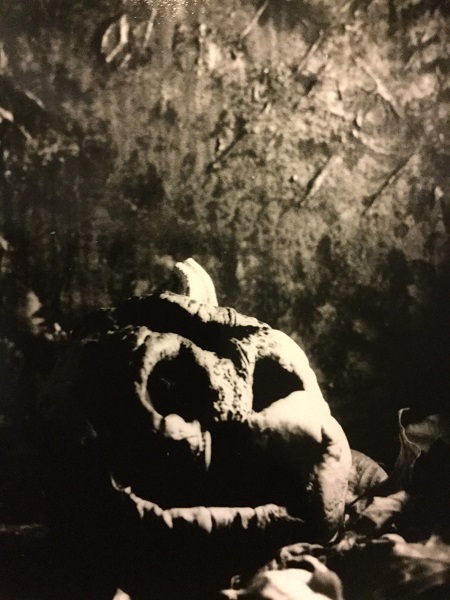
Pumpkin. 2007. Photo by Coby Michael
Halloween has always had a special place in my heart. Some of my best childhood memories happened during this time of the year. Those memories come rushing back when I smell dead leaves, and autumn fires burning. It wasn’t until my early teenage years when I began studying witchcraft that Halloween came to have a more sacred meaning. I came to understand it for more than just the secular holiday of costumes and haunted houses. Halloween always held more meaning for me than that anyway. I remember at a young age being able to sense the strange power in the air when I would be out trick-or-treating with my family or celebrating with my friends. As I started to learn more about witchcraft, Halloween became Samhain, and adopted an additional meaning. The secular celebration of Halloween will always be part of my celebration this time of the year, but now it is also about honoring and communing with the ancestors of our traditions, feeding the shades of the dead with offerings, and celebrating with the gods of magic and death. As my studies have led me in various directions; I have come to settle upon the practices of British traditional witchcraft and also the magical practices of mainland Germany and France as my area of focus. My study of witchcraft throughout history has taught me that Halloween or All Hallows Eve may have connections to the Celtic feast of Samhain, but there are multiple layers and influences in addition to the Celtic influences.
The most immediate connection starts with the Western Christian observance of All Hallows Tide, which occurs as a triduum (three day period) from October 31st to November 2nd. All Hallows Eve begins the liturgical practice of All Saint’s Day during the evening prayer service, vespers, on October 31st, the night before. The Feast of All Saints occurs on November 1st, and its purpose is to remember and honor all the saints canonized. On the next day, November 2nd the faithful dead are remembered with the Feast of All Souls. The similar themes of honoring the dead made it easier to replace existing pagan celebrations with Church sanctioned ones. Both of these Christian observances were moved from their original dates to replace the Celtic celebration of Samhain. Interestingly, the original dates of both the Feast of All Saints and the Feast of All Souls correspond to Pagan celebrations in the Roman calendar as well.
It was Pope Gregory III who transferred All Saints Day to November 1st in 835 CE. Its original date is still observed by Eastern Orthodox traditions as the Sunday after Pentecost, which would have been in May. It is difficult to trace the exact origins of All Saints, however many believe that the original date has origins in the Roman Feast of Lemures, a Pagan celebration similar to Celtic Samhain. Lemuralia as it was also known was a time when restless spirits were propitiated, and it was observed on May 13th. The same is true when we look at the Feast of All Souls, which was originally designated as February 21st to replace the Roman observance of Parentalia, it was moved to its current date in 998 CE. The Roman calendar consisted of three observances during which the spirits of the dead could be propitiated; the first was Parentalia, then Lemuralia, and finally Feralia. The last of the three festivals held in late October, Feralia, was held in honor of Jupiter Feretrius and the infernal powers. During this time Romans traditionally commemorated the passing of the dead. The Romans had conquered much of the Celtic territories by 43 A.D. During the 400 year rule Celtic and Roman Christo-Pagan traditions mingled with one another. The Roman contact with similar Celtic feasts of the dead both helped influence our current Halloween celebrations.
In the British Isles All Saints was being celebrated on November 1st by the beginning of the 8th century to gradually replace the Celtic Samhain festival, just like the original dates replaced the ancient roman holidays. Traditional Hallow Fires were still being burned in Ireland, Wales, and Northern England and Scotland where people danced and celebrated while the god-fearing folk stayed indoors. These traditional balefires were banned by the Church briefly in the 16th century. Celtic influences held on the longest in these areas, and remained after Roman occupation subsided.
Even after Roman rule, when the Catholic church began to spread its influence throughout Britain and Ireland; it met with great resistance in regards to the festivities of Samhain. The Church initially attempted to subjugate the holiday completely, but even after conversion the British and Irish continued honoring their dead at this time. This is why Pope Gregory III adopted the holiday into the Christian calendar as part of All Hallows.
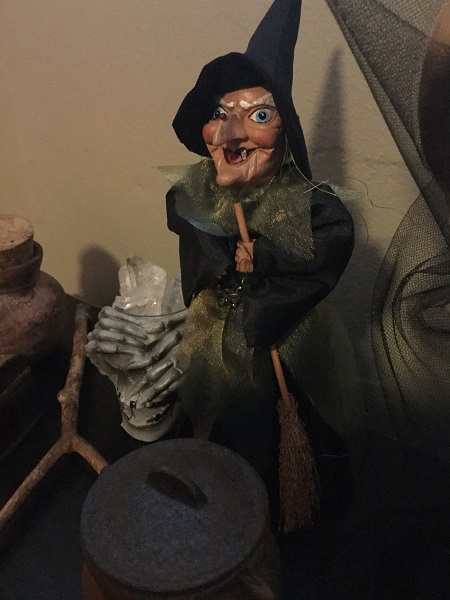
Halloween Witch. Photo by Coby Michael. 2016.
In my opinion, All Hallows Eve lost much of its religious and cultural significance when it was imported to America in the mid 1800s. It was a cultural custom that was brought over by Irish immigrants during the Potato Famine. It was initially concentrated in these communities before becoming part of mainstream secular society. During the Victorian Era in America Halloween took on many of the characteristic associations that it has today, such as; parties and festivities where games were played and food was enjoyed. During this era people were encouraged to remove any dark symbolism from the holiday turning it into a day of merrymaking, losing much of its original intention.
It wasn’t until the 1920s that we begin to see Halloween become a night of children’s mischief. Originally, innocent pranks were played on unsuspecting neighbors, but throughout the twentieth century the innocent fun that the Victorians sought became a means of social protest which resulted in serious vandalism. The holiday suffered attacks from the fundamentalist Evangelical communities that emerged in the 1950s and 60s. Smear campaigns using false propaganda brought the Devil back into American Halloween with its suggestion that Halloween celebrations led to Satanic practices. The mainstream media and local news stations fueled paranoia as the infamous urban legend of tainted Halloween Candy spread across the country. The majority of confirmed cases that have factual basis we understand now to be the result of individuals within the immediate family group responsible, not a widespread conspiracy of deviants. Christian Fundamentalists used this fear as fuel for the “satanic panic” that would ensue from the late 1970s through the 90s.
The bottom line is that this time of year has an innate power all its own that cannot be ignored or denied. Heathens and Christians alike feel the power in the air this time of year. It is a time of shadows and misty darkness, obscuring the light so that we may see with new sight into the unseen world beyond. It is about community; reuniting with our spiritual brethren in celebration of the ever turning wheel of life. Whether living or dead, we are all spiritual entities experiencing this Universe through various means. During this time of year the other world is at its closest to our own, and the veil that separates us is pulled aside. Those of us who traffic in the worlds of spirits on a regular basis will find it much easier to pass in and out of these realms as if simultaneously existing in both.
As a practitioner of traditional witchcraft, much of the symbolism of the medieval Witches Sabbath as a means of spiritual congress is used in oneiric workings or through inducing trance. During this time of the year Sabbatic workings are at their most powerful. The company of spirits at the witch’s round during the dark days surrounding this time of year is greater than any other time. Samhain is a perfect example of the original pre-Christian traditions of the Celts, the similarities shared with the pagan holidays of ancient Rome, and their early Christian counterparts, which influenced the Christo-Pagan folk practices that would hang on as the historical traditions still observed today. It is through this Christo-Pagan synthesis that many of these pre-Christian practices were preserved. Christianity, being the dominant culture of the time undeniably left its mark on the history of these practices, however without which these practices would likely have been lost altogether. As a traditional witch and Pagan academic, I look to find the original roots of these practices and how they have been disguised and maintained by various folk practices across Western Europe.
Sources:
theisticsatanism.com/geifodd/Halloween.html
www.discovermiddleages.co.uk/the-history-of-halloween/
www.history.com/topics/halloween/history-of-halloween
Magic and Witchcraft in History
Previous Post
October 14, 2016
The Birth of the Magus
Next Post

November 1, 2016 The Season of the Witch is Just Beginning
Browse Our Archives
Select a Category alchemy astrology Community Outreach and Events Current Events Featured Practitioners Gods and Goddesses green magic Green Witchcraft herbalism History of the Devil luciferian tradition Magic Magic and Ritual Magic and Witchcraft in History Magical Community magical herbalism Medieval Herbalism Metaphysics Modern Witchcraft natal charts natural magic Northern Traditions Occult Art Occult Artifacts Occultism pagan authors Pagan Community Pagan Holidays pagan philosophy Pagan Sightseeing Paganism Personal Practice planetary glyphs planetary symbols Recommended Reading Sabbatic Witchcraft samhain satanism Spells The Armchair The Poison Path Traditional Witchcraft Uncategorized Veneficium wicca witch's practice Witchcraft witches' sabbats
Select a Month December 2022 September 2022 August 2022 July 2022 March 2022 February 2022 January 2022 December 2021 October 2021 September 2021 August 2021 July 2021 May 2021 April 2021 March 2021 January 2021 December 2020 October 2020 September 2020 July 2020 June 2020 May 2020 April 2020 March 2020 February 2020 January 2020 December 2019 November 2019 October 2019 September 2019 August 2019 July 2019 June 2019 May 2019 April 2019 March 2019 February 2019 January 2019 December 2018 November 2018 October 2018 September 2018 August 2018 July 2018 June 2018 May 2018 April 2018 March 2018 February 2018 January 2018 December 2017 November 2017 October 2017 September 2017 August 2017 July 2017 June 2017 May 2017 April 2017 March 2017 February 2017 January 2017 December 2016 November 2016 October 2016 September 2016 August 2016 July 2016 June 2016 May 2016 March 2016 February 2016
Follow Us!
TAKE THE
Religious Wisdom Quiz
What does Paul tell Timothy to flee from in 2 Timothy?
Select your answer to see how you score.
Evil desires of youth False teaching The love of money Persecution
Related posts from Poisoner's Apothecary
Witch City Tarot Gathering Re-Cap
The Fairy Godmother of Occult Publishing
Flower Essences from the Witch's Garden
Philosophia Toxicum: A Discourse on the Poison Path
TRENDING AT PATHEOS Pagan

I was recently chatting with someone on Instagram. She asked me what...

While there are many people who share their results, the end of...

On July 23, I saw Christopher Nolan's The Odyssey which is Homer’s...

As I write this two big events have just finished up. One...

Restoring the Watershed of Divine Love
Perhaps cooperation is not something we manufacture through legislation, ideology, or moral...

Many UUs don’t pray because of bad experiences in a previous religion,...
view all Pagan blogs
Ad-Free & Subscriber Log-In Subscription Support
- About Us
- 2026 Calendar
- Videos
- Podcasts
- Library of World Religions
- Faith In Media Tracker
- Advertise With Us
- Write for Us
- Privacy Policy
- Terms of Service
- Do Not Sell My Data
- Contact Us
- Radiant Digital
- Manage Newsletter Subscriptions
- Unsubscribe From Notifications
- Sitemap
Copyright 2008-2026, Patheos. All rights reserved.
Subscription Support Ad-Free & Subscriber Log-In
Follow Patheos