
BuddhistCatholicContemplativeEvangelicalGeneral ChristianHinduJewishLatter-day SaintMuslimNew VisionsProgressive Christian
Beliefs
- Buddhist
- Catholic
- Contemplative
- Evangelical
- General Christian
- Hindu
- Jewish
- Latter-day Saint
- More Voices
- Muslim
- New Visions
- Pagan
- Progressive Christian
Topics
- Religion News
- Food and Religion
- Sports and Religion
- Religious Art
- Religious Music and Entertainment
- Religious Events
- History and Religion
- Style and Religion
- Politics and Religion
- Women in Religion
- Recreation Outdoors and Religion
- Business Finance and Religion
- Careers Workplace and Religion
- Education and Religion
- Family Parenting and Religion
- Health Fitness and Religion
- Home and Religion
- Relationships and Religion
- Technology and Religion
- Travel and Religion
Columnists
- Buddhist Columnists
- Business Finance and Religion Columnists
- Careers Workplace and Religion Columnists
- Catholic Columnists
- Contemplative Columnists
- Education and Religion Columnists
- Evangelists Columnists
- Family Parenting and Religion Columnists
- General Christian Columnists
- Health Fitness and Religion Columnists
- Hindu Columnists
- History and Religion Columnists
- Home and Religion Columnists
- Jewish Columnists
- More Voices Columnists
- Latter Day Columnists
- Muslim Columnists
- New Visions Columnists
- Nonreligious Columnists
- Pagan Columnists
- Politics and Religion Columnists
- Progressive Columnists
- Recreation Outdoors and Religion Columnists
- Relationships and Religion Columnists
- Religion News Columnists
- Religious Art Columnists
- Religious Events Columnists
- Religious Music and Entertainment Columnists
- Sports and Religion Columnists
- Style and Religion Columnists
- Technology and Religion Columnists
- Travel and Religion Columnists
- Women in Religion Columnists
Resource Library
- 2026 Calendar
- Library of World Religions
- The 100 Most Holy Places on Earth
- Patheos Answers
- Podcasts
- Videos
- Faith Leaders Database
- Anglican Episcopalian
- Bahai
- Baptist
- Buddhism
- Christianity
- Confucianism
- Eastern Orthodoxy
- Hinduism
- Holiness and Pentecostal
- ISKCON
- Islam
- Judaism
- Lutheran
- Methodist
- The Church of Jesus Christ of Latter-day Saints
- New Age
- Paganism
- Presbytarian and Reformed
- Protestantism
- Religion Behind the Scenes
- Roman Catholic
- Scientology
- Shia Islam
- Sikhism
- Sufism
- Sunni Islam
- Taoism
- Zen
- See all religions
Research Tools
 Ad-Free & Subscriber Log-In Subscription Support
Ad-Free & Subscriber Log-In Subscription Support
Follow Patheos 

- Trending:
- Forgiveness
- |
- Marriage
- |
- Consciousness
- |
- Death Penalty
- |
- Election
- |
- Halloween
 Poisoner's Apothecary
- Home
- Pagan
- Traditional Wicca, Traditional Witchcraft, and British Traditional Witchcraft???
Traditional Wicca, Traditional Witchcraft, and British Traditional Witchcraft???
Last updated on: September 19, 2016 at 6:41 pm by Coby Michael Ward
Traditional Wicca, Traditional Witchcraft, and British Traditional Witchcraft??? 2016-09-19T18:41:13-04:00 Coby Michael Ward
Patheos Explore the world's faith through different perspectives on religion and spirituality! Patheos has the views of the prevalent religions and spiritualities of the world.
The word “Traditional” can lead to a lot of confusion if taken out of context. This is my attempt to shed some light on the discussion. I try to remain as objective as possible in my presentation.
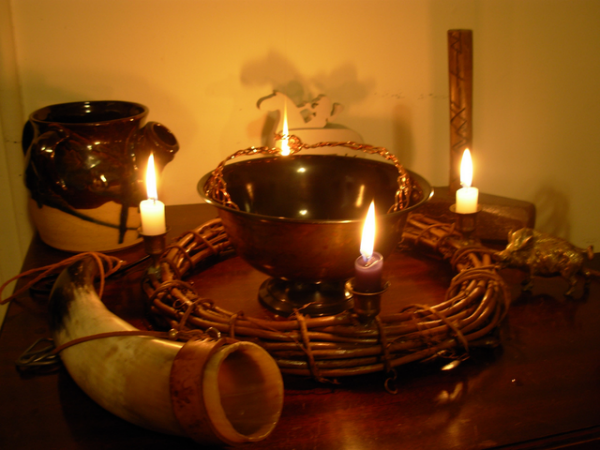
Heathen Altar, photo by Rebecca Radcliff. From WikiMedia CC License.
A 2012 interview with the late Michael Howard, by Three Hands Press preserves an important distinction that I think needs to be reiterated. For many modern practitioners, who weren’t there in the early days of the Witchcraft Revival, myself included; it can be difficult to sort out who is who, and who said what in our murky history. It can be especially difficult when trying to find which tradition resonates with you when presented with so many similar, but distinct options.
Traditional Witchcraft can be defined by the combination of various magical systems in its praxis. The traditional witch’s main focus is the attainment of esoteric knowledge and spiritual communion through tried-and-true methods passed down orally or recorded in occult documents. The way in which traditional witchcraft is able to integrate the primitive folk practices of the heathen with the scholarly ceremonialism of the occultist spoke to me of an age old science of magical practice perfected over the centuries in dark forests and dusty libraries.
According to Howard, the terms British Traditional Witchcraft were first used in the US to describe the traditions of modern neo-pagan witchcraft that had originated in Great Britain with Gardner and Sanders. Traditional Wicca was a term used to describe the various neo-pagan Wicca traditions that would emerge, including distinctions like solitary, kitchen and hedge witches. It is this early distinction that has caused confusion among modern witches, Wiccan and non-Wiccan alike.
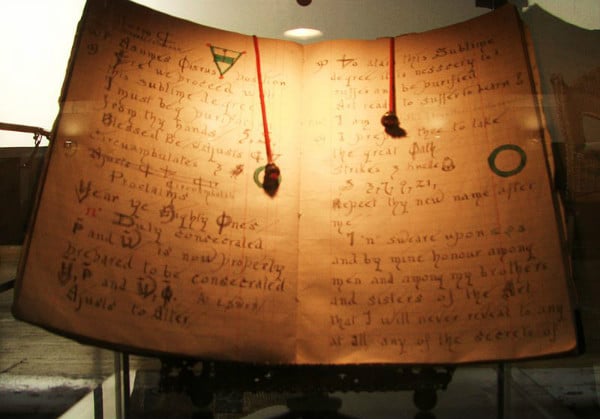
Gerald Gardner’s Book of Shadows, photo by Midnightblueowl. From WikiMedia.
Today, British Traditional Witchcraft denotes those traditional practices from Great Britain during the medieval and early modern periods . British Traditional Wicca represents the initiatory traditions of Gardner and Sanders, and their offshoots that began in the 1950s. Traditional Wicca or just Wicca would be any other initiatory Wiccan tradition that did not originate in Great Britain. Then there is traditional witchcraft, which we could consider folk magic that has been transmitted orally with specific cultural origins e.g. (Italian, British, Scandinavian, etc.) Traditional Witchcraft with a capital “T” refers to non-wiccan initiatory traditions such as the Cultus Sabbati or Clan of Tubal-Cain; those traditions influenced by Robert Cochrane, Andrew Chumbley and Michael Howard. There are also many solitary eclectic practitioners who practice witchcraft, but do not identify as specifically Wiccan or traditional.
The religion of Wicca has a definite system of beliefs that its followers adhere to; the Wiccan Rede, Threefold Law, and Charge of the Goddess are some of Wicca’s earliest doctrines. As an initiatory tradition, there are certain mysteries that are kept from novices until completion of a probationary period of study. Many Wiccan traditions follow this format, similar to the ancient mystery societies, which had a major influence on Western esoteric thought. Some Wiccans focus solely on the religious aspects of their religion, many incorporate the practice of witchcraft, using spells and magic to achieve personal ends. Wicca’s main focus is as a Pagan Fertility Religion; the rituals of the major Sabbats and minor esbats contribute to the majority of Wiccan ritual practice.
On the other hand modern traditional witchcraft is not a Pagan fertility religion, many traditionalists do not consider their craft a religion, but a magical system or occult path for spiritual development and esoteric knowledge. Many followers of traditional witchcraft practice magic for both material objectives and also spiritual advancement. There is a tendency to reject the modern notion of religion as an institution in traditionalist circles. For example, imagery in (traditional) Sabbatic Witchcraft, draws on the medieval Witches’ Sabbath a source of inspirational symbolism that challenges psychological constructs taught to us by the early Church; such as concepts of original sin and good versus evil.
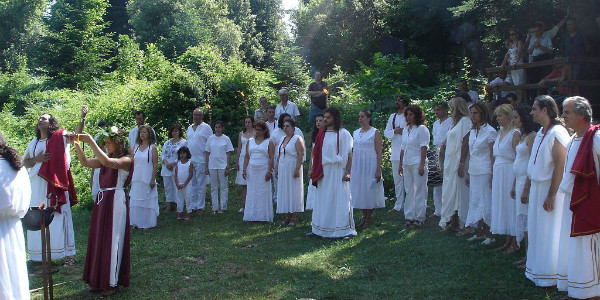
Hellen ritual performed by members of the YSEE, Supreme Council of Ethnikoi Hellenes. From WikiMedia. CC License.
This division can be explained by the terms theurgy, which refers to the magical practice of working with deities for self-attainment, and thaumaturgy which we associate with the practice of witchcraft and material attainment. The former is considered celestial in nature and the latter terrestrial by medieval occultists and modern practitioners. In most traditions of witchcraft, there are various mysteries and practices depending on one’s individual involvement which are separated by inner and outer courts. The outer mysteries of a specific tradition consist of the general practices of the tradition, usually one begins their work in the outer tradition which often serves as one of many symbolic veils leading to the inner mysteries of the tradition. The inner mysteries are those secrets held and maintained by initiates, often the deeper meaning of outer ritual symbolism. The inner mysteries serve to provide initiates with spiritual attainment through divine interaction. These inner and outer divisions can be seen in both modern traditional witchcraft and Wiccan practices.
There are many similarities between modern non-Wiccan practitioners and those who follow some type of modern traditional witchcraft. However, just because someone is not Wiccan doesn’t necessarily mean that they consider themselves a traditional witch.
I think a synthesis is coming between the old lore maintained by traditionalists, and the mysteries of neo-Pagan religions including Wicca. Our roots and history are the same. We are influenced by many of the same mythologies, as Pagans we are able to respect the gods of our brothers and sisters, recognizing the familiar faces of our own gods within them. Every myth and tradition that has grown up around it is a veil for a greater, deeper mystery. It is only in this modern time that we have divided ourselves, attempting to recreate the institutions and dogma we left behind.
Sources:
Traditional Witchcraft: Historicity and Perpetuity. https://threehandspress.com/traditional-witchcraft-historicity-and-perpetuity/
Previous Post
September 12, 2016
A Year-and-a-day, Armchair Occultism, and Witchcraft
Next Post
September 26, 2016 Fire Burn and Cauldron Bubble
Browse Our Archives
Select a Category alchemy astrology Community Outreach and Events Current Events Featured Practitioners Gods and Goddesses green magic Green Witchcraft herbalism History of the Devil luciferian tradition Magic Magic and Ritual Magic and Witchcraft in History Magical Community magical herbalism Medieval Herbalism Metaphysics Modern Witchcraft natal charts natural magic Northern Traditions Occult Art Occult Artifacts Occultism pagan authors Pagan Community Pagan Holidays pagan philosophy Pagan Sightseeing Paganism Personal Practice planetary glyphs planetary symbols Recommended Reading Sabbatic Witchcraft samhain satanism Spells The Armchair The Poison Path Traditional Witchcraft Uncategorized Veneficium wicca witch's practice Witchcraft witches' sabbats
Select a Month December 2022 September 2022 August 2022 July 2022 March 2022 February 2022 January 2022 December 2021 October 2021 September 2021 August 2021 July 2021 May 2021 April 2021 March 2021 January 2021 December 2020 October 2020 September 2020 July 2020 June 2020 May 2020 April 2020 March 2020 February 2020 January 2020 December 2019 November 2019 October 2019 September 2019 August 2019 July 2019 June 2019 May 2019 April 2019 March 2019 February 2019 January 2019 December 2018 November 2018 October 2018 September 2018 August 2018 July 2018 June 2018 May 2018 April 2018 March 2018 February 2018 January 2018 December 2017 November 2017 October 2017 September 2017 August 2017 July 2017 June 2017 May 2017 April 2017 March 2017 February 2017 January 2017 December 2016 November 2016 October 2016 September 2016 August 2016 July 2016 June 2016 May 2016 March 2016 February 2016
Follow Us!
TAKE THE
Religious Wisdom Quiz
How many days did God take to create the world?
Select your answer to see how you score.
Two Six Seven Ten
Related posts from Poisoner's Apothecary

Interview with a Vampyre Witch: Alexis Pharae
Witch City Tarot Gathering Re-Cap

The Satyr's Kiss by Storm Faerywolf
The Fairy Godmother of Occult Publishing
TRENDING AT PATHEOS Pagan

When we talk about Greek religion, we often begin with the dodekatheion—the...

I was recently chatting with someone on Instagram. She asked me what...

While there are many people who share their results, the end of...

On July 23, I saw Christopher Nolan's The Odyssey which is Homer’s...

As I write this two big events have just finished up. One...

Restoring the Watershed of Divine Love
Perhaps cooperation is not something we manufacture through legislation, ideology, or moral...
view all Pagan blogs
Ad-Free & Subscriber Log-In Subscription Support
- About Us
- 2026 Calendar
- Videos
- Podcasts
- Library of World Religions
- Faith In Media Tracker
- Advertise With Us
- Write for Us
- Privacy Policy
- Terms of Service
- Do Not Sell My Data
- Contact Us
- Radiant Digital
- Manage Newsletter Subscriptions
- Unsubscribe From Notifications
- Sitemap
Copyright 2008-2026, Patheos. All rights reserved.
Subscription Support Ad-Free & Subscriber Log-In
Follow Patheos