
BuddhistCatholicContemplativeEvangelicalGeneral ChristianHinduJewishLatter-day SaintMuslimNew VisionsProgressive Christian
Beliefs
- Buddhist
- Catholic
- Contemplative
- Evangelical
- General Christian
- Hindu
- Jewish
- Latter-day Saint
- More Voices
- Muslim
- New Visions
- Pagan
- Progressive Christian
Topics
- Religion News
- Food and Religion
- Sports and Religion
- Religious Art
- Religious Music and Entertainment
- Religious Events
- History and Religion
- Style and Religion
- Politics and Religion
- Women in Religion
- Recreation Outdoors and Religion
- Business Finance and Religion
- Careers Workplace and Religion
- Education and Religion
- Family Parenting and Religion
- Health Fitness and Religion
- Home and Religion
- Relationships and Religion
- Technology and Religion
- Travel and Religion
Columnists
- Buddhist Columnists
- Business Finance and Religion Columnists
- Careers Workplace and Religion Columnists
- Catholic Columnists
- Contemplative Columnists
- Education and Religion Columnists
- Evangelists Columnists
- Family Parenting and Religion Columnists
- General Christian Columnists
- Health Fitness and Religion Columnists
- Hindu Columnists
- History and Religion Columnists
- Home and Religion Columnists
- Jewish Columnists
- More Voices Columnists
- Latter Day Columnists
- Muslim Columnists
- New Visions Columnists
- Nonreligious Columnists
- Pagan Columnists
- Politics and Religion Columnists
- Progressive Columnists
- Recreation Outdoors and Religion Columnists
- Relationships and Religion Columnists
- Religion News Columnists
- Religious Art Columnists
- Religious Events Columnists
- Religious Music and Entertainment Columnists
- Sports and Religion Columnists
- Style and Religion Columnists
- Technology and Religion Columnists
- Travel and Religion Columnists
- Women in Religion Columnists
Resource Library
- 2026 Calendar
- Library of World Religions
- The 100 Most Holy Places on Earth
- Patheos Answers
- Podcasts
- Videos
- Faith Leaders Database
- Anglican Episcopalian
- Bahai
- Baptist
- Buddhism
- Christianity
- Confucianism
- Eastern Orthodoxy
- Hinduism
- Holiness and Pentecostal
- ISKCON
- Islam
- Judaism
- Lutheran
- Methodist
- The Church of Jesus Christ of Latter-day Saints
- New Age
- Paganism
- Presbytarian and Reformed
- Protestantism
- Religion Behind the Scenes
- Roman Catholic
- Scientology
- Shia Islam
- Sikhism
- Sufism
- Sunni Islam
- Taoism
- Zen
- See all religions
Research Tools
 Ad-Free & Subscriber Log-In Subscription Support
Ad-Free & Subscriber Log-In Subscription Support
Follow Patheos 

- Trending:
- Forgiveness
- |
- Marriage
- |
- Consciousness
- |
- Death Penalty
- |
- Election
- |
- Halloween
 Pilgrim's Road Trip
- Home
- Evangelical
- Review: Strange Fire, Holy Fire
Review: Strange Fire, Holy Fire
Last updated on: November 30, 2015 at 7:38 am by Michelle Van Loon
Review: Strange Fire, Holy Fire 2015-11-30T07:38:08-06:00 Michelle Van Loon
Patheos Explore the world's faith through different perspectives on religion and spirituality! Patheos has the views of the prevalent religions and spiritualities of the world.
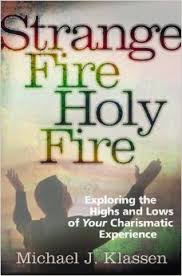 I wish I could give a copy of Michael J. Klassen’s Strange Fire, Holy Fire: Exploring the Highs and Lows of Your Charismatic Experience (Bethany House Publishers, 2009) to every person I’ve ever met in the various Pentecostal, Charismatic, and Third Wave/Vineyard congregations of which we’ve been a part. Whether they’re still a part of one of these congregations, have jumped to a different stream within the Church, or have chosen to hang out the “Done” sign on any formal church involvement, Klassen’s book is a helpful insider’s view from someone who has been there…and there…and there. He’s seen it all, participated in most of it, and has emerged with a chastened, mature perspective on the movement(s). Klassen is not speaking as an enemy of the charismatic world. Instead, he calls himself at the outset of the book both “a critic and apologist”. He manages the tricky business of being both detractor and explainer by speaking to his readers with a warm pastoral voice meant to help them figure out how to toss the bathwater while hanging on to the baby.
The Oral Roberts University and Fuller Seminary grad covers just about every topic that has marked the modern Pentecostal/Charismatic movement including definitions of the various sub-groups fitting under this umbrella, tongues, the thirst for power, authority, titles, personal prophecy, legalism, the Word of Faith movement, wacky theology, anti-intellectualism, healing, the nature of faith, emotionalism, spiritual warfare, and suffering. “Tongues might be the litmus test of a true-blue charismatic, but what we craved was power,” Klassen writes. “The charismatic movement is more about power than anything.” Charismatics don’t believe Jesus’ words are a set of propositions they need to adopt, but instead lean hard on Jesus’ promise that his followers would do greater works than he did.
Every single emphasis from within the movement can be found in Scripture; so, too, can evidences of excess and abuse/false teaching from the very beginning of the Church. Two thousand years of Church history prove that we are still vulnerable to the same temptations our spiritual forebears were. Klassen gives particular emphasis to the Word of Faith movement, understandable given his own church and educational background. TV prosperity preachers wearing expensive, custom-tailored Italian suits may be the most visible expression of this movement, but the seeds of Word of Faith thinking have been sown across the Charismatic/Pentecostal world. “If I didn’t know better, I would think that some people in the Word of Faith movement were simply charismatic Christian Scientists,” he writes. With a focus on speaking just the right words to reflect mastery of and belief in a set of deistic principles (“Don’t say, ‘I was just laid off from work’, say ‘God is positioning me for a fulfilling job that pays me more money than I ever dreamed”), I found this reliance on formula deeply rooted in most of the Charismatic congregations of which we’ve been a part, though none were officially affiliated with any of the Word of Faith teachers/ministries.
In the midst of his discussion on pain and suffering, the author of Hebrews offers these words: ‘Therefore, holy brothers, who share in the heavenly calling, fix your thoughts on Jesus, the apostle and high priest who we confess” (Hebrews 3:1).
In the midst of pain and suffering, the author doesn’t say:
- ‘Curse the suffering’ or
- ‘Bind and rebuke the spirits of suffering’ or
- ‘Ignore the pain’ or
- ‘Exercise the faith to overcome it.’
He says, ‘Fix your thoughts on Jesus.’
Klassen offers practical, grounded coaching for those wounded by the specific excess he addresses in the chapter as well as posing thoughtful questions for those who are still part of churches where the excess is the main course each week. The last couple of decades have found more mainstream Evangelical congregations joining their Catholic and Anglican brothers and sisters in integrating charismatic belief and practice into their common life. As a result, independent charismatic congregations and historical Pentecostal denominations…”seem to be working hard to remain ‘a peculiar people.’ They chase trendy theologies and become increasingly addicted to hype,” Klassen notes. “What does the future hold for independent charismatic? If they continue trying to be peculiar, they’ll eventually fade away into oblivion, because the mainstream churches will offer something more grounded and palatable to society.”
In my own case, I’m not sure I was in search of power as much as I was longing to experience God heart, soul, mind, and strength. I first encountered the charismatic movement during the 1970’s via televangelist Pat Robertson’s 700 Club, a bunch of books I bought at a Christian bookstore written by faith healers Charles and Frances Hunter, and attendance at a Saturday night gathering connected with the Shepherding Movement. I prayed during those years to receive the baptism with the Holy Spirit, but soon learned that the experience was not the essence of discipleship – keeping in step with the Spirit was. My husband and I were part of a “second wave” charismatic church for several years before landing in a series of “third wave” Vineyard/Vineyard-influenced churches throughout the 1990’s and into the first couple of years of the new millennium. We logged time at the International House of Prayer (Klassen doesn’t address this influential rivulet flowing from the Vineyard movement in his book) before moving back into mainstream Evangelicalism during the last decade. The charismatic movement modeled for me the gifts of unbridled passion for God and a certainty that God was willing to intervene in the affairs of humanity here and now. It also left me with the scars of spiritual abuse and an ongoing frustration with sloppy theology because of the primacy of emotional experience in those congregations.
I recommend Strange Fire, Holy Fire to you if you too have “been there”. Even more, I commend it to you if you still are “there”. May we all grow as one body toward the spiritual maturity, which is not the same thing as quenching the Spirit. Michael J. Klassen helps us see the difference, and choose the former while not doing the latter.
Have you spent time in a charismatic or Pentecostal congregation? Has the experience been positive or negative for you?
Previous Post

November 24, 2015
Giving Thanks From The Valley Of The Shadow
Next Post
December 3, 2015 At The Intersection Of Time & Eternity: Chanukah
Browse Our Archives
Select a Category Baggage Books Calendar Church and Ministry CVID Ecclesiology Everyday Christian life Faith Falling Upward From The Margins Housing Jesus Movement's Unintended Consequences Midlife Midlife Survey #1 Midlife Survey #2 Moments and Days Out To The Margins Pilgrim's Road Trip Regret Seminary Spiritual Formation Uncategorized What's A Nice Jewish Grandmother Like You Doing In Seminary? When The Heart Waits Writing
Select a Month June 2017 May 2017 April 2017 March 2017 February 2017 January 2017 December 2016 November 2016 October 2016 September 2016 August 2016 July 2016 June 2016 May 2016 April 2016 March 2016 February 2016 January 2016 December 2015 November 2015 October 2015 September 2015 August 2015 July 2015 June 2015 May 2015 April 2015 March 2015 February 2015 January 2015 December 2014 November 2014 October 2014 September 2014 August 2014 July 2014 June 2014 May 2014 April 2014 March 2014 February 2014 January 2014 December 2013 October 2013 September 2013 August 2013 July 2013 June 2013 May 2013 April 2013 March 2013 February 2013 January 2013 December 2012 November 2012 October 2012 September 2012 August 2012 July 2012 June 2012 May 2012 April 2012 March 2012 February 2012 January 2012 December 2011 November 2011 October 2011 September 2011 August 2011 July 2011 June 2011 May 2011 April 2011 March 2011 February 2011 January 2011 December 2010 November 2010 October 2010 September 2010 August 2010 July 2010 June 2010 May 2010 April 2010 March 2010 February 2010 January 2010 December 2009 November 2009 October 2009 September 2009 August 2009 July 2009 June 2009 May 2009 April 2009 March 2009 February 2009 January 2009 December 2008 November 2008 October 2008 September 2008 August 2008 July 2008 June 2008 May 2008 April 2008 March 2008 February 2008 January 2008 December 2007 November 2007 October 2007 September 2007 August 2007 July 2007 June 2007 May 2007 April 2007
Follow Us!
TAKE THE
Religious Wisdom Quiz
What ailment did Jesus heal with mud made from saliva?
Select your answer to see how you score.
Deafness Paralysis Leprosy Blindness
Related posts from Pilgrim's Road Trip

Some Thoughts On The Relationship Between Bloggers And...

What Do Your Kids Know About Communion?

Evangelical Leaders, I'm Listening...

Living The Jesus Creed This February
TRENDING AT PATHEOS Evangelical

How the author of the world's best hymn...
I've been working with John Newton for a while now. This makes...

Long before this Lectio Divina, Psalm 130 - the song - started...

What About the Trees? Another Living Parable
After I finished writing the last article about falling leaves as a...

Why Classical Education Is a Conversation, Not a...
Come and Read: Joy in Classical Education When I was a little...

Falling Leaves: A Living Parable on Letting Go
I’ve spent the vast majority of my life in the southeast corner...

Cornell University has received a great deal of negative publicity and intense...
view all Evangelical blogs
Ad-Free & Subscriber Log-In Subscription Support
- About Us
- 2026 Calendar
- Videos
- Podcasts
- Library of World Religions
- Faith In Media Tracker
- Advertise With Us
- Write for Us
- Privacy Policy
- Terms of Service
- Do Not Sell My Data
- Contact Us
- Radiant Digital
- Manage Newsletter Subscriptions
- Unsubscribe From Notifications
- Sitemap
Copyright 2008-2026, Patheos. All rights reserved.
Subscription Support Ad-Free & Subscriber Log-In
Follow Patheos