
BuddhistCatholicContemplativeEvangelicalGeneral ChristianHinduJewishLatter-day SaintMuslimNew VisionsProgressive Christian
Beliefs
- Buddhist
- Catholic
- Contemplative
- Evangelical
- General Christian
- Hindu
- Jewish
- Latter-day Saint
- More Voices
- Muslim
- New Visions
- Pagan
- Progressive Christian
Topics
- Religion News
- Food and Religion
- Sports and Religion
- Religious Art
- Religious Music and Entertainment
- Religious Events
- History and Religion
- Style and Religion
- Politics and Religion
- Women in Religion
- Recreation Outdoors and Religion
- Business Finance and Religion
- Careers Workplace and Religion
- Education and Religion
- Family Parenting and Religion
- Health Fitness and Religion
- Home and Religion
- Relationships and Religion
- Technology and Religion
- Travel and Religion
Columnists
- Buddhist Columnists
- Business Finance and Religion Columnists
- Careers Workplace and Religion Columnists
- Catholic Columnists
- Contemplative Columnists
- Education and Religion Columnists
- Evangelists Columnists
- Family Parenting and Religion Columnists
- General Christian Columnists
- Health Fitness and Religion Columnists
- Hindu Columnists
- History and Religion Columnists
- Home and Religion Columnists
- Jewish Columnists
- More Voices Columnists
- Latter Day Columnists
- Muslim Columnists
- New Visions Columnists
- Nonreligious Columnists
- Pagan Columnists
- Politics and Religion Columnists
- Progressive Columnists
- Recreation Outdoors and Religion Columnists
- Relationships and Religion Columnists
- Religion News Columnists
- Religious Art Columnists
- Religious Events Columnists
- Religious Music and Entertainment Columnists
- Sports and Religion Columnists
- Style and Religion Columnists
- Technology and Religion Columnists
- Travel and Religion Columnists
- Women in Religion Columnists
Resource Library
- 2026 Calendar
- Library of World Religions
- The 100 Most Holy Places on Earth
- Patheos Answers
- Podcasts
- Videos
- Faith Leaders Database
- Anglican Episcopalian
- Bahai
- Baptist
- Buddhism
- Christianity
- Confucianism
- Eastern Orthodoxy
- Hinduism
- Holiness and Pentecostal
- ISKCON
- Islam
- Judaism
- Lutheran
- Methodist
- The Church of Jesus Christ of Latter-day Saints
- New Age
- Paganism
- Presbytarian and Reformed
- Protestantism
- Religion Behind the Scenes
- Roman Catholic
- Scientology
- Shia Islam
- Sikhism
- Sufism
- Sunni Islam
- Taoism
- Zen
- See all religions
Research Tools
 Ad-Free & Subscriber Log-In Subscription Support
Ad-Free & Subscriber Log-In Subscription Support
Follow Patheos 

- Trending:
- Forgiveness
- |
- Marriage
- |
- Consciousness
- |
- Death Penalty
- |
- Election
- |
- Halloween
 Pilgrim's Road Trip
- Home
- Evangelical
- I Need A Hero
I Need A Hero
Last updated on: December 1, 2014 at 1:17 pm by Michelle Van Loon
I Need A Hero 2014-12-01T13:17:31-06:00 Michelle Van Loon
Patheos Explore the world's faith through different perspectives on religion and spirituality! Patheos has the views of the prevalent religions and spiritualities of the world.
Regular readers of this blog know that my family and I have experienced a number of nightmarish church experiences over the last three and a half decades. Not too long ago, someone asked me why I didn’t just exit the Church at one particularly miserable juncture twenty or so years ago and just keep walking.
My short answer came from Simon Peter’s words to Jesus: “Lord, to whom shall we go? You have the words of eternal life.” (John 6:68) Though I don’t believe that showing up in a church for weekly services makes a person a believer any more than a wrench in the garage means there’s a mechanic in the house, I also believe faith is not a d-i-y enterprise. It is formed in community. And by “community”, I mean that it is not a a spectator sport, which, sadly, is the message many churches pass on each week to their audiences er, rank-and-file congregants.
My longer answer to the question has come as I’ve reconciled Peter’s exclaimed revelation with intentionally seeking out people who understand that they are the Church. Most all have maintained connection with a local congregation, but that connection is not their spiritual destination. Some of these people are individuals I’ve met on my journey: moms, hospice nurses, grocery store clerks, writers, engineers, children, janitors, grandfathers, teachers. The example of these people has shown me what it is to be the Church in ways that the veritable cavalcade of power-hungry or sex-addicted congregational leaders who’ve marched through my life have not. When Paul said, “Follow my example, as I follow the example of Christ” (1 Cor. 11:1), he told me that if I could find someone following the example of Jesus, I needed to pattern my life after what I saw expressed of his character in theirs.
Those role models aren’t always flesh and blood human beings (though they’re definitely the best kind). Sometimes, I meet them in books. Biographies, histories and memoirs have implanted imitators of Christ in my soul spanning two millennia and too many places to count in this world. Their stories are a close-up snapshot of some of the great cloud of witnesses who are the Church. Just like I am, and just as I long to be.
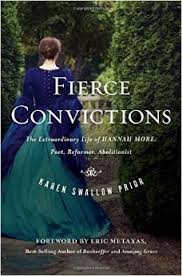 Recently I had an opportunity to meet a new faith hero. Her name is Hannah More. Born more than 250 years ago in England, More served God and countless others using her brilliant mind and willing heart. The words that flowed from her pen graced stage and page. She was involved in bringing education to underserved people in her city. Her relationships with key voices in the nascent abolitionist movement, including William Wilberforce, were instrumental in bringing about stunning social change in the caste-bound culture of the day.
My friend Karen Swallow Prior has written an accessible, inspiring biography of More entitle Fierce Convictions: The Extraordinary Life Of Hannah More – Poet, Reformer, Abolitionist (Nelson, 2014). Prior’s meticulous research and nimble words introduce modern readers to a human being, complete with flaws, struggles and blind spots, who loved God with a single minded devotion that allowed her life to be used by him for the benefit of others. In a time where women’s roles were prescribed within a very limited, specific framework, the never-married More managed to create a space for her life and work that functioned within that framework while stretching its margins simply because she was compelled to follow God where he led.
More was determined to make Jesus known, and she wasn’t willing to compromise in order to do so. Her words sound as though they could have been spoken today:
The inculcation of the Christian faith, More argued, should not be left to personal whim or mere chance. “Do you persons, then, become musicians, and painters, and linguists, and mathematicians, by early study and regular labour; and they shall become Christians by accident?” she asked. She cautioned, too, against a sugar-coated Christianity that made false promises of ease and pleasure from its embrace. She called such deceptions an “error into which even some good people are apt to fall” in their eagerness to attract adherents to the faith. “In order to allure” young people to Christianity, she cautioned, “they exhibit false, or faint, or inaequated views of Christianity; and while they represent it, as it really is, as a life of superior happiness and advantage, they conceal its difficulties.” The results might ultimately result in abandonment of the faith: “May it not be partly owing to the want of a due introduction to the knowledge of the real nature and spirit of religion, that so many young Christians, who set out in a fair and flourishing way, decline and whiter when they come to perceive the requisitions of experimental Christianity? requisitions which they had not suspected of making any part of the plan; and from which, when they afterwards discover them, they shrink back, as not prepared and hardened for the unexpected contest?”
More truly was a reformer, not a revolutionary. Her unflinching principles could have turned her into a rogue or outlier. But she fought for change right where she was. The combination of her service to others and her willingness to serve as a loving irritant to both church and culture is an inspiration to me. In this time when it seems as though heroes of the faith may be in short supply, I am grateful I know where to look for those role models: behind a broom, at the bedside of a patient, hidden in prayer, or tucked inside the pages of books like Fierce Convictions.
Previous Post

November 21, 2014
Transforming The Literal Into *POOF* The Spiritual
Next Post
December 2, 2014 Q & A With Jennifer Grant, Author Of Wholehearted Living
Browse Our Archives
Select a Category Baggage Books Calendar Church and Ministry CVID Ecclesiology Everyday Christian life Faith Falling Upward From The Margins Housing Jesus Movement's Unintended Consequences Midlife Midlife Survey #1 Midlife Survey #2 Moments and Days Out To The Margins Pilgrim's Road Trip Regret Seminary Spiritual Formation Uncategorized What's A Nice Jewish Grandmother Like You Doing In Seminary? When The Heart Waits Writing
Select a Month June 2017 May 2017 April 2017 March 2017 February 2017 January 2017 December 2016 November 2016 October 2016 September 2016 August 2016 July 2016 June 2016 May 2016 April 2016 March 2016 February 2016 January 2016 December 2015 November 2015 October 2015 September 2015 August 2015 July 2015 June 2015 May 2015 April 2015 March 2015 February 2015 January 2015 December 2014 November 2014 October 2014 September 2014 August 2014 July 2014 June 2014 May 2014 April 2014 March 2014 February 2014 January 2014 December 2013 October 2013 September 2013 August 2013 July 2013 June 2013 May 2013 April 2013 March 2013 February 2013 January 2013 December 2012 November 2012 October 2012 September 2012 August 2012 July 2012 June 2012 May 2012 April 2012 March 2012 February 2012 January 2012 December 2011 November 2011 October 2011 September 2011 August 2011 July 2011 June 2011 May 2011 April 2011 March 2011 February 2011 January 2011 December 2010 November 2010 October 2010 September 2010 August 2010 July 2010 June 2010 May 2010 April 2010 March 2010 February 2010 January 2010 December 2009 November 2009 October 2009 September 2009 August 2009 July 2009 June 2009 May 2009 April 2009 March 2009 February 2009 January 2009 December 2008 November 2008 October 2008 September 2008 August 2008 July 2008 June 2008 May 2008 April 2008 March 2008 February 2008 January 2008 December 2007 November 2007 October 2007 September 2007 August 2007 July 2007 June 2007 May 2007 April 2007
Follow Us!
TAKE THE
Religious Wisdom Quiz
Who said, "The Lord said to my Lord, ‘Sit at my right hand’"?
Select your answer to see how you score.
David Isaiah Moses Solomon
Related posts from Pilgrim's Road Trip
Introducing: Long Days Of Small Things
Review: Deliberate Acts of Kindness
Review: Of Stillness And Storm
Reflection: The Sound of a Million Dreams
TRENDING AT PATHEOS Evangelical

How the author of the world's best hymn...
I've been working with John Newton for a while now. This makes...

Long before this Lectio Divina, Psalm 130 - the song - started...

What About the Trees? Another Living Parable
After I finished writing the last article about falling leaves as a...

Why Classical Education Is a Conversation, Not a...
Come and Read: Joy in Classical Education When I was a little...

Falling Leaves: A Living Parable on Letting Go
I’ve spent the vast majority of my life in the southeast corner...

Cornell University has received a great deal of negative publicity and intense...
view all Evangelical blogs
Ad-Free & Subscriber Log-In Subscription Support
- About Us
- 2026 Calendar
- Videos
- Podcasts
- Library of World Religions
- Faith In Media Tracker
- Advertise With Us
- Write for Us
- Privacy Policy
- Terms of Service
- Do Not Sell My Data
- Contact Us
- Radiant Digital
- Manage Newsletter Subscriptions
- Unsubscribe From Notifications
- Sitemap
Copyright 2008-2026, Patheos. All rights reserved.
Subscription Support Ad-Free & Subscriber Log-In
Follow Patheos