
BuddhistCatholicContemplativeEvangelicalGeneral ChristianHinduJewishLatter-day SaintMuslimNew VisionsProgressive Christian
Beliefs
- Buddhist
- Catholic
- Contemplative
- Evangelical
- General Christian
- Hindu
- Jewish
- Latter-day Saint
- More Voices
- Muslim
- New Visions
- Pagan
- Progressive Christian
Topics
- Religion News
- Food and Religion
- Sports and Religion
- Religious Art
- Religious Music and Entertainment
- Religious Events
- History and Religion
- Style and Religion
- Politics and Religion
- Women in Religion
- Recreation Outdoors and Religion
- Business Finance and Religion
- Careers Workplace and Religion
- Education and Religion
- Family Parenting and Religion
- Health Fitness and Religion
- Home and Religion
- Relationships and Religion
- Technology and Religion
- Travel and Religion
Columnists
- Buddhist Columnists
- Business Finance and Religion Columnists
- Careers Workplace and Religion Columnists
- Catholic Columnists
- Contemplative Columnists
- Education and Religion Columnists
- Evangelists Columnists
- Family Parenting and Religion Columnists
- General Christian Columnists
- Health Fitness and Religion Columnists
- Hindu Columnists
- History and Religion Columnists
- Home and Religion Columnists
- Jewish Columnists
- More Voices Columnists
- Latter Day Columnists
- Muslim Columnists
- New Visions Columnists
- Nonreligious Columnists
- Pagan Columnists
- Politics and Religion Columnists
- Progressive Columnists
- Recreation Outdoors and Religion Columnists
- Relationships and Religion Columnists
- Religion News Columnists
- Religious Art Columnists
- Religious Events Columnists
- Religious Music and Entertainment Columnists
- Sports and Religion Columnists
- Style and Religion Columnists
- Technology and Religion Columnists
- Travel and Religion Columnists
- Women in Religion Columnists
Resource Library
- 2026 Calendar
- Library of World Religions
- The 100 Most Holy Places on Earth
- Patheos Answers
- Podcasts
- Videos
- Faith Leaders Database
- Anglican Episcopalian
- Bahai
- Baptist
- Buddhism
- Christianity
- Confucianism
- Eastern Orthodoxy
- Hinduism
- Holiness and Pentecostal
- ISKCON
- Islam
- Judaism
- Lutheran
- Methodist
- The Church of Jesus Christ of Latter-day Saints
- New Age
- Paganism
- Presbytarian and Reformed
- Protestantism
- Religion Behind the Scenes
- Roman Catholic
- Scientology
- Shia Islam
- Sikhism
- Sufism
- Sunni Islam
- Taoism
- Zen
- See all religions
Research Tools
 Ad-Free & Subscriber Log-In Subscription Support
Ad-Free & Subscriber Log-In Subscription Support
Follow Patheos 

- Trending:
- Forgiveness
- |
- Marriage
- |
- Consciousness
- |
- Death Penalty
- |
- Election
- |
- Halloween
 Pilgrim's Road Trip
- Home
- Evangelical
- Two Wildly Different, Strangely Similar Books Asking One Question: Who Am I?
Two Wildly Different, Strangely Similar Books Asking One Question: Who Am I?
Last updated on: July 15, 2014 at 7:01 pm by Michelle Van Loon
Two Wildly Different, Strangely Similar Books Asking One Question: Who Am I? 2014-07-15T19:01:45-05:00 Michelle Van Loon
Patheos Explore the world's faith through different perspectives on religion and spirituality! Patheos has the views of the prevalent religions and spiritualities of the world.
It’s complicated.
No, that’s not a Facebook update on my relationship status.* Recently, I wrote a short bit as part of a group post for the Her.meneutics blog about the need to embrace complexity in our understanding of maturing faith. There’s complexity, then there’s the borderlands just beyond complexity. Those lands have names like Chaos, Confusion, and “It’s Complicated”.
Recently, I read two books that captured the complicated nature of being a Jewish person in an Evangelical subculture: My Jesus Year: A Rabbi’s Son Wanders The Bible Belt in Search Of His Own Faith (Harper Collins, 2008) by Benyamin Cohen and Jew In The Pew: A Memoir (Kipling House Books, 2013) by Jenny Berg Chandler. Cohen found himself curious about and perhaps coveting some sort of entre into the churchy Atlanta culture surrounding his modern Orthodox lifestyle. Chandler, who grew up in the first wave of the post-1967 contemporary Messianic Jewish world, eventually migrated into the mainstream Evangelical church for a couple of decades before hitting an emotional and spiritual wall. Both books detail the authors’ respective struggle to make sense of their Jewish identity using the prism of the church to do so.
Cohen spent a year sampling from the Christian buffet, visiting services and outreaches at places like Eddie Long’s mega-church (shortly before this all came to light), a Christian rock festival, a Pentecostal healing service and a wrestling-for-Jesus event. He also attends a couple of mainline services, a Catholic monastery and engages with a Mormon, a nod to the reality that many in this country perceive Mormons as just another branch of the Christian church. But it was the non-denominational expressions of Christian faith that captured his imagination. He explains, “Of all the Christian churches I know, evangelical churches seem to be the most exciting, the most fantastical, and the most entertaining. I wholly admit this is based on nothing more than multiple viewings of the 1992 Steve Martin comedy Leap of Faith, about a crooked preacher who inspires the downtrodden at elaborate Holy Roller tent revival services.” By year’s end, though he found elements of the way in which we practice Christianity compelling (while being rightly repulsed by others), Cohen’s journey through the borderland served to direct him back to a more settled practice of the Orthodox Judaism of his youth.
Chandler grew up in a Jewish family that divided when her mother came to faith in Jesus, the Jewish Messiah. Chandler’s parents divorced during her elementary school years, somewhere along the way, her grandparents embraced their now-divorced daughter’s faith as well. Chandler spent the second half of her childhood in a Messianic intentional community. Like too many who formed congregations in the midst of the tsunami of 1970’s Jesus Freak-era revival, of which the modern Messianic movement is sort of a subset, the group where Chandler’s mom and grandparents landed ended up devolving from joyous revival into spiritual abuse at some point during her teens. The family left the fellowship bearing wounds. Chandler’s faith in Jesus remained intact, and she eventually married a Gentile believer. The young couple set about building their spiritual lives in the non-denominational, then Anglican, branches of the church. After years of this, she found herself restless and feeling disconnected from the Jewishness of her faith, and from her own Jewish identity. Her self-published memoir details her year-long attempt to rekindle Jewish observance in her family and integrate into the mainstream Jewish community while maintaining her identity as a Jewish believer in Jesus.
Chandler and Cohen both capture the strength and the struggle of what it is to be Jewish in America right now. The strength for observant Jews is a powerful connection to a small but formational community, shaped by a shared vocabulary of Sabbath/festal cycle practice. The struggle is that ritual and a focus on ethical behavior don’t necessarily create an intimate relationship with God. Cohen longed for a faith more personal and active than ritual’s habits afforded him. He’d witnessed the commitment and enthusiasm the committed Christian Gentiles surrounding him seemed to have for their faith. He wanted that in some form for himself. Chandler had lots of warm childhood memories of those rituals. Though she had a personal connection with faith in her Jewish Savior, she felt increasingly disconnected from her Jewish identity by years of immersion in the d-i-y liturgy of non-denominationalism and the church year calendar of Anglicanism.
Though I chafe at the formulaic “a year in the life of” memoir structure, in the cases of both Cohen and Chandler’s books, the structure made sense. Jewish life is shaped by these cycles, and the year Cohen took to explore Christianity (with a brief foray into Mormonism, which is not exactly orthodox Christianity) a nod to that. Every season of the year has a different story to tell us about the One who created sun, moon, stars and our revolving planetary home. Both books also featured heapin’ helpins of Jewish humor and guilt. (Where does one end and the other begin? That’s a question for another blog.) Cohen wrestled mightily throughout his Jesus year with the un-kosherness of his Christian explorations, as well as the tugs he sometimes felt toward a faith so unlike his own religio-ethnic idenity. Chandler’s identity confusion came out in angsty anger toward the Christian church’s dispassionate disconnect with its Jewish roots, as well as her uncomfortable realization that she didn’t quite fit in the mainstream Jewish community, either.
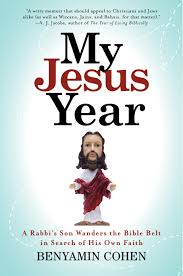 Cohen’s book is the more readable of the two, a mark of his own skill as a writer as well as the fact that it had been through a stringent vetting and editorial process by a big name publisher. His observations about Evangelical subculture are worth the price of the book. There is nothing quite like seeing the familiar through the eyes of an interested outsider. Cohen is sympathetic, fair and kind in his assessments of the various churches he visits. I wish he would have engaged a mature, solid Jewish believer at some point in his Jesus year, because that would have certainly added a whole new set of questions to the ones he already had. I am grateful for the book, and pray that the restlessness that sparked his journey into the borderlands continues to prod him forward. I don’t think his faith story is settled yet – not when the entire year was itself a prayer.
 Chandler’s self-published book has value in its important message that the church isn’t always an easy place for Jews who believe in Jesus to be. There are a number of places in the book she either tries too hard to strut her Jewish cred, talks too much about the stuff of her daily life (dog, cooking, driving kids to and fro), or repeats her rants about not fitting in anywhere. Her message about what it means to be a Jew in the pew is an important one, and is why I am talking about it here while praying she elects to put the manuscript through a merciless editorial process with a paid professional. My critique is offered in love, because the message of her book is of great value to sparking conversation about the subject. In many ways her story – and her frustrations – mirrors some of my own experience in the church.
Because we who are Jewish believers are often told by well-meaning Christians with weak theology that our Jewishness doesn’t matter now that we are following Jesus (click here and read a couple of the most recent comments on my recent piece about the Jewish roots of Christian sabbath to get a sense of what we’re up against), I commend both of these books to you if you care about the Jews in your pews – or those standing on the sidelines, full of questions, watching.
*In case you’re wondering, this October, Bill and I will be celebrating our 35th anniversary.
Previous Post

July 8, 2014
Faith Unsettled
Next Post
July 16, 2014 God Has A Wonderful Plan For Your Life!
Browse Our Archives
Select a Category Baggage Books Calendar Church and Ministry CVID Ecclesiology Everyday Christian life Faith Falling Upward From The Margins Housing Jesus Movement's Unintended Consequences Midlife Midlife Survey #1 Midlife Survey #2 Moments and Days Out To The Margins Pilgrim's Road Trip Regret Seminary Spiritual Formation Uncategorized What's A Nice Jewish Grandmother Like You Doing In Seminary? When The Heart Waits Writing
Select a Month June 2017 May 2017 April 2017 March 2017 February 2017 January 2017 December 2016 November 2016 October 2016 September 2016 August 2016 July 2016 June 2016 May 2016 April 2016 March 2016 February 2016 January 2016 December 2015 November 2015 October 2015 September 2015 August 2015 July 2015 June 2015 May 2015 April 2015 March 2015 February 2015 January 2015 December 2014 November 2014 October 2014 September 2014 August 2014 July 2014 June 2014 May 2014 April 2014 March 2014 February 2014 January 2014 December 2013 October 2013 September 2013 August 2013 July 2013 June 2013 May 2013 April 2013 March 2013 February 2013 January 2013 December 2012 November 2012 October 2012 September 2012 August 2012 July 2012 June 2012 May 2012 April 2012 March 2012 February 2012 January 2012 December 2011 November 2011 October 2011 September 2011 August 2011 July 2011 June 2011 May 2011 April 2011 March 2011 February 2011 January 2011 December 2010 November 2010 October 2010 September 2010 August 2010 July 2010 June 2010 May 2010 April 2010 March 2010 February 2010 January 2010 December 2009 November 2009 October 2009 September 2009 August 2009 July 2009 June 2009 May 2009 April 2009 March 2009 February 2009 January 2009 December 2008 November 2008 October 2008 September 2008 August 2008 July 2008 June 2008 May 2008 April 2008 March 2008 February 2008 January 2008 December 2007 November 2007 October 2007 September 2007 August 2007 July 2007 June 2007 May 2007 April 2007
Follow Us!
TAKE THE
Religious Wisdom Quiz
Who was the Roman emperor when Jesus was born?
Select your answer to see how you score.
Augustus Julius Caesar Tiberius Nero
Related posts from Pilgrim's Road Trip

Some Thoughts On The Relationship Between Bloggers And...
Introducing: Long Days Of Small Things
Review: Deliberate Acts of Kindness
Review: Of Stillness And Storm
TRENDING AT PATHEOS Evangelical

The REST of Your Life: A Creative Wrestles...
This week I had a conversation with a good friend from church....

How the author of the world's best hymn...
I've been working with John Newton for a while now. This makes...

Long before this Lectio Divina, Psalm 130 - the song - started...

What About the Trees? Another Living Parable
After I finished writing the last article about falling leaves as a...

Why Classical Education Is a Conversation, Not a...
Come and Read: Joy in Classical Education When I was a little...

Cornell University has received a great deal of negative publicity and intense...
view all Evangelical blogs
Ad-Free & Subscriber Log-In Subscription Support
- About Us
- 2026 Calendar
- Videos
- Podcasts
- Library of World Religions
- Faith In Media Tracker
- Advertise With Us
- Write for Us
- Privacy Policy
- Terms of Service
- Do Not Sell My Data
- Contact Us
- Radiant Digital
- Manage Newsletter Subscriptions
- Unsubscribe From Notifications
- Sitemap
Copyright 2008-2026, Patheos. All rights reserved.
Subscription Support Ad-Free & Subscriber Log-In
Follow Patheos