
BuddhistCatholicContemplativeEvangelicalGeneral ChristianHinduJewishLatter-day SaintMuslimNew VisionsProgressive Christian
Beliefs
- Buddhist
- Catholic
- Contemplative
- Evangelical
- General Christian
- Hindu
- Jewish
- Latter-day Saint
- More Voices
- Muslim
- New Visions
- Pagan
- Progressive Christian
Topics
- Religion News
- Food and Religion
- Sports and Religion
- Religious Art
- Religious Music and Entertainment
- Religious Events
- History and Religion
- Style and Religion
- Politics and Religion
- Women in Religion
- Recreation Outdoors and Religion
- Business Finance and Religion
- Careers Workplace and Religion
- Education and Religion
- Family Parenting and Religion
- Health Fitness and Religion
- Home and Religion
- Relationships and Religion
- Technology and Religion
- Travel and Religion
Columnists
- Buddhist Columnists
- Business Finance and Religion Columnists
- Careers Workplace and Religion Columnists
- Catholic Columnists
- Contemplative Columnists
- Education and Religion Columnists
- Evangelists Columnists
- Family Parenting and Religion Columnists
- General Christian Columnists
- Health Fitness and Religion Columnists
- Hindu Columnists
- History and Religion Columnists
- Home and Religion Columnists
- Jewish Columnists
- More Voices Columnists
- Latter Day Columnists
- Muslim Columnists
- New Visions Columnists
- Nonreligious Columnists
- Pagan Columnists
- Politics and Religion Columnists
- Progressive Columnists
- Recreation Outdoors and Religion Columnists
- Relationships and Religion Columnists
- Religion News Columnists
- Religious Art Columnists
- Religious Events Columnists
- Religious Music and Entertainment Columnists
- Sports and Religion Columnists
- Style and Religion Columnists
- Technology and Religion Columnists
- Travel and Religion Columnists
- Women in Religion Columnists
Resource Library
- 2026 Calendar
- Library of World Religions
- The 100 Most Holy Places on Earth
- Patheos Answers
- Podcasts
- Videos
- Faith Leaders Database
- Anglican Episcopalian
- Bahai
- Baptist
- Buddhism
- Christianity
- Confucianism
- Eastern Orthodoxy
- Hinduism
- Holiness and Pentecostal
- ISKCON
- Islam
- Judaism
- Lutheran
- Methodist
- The Church of Jesus Christ of Latter-day Saints
- New Age
- Paganism
- Presbytarian and Reformed
- Protestantism
- Religion Behind the Scenes
- Roman Catholic
- Scientology
- Shia Islam
- Sikhism
- Sufism
- Sunni Islam
- Taoism
- Zen
- See all religions
Research Tools
 Ad-Free & Subscriber Log-In Subscription Support
Ad-Free & Subscriber Log-In Subscription Support
Follow Patheos 

- Trending:
- Forgiveness
- |
- Marriage
- |
- Consciousness
- |
- Death Penalty
- |
- Election
- |
- Halloween
 Pilgrim's Road Trip
- Home
- Evangelical
- Sample: Teach Us To Want
Sample: Teach Us To Want
Last updated on: July 22, 2014 at 11:06 pm by Michelle Van Loon
Sample: Teach Us To Want 2014-07-22T23:06:35-05:00 Michelle Van Loon
Patheos Explore the world's faith through different perspectives on religion and spirituality! Patheos has the views of the prevalent religions and spiritualities of the world.
We who follow Jesus are supposed to desire God, and in doing so, will ourselves brute-force-style out of desiring anything else this world has to offer. Our desires are wrong and carnal. At least, that’s the message we think we’re supposed to believe about the nature of our desire.
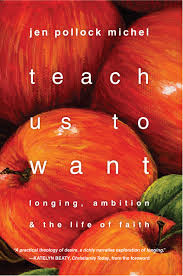 My friend and fellow Her.meneutics contributor Jen Pollock Michel contends in her new book Teach Us To Want: Longing, Ambition and the Life of Faith (IVPress, 2014) that God has a different story to tell us about our desires. Her lovely book offers an intelligent, honest and Scripturally-grounded extended meditation on the subject. Jen invites us to consider that there is a third way to approach our desires beyond either indulgence or stifling. I liked this book a lot, and commend it to you – particularly if you’re wrestling with the meaning of your own longings or are working with people facing transition in their lives.
I’m honored to share an excerpt (from one of my favorite chapters!) from the book, below. Enjoy!
Chapter 2: Aperture of the Heart: Courage
Recently, a new field of psychology has spawned to address [the] task of examining desire. Wantology, of which Arlie Russell Hochschild makes mention in her New York Times article, “The Outsourced Life,” is a field of expertise aimed at helping people discern their desires and work towards getting what they want. A wantologist helps clients verbalize their latent, unrequited desires and moves them toward achieving happiness by identifying the ways they can satisfy those desires. The goal of wantology is to help clients connect the dots of desire: what do they want and how do they get it? I suppose if we are paying people to help us in this task, we’re admitting both that it’s difficult and that most of us lack the skills for doing it on our own.
But wantology can’t offer all the answers we as Christians need. As followers of Jesus, we’re asking different questions and in need of different answers. We’re asking, not just What do I want? but Is what I want right? We’re interested in congruence: Is what I want what God wants for me? Am I following God’s will? But this kind of reflective, prayerful examination of our heart’s desires, when we’re honest about it, can challenge us see the ways we’ve clamored to get what we’ve wanted and ultimately failed to trust. It’s not a truth we find easy to see. It’s often a truth we’re rather avoid. Our dismissal of desire may be built less on our holy hesitations about desire. In fact, ignoring our desires may serve as the convenient way we remain ignorant and resist change.
* * * * *
“I’ve been reading your blog,” my friend starts after dinner as we clear plates and rinse dishes. Our children had been growing up together before we moved from Chicago to Toronto. We had attended Bible study together, traded carpool responsibilities and exchanged birthday gifts. This is the friend who had been watching my children the day I returned with the ultrasound picture of the twin babies I had been carrying only four years earlier.
“I read and think, ‘Yeah, that’s the same old Jen.’”
I brace for support.
“You know. You write about how you’re always struggling with the whole motherhood thing, how you’re wanting more. You seem discontent and unsatisfied.”
I nod.
“Don’t you think that’s actually a form of coveting?”
Sticks and stones might break your bones. And words, they gut your insides.
* * * * *
In an early chapter of Pilgrim at Tinker Creek, Annie Dillard recounts what she learned from stories of blind patients who recovered their sight after surgeons had learned how to safely remove cataracts.
Though we might imagine that these newly sighted people felt ecstatic, in every instance, their new capacity was disorienting. In many cases, it was even terrifying. Patients struggled to make use of their new sense, and some rejected it altogether, “continuing to go over objects with their tongues,” writes Dillard, “and lapsing into apathy and despair.” One patient, a fifteen-year-old boy, cried, “No, really, I can’t stand it any more . . . If things aren’t altered, I’ll tear my eyes out.”
In the Scriptures, one of the most prominent metaphors for spiritual conversion is recovering sight. When we come to a saving faith in Jesus Christ, we are healed of the spiritual blindness into which we were born (cf. John 9:39). This repairs our ability to see Christ as well as to see ourselves. It’s this new “sight,” which causes us to acknowledge both that Christ saves and that we desperately need such saving.
But like the newly sighted patients whom Dillard describes, our new sense can disorient, even terrify us. This may be owed to the theological truth that our spiritual eyes are not mere transmitters of perception. Indeed, Jesus teaches that our spiritual eyes emit light, sending up from the caverns of the self either brooding darkness or soul incandescence. “Your eye is the lamp of your body. When your eye is healthy, your whole body is full of light, but when it is bad, your body is full of darkness. Therefore be careful lest the light in you be darkness,” (Matthew 6:22-23).
It is often true that, once we are made to see, we don’t like what we apprehend. Spiritually seeing, we learn who we are. We recognize our heart’s attachments. We see into our own heart of darkness. It should be of no surprise that when Jesus teaches about corollary health of eye and body, he does so in the context of teaching about money. “No one can serve two masters, for either he will hate the one and love the other, or he will be devoted to the one and despise the other,” (v. 24). Spiritual sight gives us the frightening capacity for recognizing what we have loved and desired more than God.
Our continual challenge is embrace this capacity for spiritual sight, which isn’t just the ability to see but the willingness to be seen. We must be seen by God, by others, and must even will ourselves to stand naked in front of a mirror. As we see and are seen, we will begin to wrestle with the nature of our desires, even find the courage to admit when they fall painfully short of God’s glory. Like the cataract patients Annie Dillard describes, we may want to reject this new sense, not least because spiritual “sight” commits us to a posture of sustained humility: humility before the Scriptures as they, in Eugene Peterson’s words, “read us,” humility in our relationships, which we injure; humility in prayer to the God before whom “we are naked and exposed” (Heb. 4:13). Humility is one of the hardest habits to wear—which may be why talking about desire is sometimes the last thing we want to do. But we must: see the truth, own the truth, tell the truth, receive the truth, live in the truth—about who we are and about what we want.
Taken from Teach Us to Want by Jen Pollock Michel. Copyright (c) 2014 by Jen Pollock Michel. Used by permission of InterVarsity Press, P.O. Box 1400, Downers Grove IL 60515-1426. www.ivpress.com
Previous Post

July 21, 2014
Interview: Love Letters From The Edge
Next Post
July 25, 2014 Interview: Immigration (The Skeptic's Guide Series)
Browse Our Archives
Select a Category Baggage Books Calendar Church and Ministry CVID Ecclesiology Everyday Christian life Faith Falling Upward From The Margins Housing Jesus Movement's Unintended Consequences Midlife Midlife Survey #1 Midlife Survey #2 Moments and Days Out To The Margins Pilgrim's Road Trip Regret Seminary Spiritual Formation Uncategorized What's A Nice Jewish Grandmother Like You Doing In Seminary? When The Heart Waits Writing
Select a Month June 2017 May 2017 April 2017 March 2017 February 2017 January 2017 December 2016 November 2016 October 2016 September 2016 August 2016 July 2016 June 2016 May 2016 April 2016 March 2016 February 2016 January 2016 December 2015 November 2015 October 2015 September 2015 August 2015 July 2015 June 2015 May 2015 April 2015 March 2015 February 2015 January 2015 December 2014 November 2014 October 2014 September 2014 August 2014 July 2014 June 2014 May 2014 April 2014 March 2014 February 2014 January 2014 December 2013 October 2013 September 2013 August 2013 July 2013 June 2013 May 2013 April 2013 March 2013 February 2013 January 2013 December 2012 November 2012 October 2012 September 2012 August 2012 July 2012 June 2012 May 2012 April 2012 March 2012 February 2012 January 2012 December 2011 November 2011 October 2011 September 2011 August 2011 July 2011 June 2011 May 2011 April 2011 March 2011 February 2011 January 2011 December 2010 November 2010 October 2010 September 2010 August 2010 July 2010 June 2010 May 2010 April 2010 March 2010 February 2010 January 2010 December 2009 November 2009 October 2009 September 2009 August 2009 July 2009 June 2009 May 2009 April 2009 March 2009 February 2009 January 2009 December 2008 November 2008 October 2008 September 2008 August 2008 July 2008 June 2008 May 2008 April 2008 March 2008 February 2008 January 2008 December 2007 November 2007 October 2007 September 2007 August 2007 July 2007 June 2007 May 2007 April 2007
Follow Us!
TAKE THE
Religious Wisdom Quiz
My walls crumbled after seven days of marching, shouting, and trumpet blasts. What city am I?
Select your answer to see how you score.
Jericho Bethel Ai Jerusalem
Related posts from Pilgrim's Road Trip
Introducing: Long Days Of Small Things
Review: Deliberate Acts of Kindness
Review: Of Stillness And Storm
Reflection: The Sound of a Million Dreams
TRENDING AT PATHEOS Evangelical

How the author of the world's best hymn...
I've been working with John Newton for a while now. This makes...

Long before this Lectio Divina, Psalm 130 - the song - started...

What About the Trees? Another Living Parable
After I finished writing the last article about falling leaves as a...

Why Classical Education Is a Conversation, Not a...
Come and Read: Joy in Classical Education When I was a little...

Falling Leaves: A Living Parable on Letting Go
I’ve spent the vast majority of my life in the southeast corner...

Cornell University has received a great deal of negative publicity and intense...
view all Evangelical blogs
Ad-Free & Subscriber Log-In Subscription Support
- About Us
- 2026 Calendar
- Videos
- Podcasts
- Library of World Religions
- Faith In Media Tracker
- Advertise With Us
- Write for Us
- Privacy Policy
- Terms of Service
- Do Not Sell My Data
- Contact Us
- Radiant Digital
- Manage Newsletter Subscriptions
- Unsubscribe From Notifications
- Sitemap
Copyright 2008-2026, Patheos. All rights reserved.
Subscription Support Ad-Free & Subscriber Log-In
Follow Patheos