
BuddhistCatholicContemplativeEvangelicalGeneral ChristianHinduJewishLatter-day SaintMuslimNew VisionsProgressive Christian
Beliefs
- Buddhist
- Catholic
- Contemplative
- Evangelical
- General Christian
- Hindu
- Jewish
- Latter-day Saint
- More Voices
- Muslim
- New Visions
- Pagan
- Progressive Christian
Topics
- Religion News
- Food and Religion
- Sports and Religion
- Religious Art
- Religious Music and Entertainment
- Religious Events
- History and Religion
- Style and Religion
- Politics and Religion
- Women in Religion
- Recreation Outdoors and Religion
- Business Finance and Religion
- Careers Workplace and Religion
- Education and Religion
- Family Parenting and Religion
- Health Fitness and Religion
- Home and Religion
- Relationships and Religion
- Technology and Religion
- Travel and Religion
Columnists
- Buddhist Columnists
- Business Finance and Religion Columnists
- Careers Workplace and Religion Columnists
- Catholic Columnists
- Contemplative Columnists
- Education and Religion Columnists
- Evangelists Columnists
- Family Parenting and Religion Columnists
- General Christian Columnists
- Health Fitness and Religion Columnists
- Hindu Columnists
- History and Religion Columnists
- Home and Religion Columnists
- Jewish Columnists
- More Voices Columnists
- Latter Day Columnists
- Muslim Columnists
- New Visions Columnists
- Nonreligious Columnists
- Pagan Columnists
- Politics and Religion Columnists
- Progressive Columnists
- Recreation Outdoors and Religion Columnists
- Relationships and Religion Columnists
- Religion News Columnists
- Religious Art Columnists
- Religious Events Columnists
- Religious Music and Entertainment Columnists
- Sports and Religion Columnists
- Style and Religion Columnists
- Technology and Religion Columnists
- Travel and Religion Columnists
- Women in Religion Columnists
Resource Library
- 2026 Calendar
- Library of World Religions
- The 100 Most Holy Places on Earth
- Patheos Answers
- Podcasts
- Videos
- Faith Leaders Database
- Anglican Episcopalian
- Bahai
- Baptist
- Buddhism
- Christianity
- Confucianism
- Eastern Orthodoxy
- Hinduism
- Holiness and Pentecostal
- ISKCON
- Islam
- Judaism
- Lutheran
- Methodist
- The Church of Jesus Christ of Latter-day Saints
- New Age
- Paganism
- Presbytarian and Reformed
- Protestantism
- Religion Behind the Scenes
- Roman Catholic
- Scientology
- Shia Islam
- Sikhism
- Sufism
- Sunni Islam
- Taoism
- Zen
- See all religions
Research Tools
 Ad-Free & Subscriber Log-In Subscription Support
Ad-Free & Subscriber Log-In Subscription Support
Follow Patheos 

- Trending:
- Forgiveness
- |
- Marriage
- |
- Consciousness
- |
- Death Penalty
- |
- Election
- |
- Halloween
 Pilgrim's Road Trip
- Home
- Evangelical
- Reviews: Pursuing God’s Will Together and I’ve Got Your Back
Reviews: Pursuing God’s Will Together and I’ve Got Your Back
Last updated on: February 6, 2013 at 4:09 pm by Michelle Van Loon
Reviews: Pursuing God’s Will Together and I’ve Got Your Back 2013-02-06T16:09:21-06:00 Michelle Van Loon
Patheos Explore the world's faith through different perspectives on religion and spirituality! Patheos has the views of the prevalent religions and spiritualities of the world.
I’ve had some pretty terrible leaders. I’ve served under leaders who were burned out, on power trips, coddling a secret life of sin and corruption. I’ve had leaders who were living illustrations of The Peter Principle, and others who got their training in the Benito Mussolini School of Management.
A good, long look in the mirror shows me the face of someone who has been a terrible leader, too. Left to my own devices, I tend to make fast, unilateral decisions – which can alternately frustate or terrify teammates. That style works well for me as a self-employed writer and communications consultant. But I need to give myself an occasional Mussolini-style speech when I am working with others, reminding myself to rein it in, listen and give others an opportunity to contribute.
Because I do lead teams or projects from time to time, I want to learn to lead better – with an asterisk. Too many Leader Culture books say the same thing, and some who drink too much of that Kool-Aid can buy the lie that manipulation plus good intentions equals leadership. I recently reviewed two very different books on the subject of leadership, and both gave me some new food for thought on the topic of what it means to lead and follow well.
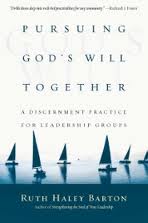
Ruth Haley Barton’s Pursuing God’s Will Together: A Discernment Practice For Leadership Groups (IVP, 2012), is the kind of book that will change the way a church leadership team or not-for-profit board functions – for the better. Instead of using business principles, Roberts’ Rules Of Order and bookends of perfunctory prayer to run meetings and make decisions, Haley Barton describes an entirely different paradigm. Instead of decision-making, she suggests that these groups need to learn to discern God’s will together. Discernment requires all members on a team to commit to attend to their own individual spiritual lives, pursue spiritual community among themselves, learn to listen to God together, learn to listen to one another together, and commit, preferably in a covenanted relationship, to a process that is rooted in the character of God.
She explains why the dominant style of leadership in our culture does not translate well to church or faith-based nonprofit settings: “Gifted leaders – Christian or otherwise – can function effectively for a while on the basis of natural gifting and knowing how to maneuver in the business world. This does not necessarily qualify them for spiritual leadership. The destructive results of a lack of self-knowledge may not become evident until the person has been in leadership long enough for the public persona to fray around the edges when the pressure is on. When pushed against the wall, such leaders will capitulate to old unresolved patterns.”
As I read, I reflected on some of the teams of which I’ve been a part and tried to imagine what it would have been like to function via shared discernment instead of the ways we made decisions (by crisis, by voting, by steamrolling, by passive-agressive avoidance). Shared discernment comes at a cost of time and ego, but reeks in the most beautifully fragrant sort of way, of flourishing, abundant life together.
 Dr. James Galvin, a seasoned organizational consultant, addresses the effects of leaders’ misspent time and ego issues in his book I’ve Got Your Back: A Leadership Parable. He contends that “follower abuse” is everywhere. (Show of hands if you agree.) Without intentional and pro-active response on the part of followers as they deal with abusive leaders, they are doomed to either repeat the pattern or abdicate, taking their gifts and growth potential with them. To that end, Galvin offers a fictitious story of the ongoing interchange between four young adults stuck in various confusing and dysfunctional work or ministry situation and an older, wiser mentor. A number of charts and graphs sprinkled throughout the book offer quick visual support for the coaching Galvin’s mentor character, Jack, offers to mentees Brad, Randall, Lynn and Valerie.
The story portion of the book is didactic in nature; it is comprised of a series of instructional conversations. The dilemmas each young person faces is entirely believable, though the the conversations tend to be more positive and character tensions resolve more quickly than a true work of fiction would allow. This is a parable, however, meant to teach, and Galvin packs a lot of practical advice into this story about learning to follow well even when the leader is not holding up his or her end of the bargain. After he wraps up the parable portion of I’ve Got Your Back, Galvin offers up a short theology of follower-ship that is a wonderful summary of the conversation in the first two-thirds of the book. He writes, “Even with all the research and books available to us, leadership is still messed up. When managers or politicians or pastors dominate in meetings, demand their own way, treat people as objects or abuse followers, we typically call them ‘strong’ leaders. Harsh leaders would be a better descriptor. Clumsy would work…Why do we put up with it and call them ‘strong’ leaders as if what they’re doing is acceptable? As followers, our mental model of leadership must be messed up, too.”
In no way does he advocate a doormat-like acceptance of this abuse. Rather, he encourages readers to be proactive in pursuing their own growth and the good of others around and over them, which I’d say is a pretty decent leadership training program.
What is your favorite book on leadership? Why?
Previous Post

February 4, 2013
Pilgrim's Road Trip #7 – Mama Rebekah
Next Post
February 11, 2013 Praying for you, future Pope
Browse Our Archives
Select a Category Baggage Books Calendar Church and Ministry CVID Ecclesiology Everyday Christian life Faith Falling Upward From The Margins Housing Jesus Movement's Unintended Consequences Midlife Midlife Survey #1 Midlife Survey #2 Moments and Days Out To The Margins Pilgrim's Road Trip Regret Seminary Spiritual Formation Uncategorized What's A Nice Jewish Grandmother Like You Doing In Seminary? When The Heart Waits Writing
Select a Month June 2017 May 2017 April 2017 March 2017 February 2017 January 2017 December 2016 November 2016 October 2016 September 2016 August 2016 July 2016 June 2016 May 2016 April 2016 March 2016 February 2016 January 2016 December 2015 November 2015 October 2015 September 2015 August 2015 July 2015 June 2015 May 2015 April 2015 March 2015 February 2015 January 2015 December 2014 November 2014 October 2014 September 2014 August 2014 July 2014 June 2014 May 2014 April 2014 March 2014 February 2014 January 2014 December 2013 October 2013 September 2013 August 2013 July 2013 June 2013 May 2013 April 2013 March 2013 February 2013 January 2013 December 2012 November 2012 October 2012 September 2012 August 2012 July 2012 June 2012 May 2012 April 2012 March 2012 February 2012 January 2012 December 2011 November 2011 October 2011 September 2011 August 2011 July 2011 June 2011 May 2011 April 2011 March 2011 February 2011 January 2011 December 2010 November 2010 October 2010 September 2010 August 2010 July 2010 June 2010 May 2010 April 2010 March 2010 February 2010 January 2010 December 2009 November 2009 October 2009 September 2009 August 2009 July 2009 June 2009 May 2009 April 2009 March 2009 February 2009 January 2009 December 2008 November 2008 October 2008 September 2008 August 2008 July 2008 June 2008 May 2008 April 2008 March 2008 February 2008 January 2008 December 2007 November 2007 October 2007 September 2007 August 2007 July 2007 June 2007 May 2007 April 2007
Follow Us!
TAKE THE
Religious Wisdom Quiz
I killed 600 Philistines with nothing but an oxgoad. Who am I?
Select your answer to see how you score.
Ehud Gideon Samson Shamgar
Related posts from Pilgrim's Road Trip
Introducing: Long Days Of Small Things
Review: Deliberate Acts of Kindness
Review: Of Stillness And Storm

Reflection: The Sound of a Million Dreams
TRENDING AT PATHEOS Evangelical

The REST of Your Life: A Creative Wrestles...
This week I had a conversation with a good friend from church....

How the author of the world's best hymn...
I've been working with John Newton for a while now. This makes...

Long before this Lectio Divina, Psalm 130 - the song - started...

What About the Trees? Another Living Parable
After I finished writing the last article about falling leaves as a...

Why Classical Education Is a Conversation, Not a...
Come and Read: Joy in Classical Education When I was a little...

Cornell University has received a great deal of negative publicity and intense...
view all Evangelical blogs
Ad-Free & Subscriber Log-In Subscription Support
- About Us
- 2026 Calendar
- Videos
- Podcasts
- Library of World Religions
- Faith In Media Tracker
- Advertise With Us
- Write for Us
- Privacy Policy
- Terms of Service
- Do Not Sell My Data
- Contact Us
- Radiant Digital
- Manage Newsletter Subscriptions
- Unsubscribe From Notifications
- Sitemap
Copyright 2008-2026, Patheos. All rights reserved.
Subscription Support Ad-Free & Subscriber Log-In
Follow Patheos