
BuddhistCatholicContemplativeEvangelicalGeneral ChristianHinduJewishLatter-day SaintMuslimNew VisionsProgressive Christian
Beliefs
- Buddhist
- Catholic
- Contemplative
- Evangelical
- General Christian
- Hindu
- Jewish
- Latter-day Saint
- More Voices
- Muslim
- New Visions
- Pagan
- Progressive Christian
Topics
- Religion News
- Food and Religion
- Sports and Religion
- Religious Art
- Religious Music and Entertainment
- Religious Events
- History and Religion
- Style and Religion
- Politics and Religion
- Women in Religion
- Recreation Outdoors and Religion
- Business Finance and Religion
- Careers Workplace and Religion
- Education and Religion
- Family Parenting and Religion
- Health Fitness and Religion
- Home and Religion
- Relationships and Religion
- Technology and Religion
- Travel and Religion
Columnists
- Buddhist Columnists
- Business Finance and Religion Columnists
- Careers Workplace and Religion Columnists
- Catholic Columnists
- Contemplative Columnists
- Education and Religion Columnists
- Evangelists Columnists
- Family Parenting and Religion Columnists
- General Christian Columnists
- Health Fitness and Religion Columnists
- Hindu Columnists
- History and Religion Columnists
- Home and Religion Columnists
- Jewish Columnists
- More Voices Columnists
- Latter Day Columnists
- Muslim Columnists
- New Visions Columnists
- Nonreligious Columnists
- Pagan Columnists
- Politics and Religion Columnists
- Progressive Columnists
- Recreation Outdoors and Religion Columnists
- Relationships and Religion Columnists
- Religion News Columnists
- Religious Art Columnists
- Religious Events Columnists
- Religious Music and Entertainment Columnists
- Sports and Religion Columnists
- Style and Religion Columnists
- Technology and Religion Columnists
- Travel and Religion Columnists
- Women in Religion Columnists
Resource Library
- 2026 Calendar
- Library of World Religions
- The 100 Most Holy Places on Earth
- Patheos Answers
- Podcasts
- Videos
- Faith Leaders Database
- Anglican Episcopalian
- Bahai
- Baptist
- Buddhism
- Christianity
- Confucianism
- Eastern Orthodoxy
- Hinduism
- Holiness and Pentecostal
- ISKCON
- Islam
- Judaism
- Lutheran
- Methodist
- The Church of Jesus Christ of Latter-day Saints
- New Age
- Paganism
- Presbytarian and Reformed
- Protestantism
- Religion Behind the Scenes
- Roman Catholic
- Scientology
- Shia Islam
- Sikhism
- Sufism
- Sunni Islam
- Taoism
- Zen
- See all religions
Research Tools
 Ad-Free & Subscriber Log-In Subscription Support
Ad-Free & Subscriber Log-In Subscription Support
Follow Patheos 

- Trending:
- Forgiveness
- |
- Marriage
- |
- Consciousness
- |
- Death Penalty
- |
- Election
- |
- Halloween
 Pilgrim's Road Trip
- Home
- Evangelical
- Spiritual narcissism
Spiritual narcissism
Last updated on: June 30, 2011 at 7:34 am by Michelle Van Loon
Spiritual narcissism 2011-06-30T07:34:00-05:00 Michelle Van Loon
Patheos Explore the world's faith through different perspectives on religion and spirituality! Patheos has the views of the prevalent religions and spiritualities of the world.
Yesterday while I was playing hooky, I headed to WI for a quick visit with Meg, my long-time prayer partner. We ended our day in the empty sanctuary of her Pewaukee church. It is a small modern space, but was sited onto the land with great respect to the old trees and plantings already residing on the land. Windows behind the altar bring breathtaking views of creation into the building all four seasons of the year.
As Meg and I prayed, I could almost hear a sermon preached to me by the plants and trees in full bloom. Their early summer majesty whispered to me that they are helpless to grow themselves; sun, wind, soil, rain and time are given them by the One who hard-wired the DNA within each one’s seed. Dr. Gerald May noted, “The gentlest form of spiritual narcissism is the idea that one can accomplish one’s own spiritual growth.”
Jesus told a story about the nature and purpose of spiritual growth. In my book Uprooted: Growing A Parable Life From The Inside Out, I spent a little time imagining Jesus’ revolutionary idea that God alone causes growth to happen in our lives. Enjoy!
He also said, “This is what the kingdom of God is like. A man scatters seed on the ground. Night and day, whether he sleeps or gets up, the seed sprouts and grows, though he does not know how. All by itself the soil produces grain—first the stalk, then the head, then the full kernel in the head. As soon as the grain is ripe, he puts the sickle to it, because the harvest has come.” -Mark 4:26-29
Levi groaned. The first rays of the sun slanted through the open doorway, and he rolled over, draping his arm across his eyes. Ah, for just a few more minutes of sleep.
Miriam’s side of the bed was already cold. She was a good woman, that one, up before the dawn to begin preparing breakfast for the family.
He let his arm drop, and pushed himself up to a sitting position. As his feet hit the floor, he uttered the day’s first prayer: I give thanks before you, King, living and eternal, for you have returned within me my soul with compassion, abundant is Your faithfulness. Amen.
He’d built his life using the pattern given him by his father, may he rest in peace, and from his grandfather before him. Levi’s family was comprised of an unbroken chain of rabbis, honorable men who’d taught others how to live every jot and tittle of the Torah.
He lifted the tefillin, those small boxes containing portions of God’s Word, one for his head and one for his hand, and began wrapping the leather strapping to himself in the prescribed manner. Left hand first, Levi prayed: Blessed are you, Lord, our God, King of the universe, Who has sanctified us with His commandments and has commanded us to put on tefillin. Amen. Up the arm, 7 times around, Levi pulled the straps snugly: Blessed is the Name of His glorious kingdom for ever and ever. Amen. He affixed the other precious little box to his head, and continued, Blessed are you, Lord, our God, King of the universe, Who has sanctified us with His commandments and has commanded us regarding the commandment of tefillin. Amen.
He paused for a respectful moment, then repeated the statement that completed this part of the ritual. He’d said it by rote every day of his life since the day he became a man: I will betroth you to Me forever, and I will betroth you to Me with righteousness, justice, kindness, and mercy. I will betroth you to Me with faithfulness, and you shall know Me, God.
He dropped his prayer shawl over his head like a small tent and raised his hands: Blessed are You, Lord, our God, King of the universe, Who has sanctified us with His commandments, and commanded us regarding the commandment of fringes. Amen. Those carefully knotted fringes were combination amulet and billboard, a reminder of God’s 613 rules at the foundation of Levi’s life.
Levi completed his morning prayers, removed his tefillin, and went to join his wife and children for breakfast. He stopped to wash his hands: Blessed are You O Lord our God, King of the universe, Who has made us holy through His commandments, and has commanded us concerning washing hands. Amen. He then prayed a blessing on the warm flatbread (“Blessed are You, Eternal our God, Ruler of the Universe, who brings forth bread from the earth. Amen.”) and figs (“Blessed are You, Eternal our God, Ruler of the Universe, Creator of the fruit of the tree. Amen.”)
. Each moment of Levi’s day was shaped as much by those rules as by the centuries of commentary about the specifics about how to best obey those rules. His life was a chain of days; the links forged of iron obedience.
The latest debate among the men at his synagogue centered on how best to thank the Creator for two pieces of fruit when one piece was cut into pieces and the other was served whole. Give thanks for the whole piece, of course, Levi contended. But others felt that thanking God for the cut pieces was in order since those were the ones that were going to be eaten first. Some complained that they were splitting hairs with an axe, but Levi was convinced, as were his father and grandfather before him, that these questions were practically a matter of life or death.
Jesus’ full-house audience that day at beside the lake was peppered with many men like Levi, men who’d come to hear this rabbi from Nazareth. Most wondered aloud, “Can any good thing come from such a place?” They’d heard about him, and were curious to hear this teacher’s opinion about how to best thank the Creator for cut fruit, the right length for the tassels on one’s prayer shawl, and how to measure their strides on the Sabbath so they didn’t inadvertently work by taking one step too many. As he seated himself along the lakeshore in a prime spot, Levi knew he’d best be attentive. Jesus’ words would be additional kindling for the fiery discussion at the synagogue that would follow His visit to their area.
Imagine Levi’s surprise when Jesus didn’t talk about the proper way to bless a bowl of cut figs. He told a cluster of stories instead, telling His hearers about an odd kingdom He claimed was God’s where people were themselves the fruit. Levi knew the power of a story to make a point; he used the technique himself when a particularly slow-witted member of his congregation didn’t understand him.
Jesus’ stories were ridiculous…insulting even! Levi was furious that Rabbi Jesus would tell the people a story that wasn’t even much of a story – it was simply a description of the life cycle of a seed. A seed! What kind of a hoax was this?! How could a plant tell people more about God’s kingdom than a Law-loving man like Levi? Levi considered himself a fair and open-minded man, but as he listened to Jesus, he absently fingered the tassels on his tallit and slammed his heart shut.
Amen.
+ + + + + + +
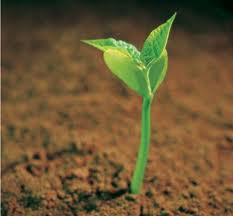
Jesus told those willing to hear Him that the process of a seed’s growth is a simile that can help us discover His kingdom here and now. A plot of ground, planted intentionally with seed, tells us exactly what we need to know about the way His kingdom works. There are many who believe they’re growing God’s kingdom by with beautifully-crafted religious technique. But all rules and methods can ever do is create a structure. We humans have the capability to build things, but are powerless to make growth happen.
Jesus’ little story, found only in the gospel of Mark, carries a heaven-sized message that tells us that we are barren earth, impotent to generate life or produce fruit. God’s kingdom is contained wholly in the seed – His life, planted in each of us who follows Him. The whole aim of the seed’s life is to come to maturity and be ready for harvest by the One who planted it in the first place. This parable isn’t a biology lesson. It’s about the mystery of His life lived in us.
And the world around us – every blade of grass, every shaft of wheat, every willow and thistle and palm is explaining the mystery to us.
Previous Post

June 22, 2011
Review: Story Engineering
Next Post
July 1, 2011 Country music words quiz
Browse Our Archives
Select a Category Baggage Books Calendar Church and Ministry CVID Ecclesiology Everyday Christian life Faith Falling Upward From The Margins Housing Jesus Movement's Unintended Consequences Midlife Midlife Survey #1 Midlife Survey #2 Moments and Days Out To The Margins Pilgrim's Road Trip Regret Seminary Spiritual Formation Uncategorized What's A Nice Jewish Grandmother Like You Doing In Seminary? When The Heart Waits Writing
Select a Month June 2017 May 2017 April 2017 March 2017 February 2017 January 2017 December 2016 November 2016 October 2016 September 2016 August 2016 July 2016 June 2016 May 2016 April 2016 March 2016 February 2016 January 2016 December 2015 November 2015 October 2015 September 2015 August 2015 July 2015 June 2015 May 2015 April 2015 March 2015 February 2015 January 2015 December 2014 November 2014 October 2014 September 2014 August 2014 July 2014 June 2014 May 2014 April 2014 March 2014 February 2014 January 2014 December 2013 October 2013 September 2013 August 2013 July 2013 June 2013 May 2013 April 2013 March 2013 February 2013 January 2013 December 2012 November 2012 October 2012 September 2012 August 2012 July 2012 June 2012 May 2012 April 2012 March 2012 February 2012 January 2012 December 2011 November 2011 October 2011 September 2011 August 2011 July 2011 June 2011 May 2011 April 2011 March 2011 February 2011 January 2011 December 2010 November 2010 October 2010 September 2010 August 2010 July 2010 June 2010 May 2010 April 2010 March 2010 February 2010 January 2010 December 2009 November 2009 October 2009 September 2009 August 2009 July 2009 June 2009 May 2009 April 2009 March 2009 February 2009 January 2009 December 2008 November 2008 October 2008 September 2008 August 2008 July 2008 June 2008 May 2008 April 2008 March 2008 February 2008 January 2008 December 2007 November 2007 October 2007 September 2007 August 2007 July 2007 June 2007 May 2007 April 2007
Follow Us!
TAKE THE
Religious Wisdom Quiz
Who did God call to lead the Israelites out of Egypt?
Select your answer to see how you score.
David Aaron Moses Joseph
Related posts from Pilgrim's Road Trip

What's A Nice Jewish Grandmother Like You Doing...


Shavuot, Pentecost: To Learn, To Try, To Eat
TRENDING AT PATHEOS Evangelical

The REST of Your Life: A Creative Wrestles...
This week I had a conversation with a good friend from church....

How the author of the world's best hymn...
I've been working with John Newton for a while now. This makes...

Long before this Lectio Divina, Psalm 130 - the song - started...

What About the Trees? Another Living Parable
After I finished writing the last article about falling leaves as a...

Why Classical Education Is a Conversation, Not a...
Come and Read: Joy in Classical Education When I was a little...

Cornell University has received a great deal of negative publicity and intense...
view all Evangelical blogs
Ad-Free & Subscriber Log-In Subscription Support
- About Us
- 2026 Calendar
- Videos
- Podcasts
- Library of World Religions
- Faith In Media Tracker
- Advertise With Us
- Write for Us
- Privacy Policy
- Terms of Service
- Do Not Sell My Data
- Contact Us
- Radiant Digital
- Manage Newsletter Subscriptions
- Unsubscribe From Notifications
- Sitemap
Copyright 2008-2026, Patheos. All rights reserved.
Subscription Support Ad-Free & Subscriber Log-In
Follow Patheos