
BuddhistCatholicContemplativeEvangelicalGeneral ChristianHinduJewishLatter-day SaintMuslimNew VisionsProgressive Christian
Beliefs
- Buddhist
- Catholic
- Contemplative
- Evangelical
- General Christian
- Hindu
- Jewish
- Latter-day Saint
- More Voices
- Muslim
- New Visions
- Pagan
- Progressive Christian
Topics
- Religion News
- Food and Religion
- Sports and Religion
- Religious Art
- Religious Music and Entertainment
- Religious Events
- History and Religion
- Style and Religion
- Politics and Religion
- Women in Religion
- Recreation Outdoors and Religion
- Business Finance and Religion
- Careers Workplace and Religion
- Education and Religion
- Family Parenting and Religion
- Health Fitness and Religion
- Home and Religion
- Relationships and Religion
- Technology and Religion
- Travel and Religion
Columnists
- Buddhist Columnists
- Business Finance and Religion Columnists
- Careers Workplace and Religion Columnists
- Catholic Columnists
- Contemplative Columnists
- Education and Religion Columnists
- Evangelists Columnists
- Family Parenting and Religion Columnists
- General Christian Columnists
- Health Fitness and Religion Columnists
- Hindu Columnists
- History and Religion Columnists
- Home and Religion Columnists
- Jewish Columnists
- More Voices Columnists
- Latter Day Columnists
- Muslim Columnists
- New Visions Columnists
- Nonreligious Columnists
- Pagan Columnists
- Politics and Religion Columnists
- Progressive Columnists
- Recreation Outdoors and Religion Columnists
- Relationships and Religion Columnists
- Religion News Columnists
- Religious Art Columnists
- Religious Events Columnists
- Religious Music and Entertainment Columnists
- Sports and Religion Columnists
- Style and Religion Columnists
- Technology and Religion Columnists
- Travel and Religion Columnists
- Women in Religion Columnists
Resource Library
- 2026 Calendar
- Library of World Religions
- The 100 Most Holy Places on Earth
- Patheos Answers
- Podcasts
- Videos
- Faith Leaders Database
- Anglican Episcopalian
- Bahai
- Baptist
- Buddhism
- Christianity
- Confucianism
- Eastern Orthodoxy
- Hinduism
- Holiness and Pentecostal
- ISKCON
- Islam
- Judaism
- Lutheran
- Methodist
- The Church of Jesus Christ of Latter-day Saints
- New Age
- Paganism
- Presbytarian and Reformed
- Protestantism
- Religion Behind the Scenes
- Roman Catholic
- Scientology
- Shia Islam
- Sikhism
- Sufism
- Sunni Islam
- Taoism
- Zen
- See all religions
Research Tools
 Ad-Free & Subscriber Log-In Subscription Support
Ad-Free & Subscriber Log-In Subscription Support
Follow Patheos 

- Trending:
- Forgiveness
- |
- Marriage
- |
- Consciousness
- |
- Death Penalty
- |
- Election
- |
- Halloween
 Pia de Solenni
- Home
- Catholic
- Bp Paprocki & March Madness: How to Address B16 After Feb. 28
Bp Paprocki & March Madness: How to Address B16 After Feb. 28
Last updated on: February 18, 2013 at 8:18 am by Pia de Solenni
Bp Paprocki & March Madness: How to Address B16 After Feb. 28 2013-02-18T08:18:53-07:00 Pia de Solenni
Patheos Explore the world's faith through different perspectives on religion and spirituality! Patheos has the views of the prevalent religions and spiritualities of the world.
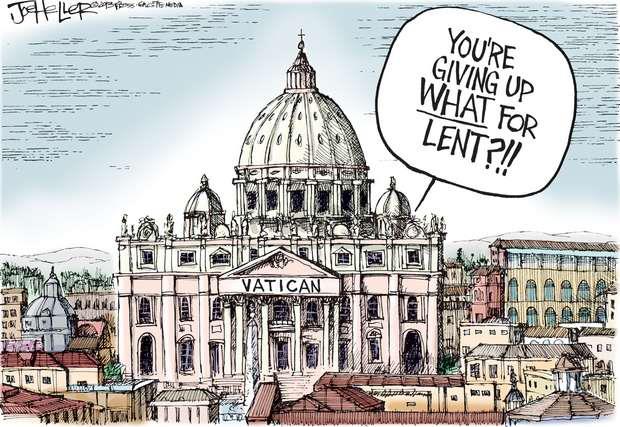 Bishop Thomas John Paprocki [STL, JD, JCD] of Springfield in Illinois sent around the following canonical analysis on what to call Pope Benedict when he leaves office on February 28th. He has graciously allowed me to post them for those of us engaged in a different sort of March Madness.
Since Pope Benedict’s surprise announcement last week, there has been much discussion about what to call a Pope who steps down from office. The confusion is understandable since a Pope has not left office alive for almost 600 years. It might even be said that a Pope has never stepped down quite under these circumstances in the 2,000 year history of the Church.
What seems to have been overlooked so far in these discussions is that the word “Pope” does not appear in the Code of Canon Law. Canon 331 defines the office held by the Pope: “The bishop of the Roman Church, in whom continues the office given by the Lord uniquely to Peter, first of the Apostles, and to be transmitted to his successors, is the head of the college of bishops, the Vicar of Christ, and the Pastor of the universal Church on earth. By virtue of his office he possesses supreme, full, immediate and universal ordinary power in the Church, which he is always able to exercise freely.”
From this canon, we can draw several titles for the office held by a Pope: Bishop of Rome, Successor of St. Peter, Head of the College of Bishops, Vicar of Christ, and Pastor of the Universal Church. Other canons give us the title most commonly used for the Petrine office throughout the Code: “Roman Pontiff” (e.g., canons 330, 332, 333, 334, 337, 338, 341, 342, 343, 346, 347, 348, 349, 350, 351, 352, 353, 354, 355, 356, 358, 361, 362, and 363). The title “Supreme Pontiff” is also used frequently in the Code (e.g., canons 340, 355, 360). The Code even eschews the popular and colloquial term “Papal Legate” when referring to the ecclesial diplomats who act as representatives of the Holy See, calling them officially “Legates of the Roman Pontiff” and “pontifical legates” (see canons 362-367).
Accordingly, Benedict did not use the word “Pope” anywhere in his spoken announcement or letter of resignation, in which he said that he would step down from “the ministry of Bishop of Rome, Successor of Saint Peter, entrusted to me by the Cardinals on 19 April 2005, in such a way, that as from 28 February 2013, at 20:00 hours, the See of Rome, the See of Saint Peter, will be vacant and a Conclave to elect the new Supreme Pontiff . . .” As such, he used the titles for the office listed in canon 331 and 340. He signed that letter “BENEDICTUS PP. XVI,” which simply means that he is the sixteenth Pope by the name “Benedict.” That is a historical fact that will never change.
How then are we to understand the word “Pope?” It is an honorific, even a term of endearment (“Papa” in Italian). It is not the title of an ecclesiastical office. We make this distinction all the time. We still call a priest by the honorific “Father” even after he has resigned from the office of Pastor. Having lived in Italy for three and a half years when I was studying canon law, and having a sense of the culture, I have a feeling the Italians will continue to call Pope Benedict Papa Benedetto even after he leaves office as the Bishop of Rome. So I don’t think people will have a hard time wrapping their minds around having a Pope who is no longer the Roman Pontiff, Bishop of Rome, etc. Certainly, in direct address, one would never address him as anything but, “Your Holiness.”
Of course, it would be best to know what Pope Benedict himself wants to be called after February 28 and I hope he will tell us. We can get some idea of that from the name under which his books about Jesus of Nazareth have been published: “Joseph Ratzinger – Pope Benedict XVI.” In his forward to the first volume, he made it clear that “this book is in no way an exercise of the magisterium, but solely an expression of my personal search ‘for the face of the Lord’ (Cf. Ps 27:8).” So, writing in his personal capacity and not as Supreme Pontiff, he called himself, “Joseph Ratzinger – Pope Benedict XVI.”
Some have suggested that he should return to being “Cardinal Ratzinger.” That does not seem correct. If he had resigned before reaching the age of 80, after which a Cardinal may no longer vote in a papal conclave, I do not think he would have, should have or could have donned a red cassock and entered the conclave in the Sistine Chapel to vote for his successor.
Instead, at 8:00 PM Rome time on February 28, 2013, Pope Benedict XVI will have a new identity to which we will have to become accustomed: His Holiness, Joseph Ratzinger, Pope Benedict XVI, former Roman/Supreme Pontiff, Bishop Emeritus of Rome.
There has also been some discussion about whether Pope Benedict “renounced,” “resigned” or “abdicated” the office of Roman Pontiff. The official English translation of the Code of Canon Law translates “renuntiatio” in canon 332, §2 as “resignation.” (“If it happens that the Roman Pontiff resigns his office, it is required for validity that the resignation is made freely and properly manifested, but not that it be accepted by anyone.” In Latin: “Si contingat ut Romanus Pontifex muneri suo renuntiet, ad validitatem requiritur ut renuntiatio libere fiat et rite manifestetur, non vero ut a quopiam acceptetur.”)
Accordingly, I believe “resign” is a more accurate translation in this context than “renounce” and certainly not “abdicate” (a term used by royalty when a monarch steps down from the throne). It does seem odd that someone could resign without submitting that resignation to anyone, so the canon specifically addresses that question by saying that for validity it is required that the resignation must be “made freely and properly manifested, but not that it be accepted by anyone.”
Although “renounce” has been used even in the Holy See’s translation of his announcement and letter of resignation, I think that “renounce” is a literal but not necessarily accurate translation of “renuntio” in this context. Since the Pope wrote and spoke in Latin, it is a question of translation. Parallel passages in canon law regarding bishops and pastors stepping down from office use the word “renuntiatio,” but we never speak of a bishop sending in his letter of “renunciation” when he turns 75 or a pastor “renouncing” his office. So my interpretation as a canon lawyer is that “resignation” is the proper translation of “renuntiatio” in this context.
These observations are my humble canonical opinions and interpretations, so I willingly defer to more learned experts in these matters. Of course, this could all become moot if the Holy Father tells us clearly his wishes. In any event, I pray for Pope Benedict XVI during this time of transition and for the guidance of the Holy Spirit in the election of his successor.
Many thanks to Bishop Paprocki for his input!
Previous Post

February 15, 2013
Benedict's Resignation - Bringing the Church into the Modern Age
Next Post
February 22, 2013 B16: No more church of what's-happenin'-now.
Browse Our Archives
Select a Category Articles Thinking Out Loud Uncategorized
Select a Month August 2016 July 2016 May 2016 March 2016 February 2016 July 2015 June 2015 May 2015 April 2015 March 2015 February 2015 January 2015 December 2014 November 2014 October 2014 September 2014 August 2014 July 2014 June 2014 May 2014 April 2014 March 2014 February 2014 September 2013 August 2013 May 2013 April 2013 March 2013 February 2013 January 2013 December 2012 November 2012 October 2012 September 2012 August 2012 July 2012 June 2012 April 2012 March 2012 February 2012 January 2012 December 2011 November 2011 October 2011 September 2011 August 2011 July 2011 June 2011 May 2011 April 2011 March 2011 February 2011 January 2011 December 2010 November 2010 October 2010 September 2010 May 2010 April 2010 March 2010 August 2009 June 2009 May 2009 April 2009 March 2009 February 2009 December 2008 November 2008 October 2008 September 2008 August 2008 July 2008 June 2008 May 2008 April 2008 March 2008 February 2008 January 2008 December 2007 November 2007 October 2007 September 2007 July 2007 October 1008
Follow Us!
TAKE THE
Religious Wisdom Quiz
In 2 Corinthians, Paul describes a man being caught up to the third heaven. How many years before writing did this happen?
Select your answer to see how you score.
Fourteen years Twelve years Ten years Seven years
Related posts from Pia de Solenni

Young Catholics, The New Pope, HuffPost, & Me

Moving Forward: Muslims And Jews Show Solidarity With...

On divorce, Chaput and Francis singing from the...

The Trans Movement - Another Form of Patriarchy
TRENDING AT PATHEOS Catholic

Creation, Preservation, and Teleology in Catholic Theology
As I write this, it is very early Monday morning. Like millions...

The Parable Of The Sower And The Word...
One of Christ’s most famous parables is that of the sower who...

Rejecting Doom: Christian Hope And Human Action
Christianity is a religion of hope. We are to have hope and...

Why I Choose the Eucharist Over the Sermon
Choose the Eucharist, Not the Sermon What are we supposed to get...

5 Design Elements Found in Spiritually Rooted Homes
Putting Spirituality Into Home Decor Our homes are more than our living...

Credo: A Story of God Told with the...
About 10 years ago, I began to imagine a personal "Credo" that...
view all Catholic blogs
Ad-Free & Subscriber Log-In Subscription Support
- About Us
- 2026 Calendar
- Videos
- Podcasts
- Library of World Religions
- Faith In Media Tracker
- Advertise With Us
- Write for Us
- Privacy Policy
- Terms of Service
- Do Not Sell My Data
- Contact Us
- Radiant Digital
- Manage Newsletter Subscriptions
- Unsubscribe From Notifications
- Sitemap
Copyright 2008-2026, Patheos. All rights reserved.
Subscription Support Ad-Free & Subscriber Log-In
Follow Patheos