
BuddhistCatholicContemplativeEvangelicalGeneral ChristianHinduJewishLatter-day SaintMuslimNew VisionsProgressive Christian
Beliefs
- Buddhist
- Catholic
- Contemplative
- Evangelical
- General Christian
- Hindu
- Jewish
- Latter-day Saint
- More Voices
- Muslim
- New Visions
- Pagan
- Progressive Christian
Topics
- Religion News
- Food and Religion
- Sports and Religion
- Religious Art
- Religious Music and Entertainment
- Religious Events
- History and Religion
- Style and Religion
- Politics and Religion
- Women in Religion
- Recreation Outdoors and Religion
- Business Finance and Religion
- Careers Workplace and Religion
- Education and Religion
- Family Parenting and Religion
- Health Fitness and Religion
- Home and Religion
- Relationships and Religion
- Technology and Religion
- Travel and Religion
Columnists
- Buddhist Columnists
- Business Finance and Religion Columnists
- Careers Workplace and Religion Columnists
- Catholic Columnists
- Contemplative Columnists
- Education and Religion Columnists
- Evangelists Columnists
- Family Parenting and Religion Columnists
- General Christian Columnists
- Health Fitness and Religion Columnists
- Hindu Columnists
- History and Religion Columnists
- Home and Religion Columnists
- Jewish Columnists
- More Voices Columnists
- Latter Day Columnists
- Muslim Columnists
- New Visions Columnists
- Nonreligious Columnists
- Pagan Columnists
- Politics and Religion Columnists
- Progressive Columnists
- Recreation Outdoors and Religion Columnists
- Relationships and Religion Columnists
- Religion News Columnists
- Religious Art Columnists
- Religious Events Columnists
- Religious Music and Entertainment Columnists
- Sports and Religion Columnists
- Style and Religion Columnists
- Technology and Religion Columnists
- Travel and Religion Columnists
- Women in Religion Columnists
Resource Library
- 2026 Calendar
- Library of World Religions
- The 100 Most Holy Places on Earth
- Patheos Answers
- Podcasts
- Videos
- Faith Leaders Database
- Anglican Episcopalian
- Bahai
- Baptist
- Buddhism
- Christianity
- Confucianism
- Eastern Orthodoxy
- Hinduism
- Holiness and Pentecostal
- ISKCON
- Islam
- Judaism
- Lutheran
- Methodist
- The Church of Jesus Christ of Latter-day Saints
- New Age
- Paganism
- Presbytarian and Reformed
- Protestantism
- Religion Behind the Scenes
- Roman Catholic
- Scientology
- Shia Islam
- Sikhism
- Sufism
- Sunni Islam
- Taoism
- Zen
- See all religions
Research Tools
 Ad-Free & Subscriber Log-In Subscription Support
Ad-Free & Subscriber Log-In Subscription Support
Follow Patheos 

- Trending:
- Forgiveness
- |
- Marriage
- |
- Consciousness
- |
- Death Penalty
- |
- Election
- |
- Halloween
 The Phoenix and Olive Branch
- Home
- New Visions
- Emotional Incest: The Bottom Line
Emotional Incest: The Bottom Line
Last updated on: July 3, 2014 at 11:29 am by Sierra Phoenix
Emotional Incest: The Bottom Line 2014-07-03T11:29:07-04:00 Sierra Phoenix
Patheos Explore the world's faith through different perspectives on religion and spirituality! Patheos has the views of the prevalent religions and spiritualities of the world.
My last two posts, and indeed all my thinking on the subject has led me to some conclusions about the ways that Christian Patriarchy and purity culture enable and even celebrate emotional incest. The following are the cliff notes:
Christian patriarchy turns marriage from a relationship to an institution, effectively reversing the historical trend from business partnerships and heir insurance to bonds between two free agents based on love. Evangelical culture says that marriage takes three: you, your spouse, and God. It also promotes self-denial and the sublimation of one’s own desires to those of Christ. Therefore, any two evangelical Christians should be able to marry each other and have a godly, fulfilling marriage, given enough work and prayer. Purity culture says that chemistry and personality don’t matter. What matters is following the Word of God. Husbands and wives should love each other because it’s commanded in God’s Word to do so; loving his wife is a husband’s “first ministry.” Similarly, a wife “ministers” to her husband by submission and love. The core of marriage in Christian patriarchy is the commitment to be loyal to God and to the marriage, not attachment to the person of the spouse. This is why evangelical courtships are more focused on purity than the prospective partners getting to know each other personally; what matters is getting to the altar without regrets. The love in marriage flows from commitment rather than the other way around, mirroring the logic of arranged marriage.(Note: Most evangelical Christians do acknowledge the importance of an emotional bond between the bride and groom that develops before the wedding day. Most evangelical Christians do want their children to marry people whom they find attractive, companionable and fun. If you are one of these Christians, you’re not the one I’m critiquing. (Congratulations! You’re normal!) What I do find problematic is the branch of evangelical-fundamentalist Christianity led by people like Bill Gothard, Matthew Chapman (who famously didn’t ask his wife to marry him), Doug Wilson, Jonathan Lindvall, et al. who expect young people to marry with hardly any knowledge of each other, rigid parental oversight and laundry lists of abstract virtues rather than personality traits in mind.)
The institutionalization of marriage in Christian patriarchy leads to relationships based on order, hierarchy and duty rather than affection. Husbands are commanded to be leaders of their wives. Wives are commanded to submit. Husbands are commanded to love. Wives are commanded to reverence. Marriage is reduced to performance of a gender role. Although individuals frequently subvert this, the ideal is that husband and wife will relate to one another as master and subordinate, with two distinct spheres of duty.
Women who must obey their husbands turn to their sons for more equal partnerships. Most evangelical-fundamentalists do not place the son’s authority higher than the mother’s, though some do. A mother can share interests with her son, disagree with him, choose their mutual activities and challenge her son in ways that she cannot challenge her husband. This promotes emotionally incestuous mother-son relationships in which the son becomes his mother’s main source of emotional support.
Husbands whose wives are constrained with childbearing and homemaking turn to their daughters for emotional affirmation. Wives are required to respect, obey, and love their husbands. Daughters are, too, but their devotion and admiration are more often the natural results of kind parenting than coercion or dogmatic instruction. (I fully acknowledge that many daughters don’t love their fathers, because their fathers are distant, abusive, etc. I am one of those daughters. However, a daughter whose father raises her kindly will usually love him without hesitation.) A daughter’s love is more spontaneous, and hence may feel more genuine than a wife’s love. A daughter is also less inhibited by years of conflicts, submission and moral instruction. She is simply younger and (usually) more enthusiastic. As a child, she is also more inclined to want to please her father – especially as that trait is cultivated in girls. As Libby Anne also points out, a daughter is more susceptible to her father’s influence, and has the potential to be molded into the ideal partner.
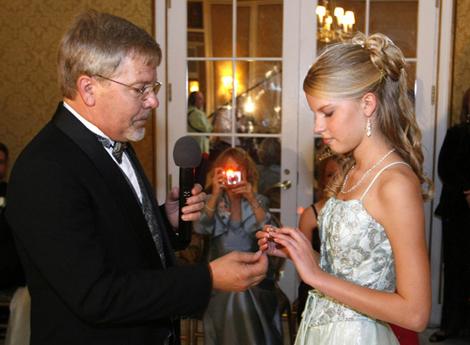
Christian patriarchy cultivates father-daughter emotional incest through purity pledges and purity balls, father-daughter dating, stay-at-home daughterhood, “practice” homemaking and the courtship process that gives fathers veto power over a girl’s relationships. Daughters are explicitly taught that they should submit to their fathers as their “heads” until they marry, that the father-daughter relationship is practice for marriage, that fathers should treat their daughters the way they want their future husbands to treat them (as opposed to being an example by treating their wives the way they want their daughters treated). With your father “guarding your heart,” you can hardly form relationships that don’t include, or indeed center on, him.
**Purity culture limits young people’s access to one another through courtship and sex-segregated activities.**This means that contact between the sexes is extremely formal, and many children of large families form their deepest bonds with their parents and siblings. This can stunt their ability to make friends or find partners on their own, further cementing parental control over spousal choices. It also limits children’s access to other families that could show them alternatives to the kinds of relationships that exist within their own families, leading them to think that their own family dynamic is “normal” even if it isn’t.
Quiverfull families normally rely on the eldest children (usually daughters) to parent younger siblings. This can artificially elevate the eldest children to the status of co-parents or partners for their parents. Normally, emotional incest occurs between a parent and his or her eldest child (though there are undoubtedly exceptions).
This is not to say that only patriarchal Christians are vulnerable to emotional incest. It is, however, to point out that some central tenets of Christian patriarchy and quiverfull enable those relationships to flourish unchecked. The results, when they are terminated, can be devastating for both parents and children. These relationships can have ripple effects that prevent children from forming healthy bonds with their own partners in adulthood. In the case of stay-at-home daughterhood, however, this flaw is considered a benefit. If daughters remain at home, serving their fathers, well into their own adulthood, they are treated as success stories. They shouldn’t be.
Previous Post

April 5, 2012
Emotional Incest: The Mama's Boy and the Other Woman
Next Post
April 11, 2012 Bedroom Submission, Birth Control and Tokophobia
Browse Our Archives
Select a Category abortion birth control chastity christian culture economy eschatology families fear feminism graduate school homeschooling islam LGBTQ issues love marriage media men modesty music patriarchy phoenix preaching quiverfull race sexuality project skirts-only submission Uncategorized william branham witnessing women
Select a Month July 2013 April 2013 February 2013 January 2013 December 2012 November 2012 October 2012 September 2012 August 2012 July 2012 June 2012 May 2012 April 2012 March 2012 February 2012 December 2011 November 2011 October 2011 September 2011 August 2011 July 2011 May 2011 April 2011 March 2011 February 2011 December 2010 November 2010 October 2010 September 2010 August 2010
Follow Us!
TAKE THE
Religious Wisdom Quiz
You are robbing me in tithes and offerings. Bring the whole tithe into the storehouse and test me in this. What will I do?
Select your answer to see how you score.
Care for the poor Return it tenfold Forgive you Open the floodgates of heaven
Related posts from The Phoenix and Olive Branch

The Fistfight Fallacy: rape culture's ahistorical premise

Sexism, Judgment Day and Forgetting as a Survival...

A Sober Second Look writes about Islamophobia

Daughter of the Patriarchy, epilogue: What does leaving...
TRENDING AT PATHEOS New Visions

Did Prayer Cure His Cancer? Or Was It...
At 4 AM one morning, Joshua W. Brown’s wife awoke to a...

8 Ways a Near-Death Experience Rewires the Soul
Does Consciousness Survive Physical Death? After 50 Years of Research, Dr. Raymond...

Holy Longing: What Our Restlessness Is Telling Us
“One can find so many pains when the rain is falling.” -John...

What this is NOT about. This blog is definitely not about...

Who said the Israelites were God’s chosen? That’s right, they did. Who...

The Spirit World Is the Real World: God...
A Monk’s Wisdom on Body and Spirit I sit with Brother Martin...
view all New Visions blogs
Ad-Free & Subscriber Log-In Subscription Support
- About Us
- 2026 Calendar
- Videos
- Podcasts
- Library of World Religions
- Faith In Media Tracker
- Advertise With Us
- Write for Us
- Privacy Policy
- Terms of Service
- Do Not Sell My Data
- Contact Us
- Radiant Digital
- Manage Newsletter Subscriptions
- Unsubscribe From Notifications
- Sitemap
Copyright 2008-2026, Patheos. All rights reserved.
Subscription Support Ad-Free & Subscriber Log-In
Follow Patheos