
BuddhistCatholicContemplativeEvangelicalGeneral ChristianHinduJewishLatter-day SaintMuslimNew VisionsProgressive Christian
Beliefs
- Buddhist
- Catholic
- Contemplative
- Evangelical
- General Christian
- Hindu
- Jewish
- Latter-day Saint
- More Voices
- Muslim
- New Visions
- Pagan
- Progressive Christian
Topics
- Religion News
- Food and Religion
- Sports and Religion
- Religious Art
- Religious Music and Entertainment
- Religious Events
- History and Religion
- Style and Religion
- Politics and Religion
- Women in Religion
- Recreation Outdoors and Religion
- Business Finance and Religion
- Careers Workplace and Religion
- Education and Religion
- Family Parenting and Religion
- Health Fitness and Religion
- Home and Religion
- Relationships and Religion
- Technology and Religion
- Travel and Religion
Columnists
- Buddhist Columnists
- Business Finance and Religion Columnists
- Careers Workplace and Religion Columnists
- Catholic Columnists
- Contemplative Columnists
- Education and Religion Columnists
- Evangelists Columnists
- Family Parenting and Religion Columnists
- General Christian Columnists
- Health Fitness and Religion Columnists
- Hindu Columnists
- History and Religion Columnists
- Home and Religion Columnists
- Jewish Columnists
- More Voices Columnists
- Latter Day Columnists
- Muslim Columnists
- New Visions Columnists
- Nonreligious Columnists
- Pagan Columnists
- Politics and Religion Columnists
- Progressive Columnists
- Recreation Outdoors and Religion Columnists
- Relationships and Religion Columnists
- Religion News Columnists
- Religious Art Columnists
- Religious Events Columnists
- Religious Music and Entertainment Columnists
- Sports and Religion Columnists
- Style and Religion Columnists
- Technology and Religion Columnists
- Travel and Religion Columnists
- Women in Religion Columnists
Resource Library
- 2026 Calendar
- Library of World Religions
- The 100 Most Holy Places on Earth
- Patheos Answers
- Podcasts
- Videos
- Faith Leaders Database
- Anglican Episcopalian
- Bahai
- Baptist
- Buddhism
- Christianity
- Confucianism
- Eastern Orthodoxy
- Hinduism
- Holiness and Pentecostal
- ISKCON
- Islam
- Judaism
- Lutheran
- Methodist
- The Church of Jesus Christ of Latter-day Saints
- New Age
- Paganism
- Presbytarian and Reformed
- Protestantism
- Religion Behind the Scenes
- Roman Catholic
- Scientology
- Shia Islam
- Sikhism
- Sufism
- Sunni Islam
- Taoism
- Zen
- See all religions
Research Tools
 Ad-Free & Subscriber Log-In Subscription Support
Ad-Free & Subscriber Log-In Subscription Support
Follow Patheos 

- Trending:
- Forgiveness
- |
- Marriage
- |
- Consciousness
- |
- Death Penalty
- |
- Election
- |
- Halloween
 Philosophical Fragments
- Home
- Evangelical
- Daniel’s Story: Genesis of the US Government’s AIDS Relief in Africa
Daniel’s Story: Genesis of the US Government’s AIDS Relief in Africa
Last updated on: June 30, 2014 at 9:13 pm by Guest Contributor
Daniel’s Story: Genesis of the US Government’s AIDS Relief in Africa 2014-06-30T21:13:26-04:00 Guest Contributor
Patheos Explore the world's faith through different perspectives on religion and spirituality! Patheos has the views of the prevalent religions and spiritualities of the world.
Editors’ Note: This article is part of the Public Square 2014 Summer Series: Conversations on Religious Trends. In collaboration with the ONE Campaign, the Evangelical Channel is focusing on evangelical responses to the AIDS crisis. Read other perspectives from the Evangelical community here.
By Jay Hein, author of The Quiet Revolution
Dr. Joseph Mamlin had perfected the balance between compassion and realism required of all doctors in the developing world. He could save a few but he could not save them all. So when he walked through the dimly lit Bay 3 of the Indiana University hospital in rural northern Kenya, he became alarmed to see one of his fresh-faced medical students agonizing at a dying patient’s bedside.
Mamlin counseled the doctor-in-training on the fine art of keeping appropriate emotional distance as a survival technique. “But it’s Daniel,” shot back the intern. Sure enough, the dying patient was one of their fellow medical students, Daniel Ochieng, who represented the Kenyan side of the IU-Kenya medical partnership established in 1989. A twenty-four-year-old from Kisumu, Daniel hid his illness from family and friends as was often the case with AIDS in Africa during the 1980s-90s. The disease’s debilitating nature and sure-fire death sentence coupled with wild rumors about how it spread resulted in harsh social exclusion and discrimination. It was much simpler to keep this turmoil a secret.
However, the disease’s ravaging effects soon became impossible to disguise and the pain too great for Daniel to keep it hidden any longer. He was transformed from a vital, promising doctor to hopeless patient as his body was unable to fight off the fast-encroaching infection. Consistent with the disease’s predictable toll, his body began to break down with symptoms ranging from severe coughing, the loss of sight in his right eye, oral thrush which coated his mouth with a cotton-like substance and a diagnosis of tuberculosis.
During Mamlin’s first tour of duty as IU’s physician-in-residence in 1992-93, he watched about 85 Kenyans die from AIDS, most of them in their 50s. Now merely seven years later, he had 1,000 patients filling the same ward and the average age collapsed to 30. Mamlin knew that death for these thousand would be excruciating and relatively short. He tried to convince himself that Daniel’s status as a medical student should not cause him to ignore his own advice about not becoming emotionally involved. But he could not. He did indeed feel responsible for one of his own and couldn’t shake the notion that he had the power to heal him.
While he could not save a continent that was host to the world’s greatest health pandemic, he had an unshakable burden to save this one life. He also knew that he couldn’t do it alone. Global health developments were moving in his favor. While the AIDS patient trend line was racing upward, the cost for treating patients was slowly but steadily inching downward. He returned to the IU Guest House from the hospital, sat at his computer and typed a note to his stateside colleagues asking for help. It would cost approximately $20,000 a year to keep Daniel alive. Could they muster enough Hoosier generosity to make it happen? He didn’t have to wait long for an answer. A doctor from Indiana University’s medical school offered to send the money personally.

Daniel Ochieng. Photo courtesy of Indiana University.
Little did they know that the return on this charitable investment would be not only a life saved but also a pivot point in the world’s response to the AIDS pandemic. Fifty pounds underweight and too weak to leave his own bed, Daniels’s recovery from the dead resembled a modern day version of the biblical Lazarus. Mamlin would later remark that seeing one person come back to life while all others around him were dying “was one of the most miraculous experiences medically that I’ve ever had.” Once back on his feet, Daniel became outreach coordinator for the IU-Kenya and an ambassador for “Lazarus Effect” across sub-Saharan Africa desperate for hope.
Mamlin did not think he could save a continent but there was someone in the Oval Office pondering whether to do just that. A new American president had taken office following a closely pitched 2000 election campaign where the subjects of Africa and AIDS were unmentioned. Yet, George W. Bush was an advisor to his father’s presidency in the early 1990s and the elder Bush took an active interest in the emerging disease and he was eager to do something about it.
Now ten years after that briefing, the younger Bush could be pleased that so much progress had been made on the response to domestic AIDS. Treatment regimens continued to improve and become more affordable. High profile cases such as NBA star Magic Johnson demonstrated that patients could live a quality life while managing the disease. However, the experience was still hopeless in the developing world. Africa possessed two-thirds of the world’s AIDS cases deaths even though they had less than 10 percent of the world’s population. Worse, and opposite the courageous and smiling example of Magic Johnson, virtually all of Africa’s AIDS cases resulted in being outcast before a lonely death.
On June 19, 2002, President Bush said that HIV/AIDS “staggers the imagination and shocks the conscience” before announcing a new $500 million initiative to prevent Mother-to-Child transmission of HIV/AIDS in the hardest hit regions of Africa and the Caribbean. This was the world’s first full-scale assault on the deadly disease outside the borders of rich nations. It was unilateral action and simply a warm-up act to what the president would announce six months later in his 2003 State of the Union address: a $15 billion plan known as the President’s Emergency Plan for AIDS Relief, soon to be widely known as PEPFAR.
While America’s solution was unilateral, the President clearly could not do it on his own. He needed congressional approval and public support and he found it in an unlikely alliance formed by a curmudgeonly U.S. Senator, an Irish rock star and a Southern Baptist preacher. The biggest obstacle to Bush’s plan becoming reality was the imposing figure of Jesse Helms, an unreconstructed Southern conservative who was fond of saying that foreign aid amounted to pouring money down a rat hole. As chairman of the powerful Senate Foreign Relations committee, he could do more than talk. He could stop the Bush plan before it even began.
Senator Helms was far more multi-dimensional than his public caricature, however. His opposition to foreign aid was not reflexive but rather a principled rebuttal of the Cold War strategy deploying humanitarian assistance to win friends among corrupt regimes. His close friend, the evangelist Franklin Graham, eulogized him in 2008 by recalling Helms’ confession at Graham’s Christian Summit on HIV/AIDS that he should have done more for the suffering.
The summit itself was a breakthrough in AIDS politics. Hosted by the conservative Graham and his Samaritans Purse charity, he made a confession in his own right. The son of Christian statesman Billy Graham said that evangelical Christians had not done enough to help people with HIV/AIDS. The Baptist Standard reported that Franklin Graham’s 2002 “Prescriptions for Hope” summit in Washington was “part Christian theology lesson, part AIDS education program and part pep rally for social ministry.”
It is one thing for Helms to be persuaded by Franklin Graham, a fellow North Carolinian and ally but it was even more remarkable for the 80 year-old, five-term Senator to be lobbied while propped on his four-prong cane backstage at a U2 concert in 2001. But it was actually the U2 front man Bono who helped convert Helms to the Africa mission. Bono challenged the Senator with the Bible’s verses about poverty, notably Matthew chapter 25 (“I was naked and you clothed me”). The Senator was moved and the stage was set for his partnership with Graham and his eventual legislative work on Capitol Hill.
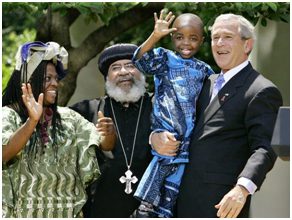
In this Associated Press file photo, former US President George W. Bush, right, hoists 4-year-old Baron Mosima Loyiso Tantoh, son of Manyongo Mosima “Kuene” Tantoh of South Africa, left, who is HIV-positive, after speaking about his efforts to fight HIV/AIDS worldwide, in the Rose Garden of the White House in Washington.
Thus it was a troika of executive branch, congressional, and cultural leaders—on the stage and in the pews—who moved the African AIDS epidemic front and center while the rest of the world either tearfully mourned or willfully ignored its victims. President Bush, Senator Helms, Bono and Franklin Graham were among the American leaders who considered it an unacceptable crisis. Each believed that there was a biblical mandate to do something about it.
Faith was at the heart of the policymakers’ motivation just as faith-based groups were at the center of the program’s implementation. A 2008 Gallup Poll taken in 19 African nations indicate that 76% of Africans reported trust in faith-based groups, higher than any other organization including government and the police. For their part, the Bush administration knew that it needed to rely on indigenous charities to deliver the services rather than Western ones that would leave the villages when the program ended. Therefore, more than 8 in 10 PEPFAR grantees were African faith-based and community organizations.
I was privileged to lend a modest hand to this work as President Bush’s faith-based director in 2006-08 and I recount more of these compassion-in-action stories in a new book called, The Quiet Revolution. The book title surely captures the African health miracles over the past ten years. Before PEPFAR, African mothers did not name their babies for three months for fear of premature death. Today, Secretary of State John Kerry is presenting the idea of an AIDS-free Africa scarcely more than a decade ahead.
The Indiana University health care program exists because a Christian philanthropist sponsored the travel by several young docs to set up shop in Kenya. PEPFAR exists because an American president understands the scriptures to teach that African AIDS patients are equal in God’s eyes to our citizens and family members. This radical belief can trace its arc to the early Christian church whose members ran into the Roman plagues to care for dying babies as even their own family members ran out of the cities for sake of their own lives.
The church has always been the first responder to human distress and its response to the AIDS crisis is no exception. Yet, it has been far from perfect. Balancing the axis of truth and grace requires an uncommon love for those who hurt while attempting to prevent such pain in the first place. Too often the church’s axis tilted more heavily toward judgment over compassion. Now it must ensure that it seeks to ennoble lives even as it continues to rescue and restore. The church is the hope of the world because it sees not victims but imago Dei. This partnership between Patheos and ONE represents a study bridge to traverse this perilous landscape. Its overriding message is clear: we must continue to put our faith in action.
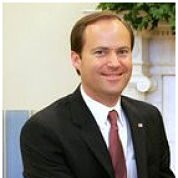 Jay Hein is president of Sagamore Institute and a fellow at Baylor University’s Institute for the Study of Religion. He is also author of The Quiet Revolution: An Active Faith That Transforms Lives and Communities.
Previous Post

June 27, 2014
My HIV+ Little Brother
Next Post

June 30, 2014 The American Church and Global AIDS over the Last Decade: An Untold Story
Browse Our Archives
Select a Category Abortion Abortion adoption Africa Aging AIDS America Worship American history Americolatry An Open Letter to a College Freshman animals Apologetics art Atheism Authors Barack Obama Bible Biblical Scholarship Billy Graham Blogging Bono Book Review Books That Change Lives Breakfast Links Bulletin Board Business Children Christian Approach to Politics Christian Media Christian Right Derangement Syndrome Christianity and Homosexuality Christians in Government Christmas Chuck Colson CLS v Martinez Comic Creation Creativity and the Arts Cross Examinations Cross Investigations Daily Fragment Daily Trinity Death debt Deep Thoughts on Fatherhood depression economy education Election 2012 entertainment Environment Epistemology Erik Campano Euthanasia Evangelicalism Evangelicals and Gays Everyday Transcendence evil evolution Facebook Jesus faith Faith and Politics Faith and Politics Faith and Politics Faith and Politics Faith and Politics Faith and Politics Faith and Politics faith and reason family Feminism foreign affairs Franklin Graham Future of Evangelicalism Galen D. gay marriage George W. Bush Guest Posts Guns Gymnastics Harold Camping Heaven Hell Holidays Hollywood Homosexuality iam2.org Illegal Immigration immigration Immigration Reform Injustice Inspiration Interviews Islam Jeremy Lin Jesus jesus christ John Mark Reynolds Johnnie Moore Judgment Day Just War Theory Killing Osama Link of the Day Lists of the Week Mark Goldblatt Marriage Military Missions Mitt Romney Modern Western Thought Monastic wisdom Mormonism Morning Hash Morning Report Motherhood Movies Obamacare Old Testament Orphan Care Palin Parenting Pastoral Resources Patheos Peace Between Religions PEPFAR Persecution Peter Wehner Peter Wehner Philosophy Political Quotes of the Day politics Politics and Economics Pornography Prejudice Prisoner Rape Question of the Week Race Radical Faith Rapture Ravi Zacharias Rick Santorum Russia Salvation Sarah Palin Scandals Science Science and Faith Separation of Church and State Series sex sex slavery social justice Social Justice Ministry Spiritual Disciplines sports Steven Tyler Suffering Suicide Sunday Funnies T. Dalrymple Tea Party Technology terrorism The Christian Media Files The Daily Trinity The Electorate The Ethics of Rhetoric The Future of Seminary Education The Middle East The Obama Presidency theological Theological Renewal Theology Uncategorized Understanding Evangelicalism Vocation war War and Peace With Distinction Word to the Wise Writers
Select a Month October 2015 June 2015 May 2015 March 2015 December 2014 September 2014 August 2014 July 2014 June 2014 May 2014 April 2014 March 2014 February 2014 January 2014 December 2013 November 2013 October 2013 September 2013 August 2013 July 2013 June 2013 May 2013 April 2013 March 2013 February 2013 January 2013 December 2012 November 2012 October 2012 September 2012 August 2012 July 2012 June 2012 May 2012 April 2012 March 2012 February 2012 January 2012 December 2011 November 2011 October 2011 September 2011 August 2011 July 2011 June 2011 May 2011 April 2011 March 2011 February 2011 January 2011 December 2010 November 2010 October 2010 September 2010 August 2010 July 2010 June 2010 May 2010 April 2010 March 2010 October 2009 September 2009 August 2009 July 2009 June 2009
Follow Us!
TAKE THE
Religious Wisdom Quiz
What New Testament letter includes the "fruit of the Spirit"?
Select your answer to see how you score.
Galatians James Ephesians Hebrews
Related posts from Philosophical Fragments

Reflections on the Gay Marriage Decision
Gay Unions and Christian Divisions

The Secularization of Suicide: Guarding the Elevators

TRENDING AT PATHEOS Evangelical

How the author of the world's best hymn...
I've been working with John Newton for a while now. This makes...

Long before this Lectio Divina, Psalm 130 - the song - started...

What About the Trees? Another Living Parable
After I finished writing the last article about falling leaves as a...

Why Classical Education Is a Conversation, Not a...
Come and Read: Joy in Classical Education When I was a little...

Falling Leaves: A Living Parable on Letting Go
I’ve spent the vast majority of my life in the southeast corner...

Cornell University has received a great deal of negative publicity and intense...
view all Evangelical blogs
Ad-Free & Subscriber Log-In Subscription Support
- About Us
- 2026 Calendar
- Videos
- Podcasts
- Library of World Religions
- Faith In Media Tracker
- Advertise With Us
- Write for Us
- Privacy Policy
- Terms of Service
- Do Not Sell My Data
- Contact Us
- Radiant Digital
- Manage Newsletter Subscriptions
- Unsubscribe From Notifications
- Sitemap
Copyright 2008-2026, Patheos. All rights reserved.
Subscription Support Ad-Free & Subscriber Log-In
Follow Patheos