
BuddhistCatholicContemplativeEvangelicalGeneral ChristianHinduJewishLatter-day SaintMuslimNew VisionsProgressive Christian
Beliefs
- Buddhist
- Catholic
- Contemplative
- Evangelical
- General Christian
- Hindu
- Jewish
- Latter-day Saint
- More Voices
- Muslim
- New Visions
- Pagan
- Progressive Christian
Topics
- Religion News
- Food and Religion
- Sports and Religion
- Religious Art
- Religious Music and Entertainment
- Religious Events
- History and Religion
- Style and Religion
- Politics and Religion
- Women in Religion
- Recreation Outdoors and Religion
- Business Finance and Religion
- Careers Workplace and Religion
- Education and Religion
- Family Parenting and Religion
- Health Fitness and Religion
- Home and Religion
- Relationships and Religion
- Technology and Religion
- Travel and Religion
Columnists
- Buddhist Columnists
- Business Finance and Religion Columnists
- Careers Workplace and Religion Columnists
- Catholic Columnists
- Contemplative Columnists
- Education and Religion Columnists
- Evangelists Columnists
- Family Parenting and Religion Columnists
- General Christian Columnists
- Health Fitness and Religion Columnists
- Hindu Columnists
- History and Religion Columnists
- Home and Religion Columnists
- Jewish Columnists
- More Voices Columnists
- Latter Day Columnists
- Muslim Columnists
- New Visions Columnists
- Nonreligious Columnists
- Pagan Columnists
- Politics and Religion Columnists
- Progressive Columnists
- Recreation Outdoors and Religion Columnists
- Relationships and Religion Columnists
- Religion News Columnists
- Religious Art Columnists
- Religious Events Columnists
- Religious Music and Entertainment Columnists
- Sports and Religion Columnists
- Style and Religion Columnists
- Technology and Religion Columnists
- Travel and Religion Columnists
- Women in Religion Columnists
Resource Library
- 2026 Calendar
- Library of World Religions
- The 100 Most Holy Places on Earth
- Patheos Answers
- Podcasts
- Videos
- Faith Leaders Database
- Anglican Episcopalian
- Bahai
- Baptist
- Buddhism
- Christianity
- Confucianism
- Eastern Orthodoxy
- Hinduism
- Holiness and Pentecostal
- ISKCON
- Islam
- Judaism
- Lutheran
- Methodist
- The Church of Jesus Christ of Latter-day Saints
- New Age
- Paganism
- Presbytarian and Reformed
- Protestantism
- Religion Behind the Scenes
- Roman Catholic
- Scientology
- Shia Islam
- Sikhism
- Sufism
- Sunni Islam
- Taoism
- Zen
- See all religions
Research Tools
 Ad-Free & Subscriber Log-In Subscription Support
Ad-Free & Subscriber Log-In Subscription Support
Follow Patheos 

- Trending:
- Forgiveness
- |
- Marriage
- |
- Consciousness
- |
- Death Penalty
- |
- Election
- |
- Halloween
 Philosophical Fragments
- Home
- Evangelical
- The Rings of the Lord
The Rings of the Lord
Last updated on: June 13, 2014 at 7:30 pm by Guest Contributor
The Rings of the Lord 2014-06-13T19:30:12-04:00 Guest Contributor
Patheos Explore the world's faith through different perspectives on religion and spirituality! Patheos has the views of the prevalent religions and spiritualities of the world.
By Robert Crosby
Jesus had an inner circle. The Bible offers plenty of examples. As a matter of fact, he had several circles or rings of relationship around him.
When the mother of James and John asked Jesus to allow her sons to enter one of those rings, he did not deny her request. However, he did ask them an important question: “Can you drink the cup I am going to drink?” (Matt. 20:22). She did not fully comprehend the magnitude of her request, but Jesus certainly did.
Pastor and author J. Oswald Sanders said, “We are as close to God as we choose to be.”1 God has made it perfectly clear he is vitally interested in being close to every man and woman he has made.
One of my great concerns for the church, however, is that we not only challenge people to grow closer to Jesus, but that we also find ways to help them know when they are doing just that. After all, what would it be like to meet with an athletic coach week after week for years and hear him say again and again, “Win the game!” but he never lets you play? Or you never find out whether you actually are growing and improving as an athlete? But many Christ followers feel exactly that way. Their leaders and the Bible regularly challenge them to grow, and yet they remain uncertain about whether they actually are growing.
The Rings
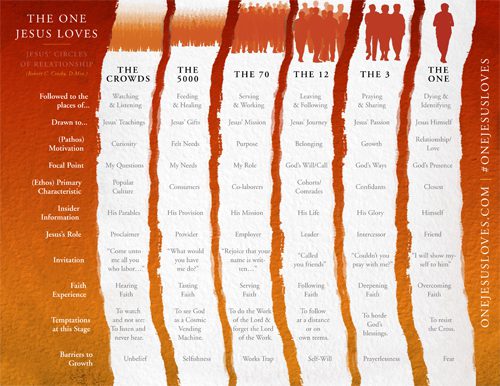
Consider the rings of relationships that gravitated around Jesus as he walked this planet. I call them the “Rings of the Lord” or the “Circles of Christ.” An overview of the Gospels shows there were at least six identifiable groups around Jesus:
1. the Crowds
2. the Five Thousand
3. the Seventy (or some versions translate this as the Seventy-two)
4. the Twelve
5. the Three
6. the One
Each group represents a circle or ring of relationship to the Lord, six stages or areas in relationship to Jesus Christ. They represent places to which people came and experienced him.
Each of the six rings of relationship around Jesus was characterized by something important, even developmental, in our relationship to God. Let’s take a quick tour of each:
THE CROWDS. The outermost ring of association with Jesus and the first one we come to is the Crowds*.* Crowds started to gather around Jesus early in his ministry. These groups at times probably numbered in the tens of thousands and perhaps more. On one occasion, the Pharisees were so astounded by the Crowds they said, “Look, the world has gone after him” (John 12:19 esv).
Among all the circles of relationship around Jesus, the Crowds were the most impressive in size and yet often the least impressive in soul and substance. The Crowds were the most loosely committed bunch then and still are today. Nonetheless, they represent an important, even precious, place—the place in which all Jesus’ followers begin their journey.
The experience of knowing Christ is more of a lifelong journey than a momentary experience. It is related to not just our position on doctrines but our personal choice in pursuing our relationship with Christ and our proximity to him.
The Crowds represent those who follow Jesus to the places of watching and listening. They come to watch what Jesus might do and to hear what he has to say. This place requires the least commitment. It was from this ocean of observers, however, that several fish were eventually caught in Christ’s net.
THE FIVE THOUSAND. The Five Thousand did more than observe and evaluate Jesus as he touched and helped them. This group followed him into the desert, desperate not to miss even one of his miraculous works of healing or provision (John 6:1–15).
The Five Thousand represent those who follow Jesus to the places of feeding and healing. They joyfully discovered then, and still do today, that Jesus has many truths to teach and many gifts to offer. Although Jesus willingly and lovingly met so many of their needs and led them to this place, he did not want them to stay there.
THE SEVENTY. Next were the Seventy. Out of the larger groups, a select team rose up to share in Jesus’ ministry. You might say these people left the ring of observation and entered the ring of participation. The Seventy would do the same works they had seen Jesus do.
The Seventy represent those who follow Jesus to the places of working and serving. To this day, many followers of Jesus make it to this ring in their relationship with him but go no farther. Yes, ministry was and is important, but Jesus wanted them to understand that his call was not primarily to work harder but to come closer to him. That’s what this book and this journey are all about.
THE TWELVE. The ring most familiar to us is the Twelve, Jesus’ beloved band of brothers, his chosen disciples: “One of those days Jesus went out to a mountainside to pray, and spent the night praying to God. When morning came, he called his disciples to him and chose twelve of them, whom he also designated apostles” (Luke 6:12–13, emphasis mine). Christ called this “Shepherd’s dozen” to leave all they had and follow him.
The Twelve represent those who walk with Jesus to the places of leaving all and following him. As they entered this ring, they left their own wishes and selfish desires and entered into a new place of surrender to Jesus. But as close to Christ as this ring was, there were closer places still.
THE THREE. One of the innermost circles around Jesus was his cabinet of Three. Church history respectfully dubbed this ring the Triumvirate. Triumvirate is a Latin term that refers to a powerful team of three individuals. Of all Jesus’ disciples, there were three who saw, heard, and experienced the most.
The Three represent those who follow Jesus to the places of glory and suffering. These were the confidants of Christ. He entrusted them with insights and experiences the rest of the Twelve were apparently unprepared to hear or know.
THE ONE. Ultimately only one person bears the distinction of having been the closest person to Christ during his earthly ministry. I like to think of this person as the One, the closest One.
The One sat right next to Jesus at the Last Supper. The One listened closer to Jesus’ words than anyone else and, as a result, recorded more of them than anyone else. The One was the go-to man when Jesus’ disciples had a question they wanted to ask him. The One spotted Jesus on the shore when no one else in the boat recognized him. The One followed Christ to at least one place no other among the Twelve would go.
Desiring God
Our desire for God is a gift we must regularly open and engage if we are to fully realize and enjoy it. While salvation is an unconditional gift of God’s grace, some intimacies with God come only with a relentless pursuit of him.
Author and pastor A. W. Tozer warned against rigid and overly structured approaches to God and faith: “The whole transaction of religious conversion has been made mechanical and spiritless. . . . We [must remember] that God is a Person and, as such, can be cultivated as any person can.”2
The promise of Scripture affirms his glorious invitation: “Come near to God and he will come near to you” (James 4:8, emphasis mine). Make no mistake, there is one place and one place alone to which Christ wants you to be when it comes to him, and that is closer.
Remember . . . followers of Jesus refuse to follow at a distance; if you’re not moving closer,
you’re moving away.
1. J. Oswald Sanders, Enjoying Intimacy with God (Chicago: Moody Press, 1980), 19–20.
2. A. W. Tozer, The Pursuit of God (Camp Hill, PA: Christian Publications, 1982), 12–13.
 Robert Crosby is a conference speaker, writer, and pastoral leader. He has pastored Churches in New York, Boston and Ohio and served as a University Vice President. He is currently a professor of practical theology at Southeastern University in Lakeland, Florida. He writes for Christianity Today, Patheos.com, Leadership Journal, Outreach Magazine and the Huffington Post. He and his wife, Pamela, are the founders of Teaming Life Conferences & Resources. The new book, The One Jesus Loves, consists of 40 short chapters ideally suited for a 40-Day personal reading, small group interactions or a whole-church 40-Day event.
Previous Post

June 7, 2014
Why Southern Baptists Quiesced and What to Do - Part 2
Next Post

June 26, 2014 Christian Faith and the AIDS Crisis
Browse Our Archives
Select a Category Abortion Abortion adoption Africa Aging AIDS America Worship American history Americolatry An Open Letter to a College Freshman animals Apologetics art Atheism Authors Barack Obama Bible Biblical Scholarship Billy Graham Blogging Bono Book Review Books That Change Lives Breakfast Links Bulletin Board Business Children Christian Approach to Politics Christian Media Christian Right Derangement Syndrome Christianity and Homosexuality Christians in Government Christmas Chuck Colson CLS v Martinez Comic Creation Creativity and the Arts Cross Examinations Cross Investigations Daily Fragment Daily Trinity Death debt Deep Thoughts on Fatherhood depression economy education Election 2012 entertainment Environment Epistemology Erik Campano Euthanasia Evangelicalism Evangelicals and Gays Everyday Transcendence evil evolution Facebook Jesus faith Faith and Politics Faith and Politics Faith and Politics Faith and Politics Faith and Politics Faith and Politics Faith and Politics faith and reason family Feminism foreign affairs Franklin Graham Future of Evangelicalism Galen D. gay marriage George W. Bush Guest Posts Guns Gymnastics Harold Camping Heaven Hell Holidays Hollywood Homosexuality iam2.org Illegal Immigration immigration Immigration Reform Injustice Inspiration Interviews Islam Jeremy Lin Jesus jesus christ John Mark Reynolds Johnnie Moore Judgment Day Just War Theory Killing Osama Link of the Day Lists of the Week Mark Goldblatt Marriage Military Missions Mitt Romney Modern Western Thought Monastic wisdom Mormonism Morning Hash Morning Report Motherhood Movies Obamacare Old Testament Orphan Care Palin Parenting Pastoral Resources Patheos Peace Between Religions PEPFAR Persecution Peter Wehner Peter Wehner Philosophy Political Quotes of the Day politics Politics and Economics Pornography Prejudice Prisoner Rape Question of the Week Race Radical Faith Rapture Ravi Zacharias Rick Santorum Russia Salvation Sarah Palin Scandals Science Science and Faith Separation of Church and State Series sex sex slavery social justice Social Justice Ministry Spiritual Disciplines sports Steven Tyler Suffering Suicide Sunday Funnies T. Dalrymple Tea Party Technology terrorism The Christian Media Files The Daily Trinity The Electorate The Ethics of Rhetoric The Future of Seminary Education The Middle East The Obama Presidency theological Theological Renewal Theology Uncategorized Understanding Evangelicalism Vocation war War and Peace With Distinction Word to the Wise Writers
Select a Month October 2015 June 2015 May 2015 March 2015 December 2014 September 2014 August 2014 July 2014 June 2014 May 2014 April 2014 March 2014 February 2014 January 2014 December 2013 November 2013 October 2013 September 2013 August 2013 July 2013 June 2013 May 2013 April 2013 March 2013 February 2013 January 2013 December 2012 November 2012 October 2012 September 2012 August 2012 July 2012 June 2012 May 2012 April 2012 March 2012 February 2012 January 2012 December 2011 November 2011 October 2011 September 2011 August 2011 July 2011 June 2011 May 2011 April 2011 March 2011 February 2011 January 2011 December 2010 November 2010 October 2010 September 2010 August 2010 July 2010 June 2010 May 2010 April 2010 March 2010 October 2009 September 2009 August 2009 July 2009 June 2009
Follow Us!
TAKE THE
Religious Wisdom Quiz
What queen visited Solomon to test his wisdom?
Select your answer to see how you score.
Queen of Egypt Queen Esther Queen of Sheba Queen of Tyre
Related posts from Philosophical Fragments

Reflections on the Gay Marriage Decision
Gay Unions and Christian Divisions

The Secularization of Suicide: Guarding the Elevators

TRENDING AT PATHEOS Evangelical

How the author of the world's best hymn...
I've been working with John Newton for a while now. This makes...

Long before this Lectio Divina, Psalm 130 - the song - started...

What About the Trees? Another Living Parable
After I finished writing the last article about falling leaves as a...

Why Classical Education Is a Conversation, Not a...
Come and Read: Joy in Classical Education When I was a little...

Falling Leaves: A Living Parable on Letting Go
I’ve spent the vast majority of my life in the southeast corner...

Cornell University has received a great deal of negative publicity and intense...
view all Evangelical blogs
Ad-Free & Subscriber Log-In Subscription Support
- About Us
- 2026 Calendar
- Videos
- Podcasts
- Library of World Religions
- Faith In Media Tracker
- Advertise With Us
- Write for Us
- Privacy Policy
- Terms of Service
- Do Not Sell My Data
- Contact Us
- Radiant Digital
- Manage Newsletter Subscriptions
- Unsubscribe From Notifications
- Sitemap
Copyright 2008-2026, Patheos. All rights reserved.
Subscription Support Ad-Free & Subscriber Log-In
Follow Patheos