
BuddhistCatholicContemplativeEvangelicalGeneral ChristianHinduJewishLatter-day SaintMuslimNew VisionsProgressive Christian
Beliefs
- Buddhist
- Catholic
- Contemplative
- Evangelical
- General Christian
- Hindu
- Jewish
- Latter-day Saint
- More Voices
- Muslim
- New Visions
- Pagan
- Progressive Christian
Topics
- Religion News
- Food and Religion
- Sports and Religion
- Religious Art
- Religious Music and Entertainment
- Religious Events
- History and Religion
- Style and Religion
- Politics and Religion
- Women in Religion
- Recreation Outdoors and Religion
- Business Finance and Religion
- Careers Workplace and Religion
- Education and Religion
- Family Parenting and Religion
- Health Fitness and Religion
- Home and Religion
- Relationships and Religion
- Technology and Religion
- Travel and Religion
Columnists
- Buddhist Columnists
- Business Finance and Religion Columnists
- Careers Workplace and Religion Columnists
- Catholic Columnists
- Contemplative Columnists
- Education and Religion Columnists
- Evangelists Columnists
- Family Parenting and Religion Columnists
- General Christian Columnists
- Health Fitness and Religion Columnists
- Hindu Columnists
- History and Religion Columnists
- Home and Religion Columnists
- Jewish Columnists
- More Voices Columnists
- Latter Day Columnists
- Muslim Columnists
- New Visions Columnists
- Nonreligious Columnists
- Pagan Columnists
- Politics and Religion Columnists
- Progressive Columnists
- Recreation Outdoors and Religion Columnists
- Relationships and Religion Columnists
- Religion News Columnists
- Religious Art Columnists
- Religious Events Columnists
- Religious Music and Entertainment Columnists
- Sports and Religion Columnists
- Style and Religion Columnists
- Technology and Religion Columnists
- Travel and Religion Columnists
- Women in Religion Columnists
Resource Library
- 2026 Calendar
- Library of World Religions
- The 100 Most Holy Places on Earth
- Patheos Answers
- Podcasts
- Videos
- Faith Leaders Database
- Anglican Episcopalian
- Bahai
- Baptist
- Buddhism
- Christianity
- Confucianism
- Eastern Orthodoxy
- Hinduism
- Holiness and Pentecostal
- ISKCON
- Islam
- Judaism
- Lutheran
- Methodist
- The Church of Jesus Christ of Latter-day Saints
- New Age
- Paganism
- Presbytarian and Reformed
- Protestantism
- Religion Behind the Scenes
- Roman Catholic
- Scientology
- Shia Islam
- Sikhism
- Sufism
- Sunni Islam
- Taoism
- Zen
- See all religions
Research Tools
 Ad-Free & Subscriber Log-In Subscription Support
Ad-Free & Subscriber Log-In Subscription Support
Follow Patheos 

- Trending:
- Forgiveness
- |
- Marriage
- |
- Consciousness
- |
- Death Penalty
- |
- Election
- |
- Halloween
 Philosophical Fragments
- Home
- Evangelical
- Remembering James R. Schlesinger
Remembering James R. Schlesinger
Last updated on: April 23, 2014 at 9:58 pm by Guest Contributor
Remembering James R. Schlesinger 2014-04-23T21:58:27-04:00 Guest Contributor
Patheos Explore the world's faith through different perspectives on religion and spirituality! Patheos has the views of the prevalent religions and spiritualities of the world.
Hard-charging Cabinet member served three presidents, but conversion to Christianity mellowed him as he aged.
By Warren Cole Smith
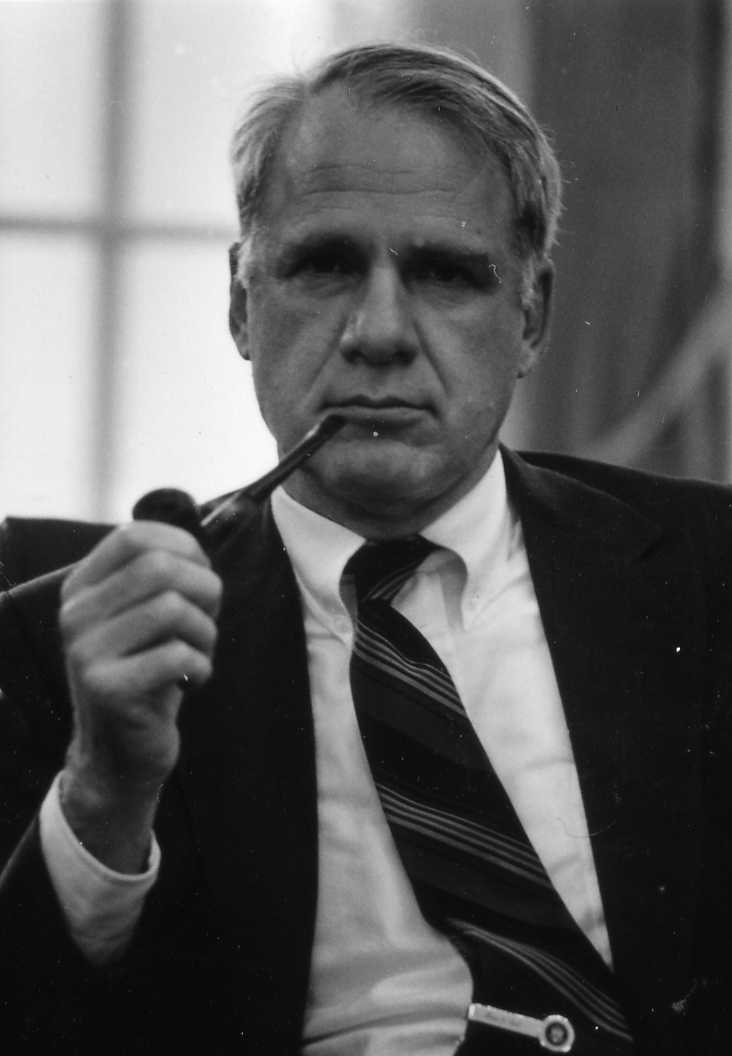 News of the death of James Schlesinger on Mar. 27 at age 85 was a mild shock to my system because of a brief but memorable meeting I had with him 35 years ago.
In the fall of 1979 I took a break from my college career at the University of Georgia to do an internship with Sen. Sam Nunn, then early in his second term representing Georgia. One of the great things about working for a fairly junior senator is that offices get doled out based on seniority, and Sam Nunn’s staff had small, inadequate offices. That was not good for the Senator and his senior staff, but it was great for me. It meant that I worked at the elbow of Nunn’s senior staffers, and saw Sen. Nunn nearly daily. Watching them, seeing how they conducted themselves, listening to them on the phone – that was more of an education that any of the mostly menial jobs they assigned me during my internship.
Georgia had a tradition of sending men to Washington who advocated a strong national defense. The legendary bachelor senator Richard Russell served 40 years in the Senate, from the 30s through the 70s, shaping America’s military policy as much as any man alive during the 20th century. Another Georgian, Carl Vinson, spent 50 years in the House of Representatives. Vinson, often called “The Father of the Two Ocean Navy,” had an aircraft carrier named after him while he was still alive, an unprecedented honor for a Member of Congress.
Carl Vinson was also Sam Nunn’s great uncle. So when Nunn came to the Senate, he knew he had big shoes to fill. He had managed to wrangle himself a seat on the Senate Armed Services Committee, and was even chairman of the Subcommittee on Manpower, but to be taken seriously he needed to exercise some thought leadership on defense issues.
So he planned to give a major policy speech on the floor of the Senate to air his views on the second Strategic Arms Limitation Treaty, often called SALT II. The United States and the Soviet Union had signed the treaty just months earlier, in June of 1979, but the Senate had not ratified it. Whether the Senate would ratify it or not depended much upon Sen. Nunn’s position, and Nunn was a skeptic. He was in favor of nuclear arms reduction. Indeed, in later years Nunn founded the Nuclear Threat Initiative, which seeks to reduce the threat of nuclear weapons. But he did not want to disarm America’s nuclear arsenal without a buildup in America’s conventional defense capabilities. Because of his position on the Armed Services Committee and because the president who signed that treaty, Jimmy Carter, was a fellow Georgian and a fellow Democrat, much depended on Sen. Nunn’s SALT II speech.
For these reasons Nunn sought the input of James Schlesinger. Schlesinger, then 50, was in the midst of a remarkable career of public service, but he was near the end of a controversial career in “official Washington.” He had been the Director of Central Intelligence under Richard Nixon, Secretary of Defense under Nixon and Gerald Ford, and Secretary of Energy – the nation’s first – under Carter. He was a brilliant strategist, but he had a reputation for not suffering fools gladly. Everywhere he went he cut budgets, slashed staff, and reorganized workflow. That meant that he left every organization he led more efficient, more mission-focused – and with a lot of enemies in his wake.
One notable example: His tenure as director of the CIA during the Nixon Administration was less than six months long, but during that time he fired more than 1000 of the agency’s 17,000 employees. CIA insiders said only half-jokingly that the security camera in the lobby of the agency’s Langley, Va., headquarters was there to keep people from defacing Schlesinger’s official portrait.
In July of 1979, Schlesinger left the last full-time government job he would ever have, fired by Jimmy Carter as Energy Secretary. Journalist (and former Bill Clinton speechwriter) Paul Glastris wrote, “Carter fired Schlesinger in 1979 in part for the same reason Gerald Ford had—he was unbearably arrogant and impatient with lesser minds who disagreed with him.”
But according to Arnold Punaro, Nunn’s military advisor at the time, “we never saw that side of him.” Punaro thinks it may be because Schlesinger considered Nunn an intellectual peer, someone who thought deeply about the issues and did his homework. It may be because Nunn also surrounded himself with equally brilliant staffers, including Punaro himself. Punaro was in his mid-30s in 1979, but he already had a lifetime of experience: a Bronze Star and Purple Heart from service in Vietnam, he was then a Marine Corps reservist with the rank of major. He also earned two master’s degrees, one in journalism from the University of Georgia and one in national security studies from Georgetown University. Punaro would eventually rise to the rank of Major General in the Marines, one of very few reservists in the history of the Marine Corps to achieve this rank. The influential Defense News consistently names him year after year one of the 100 most influential men in Washington.
Whatever the reason, Punaro told me, “Dr. Schlesinger was always willing to drop anything he was doing to help us out.” Nunn’s SALT II speech was one of those times, and I got an assignment I didn’t fully appreciate at the time: to deliver a draft of the speech to Schlesinger and not return until Schlesinger had read it given me his comments.
When I showed up at Schlesinger’s then new offices with the speech in a manila envelope, I noticed he still had boxes stacked in the corners. Schlesinger had already received a phone call from Punaro telling him I would be showing up. When I reflect back on that meeting, from a distance of 35 years, I wonder if Schlesinger – who because of his recent firing was a bit radioactive in Washington — was offended that Punaro, or Sen. Nunn himself, did not make the trip to receive Schlesinger’s advice. But if Schlesinger felt any offense, he certainly did not take it out on me. He asked me to make myself comfortable while he read the speech.
After some time, he called me into his office. I expected him simply to hand the manila envelope back to me and send me on my way. I was surprised when he asked me questions about myself. Where did I go to school? Where was I from? He even asked me about my family.
When I called Arnold Punaro to ask his recollections of those days, Punaro said he well remembered the speech and the preparations for it. “Oh, yeah,” he said. “It was a big deal.” But Punaro was not surprised by Schlesinger’s courtesy. “He was a great guy,” Punaro said. “Always friendly and personable.” Punaro said that when he was promoted to general, Schlesinger came to the ceremony. “He had long been out of government,” Punaro said. “So it was not something he had to do. It was something he did out of friendship. I was honored he was there.”
But I did not know any of this when I stood across the desk from Schlesinger in 1979, facing his questions. I didn’t know then if he genuinely cared, or if he was sizing me up. All I know is that after a couple of minutes of answering his questions he invited me to come around the desk and he went over the speech with me page-by-page. The handwritten notes on the pages were few, and they were clearly legible. But Schlesinger explained them to me as if my understanding of them mattered. He made me feel not like a delivery boy, but like a part of the process.
When I got back to Sen. Nunn’s office in the Russell Senate Office Building (named for one of those Georgia senators whose shoes Nunn was now trying to fill), I handed the speech to Arnold Punaro. He took it in to the senator. I never spoke to the Senator or to Arnold about the comments Schlesinger made. A couple of days later, Sen. Nunn delivered the speech to a nearly full house – including a packed staff gallery, where I sat with several members of Sen. Nunn’s staff. The speech got extensive media coverage, and was widely hailed as an important speech in Sen. Nunn’s own rise to be a worthy heir of Sen. Richard Russell and Rep. Carl Vinson.
The speech also had an important and long-lasting policy impact in that Nunn’s skepticism regarding the Soviets and SALT II carried the day: The Senate never ratified the treaty, and a few months later, when Ronald Reagan became president, the Democrat Nunn actively supported Reagan’s Strategic Defense Initiative and other programs that the Soviet Union eventually could not match. When the Soviet Union collapsed in 1989, Reagan was no longer president, but Nunn was still in the Senate, as chairman of the Armed Services Committee.
I never saw James Schlesinger face-to-face again, though I did pay attention when his name appeared in the news. He never held a permanent government post again, but his influence never waned. Every American president from Reagan to Obama sought his advice. History now judges his short, tempestuous tenures at the CIA and as the head of the Department of Defense and the Department of Energy as effective and even transformational. Many projects and ideas he was almost alone in championing when he was in government became important parts of our military apparatus, including the F-16 fighter and what came to be called a “build down” of our nuclear capability, the practice of continuously improving but reducing the size of our nuclear arsenal.
One aspect of James Schlesinger’s character that did not make it into many obituaries was his Christian faith. Raised in a Jewish home, he converted to Christianity as an adult. His wife Rachel, a Lutheran from Ohio, introduced him to Reformed Protestantism, and Schlesinger turned his prodigious mind toward the study of Luther and Calvin with the same vigor he approached defense and foreign policy matters. As his Christian faith grew, his temperament mellowed. In an interview late in life with the journalist and historian Walter Issacson, he said, “I tended to be too self-righteous, a quibbler, stubborn, too. It took me a while to understand how hard I must have been to deal with.” But he did not mellow completely. Until near the end of his life, according to his protégé and former National Interest editor Adam Garfinkle, he would still occasionally refer to liberals as “ninnies who think the world is some sort of Boy Scout camp.”
He would also often talk of Rachel, who he married in 1954 and who died of cancer in 1995. “I still miss Rachel,” Schlesinger would often tell his friends. To honor Rachel, an accomplished violinist, Schlesinger donated $1-million to have the Rachel M. Schlesinger Concert Hall and Arts Center at Northern Virginia Community College named in her honor.
The funeral for James R. Schlesinger took place on April 4 at Grace Evangelical Lutheran Church in Springfield, Ohio, Rachel’s home town. He was laid to rest next to his beloved Rachel at nearby Ferncliff Cemetery. His Washington friends will honor him at a memorial service this Saturday at the Rachel M. Schlesinger Hall.
 Warren Cole Smith, who lives in Charlotte, N.C., is vice president of WORLD News Group and the host of the radio program “Listening In”.
Previous Post

April 5, 2014
The Intriguing “Saffron Cross” by J. Dana Trent
Next Post
April 26, 2014 Detroit Pastor Envisions an ‘Urban Turn’ in Christian Apologetics
Browse Our Archives
Select a Category Abortion Abortion adoption Africa Aging AIDS America Worship American history Americolatry An Open Letter to a College Freshman animals Apologetics art Atheism Authors Barack Obama Bible Biblical Scholarship Billy Graham Blogging Bono Book Review Books That Change Lives Breakfast Links Bulletin Board Business Children Christian Approach to Politics Christian Media Christian Right Derangement Syndrome Christianity and Homosexuality Christians in Government Christmas Chuck Colson CLS v Martinez Comic Creation Creativity and the Arts Cross Examinations Cross Investigations Daily Fragment Daily Trinity Death debt Deep Thoughts on Fatherhood depression economy education Election 2012 entertainment Environment Epistemology Erik Campano Euthanasia Evangelicalism Evangelicals and Gays Everyday Transcendence evil evolution Facebook Jesus faith Faith and Politics Faith and Politics Faith and Politics Faith and Politics Faith and Politics Faith and Politics Faith and Politics faith and reason family Feminism foreign affairs Franklin Graham Future of Evangelicalism Galen D. gay marriage George W. Bush Guest Posts Guns Gymnastics Harold Camping Heaven Hell Holidays Hollywood Homosexuality iam2.org Illegal Immigration immigration Immigration Reform Injustice Inspiration Interviews Islam Jeremy Lin Jesus jesus christ John Mark Reynolds Johnnie Moore Judgment Day Just War Theory Killing Osama Link of the Day Lists of the Week Mark Goldblatt Marriage Military Missions Mitt Romney Modern Western Thought Monastic wisdom Mormonism Morning Hash Morning Report Motherhood Movies Obamacare Old Testament Orphan Care Palin Parenting Pastoral Resources Patheos Peace Between Religions PEPFAR Persecution Peter Wehner Peter Wehner Philosophy Political Quotes of the Day politics Politics and Economics Pornography Prejudice Prisoner Rape Question of the Week Race Radical Faith Rapture Ravi Zacharias Rick Santorum Russia Salvation Sarah Palin Scandals Science Science and Faith Separation of Church and State Series sex sex slavery social justice Social Justice Ministry Spiritual Disciplines sports Steven Tyler Suffering Suicide Sunday Funnies T. Dalrymple Tea Party Technology terrorism The Christian Media Files The Daily Trinity The Electorate The Ethics of Rhetoric The Future of Seminary Education The Middle East The Obama Presidency theological Theological Renewal Theology Uncategorized Understanding Evangelicalism Vocation war War and Peace With Distinction Word to the Wise Writers
Select a Month October 2015 June 2015 May 2015 March 2015 December 2014 September 2014 August 2014 July 2014 June 2014 May 2014 April 2014 March 2014 February 2014 January 2014 December 2013 November 2013 October 2013 September 2013 August 2013 July 2013 June 2013 May 2013 April 2013 March 2013 February 2013 January 2013 December 2012 November 2012 October 2012 September 2012 August 2012 July 2012 June 2012 May 2012 April 2012 March 2012 February 2012 January 2012 December 2011 November 2011 October 2011 September 2011 August 2011 July 2011 June 2011 May 2011 April 2011 March 2011 February 2011 January 2011 December 2010 November 2010 October 2010 September 2010 August 2010 July 2010 June 2010 May 2010 April 2010 March 2010 October 2009 September 2009 August 2009 July 2009 June 2009
Follow Us!
TAKE THE
Religious Wisdom Quiz
What Christian tradition has a worldwide leader known as the Ecumenical Patriarch?
Select your answer to see how you score.
Anglican Catholic Lutheran Eastern Orthodox
Related posts from Philosophical Fragments

Reflections on the Gay Marriage Decision
Gay Unions and Christian Divisions
TRENDING AT PATHEOS Evangelical

How the author of the world's best hymn...
I've been working with John Newton for a while now. This makes...

Long before this Lectio Divina, Psalm 130 - the song - started...

What About the Trees? Another Living Parable
After I finished writing the last article about falling leaves as a...

Why Classical Education Is a Conversation, Not a...
Come and Read: Joy in Classical Education When I was a little...

Falling Leaves: A Living Parable on Letting Go
I’ve spent the vast majority of my life in the southeast corner...

Cornell University has received a great deal of negative publicity and intense...
view all Evangelical blogs
Ad-Free & Subscriber Log-In Subscription Support
- About Us
- 2026 Calendar
- Videos
- Podcasts
- Library of World Religions
- Faith In Media Tracker
- Advertise With Us
- Write for Us
- Privacy Policy
- Terms of Service
- Do Not Sell My Data
- Contact Us
- Radiant Digital
- Manage Newsletter Subscriptions
- Unsubscribe From Notifications
- Sitemap
Copyright 2008-2026, Patheos. All rights reserved.
Subscription Support Ad-Free & Subscriber Log-In
Follow Patheos