
BuddhistCatholicContemplativeEvangelicalGeneral ChristianHinduJewishLatter-day SaintMuslimNew VisionsProgressive Christian
Beliefs
- Buddhist
- Catholic
- Contemplative
- Evangelical
- General Christian
- Hindu
- Jewish
- Latter-day Saint
- More Voices
- Muslim
- New Visions
- Pagan
- Progressive Christian
Topics
- Religion News
- Food and Religion
- Sports and Religion
- Religious Art
- Religious Music and Entertainment
- Religious Events
- History and Religion
- Style and Religion
- Politics and Religion
- Women in Religion
- Recreation Outdoors and Religion
- Business Finance and Religion
- Careers Workplace and Religion
- Education and Religion
- Family Parenting and Religion
- Health Fitness and Religion
- Home and Religion
- Relationships and Religion
- Technology and Religion
- Travel and Religion
Columnists
- Buddhist Columnists
- Business Finance and Religion Columnists
- Careers Workplace and Religion Columnists
- Catholic Columnists
- Contemplative Columnists
- Education and Religion Columnists
- Evangelists Columnists
- Family Parenting and Religion Columnists
- General Christian Columnists
- Health Fitness and Religion Columnists
- Hindu Columnists
- History and Religion Columnists
- Home and Religion Columnists
- Jewish Columnists
- More Voices Columnists
- Latter Day Columnists
- Muslim Columnists
- New Visions Columnists
- Nonreligious Columnists
- Pagan Columnists
- Politics and Religion Columnists
- Progressive Columnists
- Recreation Outdoors and Religion Columnists
- Relationships and Religion Columnists
- Religion News Columnists
- Religious Art Columnists
- Religious Events Columnists
- Religious Music and Entertainment Columnists
- Sports and Religion Columnists
- Style and Religion Columnists
- Technology and Religion Columnists
- Travel and Religion Columnists
- Women in Religion Columnists
Resource Library
- 2026 Calendar
- Library of World Religions
- The 100 Most Holy Places on Earth
- Patheos Answers
- Podcasts
- Videos
- Faith Leaders Database
- Anglican Episcopalian
- Bahai
- Baptist
- Buddhism
- Christianity
- Confucianism
- Eastern Orthodoxy
- Hinduism
- Holiness and Pentecostal
- ISKCON
- Islam
- Judaism
- Lutheran
- Methodist
- The Church of Jesus Christ of Latter-day Saints
- New Age
- Paganism
- Presbytarian and Reformed
- Protestantism
- Religion Behind the Scenes
- Roman Catholic
- Scientology
- Shia Islam
- Sikhism
- Sufism
- Sunni Islam
- Taoism
- Zen
- See all religions
Research Tools
 Ad-Free & Subscriber Log-In Subscription Support
Ad-Free & Subscriber Log-In Subscription Support
Follow Patheos 

- Trending:
- Forgiveness
- |
- Marriage
- |
- Consciousness
- |
- Death Penalty
- |
- Election
- |
- Halloween
 Philosophical Fragments
- Home
- Evangelical
- What Christians Critics of the Iraq War Forget
What Christians Critics of the Iraq War Forget
Last updated on: March 22, 2013 at 5:09 pm by Timothy Dalrymple
What Christians Critics of the Iraq War Forget 2013-03-22T17:09:25-04:00 Timothy Dalrymple
Patheos Explore the world's faith through different perspectives on religion and spirituality! Patheos has the views of the prevalent religions and spiritualities of the world.
A guest post from Mark Tooley:
*
It’s now been 10 years since the launch of the Iraq War. And some religionists have exploited the anniversary as a time for national regret and spiritual repentance.
Former McCormick Theological Seminary President Susan Brooks Thistlethwaite, in a Washington Post online column, represents many of these voices by condemning the Iraq War as a “moral, fiscal and geopolitical disaster for the United States,” which “broke the rules of war by ignoring them or so completely ‘re-defining’ them that they lost their meaning.”
Thistlethwaite cites “enhanced interrogation,” which is really “torture,” while also remembering the degradation at Abu Ghraib, as evidence of America having “lost our soul.” She also cites polls ostensibly showing most evangelicals support “torture,” although she declines really to define “torture,” as many critics of “enhanced interrogation” have.
 The Iraq War was a “war of choice, a pre-emptive war,” violating Just War principles, Thistlethwaite also complained. The early church was “pacifist,” she asserts, and Augustine and Aquinas developed Just War to emphasize “self-defense” and defense of the “vulnerable other.” Instead, the U.S. waged a “preventive war” with an absence of “imminent” threat and with no discoverable weapons of mass destruction, which she rather conspiratorially claims the U.S. government actually knew. She also claims that pre-emptive war has been “subtly corrosive” and facilitated public support for the U.S. drone program as “ pre-emptive violence.”
Thistlethwaite asserts that the Iraq War created “more terrorists” and “more enemies” instead of “reducing the threat to our nation from terrorism.” She concludes: “Ten years is a long time and it is long past time for the people of the United States, and our leaders, to engage in self-examination in how we got to such a state that we are willing to unilaterally attack another nation, engage in torture, deceive about the pretext for war, and count the real costs, morally, fiscally and geopolitically.”
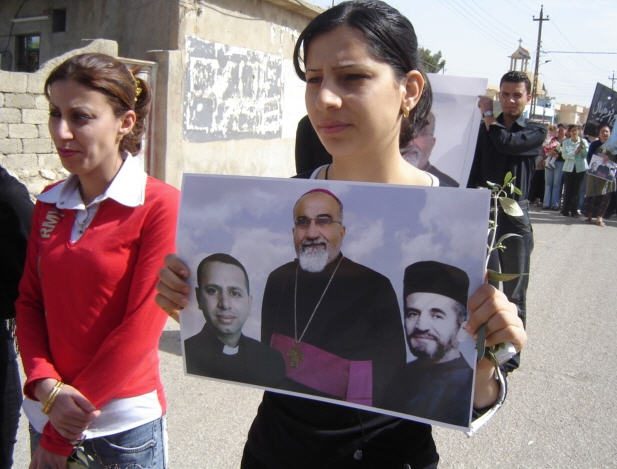
In a similar but more explicitly pacifist vein, Florida pastor and peace activist Craig Watts, writing for Tony Campolo’s “Red Letter Christians,” denounces the Iraq War as “immoral and unjust.” Indeed, “only those who view the world through the thickest ideological lens and those who have benefited the most economically claim the war was ‘worth it.’” He cites 134,000 dead Iraqis, nearly 4500 U.S. dead service personnel and 3400 U.S. contractors killed. He claims “increased radicalism in the region.” And he also notes the exodus of Iraqi Christians since the war. “The American public and nationalistically inclined religious leaders too quickly and uncritically accepted the dubious justifications for invading Iraq,” Watts claims, specifically criticizing U.S. evangelicals for supporting the war. Unlike Thistlethwaite, he does not cite Just War teaching, because presumably he does not believe in it.
Watts and Thistlethwaite, like most secular critics of the war, don’t dwell on the downside of Saddam Hussein’s reign, nor do they describe preferred alternatives to removing Saddam circa 2003 or beyond. Their critique would be more serious if it admitted Saddam directly murdered hundreds of thousands, while robbing, torturing and raping many more, waged war against at least 4 of his neighbors, was effectively still at war with the U.S. and other coalition nations since the ceasefire of the 1990 Persian Gulf War, had ties to the 1993 World Trade Center bombing, had attempted to assassinate former President George H. W. Bush, was funding Palestinian terrorism, had links with a network of terror groups including al Qaeda (although not an ongoing collaborative relationship, as the 9-11 Commission specified), had joined Afghanistan’s Taliban regime as one of only two governments in the world to publicly endorse 9-11, had an ongoing chemical warfare program that was resurrecting although lacking discoverable, deployable weapons, and was exploiting the international sanctions against his further weapons procurement to enrich himself and his Baathist Party at the expense of reputedly hundreds of thousands of Iraqis who were prematurely dying for lack of food, clean water, and medicines, even as those international sanctions were eroding, thanks partly to Russians, French and others who were themselves profiteering off Iraqi oil.
The war critics, religious and otherwise, usually omit that Saddam’s continued reign required an ongoing U.S. troops presence in Saudi Arabia, which was politically problematic and perhaps unsustainable. Osama bin Laden cited this infidel presence in the land of the Prophet as a specific motive of 9-11. There was also in 2003 the by then 13 year U.S. and British air force no-fly zones imposed upon Iraq to prevent Saddam’s further slaughter of the Kurds to the north and Shiites in the south. This largely humanitarian military project was perhaps also unsustainable and would now be 23 years old. Of course, Saddam’s rule also necessitated U.S. troops in Kuwait, which he previously invaded.
Hardheaded realists have argued and do argue that continued military containment of Saddam, even with all his ongoing murderous horrors, was preferable to war in 2003. These realists are at least transparently consistent. But more idealistic religious critics of the Iraq War, and of usually all wars, simplistically assert a stark choice between war and peace, without admitting more may die and suffer from a supposed peace than from war, or that avoidance of war may in fact only delay it, often facilitating an even wider and more horrific war.
Christian pacifists of today reject all war at all times, while only rarely admitting the increased suffering that may actually result. Many religionists who profess Just War adherence often demand maximalist, unattainable standards that default towards a functional pacifism. Actual policymakers, many of whom are often Christian and seriously regard church teachings, cannot and should not heed utopian demands from academics, activists and clergy who intone from on high and do not plausibly transmit the Just War tradition to which the vast majority of The Church has long adhered.
Serious Christians must apply their teachings with discernment about the real world, not a preferred dream sequence. There must also be historical perspective. Would the world really be better today if Saddam’s murderous Baathist regime were still in place? How so? American anti-war activists, religious and otherwise, have been in high dungeon since the Vietnam War, but rarely if ever consider the genocide, slavery and suffering that ensued after the U.S. withdrawal they sought. The Korean War killed 10 times as many Americans and Koreans as the Iraq War, and was far more disastrous in many ways, leaving North Korea’s tyranny in place and South Korea a dictatorship for another 40 years. Yet historically, 60 years later, it is now considered a measured success, a key moment in the West’s survival during the Cold War that spared now prosperous and democratic South Koreans from North Korea’s dark, impoverished servitude. World War II was the “good war” that killed over 400,000 Americans in under 4 years and that entailed the U.S. air force’s incinerating countless German and Japanese cities while in alliance with a Stalinist tyranny little if at all morally better than the Nazis, and leaving half of Europe in captivity to that surviving tyranny. And yet the alternatives were even worse.
The U.S. war most resembling Iraq was the now largely forgotten Philippines Insurrection after the Spanish American War, which killed about the same number of Americans, with Filipino deaths on par with Iraqis. U.S. forces were accused of torture and atrocities against the guerrillas. Like Thistlethwaite, critics of U.S. imperialism like Mark Twain and William Jennings Bryan warned America would lose its soul. At the start, President William McKinley told his fellow Methodists he chose to retain the Philippines for America after prayerful consideration that other imperial empires would have gobbled them up otherwise. Likely he was right, and probably Japan would have seized the Philippines about that time as it did Korea, inflicting decades of notorious cruelty until overthrown by American force of arms over 40 years later.
Christians must address the world as it is, not as we wish, advancing incremental justice when possible, with the available instruments at hand. We must realize that power vacuums will always be filled by some force, and some earthly powers are decidedly preferable to others. We also have to admit that all human endeavors, warlike or peaceful, even when noble, are flawed by human sin and finite wisdom, and usually will have unintended negative consequences. Sometimes relative justice has been advanced by the severity of war. And sometimes injustice and disaster are precipitated by the inept pursuit of peace.
In his marvelous new book Shaking Hands with the Devil: The Failure of Humanity in Rwanda, United Methodist theologian William Abraham of Southern Methodist University notes the “world is shot through with evil and sin; people deliberately and systematically reject the full resources of grace in their private and public lives; the default position in human life is war not peace.” Theologically grounded Christians should understand this basic truth, but how many truly do?
Americans of both left and right, religious and otherwise, are inherently idealistic and often expect a perfection impossible in war or peace. Such perfection will be possible only when God’s Kingdom is fully consummated. Until then, Christians can modestly work for what is attainable by God’s grace.
*
Mark Tooley is President of the Institute on Religion and Democracy.
Previous Post

March 21, 2013
The Bible Miniseries - the Computer Game
Next Post

March 26, 2013 Iraq's Imperiled Christians
Browse Our Archives
Select a Category Abortion Abortion adoption Africa Aging AIDS America Worship American history Americolatry An Open Letter to a College Freshman animals Apologetics art Atheism Authors Barack Obama Bible Biblical Scholarship Billy Graham Blogging Bono Book Review Books That Change Lives Breakfast Links Bulletin Board Business Children Christian Approach to Politics Christian Media Christian Right Derangement Syndrome Christianity and Homosexuality Christians in Government Christmas Chuck Colson CLS v Martinez Comic Creation Creativity and the Arts Cross Examinations Cross Investigations Daily Fragment Daily Trinity Death debt Deep Thoughts on Fatherhood depression economy education Election 2012 entertainment Environment Epistemology Erik Campano Euthanasia Evangelicalism Evangelicals and Gays Everyday Transcendence evil evolution Facebook Jesus faith Faith and Politics Faith and Politics Faith and Politics Faith and Politics Faith and Politics Faith and Politics Faith and Politics faith and reason family Feminism foreign affairs Franklin Graham Future of Evangelicalism Galen D. gay marriage George W. Bush Guest Posts Guns Gymnastics Harold Camping Heaven Hell Holidays Hollywood Homosexuality iam2.org Illegal Immigration immigration Immigration Reform Injustice Inspiration Interviews Islam Jeremy Lin Jesus jesus christ John Mark Reynolds Johnnie Moore Judgment Day Just War Theory Killing Osama Link of the Day Lists of the Week Mark Goldblatt Marriage Military Missions Mitt Romney Modern Western Thought Monastic wisdom Mormonism Morning Hash Morning Report Motherhood Movies Obamacare Old Testament Orphan Care Palin Parenting Pastoral Resources Patheos Peace Between Religions PEPFAR Persecution Peter Wehner Peter Wehner Philosophy Political Quotes of the Day politics Politics and Economics Pornography Prejudice Prisoner Rape Question of the Week Race Radical Faith Rapture Ravi Zacharias Rick Santorum Russia Salvation Sarah Palin Scandals Science Science and Faith Separation of Church and State Series sex sex slavery social justice Social Justice Ministry Spiritual Disciplines sports Steven Tyler Suffering Suicide Sunday Funnies T. Dalrymple Tea Party Technology terrorism The Christian Media Files The Daily Trinity The Electorate The Ethics of Rhetoric The Future of Seminary Education The Middle East The Obama Presidency theological Theological Renewal Theology Uncategorized Understanding Evangelicalism Vocation war War and Peace With Distinction Word to the Wise Writers
Select a Month October 2015 June 2015 May 2015 March 2015 December 2014 September 2014 August 2014 July 2014 June 2014 May 2014 April 2014 March 2014 February 2014 January 2014 December 2013 November 2013 October 2013 September 2013 August 2013 July 2013 June 2013 May 2013 April 2013 March 2013 February 2013 January 2013 December 2012 November 2012 October 2012 September 2012 August 2012 July 2012 June 2012 May 2012 April 2012 March 2012 February 2012 January 2012 December 2011 November 2011 October 2011 September 2011 August 2011 July 2011 June 2011 May 2011 April 2011 March 2011 February 2011 January 2011 December 2010 November 2010 October 2010 September 2010 August 2010 July 2010 June 2010 May 2010 April 2010 March 2010 October 2009 September 2009 August 2009 July 2009 June 2009
Follow Us!
TAKE THE
Religious Wisdom Quiz
What does 1 John say about anyone who claims to be in the light but hates a brother or sister?
Select your answer to see how you score.
They are in darkness They do not know God They are hypocrites They are liars
Related posts from Philosophical Fragments

Out of Africa: Human Worth in the African...

Is God Insane? Is War a Failure of...

Breakfast Links for 12/17/12 - Children, Shootings and...
TRENDING AT PATHEOS Evangelical

The REST of Your Life: A Creative Wrestles...
This week I had a conversation with a good friend from church....

How the author of the world's best hymn...
I've been working with John Newton for a while now. This makes...

Long before this Lectio Divina, Psalm 130 - the song - started...

What About the Trees? Another Living Parable
After I finished writing the last article about falling leaves as a...

Why Classical Education Is a Conversation, Not a...
Come and Read: Joy in Classical Education When I was a little...

Cornell University has received a great deal of negative publicity and intense...
view all Evangelical blogs
Ad-Free & Subscriber Log-In Subscription Support
- About Us
- 2026 Calendar
- Videos
- Podcasts
- Library of World Religions
- Faith In Media Tracker
- Advertise With Us
- Write for Us
- Privacy Policy
- Terms of Service
- Do Not Sell My Data
- Contact Us
- Radiant Digital
- Manage Newsletter Subscriptions
- Unsubscribe From Notifications
- Sitemap
Copyright 2008-2026, Patheos. All rights reserved.
Subscription Support Ad-Free & Subscriber Log-In
Follow Patheos