
BuddhistCatholicContemplativeEvangelicalGeneral ChristianHinduJewishLatter-day SaintMuslimNew VisionsProgressive Christian
Beliefs
- Buddhist
- Catholic
- Contemplative
- Evangelical
- General Christian
- Hindu
- Jewish
- Latter-day Saint
- More Voices
- Muslim
- New Visions
- Pagan
- Progressive Christian
Topics
- Religion News
- Food and Religion
- Sports and Religion
- Religious Art
- Religious Music and Entertainment
- Religious Events
- History and Religion
- Style and Religion
- Politics and Religion
- Women in Religion
- Recreation Outdoors and Religion
- Business Finance and Religion
- Careers Workplace and Religion
- Education and Religion
- Family Parenting and Religion
- Health Fitness and Religion
- Home and Religion
- Relationships and Religion
- Technology and Religion
- Travel and Religion
Columnists
- Buddhist Columnists
- Business Finance and Religion Columnists
- Careers Workplace and Religion Columnists
- Catholic Columnists
- Contemplative Columnists
- Education and Religion Columnists
- Evangelists Columnists
- Family Parenting and Religion Columnists
- General Christian Columnists
- Health Fitness and Religion Columnists
- Hindu Columnists
- History and Religion Columnists
- Home and Religion Columnists
- Jewish Columnists
- More Voices Columnists
- Latter Day Columnists
- Muslim Columnists
- New Visions Columnists
- Nonreligious Columnists
- Pagan Columnists
- Politics and Religion Columnists
- Progressive Columnists
- Recreation Outdoors and Religion Columnists
- Relationships and Religion Columnists
- Religion News Columnists
- Religious Art Columnists
- Religious Events Columnists
- Religious Music and Entertainment Columnists
- Sports and Religion Columnists
- Style and Religion Columnists
- Technology and Religion Columnists
- Travel and Religion Columnists
- Women in Religion Columnists
Resource Library
- 2026 Calendar
- Library of World Religions
- The 100 Most Holy Places on Earth
- Patheos Answers
- Podcasts
- Videos
- Faith Leaders Database
- Anglican Episcopalian
- Bahai
- Baptist
- Buddhism
- Christianity
- Confucianism
- Eastern Orthodoxy
- Hinduism
- Holiness and Pentecostal
- ISKCON
- Islam
- Judaism
- Lutheran
- Methodist
- The Church of Jesus Christ of Latter-day Saints
- New Age
- Paganism
- Presbytarian and Reformed
- Protestantism
- Religion Behind the Scenes
- Roman Catholic
- Scientology
- Shia Islam
- Sikhism
- Sufism
- Sunni Islam
- Taoism
- Zen
- See all religions
Research Tools
 Ad-Free & Subscriber Log-In Subscription Support
Ad-Free & Subscriber Log-In Subscription Support
Follow Patheos 

- Trending:
- Forgiveness
- |
- Marriage
- |
- Consciousness
- |
- Death Penalty
- |
- Election
- |
- Halloween
 Philosophical Fragments
- Home
- Evangelical
- Harvard’s Pastor: “It Does Not Matter if Christianity is True…”
Harvard’s Pastor: “It Does Not Matter if Christianity is True…”
Last updated on: October 9, 2012 at 11:53 am by Timothy Dalrymple
Harvard’s Pastor: “It Does Not Matter if Christianity is True…” 2012-10-09T11:53:20-04:00 Timothy Dalrymple
Patheos Explore the world's faith through different perspectives on religion and spirituality! Patheos has the views of the prevalent religions and spiritualities of the world.
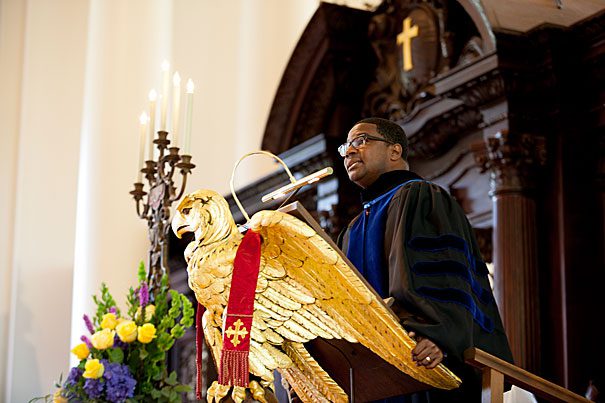
Jonathan Walton
Jonathan Walton has some giant shoes to fill. The new Pusey Minister at Harvard’s Memorial Church, and the Plummer Professor of Christian Morals in the Faculty of Arts and Sciences, he is stepping into the dual role formerly occupied by the dearly departed Peter Gomes. At Harvard, Gomes was a veritable institution unto himself. The recipient of 39 honorary degrees, one of America’s most renowned preachers and successful preacher-writers, and a brilliant and idiosyncratic African American intellectual, Gomes spoke with a kind of deliberate grandiloquence that charmed, elevated and inspired. He outlasted numerous Harvard Presidents and taught a fantastic course on Harvard’s history (which I had the pleasure of helping him teach, one year); his Wednesday afternoon teas were one of Harvard’s finest traditions; and, while never uncontroversial, Gomes was welcoming to people of all faiths, and evangelicals knew they always had a seat at his table.
Recently Walton delivered the “Freshman Sunday” sermon, his inaugural sermon, and the Harvard Gazette reports on his articulation of the Epistle of James:
“Faith as defined in this epistle is not a mere cognitive assent to a belief in a divine being,” said Walton, who succeeded the late Rev. Peter J. Gomes in the influential pulpit. “Nor should faith be conceived as blind allegiance to a perceived sacred yet illusive reality. No, … such conceptions of faith are as morally vacuous as they are ethically inept. Rather, James is referring to faith in a sacred reality that reveals itself in human activity.”
Belief is revealed by action, Walter said. “It does not matter if Christianity is true, but rather can we, as those informed by the teachings of Jesus, make it true. Hence at the end of the day, our faith is not something to be professed, as talk is cheap, but something primarily to be done.”
If I were not a man of conscience, I would take the soundbite — “It does not matter if Christianity is true” — and exploit it to make all the usual points about Harvard’s abandonment of its ancient and original Christian commitments and its obeisance to postmodern relativities. After all, Veritas — the Latin for “truth” — is emblazoned on Harvard’s shield of arms. The official motto, adopted in 1692 (84 years prior to the Declaration of Independence) is even more ironic: Veritas, Christo et ecclesiae — truth, for Christ and the church. Yet here is Harvard’s minister declaring in the heart of Harvard Yard that the truth of Christianity is insignificant.
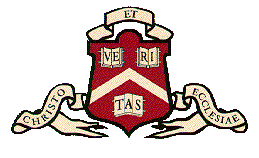 As Mark D. Roberts explains, among Harvard’s “Rules and Precepts” adopted in 1646 was that every student should be “plainly instructed” that the ultimate purpose of his life and scholarship is “to know God and Jesus Christ which is eternal life,” and thus to make Christ “the only foundation of all sound knowledge and Learning.” Students were encouraged to pray, required to read the scripture twice weekly, and to submit to theological examinations. The original seal had three books on the Harvard shield, with the top two books face-up and the bottom book face-down, to indicate the limits of human rationality and the necessity of divine revelation. Today the three books are all face-up.
It would all be so easy. A university intended to illuminate Jesus Christ as the beginning and end of all knowledge now detaches Christianity from the question of truth and appears to disregard the question of truth entirely. The blog post practically writes itself.
What Walton was saying, however, was not that the truth of Christianity is inconsequential, period. One has to read the rest of the sentence. He was saying something more subtle than that — and yet, at least to my mind, still troubling.
The Epistle of James reminded early Jewish converts to Christianity, “begotten by the Word of Truth,” that the possession of the truth of God’s grace in Christ does not mean that they could abandon the works of love to which Christ called his followers. A living faith transforms us from the inside out, resulting in a life that imitates Christ. In the absence of transformation, action, and works of love, our faith is either false or dead. Yet Walton spoke to a generation already skeptical of ultimate metaphysical truths and told them that the truth of Christianity is in its living out.
The Christian faith, in Walton’s teaching, is “faith in a sacred reality,” so there is an assertion of the reality of some sacred other. This sacred reality “reveals itself in human activity,” and so “faith is not something to be professed, as talk is cheap,” but faith is instead “something primarily to be done.”
This is not necessarily the denial of truth, but is at least its displacement. It’s one thing to say that we experience the truth of God in Christ when we live the life of Christ. It’s another to say that the only “truth” that matters is found in serving others. It’s one thing to say that we come to the truth through participation in the life of Christ. It’s another to say that there is no truth of Christianity apart from what we make true. The truth is the truth, whether or not anyone believes it or acts upon it. Christians historically have understood that they make the truth known through their deeds. But they do not make the truth true through their deeds.
And when Walton denigrates the importance of profession, he’s departing not only from Christian tradition, in which the proclamation of the Word and the confession of the gospel are paramount, but he’s departing from the tradition of Christ, who spent an awful lot of time “professing” as well as “doing.” Christ’s talk was not cheap. The Word is not cheap — and the Word was true eternally, long before there were people to “make it true.”
Walton’s sermon was consistent with the general trend of reducing Christianity to a social justice program, and justifying the presence of churches at secular universities by framing them as community organizers. Yet what was so refreshing about Peter Gomes was that he was willing to be counter-cultural. Reverend Gomes took his immense learning and his towering standing within the Harvard community and used them to stand against the stream. My friend Jeff Barneson related this story after Gomes’ death:
On one occasion [Gomes] spoke at one of the regular meetings of the Harvard Graduate School Christian Fellowship—the InterVarsity group I advise. He told the graduate students packed together in Phillips Brooks House that their calling was to “Say the intolerable thing to a generation whose only value is tolerance.” During the discussion following his remarks, I asked what he meant by “the intolerable thing.” “Jeffrey,” he said, “the intolerable thing is that Jesus Christ is Lord.”
Reverend Walton will preach hundreds of sermons in his term as the Pusey Minister and Plummer Professor of Christian Morals at Harvard. He is just beginning in his new role, which calls for grace and welcome, not a rush to judgment. Surely the evangelical community there will seek to build a friendly and productive relationship. But if he follows in the admirable tradition of his predecessor, Reverend Walton will be willing to press into the tide, to stand for truths immutable in a time of whirling change, and to defend what sounds indefensible to a generation that needs to hear it more than ever.
As one of the students said after the service, “He fits into the community here.” Let’s hope he does not fit in too much.
Previous Post

October 8, 2012
The Moral Hazard of Slum Tourism
Next Post

October 9, 2012 Daily Fragments: Excellence, Slavery, UFO's, Super-Spies and Pothead Pets
Browse Our Archives
Select a Category Abortion Abortion adoption Africa Aging AIDS America Worship American history Americolatry An Open Letter to a College Freshman animals Apologetics art Atheism Authors Barack Obama Bible Biblical Scholarship Billy Graham Blogging Bono Book Review Books That Change Lives Breakfast Links Bulletin Board Business Children Christian Approach to Politics Christian Media Christian Right Derangement Syndrome Christianity and Homosexuality Christians in Government Christmas Chuck Colson CLS v Martinez Comic Creation Creativity and the Arts Cross Examinations Cross Investigations Daily Fragment Daily Trinity Death debt Deep Thoughts on Fatherhood depression economy education Election 2012 entertainment Environment Epistemology Erik Campano Euthanasia Evangelicalism Evangelicals and Gays Everyday Transcendence evil evolution Facebook Jesus faith Faith and Politics Faith and Politics Faith and Politics Faith and Politics Faith and Politics Faith and Politics Faith and Politics faith and reason family Feminism foreign affairs Franklin Graham Future of Evangelicalism Galen D. gay marriage George W. Bush Guest Posts Guns Gymnastics Harold Camping Heaven Hell Holidays Hollywood Homosexuality iam2.org Illegal Immigration immigration Immigration Reform Injustice Inspiration Interviews Islam Jeremy Lin Jesus jesus christ John Mark Reynolds Johnnie Moore Judgment Day Just War Theory Killing Osama Link of the Day Lists of the Week Mark Goldblatt Marriage Military Missions Mitt Romney Modern Western Thought Monastic wisdom Mormonism Morning Hash Morning Report Motherhood Movies Obamacare Old Testament Orphan Care Palin Parenting Pastoral Resources Patheos Peace Between Religions PEPFAR Persecution Peter Wehner Peter Wehner Philosophy Political Quotes of the Day politics Politics and Economics Pornography Prejudice Prisoner Rape Question of the Week Race Radical Faith Rapture Ravi Zacharias Rick Santorum Russia Salvation Sarah Palin Scandals Science Science and Faith Separation of Church and State Series sex sex slavery social justice Social Justice Ministry Spiritual Disciplines sports Steven Tyler Suffering Suicide Sunday Funnies T. Dalrymple Tea Party Technology terrorism The Christian Media Files The Daily Trinity The Electorate The Ethics of Rhetoric The Future of Seminary Education The Middle East The Obama Presidency theological Theological Renewal Theology Uncategorized Understanding Evangelicalism Vocation war War and Peace With Distinction Word to the Wise Writers
Select a Month October 2015 June 2015 May 2015 March 2015 December 2014 September 2014 August 2014 July 2014 June 2014 May 2014 April 2014 March 2014 February 2014 January 2014 December 2013 November 2013 October 2013 September 2013 August 2013 July 2013 June 2013 May 2013 April 2013 March 2013 February 2013 January 2013 December 2012 November 2012 October 2012 September 2012 August 2012 July 2012 June 2012 May 2012 April 2012 March 2012 February 2012 January 2012 December 2011 November 2011 October 2011 September 2011 August 2011 July 2011 June 2011 May 2011 April 2011 March 2011 February 2011 January 2011 December 2010 November 2010 October 2010 September 2010 August 2010 July 2010 June 2010 May 2010 April 2010 March 2010 October 2009 September 2009 August 2009 July 2009 June 2009
Follow Us!
TAKE THE
Religious Wisdom Quiz
Who said, "I am not ashamed of the gospel"?
Select your answer to see how you score.
Paul John James Peter
Related posts from Philosophical Fragments
The First Biologist, in the Garden of Eden

The American Church and Global AIDS over the...

Daniel’s Story: Genesis of the US Government’s AIDS...

TRENDING AT PATHEOS Evangelical

How the author of the world's best hymn...
I've been working with John Newton for a while now. This makes...

Long before this Lectio Divina, Psalm 130 - the song - started...

What About the Trees? Another Living Parable
After I finished writing the last article about falling leaves as a...

Why Classical Education Is a Conversation, Not a...
Come and Read: Joy in Classical Education When I was a little...

Falling Leaves: A Living Parable on Letting Go
I’ve spent the vast majority of my life in the southeast corner...

Cornell University has received a great deal of negative publicity and intense...
view all Evangelical blogs
Ad-Free & Subscriber Log-In Subscription Support
- About Us
- 2026 Calendar
- Videos
- Podcasts
- Library of World Religions
- Faith In Media Tracker
- Advertise With Us
- Write for Us
- Privacy Policy
- Terms of Service
- Do Not Sell My Data
- Contact Us
- Radiant Digital
- Manage Newsletter Subscriptions
- Unsubscribe From Notifications
- Sitemap
Copyright 2008-2026, Patheos. All rights reserved.
Subscription Support Ad-Free & Subscriber Log-In
Follow Patheos