
BuddhistCatholicContemplativeEvangelicalGeneral ChristianHinduJewishLatter-day SaintMuslimNew VisionsProgressive Christian
Beliefs
- Buddhist
- Catholic
- Contemplative
- Evangelical
- General Christian
- Hindu
- Jewish
- Latter-day Saint
- More Voices
- Muslim
- New Visions
- Pagan
- Progressive Christian
Topics
- Religion News
- Food and Religion
- Sports and Religion
- Religious Art
- Religious Music and Entertainment
- Religious Events
- History and Religion
- Style and Religion
- Politics and Religion
- Women in Religion
- Recreation Outdoors and Religion
- Business Finance and Religion
- Careers Workplace and Religion
- Education and Religion
- Family Parenting and Religion
- Health Fitness and Religion
- Home and Religion
- Relationships and Religion
- Technology and Religion
- Travel and Religion
Columnists
- Buddhist Columnists
- Business Finance and Religion Columnists
- Careers Workplace and Religion Columnists
- Catholic Columnists
- Contemplative Columnists
- Education and Religion Columnists
- Evangelists Columnists
- Family Parenting and Religion Columnists
- General Christian Columnists
- Health Fitness and Religion Columnists
- Hindu Columnists
- History and Religion Columnists
- Home and Religion Columnists
- Jewish Columnists
- More Voices Columnists
- Latter Day Columnists
- Muslim Columnists
- New Visions Columnists
- Nonreligious Columnists
- Pagan Columnists
- Politics and Religion Columnists
- Progressive Columnists
- Recreation Outdoors and Religion Columnists
- Relationships and Religion Columnists
- Religion News Columnists
- Religious Art Columnists
- Religious Events Columnists
- Religious Music and Entertainment Columnists
- Sports and Religion Columnists
- Style and Religion Columnists
- Technology and Religion Columnists
- Travel and Religion Columnists
- Women in Religion Columnists
Resource Library
- 2026 Calendar
- Library of World Religions
- The 100 Most Holy Places on Earth
- Patheos Answers
- Podcasts
- Videos
- Faith Leaders Database
- Anglican Episcopalian
- Bahai
- Baptist
- Buddhism
- Christianity
- Confucianism
- Eastern Orthodoxy
- Hinduism
- Holiness and Pentecostal
- ISKCON
- Islam
- Judaism
- Lutheran
- Methodist
- The Church of Jesus Christ of Latter-day Saints
- New Age
- Paganism
- Presbytarian and Reformed
- Protestantism
- Religion Behind the Scenes
- Roman Catholic
- Scientology
- Shia Islam
- Sikhism
- Sufism
- Sunni Islam
- Taoism
- Zen
- See all religions
Research Tools
 Ad-Free & Subscriber Log-In Subscription Support
Ad-Free & Subscriber Log-In Subscription Support
Follow Patheos 

- Trending:
- Forgiveness
- |
- Marriage
- |
- Consciousness
- |
- Death Penalty
- |
- Election
- |
- Halloween
 On the Way
- Home
- Progressive Christian
- What If You Were at the Tomb?
What If You Were at the Tomb?
Last updated on: March 27, 2015 at 1:45 pm by Phil Fox Rose
What If You Were at the Tomb? 2015-03-27T13:45:29-04:00 Phil Fox Rose
Patheos Explore the world's faith through different perspectives on religion and spirituality! Patheos has the views of the prevalent religions and spiritualities of the world.
As part of Patheos’ Easter coverage, we’re imagining what it would be like to witness the Resurrection. This is my contribution. For more ‘accounts’ and other resources for Holy Week, visit the Patheos Engaging Easter page here.
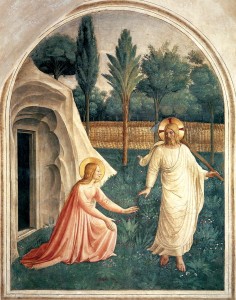
Fra Angelico; “Noli me tangere”; 1442; fresco; Convento di San Marco, Florence
The story of the resurrection of Jesus — the empty tomb; the fear and awe; Mary talking with the gardener without knowing it’s Jesus — is one of the most familiar in Christianity. You might think you know all there is to know about it; maybe you’ve heard the words every year since you were a kid. There’s a wonderful contemplative method of reading scripture from the Ignatian tradition that helps you gain new understanding of familiar passages. You place yourself in the story and use your imagination to awaken the senses. Like lectio divina, of which it is a type, it helps you bypass the rational mind, which thinks it knows the story and what it means. (Here’s an overview of lectio divina.) When you read scripture contemplatively like this, you experience the story at a deeper level, and sometimes unexpected details rise to the surface of your attention, giving you new insight, or clueing you in to an aspect of it that holds special meaning for you.
There are four phases to lectio. Use this sequence of steps or modify it as you see fit. This is a tried-and-true ancient practice with a lot of wisdom in it, but it’s here to help you, not control you.
- Sit in a quiet place where you won’t be distracted and can close your eyes for extended periods. (You can also do this in groups.) I usually caution that when eyes are closed while meditating it’s easy for the mind to start imagining things visually, but that’s exactly what we want here.
- Choose one of the resurrection narratives: John 20:1-18, Luke 23:55 – 24:1-12, Mark 16:1-8, Matthew 28:1-10. Each highlights different features of the story, and some of the characters vary. In Mark and Luke, only angels are present; while in John and Matthew, Jesus is there. In all four, Mary Magdalene, with or without other women, is the first to whom the truth is revealed, though in Luke and John, men play a role too. Pick the one that resonates with you most. If you have no preference, use the account in John.
- Begin with an opening prayer to set your intention: to gain closeness to God and better understanding of the Word. For practices like this, I like the set-aside prayer: God, please help me set aside everything I think I know about these words, myself and you. Give me an open mind that I may have a new experience of these things.
- Lectio: Slowly read through the gospel account. Sit in silence for several minutes. (If you can, set a timer so you don’t have to think about how much time has gone by.) Notice if any detail of the story, a physical detail or a descriptive word, stands out to you after reading.
- Read the passage again. (If you are doing this in a group setting, one person can read and everyone else can close their eyes through this and the next steps.) As you read it, notice the detail or wording which stood out to you the first time. Also, and here’s where we diverge from regular lectio divina, notice particularly anything about physical sensations — the blinding light of the angels, the shaking of the earth when the stone is rolled away. Read it through slowly, taking it all in.
- Meditatio: Now, with your eyes closed, imagine yourself there, by the tomb. You can pick one of the characters in the story if you’re drawn to them, or imagine yourself as a bystander, an invisible witness of this miraculous event. (Each is powerful in a different way.) Picture it. Fill in sensory details which are consistent with the story. Feel the breeze on your face. Imagine the damp of the garden at dawn. The chirping birds. The early morning light.
- Progress in your imagination through the story. While you “watch,” recall the passage, the key actions and the details which might have stood out to you in the lectio phase. If you’ve chosen to make yourself one of the players in the scene, such as Mary Magdalene, imagine yourself experiencing what they experienced, speaking to the angels or Jesus, and being spoken to. If you chose to be a witness, imagine yourself in the midst of the action (not off at a distance), turning to the different characters as they speak or take action. It’s happening all around you. And when Jesus or an angel is present, imagine the sensory experience of being in their presence.
- Oratio: Now, pray in a way that makes sense in response to whatever came up while you were imaging yourself in the scene. Did you realize you need help in some way? Ask for help. Did you have an insight into your life? Thank God for the insight and ask for help bringing your realization into practice. Were you overwhelmed with some feeling or emotion, or did the exercise stir up some deep hurt or joy? Lay yourself bare before God with all your emotions as they are. If you are filled with gratitude, just pray, “Thank you.”
- Contemplatio: When you’re done praying, don’t just leap up and go back to your day. Sit in silence for a while. In the centering prayer tradition, we call this “resting in God.” You’ve already done the reading and visualizing and praying; now just let it all soak in. Don’t try to think about anything. But don’t try to not think about anything either! Just sit. If you have limited time, set a timer so you won’t be distracted by wondering if the time is up. If not, just sit for at least 3 minutes and as much as 20 or 30. End with a closing prayer, or simply, “Amen.”
This kind of imaginative contemplative reading is a great way to approach scripture from a new angle, and as I said, it is all the more useful for those stories we think we know. Even if you don’t think you have a strong visual imagination, give it a try. I don’t; I have trouble conjuring whole visual scenes, but I can imagine sensations and enter the story that way — it surprises and delights me every time.
You can see all my Lent and Easter pieces together at patheos.com/blogs/philfoxrose/tag/lent/. Please share that link, or one to my blog, with anyone you think might be interested. Thanks!
Next Post

April 7, 2015 Unlikely Instruments: A Reflection on John 20:15-16
Browse Our Archives
Select a Category Addiction & Recovery Culture Faith & Spirituality Health Music Politics Uncategorized
Select a Month May 2019 October 2015 September 2015 April 2015 March 2015 December 2014 November 2014 October 2014 September 2014 August 2014 June 2014 May 2014 April 2014 March 2014 December 2013 November 2013 October 2013 September 2013 August 2013 July 2013 May 2013 April 2013 March 2013 February 2013 January 2013 December 2012 November 2012 October 2012 September 2012 August 2012 November 2009 August 2009
Follow Us!
TAKE THE
Religious Wisdom Quiz
Who lay on his side for over a year as a prophetic sign?
Select your answer to see how you score.
Ezekiel Hosea Micah Daniel
Related posts from On the Way

Sybil MacBeth: "I could tell you about Phyllis...
The Sea Change of Mercy and Forgiveness
Unlikely Instruments: A Reflection on John 20:15-16
With The Zimzum of Love and his new...
TRENDING AT PATHEOS Progressive Christian

Why Christians Have a Sacred Duty to Vote:...
The Bible offers strong support for the sacred duty to vote. Here...

What Being a Modern-Day Apostle Means to Me
In my last column, I discussed the ins and outs of modern-day...

Did Ancient China Once Worship the God of...
Across human history, a common thread weaves through the origins of the...

Love Your Neighbor – Including Earth-Kin: Lev. 19,...
God’s command to love your neighbor means acting in an ethical and...

Lead a Church Study of “Jesus and Lao...
Guest writer Jack Thomas (The Irreverent Reverend) reflects on leading his church...

Principles for Understanding the Apostolic Ministry Today
Whenever people discover that my formal ministry title is "apostle," as in...
view all Progressive Christian blogs
Ad-Free & Subscriber Log-In Subscription Support
- About Us
- 2026 Calendar
- Videos
- Podcasts
- Library of World Religions
- Faith In Media Tracker
- Advertise With Us
- Write for Us
- Privacy Policy
- Terms of Service
- Do Not Sell My Data
- Contact Us
- Radiant Digital
- Manage Newsletter Subscriptions
- Unsubscribe From Notifications
- Sitemap
Copyright 2008-2026, Patheos. All rights reserved.
Subscription Support Ad-Free & Subscriber Log-In
Follow Patheos