
BuddhistCatholicContemplativeEvangelicalGeneral ChristianHinduJewishLatter-day SaintMuslimNew VisionsProgressive Christian
Beliefs
- Buddhist
- Catholic
- Contemplative
- Evangelical
- General Christian
- Hindu
- Jewish
- Latter-day Saint
- More Voices
- Muslim
- New Visions
- Pagan
- Progressive Christian
Topics
- Religion News
- Food and Religion
- Sports and Religion
- Religious Art
- Religious Music and Entertainment
- Religious Events
- History and Religion
- Style and Religion
- Politics and Religion
- Women in Religion
- Recreation Outdoors and Religion
- Business Finance and Religion
- Careers Workplace and Religion
- Education and Religion
- Family Parenting and Religion
- Health Fitness and Religion
- Home and Religion
- Relationships and Religion
- Technology and Religion
- Travel and Religion
Columnists
- Buddhist Columnists
- Business Finance and Religion Columnists
- Careers Workplace and Religion Columnists
- Catholic Columnists
- Contemplative Columnists
- Education and Religion Columnists
- Evangelists Columnists
- Family Parenting and Religion Columnists
- General Christian Columnists
- Health Fitness and Religion Columnists
- Hindu Columnists
- History and Religion Columnists
- Home and Religion Columnists
- Jewish Columnists
- More Voices Columnists
- Latter Day Columnists
- Muslim Columnists
- New Visions Columnists
- Nonreligious Columnists
- Pagan Columnists
- Politics and Religion Columnists
- Progressive Columnists
- Recreation Outdoors and Religion Columnists
- Relationships and Religion Columnists
- Religion News Columnists
- Religious Art Columnists
- Religious Events Columnists
- Religious Music and Entertainment Columnists
- Sports and Religion Columnists
- Style and Religion Columnists
- Technology and Religion Columnists
- Travel and Religion Columnists
- Women in Religion Columnists
Resource Library
- 2026 Calendar
- Library of World Religions
- The 100 Most Holy Places on Earth
- Patheos Answers
- Podcasts
- Videos
- Faith Leaders Database
- Anglican Episcopalian
- Bahai
- Baptist
- Buddhism
- Christianity
- Confucianism
- Eastern Orthodoxy
- Hinduism
- Holiness and Pentecostal
- ISKCON
- Islam
- Judaism
- Lutheran
- Methodist
- The Church of Jesus Christ of Latter-day Saints
- New Age
- Paganism
- Presbytarian and Reformed
- Protestantism
- Religion Behind the Scenes
- Roman Catholic
- Scientology
- Shia Islam
- Sikhism
- Sufism
- Sunni Islam
- Taoism
- Zen
- See all religions
Research Tools
 Ad-Free & Subscriber Log-In Subscription Support
Ad-Free & Subscriber Log-In Subscription Support
Follow Patheos 

- Trending:
- Forgiveness
- |
- Marriage
- |
- Consciousness
- |
- Death Penalty
- |
- Election
- |
- Halloween
 On the Way
- Home
- Progressive Christian
- Reading Scripture Contemplatively with Lectio Divina
Reading Scripture Contemplatively with Lectio Divina
Last updated on: December 5, 2013 at 5:11 pm by Phil Fox Rose
Reading Scripture Contemplatively with Lectio Divina 2013-12-05T17:11:47-05:00 Phil Fox Rose
Patheos Explore the world's faith through different perspectives on religion and spirituality! Patheos has the views of the prevalent religions and spiritualities of the world.
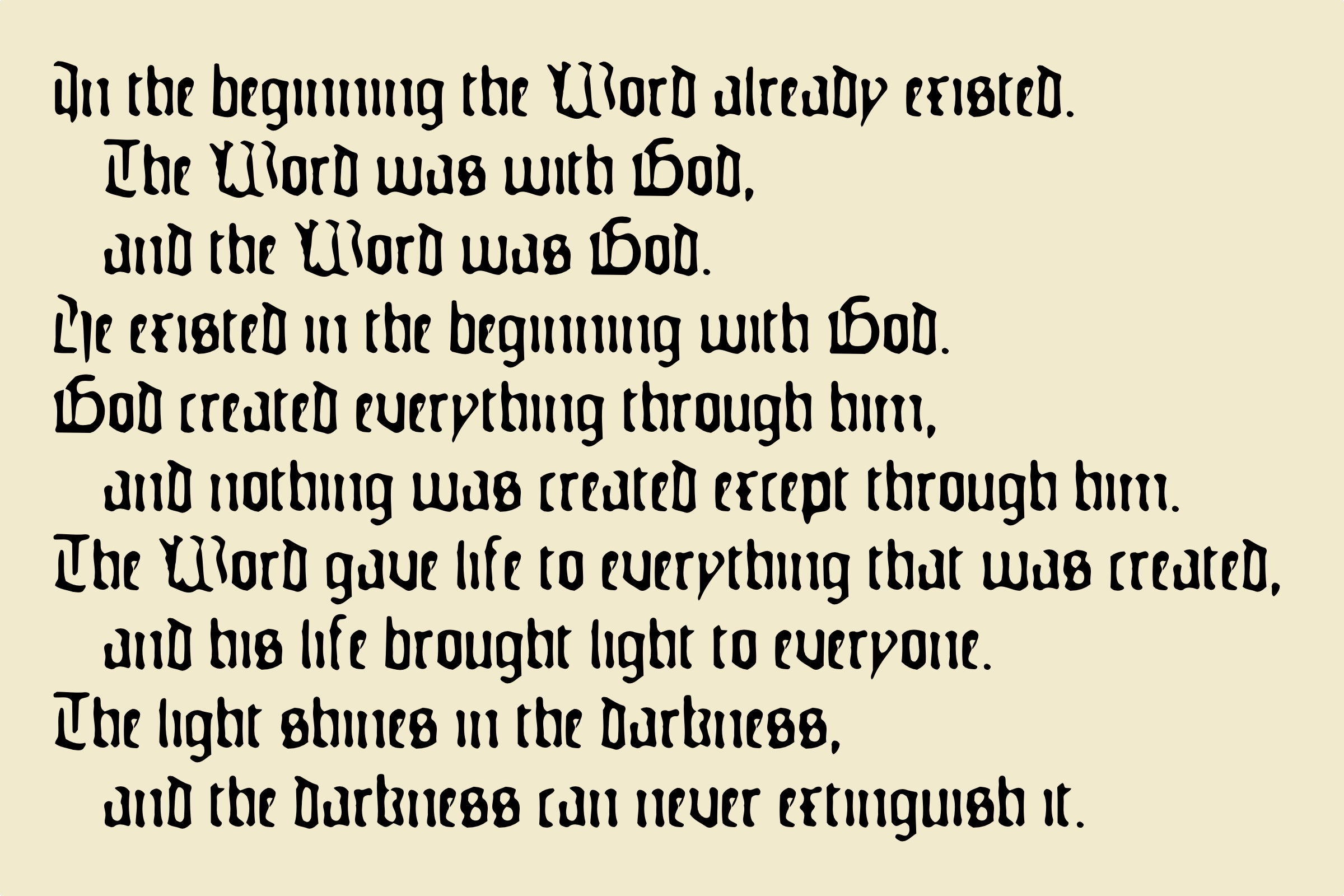
Lectio divina is a way to read scripture and other sacred writing contemplatively. It’s different from bible study or a reading plan — the goal is not to read thoroughly but deeply; to experience the text with an open heart; to comprehend the Truth beneath the words. Comprehend means to hold completely, to know interiorly, to unite with. The purpose of lectio divina is to bypass the literal information-collecting way we normally read and unite with some deeper Truth in the text that touches us personally. Lectio does not replace bible study and other rational ways of encountering scripture; it offers an entirely different perspective, grounded in contemplative principles.
Lectio divina has become much more popular in recent years, and it’s a traditional practice during Advent. So every year around this time, I’m asked by friends and colleagues for guidance or recommendations on the subject, and every year I point people to the wonderful chapter on lectio in my former spiritual teacher Cynthia Bourgeault’s book The Wisdom Jesus: Transforming Heart and Mind
So we’re all beginners in the sense that lectio is structured to have us encounter the text with what Buddhists call “a beginner’s mind.” And an inspiring conversation with a friend the other day helped me realize that sharing my learning with you, rather than my expertise, may be just as useful if not more so. So with all that prefacing, here then is an introduction to lectio divina.
Perhaps you’ve heard lectio divina mentioned by a spiritual teacher or friend on the contemplative journey. If you are a Catholic, you might know that Pope Benedict was a huge fan of lectio (while at the same time inexplicably being hostile towards the centering prayer practice which largely sprang from it). And many centering prayer groups explore lectio regularly or as a special event. My church, St. Lydia’s, approaches the scripture readings every week in a style modeled after the first stage of lectio.
Lectio divina, like many other contemplative practices, can be done alone or with a group with the practice being essentially the same in both cases, but the effect somewhat different. While the details vary somewhat in different traditions, there are two essential principles. The first is that the reading be done slowly, without theatrics yet without being passionless, and that the reading be done aloud if at all possible even if you are practicing alone. A related note: the passage should be brief enough to take in as a whole, probably no more than a paragraph, and as little as a sentence. Second is the structure of the practice. There are four stages: lectio (reading); meditatio (reflecting); oratio (praying); contemplatio (contemplating). Traditionally one moves through the stages in order, though some modern writers suggest a looser more flowing structure.
Here, in snapshot bullet-point list form, are the stages of lectio divina and the essential aspects of each. As I said, there is plenty of variation on the details within the framework, but this is my method and as good a place to start as any.
lectio (reading)
- Collect yourself with 1 minute of silence.
- Read the passage once slowly aloud, noting what sentence, phrase or single word strikes you in the text — the important thing is not what strikes you or why, but that it does.
- Sit in silence for 1 minute or more.
- Read the passage again slowly.
- If in a group, share the sentence, phrase or word you were drawn to (even if someone else has already said it.)
meditatio (reflecting)
- Read the passage again.
- Quietly and calmly let yourself — your reason, imagination, memories and emotions — think about the passage, especially the part to which you were drawn. It might bring up memories and thoughts and send you off into a whole scene in your imagination; or it might agitate you, make you feel angry or confused or overwhelmed in a non-specific way. If so, think about what it’s triggering and why. Or conversely you might be drawn positively to a phrase or image in the text, comforted or flooded with joy; again, think about why.
- If no feelings are coming easily, or if you prefer this method: Play with putting yourself in the scene, imagining the key piece of text being said near you or by you, with you live in the presence of the action. (This is the Ignatian practice of visualizing oneself in Bible scenes.)
oratio (praying)
- Rooted in the phrase that you were drawn to and the reflections you just experienced, turn to dialogue with God.
- You may pray for help or comfort involving things that came up; or express thanksgiving or worshipful feelings. Sometimes my vocal prayer is simply, “Thank you. Thank you.” Just take a few minutes relating to God in whatever way you normally do with prayer, but centered around the phrase or image or idea that struck you in the text.
- This stage is a little tricky in group settings. You might instruct folks to pray silently, or quietly, or you might encourage participants to voice the prayers out loud one at a time. Bourgeault recommends sending folks away to do these final stages in private.
contemplatio (contemplating)
- Resting in God.
- Just sit with God after the prayer period for 3 minutes or more of silence, without attaching to thoughts. You are not thinking about the passage, or what came up in meditatio and oratio, but neither are you ignoring it all. It is now part of the reality in which you are sitting with God. Your prayers of words in oratio may drift naturally into contemplatio; if so, just let it happen.
- This phase is essentially centering prayer, and, as mentioned, was a big part of the inspiration for the development of that practice.
While lectio divina is typically done with bible passages, it can be used for any sacred writing. And why not with “secular” poetry? (I say “secular” in quotes because all poetry is sacred in a sense.)
This is nothing but a snapshot. I haven’t even touched on the history of lectio, which stretches back to the very beginnings of Christianity, to Origen, Ambrose and the Desert Fathers and Mothers. There are books worth that could be said; on the other hand, as with other contemplative practices, that is all just information, while there is no substitute for doing, for being. So, give it a try. I would love to hear how you are using lectio, in your personal contemplative life or as part of a community. I look forward to writing more about it in the future, inspired by your comments. Happy Advent!

Browse Our Archives
Select a Category Addiction & Recovery Culture Faith & Spirituality Health Music Politics Uncategorized
Select a Month May 2019 October 2015 September 2015 April 2015 March 2015 December 2014 November 2014 October 2014 September 2014 August 2014 June 2014 May 2014 April 2014 March 2014 December 2013 November 2013 October 2013 September 2013 August 2013 July 2013 May 2013 April 2013 March 2013 February 2013 January 2013 December 2012 November 2012 October 2012 September 2012 August 2012 November 2009 August 2009
Follow Us!
TAKE THE
Religious Wisdom Quiz
Who saw a vision of four beasts coming out of the sea?
Select your answer to see how you score.
Ezekiel Joel Daniel Amos
Related posts from On the Way

Sybil MacBeth: "I could tell you about Phyllis...
The Sea Change of Mercy and Forgiveness
Unlikely Instruments: A Reflection on John 20:15-16
TRENDING AT PATHEOS Progressive Christian

Why Christians Have a Sacred Duty to Vote:...
The Bible offers strong support for the sacred duty to vote. Here...

What Being a Modern-Day Apostle Means to Me
In my last column, I discussed the ins and outs of modern-day...

Did Ancient China Once Worship the God of...
Across human history, a common thread weaves through the origins of the...

Love Your Neighbor – Including Earth-Kin: Lev. 19,...
God’s command to love your neighbor means acting in an ethical and...

Lead a Church Study of “Jesus and Lao...
Guest writer Jack Thomas (The Irreverent Reverend) reflects on leading his church...

Principles for Understanding the Apostolic Ministry Today
Whenever people discover that my formal ministry title is "apostle," as in...
view all Progressive Christian blogs
Ad-Free & Subscriber Log-In Subscription Support
- About Us
- 2026 Calendar
- Videos
- Podcasts
- Library of World Religions
- Faith In Media Tracker
- Advertise With Us
- Write for Us
- Privacy Policy
- Terms of Service
- Do Not Sell My Data
- Contact Us
- Radiant Digital
- Manage Newsletter Subscriptions
- Unsubscribe From Notifications
- Sitemap
Copyright 2008-2026, Patheos. All rights reserved.
Subscription Support Ad-Free & Subscriber Log-In
Follow Patheos