
BuddhistCatholicContemplativeEvangelicalGeneral ChristianHinduJewishLatter-day SaintMuslimNew VisionsProgressive Christian
Beliefs
- Buddhist
- Catholic
- Contemplative
- Evangelical
- General Christian
- Hindu
- Jewish
- Latter-day Saint
- More Voices
- Muslim
- New Visions
- Pagan
- Progressive Christian
Topics
- Religion News
- Food and Religion
- Sports and Religion
- Religious Art
- Religious Music and Entertainment
- Religious Events
- History and Religion
- Style and Religion
- Politics and Religion
- Women in Religion
- Recreation Outdoors and Religion
- Business Finance and Religion
- Careers Workplace and Religion
- Education and Religion
- Family Parenting and Religion
- Health Fitness and Religion
- Home and Religion
- Relationships and Religion
- Technology and Religion
- Travel and Religion
Columnists
- Buddhist Columnists
- Business Finance and Religion Columnists
- Careers Workplace and Religion Columnists
- Catholic Columnists
- Contemplative Columnists
- Education and Religion Columnists
- Evangelists Columnists
- Family Parenting and Religion Columnists
- General Christian Columnists
- Health Fitness and Religion Columnists
- Hindu Columnists
- History and Religion Columnists
- Home and Religion Columnists
- Jewish Columnists
- More Voices Columnists
- Latter Day Columnists
- Muslim Columnists
- New Visions Columnists
- Nonreligious Columnists
- Pagan Columnists
- Politics and Religion Columnists
- Progressive Columnists
- Recreation Outdoors and Religion Columnists
- Relationships and Religion Columnists
- Religion News Columnists
- Religious Art Columnists
- Religious Events Columnists
- Religious Music and Entertainment Columnists
- Sports and Religion Columnists
- Style and Religion Columnists
- Technology and Religion Columnists
- Travel and Religion Columnists
- Women in Religion Columnists
Resource Library
- 2026 Calendar
- Library of World Religions
- The 100 Most Holy Places on Earth
- Patheos Answers
- Podcasts
- Videos
- Faith Leaders Database
- Anglican Episcopalian
- Bahai
- Baptist
- Buddhism
- Christianity
- Confucianism
- Eastern Orthodoxy
- Hinduism
- Holiness and Pentecostal
- ISKCON
- Islam
- Judaism
- Lutheran
- Methodist
- The Church of Jesus Christ of Latter-day Saints
- New Age
- Paganism
- Presbytarian and Reformed
- Protestantism
- Religion Behind the Scenes
- Roman Catholic
- Scientology
- Shia Islam
- Sikhism
- Sufism
- Sunni Islam
- Taoism
- Zen
- See all religions
Research Tools
 Ad-Free & Subscriber Log-In Subscription Support
Ad-Free & Subscriber Log-In Subscription Support
Follow Patheos 

- Trending:
- Forgiveness
- |
- Marriage
- |
- Consciousness
- |
- Death Penalty
- |
- Election
- |
- Halloween
 On the Way
- Home
- Progressive Christian
- Advent fact — December 6 is the Feast of St. Nicholas… Sinterklaas… Santa Claus
Advent fact — December 6 is the Feast of St. Nicholas… Sinterklaas… Santa Claus
Last updated on: December 6, 2013 at 8:37 am by Phil Fox Rose
Advent fact — December 6 is the Feast of St. Nicholas… Sinterklaas… Santa Claus 2013-12-06T08:37:16-05:00 Phil Fox Rose
Patheos Explore the world's faith through different perspectives on religion and spirituality! Patheos has the views of the prevalent religions and spiritualities of the world.
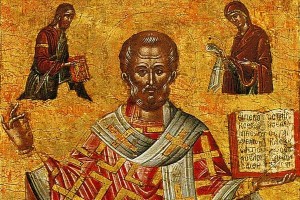 One of the numerous unrelated story lines from different traditions that runs through the Christmas season is that of Santa Claus. December 6 is the feast day of St. Nicholas, honored in the Roman Catholic, Anglican, Lutheran and some other Protestant churches. (Eastern Orthodox celebrate his feast on December 19.)
St. Nicholas or Nikolaos was the bishop of Myra, a Mediterranean port in Lycia on what is now the southern coast of Turkey — very far from the North Pole. St. Paul crossed this region and likely stayed in the town on several occasions (Acts 21:1, Acts 27:5) and some records suggest there was a Christian church presence there before A.D. 95.
Almost nothing is known about the historic figure of St. Nicholas, but his legend grew over the centuries. He was bishop of Myra in the first half of the 300s. He was imprisoned by the Romans for a while but released. He lived into his 70s.
Less certain but likely is that he was orphaned at an early age from a rich family, and cared especially for poor and orphaned children. In the realm of legend is that when he decided to join the church and in following Christ give away his family wealth, he did so by tossing small bags of coins to the poor as he went by. Another legend has him providing financial support to young women to help keep them from lives of prostitution.
It wasn’t until the late Middle Ages in northern Europe — Germany, Switzerland, Alsace-Lorraine and the Netherlands — that this legend of St. Nicholas giving away little bags of coins developed into the idea that in the wee hours of his feast day, December 6 (which is actually the anniversary of his death, so his ghost, I guess), St. Nicholas would deliver gifts to children secretly. So the kinder started leaving out their shoes the night before, to find small toys and bags of coins in them the next morning.
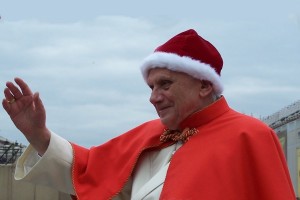
Pope Benedict wearing a traditional camauro.
The legend of Santa Claus owes a lot to the pagan legend of Odin. I mentioned Yule, the Germanic winter solstice festival, in my earlier post about Advent and other new year’s holidays. Yule gave our current Christmas a number of its trappings. During that holiday, which happens at the same time as Christmas, Odin would ride through the sky with his hunting party; children would put out carrots and sugar cubes for Odin’s flying horses and be rewarded with small gifts. It’s possible that in Northern Europe this legend merged with the St. Nicholas legend of giving away small bags of coins to poor children, giving us a Santa Claus flying through the sky with magical reindeer, landing on people’s roofs, finding snacks left for him and his reindeer, and leaving behind gifts for the children in shoes or stockings.
In Dutch culture, Sinterklaas is undeniably St. Nicholas, wearing a bishops vestments, but the mixing of stories is murky and takes a nasty turn. While it has this bishop riding through the sky and distributing gifts, it adds the idea of a book with notations of which children were nice and which were naughty. The nice ones got gifts. The naughty ones risked being thrown in jute bags by Sinterklaas’s helper — originally a devil, later the legend took on racist tones — and stolen away!
Our current conception of Santa Claus as a fat and jolly old man and many of the details we assume are ancient legend seem to be rooted in the poem “A Visit from St. Nicholas” better known as “‘Twas the Night Before Christmas,” written in 1823 by Columbia professor Clement Clarke Moore, a New Yorker inspired by the local Dutch culture and its legend of Sinterklaas. More on that poem in a later post.
One final note: Despite the fact that the fur-trimmed costume we associate with Santa Claus seems fitting for the North Pole, it’s really just a stylized fancy bishop’s outfit. Pope Benedict — always the fashion plate — created a bit of a stir a few years back when he appeared in public sporting a camauro, the fur-trimmed type of bishop’s hat on which Santa’s is based, which has fallen out of fashion for being considered too showy.
You can see all my Advent-themed pieces together at patheos.com/blogs/philfoxrose/tag/advent/. Please share this link, or just one to my blog, with anyone you think might be interested. Thanks!
Previous Post

December 5, 2012
6 Tips for Being On Time
Next Post

December 7, 2012 Not the Immaculate Conception but a Maculate One
Browse Our Archives
Select a Category Addiction & Recovery Culture Faith & Spirituality Health Music Politics Uncategorized
Select a Month May 2019 October 2015 September 2015 April 2015 March 2015 December 2014 November 2014 October 2014 September 2014 August 2014 June 2014 May 2014 April 2014 March 2014 December 2013 November 2013 October 2013 September 2013 August 2013 July 2013 May 2013 April 2013 March 2013 February 2013 January 2013 December 2012 November 2012 October 2012 September 2012 August 2012 November 2009 August 2009
Follow Us!
TAKE THE
Religious Wisdom Quiz
What order did the four beasts that rose from the sea in Daniel's vision appear?
Select your answer to see how you score.
Leopard, bear, lion with eagle's wings, terrifying beast with iron teeth Lion with eagle's wings, bear, leopard, terrifying beast with iron teeth Terrifying beast with iron teeth, lion with eagle's wings, leopard, bear Bear, lion with eagle's wings, terrifying beast with iron teeth, leopard
Related posts from On the Way

Sybil MacBeth: "I could tell you about Phyllis...
The Sea Change of Mercy and Forgiveness
Unlikely Instruments: A Reflection on John 20:15-16
TRENDING AT PATHEOS Progressive Christian

Why Christians Have a Sacred Duty to Vote:...
The Bible offers strong support for the sacred duty to vote. Here...

What Being a Modern-Day Apostle Means to Me
In my last column, I discussed the ins and outs of modern-day...

Did Ancient China Once Worship the God of...
Across human history, a common thread weaves through the origins of the...

Love Your Neighbor – Including Earth-Kin: Lev. 19,...
God’s command to love your neighbor means acting in an ethical and...

Lead a Church Study of “Jesus and Lao...
Guest writer Jack Thomas (The Irreverent Reverend) reflects on leading his church...

Principles for Understanding the Apostolic Ministry Today
Whenever people discover that my formal ministry title is "apostle," as in...
view all Progressive Christian blogs
Ad-Free & Subscriber Log-In Subscription Support
- About Us
- 2026 Calendar
- Videos
- Podcasts
- Library of World Religions
- Faith In Media Tracker
- Advertise With Us
- Write for Us
- Privacy Policy
- Terms of Service
- Do Not Sell My Data
- Contact Us
- Radiant Digital
- Manage Newsletter Subscriptions
- Unsubscribe From Notifications
- Sitemap
Copyright 2008-2026, Patheos. All rights reserved.
Subscription Support Ad-Free & Subscriber Log-In
Follow Patheos