
BuddhistCatholicContemplativeEvangelicalGeneral ChristianHinduJewishLatter-day SaintMuslimNew VisionsProgressive Christian
Beliefs
- Buddhist
- Catholic
- Contemplative
- Evangelical
- General Christian
- Hindu
- Jewish
- Latter-day Saint
- More Voices
- Muslim
- New Visions
- Pagan
- Progressive Christian
Topics
- Religion News
- Food and Religion
- Sports and Religion
- Religious Art
- Religious Music and Entertainment
- Religious Events
- History and Religion
- Style and Religion
- Politics and Religion
- Women in Religion
- Recreation Outdoors and Religion
- Business Finance and Religion
- Careers Workplace and Religion
- Education and Religion
- Family Parenting and Religion
- Health Fitness and Religion
- Home and Religion
- Relationships and Religion
- Technology and Religion
- Travel and Religion
Columnists
- Buddhist Columnists
- Business Finance and Religion Columnists
- Careers Workplace and Religion Columnists
- Catholic Columnists
- Contemplative Columnists
- Education and Religion Columnists
- Evangelists Columnists
- Family Parenting and Religion Columnists
- General Christian Columnists
- Health Fitness and Religion Columnists
- Hindu Columnists
- History and Religion Columnists
- Home and Religion Columnists
- Jewish Columnists
- More Voices Columnists
- Latter Day Columnists
- Muslim Columnists
- New Visions Columnists
- Nonreligious Columnists
- Pagan Columnists
- Politics and Religion Columnists
- Progressive Columnists
- Recreation Outdoors and Religion Columnists
- Relationships and Religion Columnists
- Religion News Columnists
- Religious Art Columnists
- Religious Events Columnists
- Religious Music and Entertainment Columnists
- Sports and Religion Columnists
- Style and Religion Columnists
- Technology and Religion Columnists
- Travel and Religion Columnists
- Women in Religion Columnists
Resource Library
- 2026 Calendar
- Library of World Religions
- The 100 Most Holy Places on Earth
- Patheos Answers
- Podcasts
- Videos
- Faith Leaders Database
- Anglican Episcopalian
- Bahai
- Baptist
- Buddhism
- Christianity
- Confucianism
- Eastern Orthodoxy
- Hinduism
- Holiness and Pentecostal
- ISKCON
- Islam
- Judaism
- Lutheran
- Methodist
- The Church of Jesus Christ of Latter-day Saints
- New Age
- Paganism
- Presbytarian and Reformed
- Protestantism
- Religion Behind the Scenes
- Roman Catholic
- Scientology
- Shia Islam
- Sikhism
- Sufism
- Sunni Islam
- Taoism
- Zen
- See all religions
Research Tools
 Ad-Free & Subscriber Log-In Subscription Support
Ad-Free & Subscriber Log-In Subscription Support
Follow Patheos 

- Trending:
- Forgiveness
- |
- Marriage
- |
- Consciousness
- |
- Death Penalty
- |
- Election
- |
- Halloween
 Muslim in the Middle
- Home
- Muslim
- The Myth Of Martyrdom In Islam
The Myth Of Martyrdom In Islam
Last updated on: September 17, 2017 at 6:47 pm by Farouk A. Peru
The Myth Of Martyrdom In Islam 2017-09-17T18:47:04+00:00 Farouk A. Peru
Patheos Explore the world's faith through different perspectives on religion and spirituality! Patheos has the views of the prevalent religions and spiritualities of the world.
In recent years, the phenomenon of the lone Jihadi has become iconic. Not only in the West but in the Middle East. In Iraq, only a decade ago, we would read about them on a daily basis. It is hard to formulate the exact motivations of these senseless killers but one factor we can never take out of the equation is martyrdom. These Jihadis have all been told, if they performed their dastardly act, they would become martyrs. But why is martyrdom such almost worshipped?
In Traditional Islam, martyrs have always been given a high consideration. They are guaranteed salvation without judgement. Their bodies do not need to be given the ritual washing. Shrines are even built to commemorate them and pilgrims even visit these shrines to obtain blessings. Consequently, pronouncing someone’s death as ‘martyrdom’ confers a great deal of reverence to it.
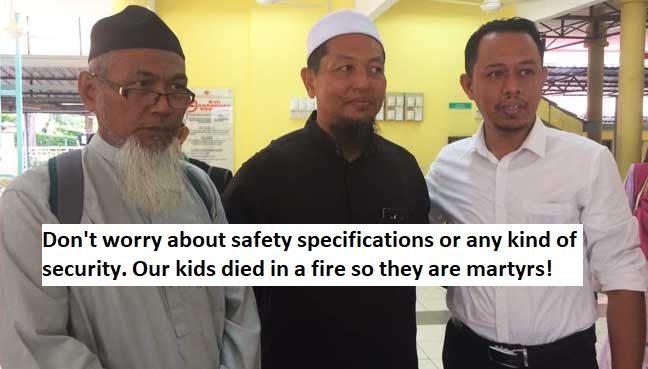
In Malaysia last week, a tahfiz school (religious school especially dedicated to the memorisation of the Quran) in the capital city of Kuala Lumpur was engulfed in a fire which claimed the lives of 21 children and 2 adult wardens. The first response by the school’s headmaster was to call the children ‘martyrs’. He could have done so for two reasons. One, the children were dedicated to the pursuit of religion or two, according to Hadith, people who die in fires are martyrs. Whatever the case, he managed to absolve himself from his own culpability. The minister in charge said that no charges will be made against the school as they have ‘suffered enough’. This is despite the fact that the school made no effort to comply with the fire and safety regulations and provided no security for the children at all. At the time of this writing, 7 teenagers are being accused of arson and the admin’s culpability is not discussed at all. The martyrdom card went a long way in soothing the emotions of the conservative majority.
Why is that the case? Because Hadith literature – sayings, doings and abstentions allegedly from Prophet Muhammad also give high value to martyrdom. There are Hadiths which confer the status for dying whilst fighting in the way of Allah (not in a Quranic sense, I should say, but in religo-tribal sense). There are also Hadiths which say that those who die from drowing, being killed in a fire and even stomach ailments become martyrs! These martyrs have the power of intercession for their close ones which doubly add to the incentive of being one.
The question is, however, is martyrdom actually acknowledged in the Quran itself? Many would point to translations of verses like Chapter 4 Verse 69 and say that ‘martyrs’ are mentioned there. But, of course, this is a mere translation of the word ‘shuhada’ (sing. ‘shaheed’) and translators differ in their understanding. Marmaduke Pickthall agrees that it means ‘martyrs’ but Yusuf Ali does not, preferring to translate it as ‘witnesses’. I myself prefer Yusuf Ali’s translation and in the proceeding paragraphs, will corroborate my evidence for thinking so.
First and most importantly, in the many scenarios of the day of judgement in the Quran, there is not a single mention of martyrs being absolved. Not even once. No single deed can absolve any of your sins. Generally, good deeds expiate bad ones.
One of the more prominent scenarios of judgement day is in 39/69-75 and there is no mention of any kind of absolution for martyrs even though the aforementioned word ‘shuhada’ is mentioned in 39/69. Pickthall translates it as witnesses here, strangely enough. Perhaps the word can be understood more clearly in 16/89 in which it is said that for every nation shall be a witness (shaheed). All translators agree it means ‘witness’ there.
Indeed, the word ‘shaheed’ and ‘shuhada’ are always used in the capacity, to bear witness to something. This can be either in a legal sense, like the witnesses for extramarital sex in 24/6 and the messenger bearing witness over his people in an earthly scenario as per 2/143.
Furthermore, in those judgement day scenarios, we cannot find any deeds which efface the sin of all other deeds at all. Although we are told by some ulama that an accepted hajj (hajj mabroor) will efface all sins as will martyrdom, the Quran does not mention such people on judgement day at all. The notion that martyrs can intercede for anyone or that any form of intercession happens is also glaringly absent. The only thing the messenger complains is that his people have taken the Quran as something abandoned (25/30).
This is not to say all deeds are the same. Obviously, if one strives in the way of Allah, that is upholding His values, then one is of a higher rank than those who do not. However, this is the exact opposite of Jihadi martyrdom which takes lives of innocent people and also the Jihadi himself. This act is apt to land the person in hell forever (4/93). Striving in the way of Allah is to bring about safe safe for where everyone is welcome. This is the goal of the islamic system (22/25).
As for martyrdom for stomach ailments, drowing, fires etc, these simply require no effort and thus no special reward given. We must remember that the Quran places great emphasis on the soul and it is the recipient of our patience, striving and good deeds. These causes of death do not come from the soul striving. They are simply afflictions and so do not earn the sufferer any special reward, let alone martyrdom.
Erroneous beliefs simply give us deluded views of the world and consequently, wrongful actions. Martyrdom is one of those beliefs. Rather, we should strive to do good in the world, as commanded by Allah.

Next Post
September 23, 2017 Nouman Ali Khan: With An Ummah Like His – Who Needs Enemies?
Browse Our Archives
Select a Category Islamic Reform Islamofascism Islamophobia Jihadism Quranology Uncategorized
Select a Month April 2018 March 2018 February 2018 December 2017 September 2017 June 2017 May 2017 April 2017 March 2017 January 2017 October 2016 August 2016 July 2016 June 2016 May 2016 April 2016 March 2016 February 2016
Follow Us!
TAKE THE
Religious Wisdom Quiz
In the Parable of the Wise and Foolish Virgins, what did the wise bring?
Select your answer to see how you score.
Extra oil Bread New clothes Wine
Related posts from Muslim in the Middle


Now It Happens While We Sleep!

A Muslim’s Plea: Protect Atheist Republic!

TRENDING AT PATHEOS Muslim

25 Years Later: How Much Has Changed for...
As we approach the 25th anniversary of September 11th, I’ve found myself...

Podcast: Third Spaces & The Rise of Yemeni...
In the latest episode of The Artistic Foodies Podcast, hosts Abbas...

HalalFest Picks: Best 60 Halal Spots for Super...
Back in 2016, I came up with a list of 29...

Unity Is America’s Strength — Division Is Its...
by Hidayatullah Ahsan When Valentina Gomez, a Republican candidate for Congress in...

Zohran Mamdani and New York’s Fight Against Islamophobia
This past June, against all odds, Zohran Mamdani won the Democratic primary...

What the Fourth of July Means to a...
As we mark another Fourth of July, millions of Americans will celebrate...
view all Muslim blogs
Ad-Free & Subscriber Log-In Subscription Support
- About Us
- 2026 Calendar
- Videos
- Podcasts
- Library of World Religions
- Faith In Media Tracker
- Advertise With Us
- Write for Us
- Privacy Policy
- Terms of Service
- Do Not Sell My Data
- Contact Us
- Radiant Digital
- Manage Newsletter Subscriptions
- Unsubscribe From Notifications
- Sitemap
Copyright 2008-2026, Patheos. All rights reserved.
Subscription Support Ad-Free & Subscriber Log-In
Follow Patheos