
BuddhistCatholicContemplativeEvangelicalGeneral ChristianHinduJewishLatter-day SaintMuslimNew VisionsProgressive Christian
Beliefs
- Buddhist
- Catholic
- Contemplative
- Evangelical
- General Christian
- Hindu
- Jewish
- Latter-day Saint
- More Voices
- Muslim
- New Visions
- Pagan
- Progressive Christian
Topics
- Religion News
- Food and Religion
- Sports and Religion
- Religious Art
- Religious Music and Entertainment
- Religious Events
- History and Religion
- Style and Religion
- Politics and Religion
- Women in Religion
- Recreation Outdoors and Religion
- Business Finance and Religion
- Careers Workplace and Religion
- Education and Religion
- Family Parenting and Religion
- Health Fitness and Religion
- Home and Religion
- Relationships and Religion
- Technology and Religion
- Travel and Religion
Columnists
- Buddhist Columnists
- Business Finance and Religion Columnists
- Careers Workplace and Religion Columnists
- Catholic Columnists
- Contemplative Columnists
- Education and Religion Columnists
- Evangelists Columnists
- Family Parenting and Religion Columnists
- General Christian Columnists
- Health Fitness and Religion Columnists
- Hindu Columnists
- History and Religion Columnists
- Home and Religion Columnists
- Jewish Columnists
- More Voices Columnists
- Latter Day Columnists
- Muslim Columnists
- New Visions Columnists
- Nonreligious Columnists
- Pagan Columnists
- Politics and Religion Columnists
- Progressive Columnists
- Recreation Outdoors and Religion Columnists
- Relationships and Religion Columnists
- Religion News Columnists
- Religious Art Columnists
- Religious Events Columnists
- Religious Music and Entertainment Columnists
- Sports and Religion Columnists
- Style and Religion Columnists
- Technology and Religion Columnists
- Travel and Religion Columnists
- Women in Religion Columnists
Resource Library
- 2026 Calendar
- Library of World Religions
- The 100 Most Holy Places on Earth
- Patheos Answers
- Podcasts
- Videos
- Faith Leaders Database
- Anglican Episcopalian
- Bahai
- Baptist
- Buddhism
- Christianity
- Confucianism
- Eastern Orthodoxy
- Hinduism
- Holiness and Pentecostal
- ISKCON
- Islam
- Judaism
- Lutheran
- Methodist
- The Church of Jesus Christ of Latter-day Saints
- New Age
- Paganism
- Presbytarian and Reformed
- Protestantism
- Religion Behind the Scenes
- Roman Catholic
- Scientology
- Shia Islam
- Sikhism
- Sufism
- Sunni Islam
- Taoism
- Zen
- See all religions
Research Tools
 Ad-Free & Subscriber Log-In Subscription Support
Ad-Free & Subscriber Log-In Subscription Support
Follow Patheos 

- Trending:
- Forgiveness
- |
- Marriage
- |
- Consciousness
- |
- Death Penalty
- |
- Election
- |
- Halloween
 Muslim in the Middle
- Home
- Muslim
- The Very Personal Nature of Islam
The Very Personal Nature of Islam
Last updated on: February 25, 2016 at 10:25 pm by Farouk A. Peru
The Very Personal Nature of Islam 2016-02-25T22:25:41+00:00 Farouk A. Peru
Patheos Explore the world's faith through different perspectives on religion and spirituality! Patheos has the views of the prevalent religions and spiritualities of the world.
Person Al-Islam. Personal Islam. That is the name of this blog and, I feel rather poignantly, the name of its inaugural post. The wordplay in the blog’s title is to suggest two things. Firstly, that one’s experience of Islam is personal and that without actual persons, there can be no Islam. There are of course, implications to that.
This view may seem counter-intuitive at first. How can religion be something personal and consequently subjective? If anything, religion is probably the most uniforming force on earth! People of a certain religion have to believe and/or act in a certain way and in doing so, give up their personal choices. As a Muslim, for example, it is unthinkable for me to assert there are two gods instead of one. Traditional Islam is characterized by the monotheist declaration – I bear witness that there is no god except Allah and the Traditional Islamic narrative emphatically tells of Prophet Muhammad’s struggle with the pagan leaders of Makkah to establish the worship of Allah in Islam’s holy city.
And that is only the beginning. In my observation, Traditional Islam has possibly the biggest ‘uniforming’ force of any religion. It has a set creed to which one needs to subscribe. It has a prophetology, focused on Prophet Muhammad and his role as the master of all messengers. It has an oligopoly of scholars who will decide what is ‘true knowledge’ of Islam and otherwise. It has a set notion of a community known as as the ‘ummah’ and it should be ideally governed by the ubiquitous sharia law. There is even a state mechanism to enforce these laws, the caliphate or the Islamic state.
Given the facts above, it would seem at this point that I have resoundingly lost the argument. Islam cannot possibly personal if the above facts are true. Instead, Islam would effectively give all its adherents a set of beliefs and practices comprising every aspect of life and there would be no room for any subjectivity. However, the above facts need to be understood for what they are – ideal forms suited for propaganda. When Islamic polemicists speak of Islam as a ‘complete way of life’, they usually fail to disclose that most details were formulated long after the Prophet by the subjective approaches of Islamic scholars. They also fail to take into account the vast disagreements that exist within the Islamic tradition. Even the actual inheritance of power (whether to the Sunni or Shia sect) is disputed.
These realities take Islam not to a personal level but at the very least to a sectarian breakdown. Islam is not one thing at this point but many group fused by a common religious origin. But even these realities do not take into account another very important factor – internal experience.
Every one of us has an internal experience of religion, indeed of everything. These internal experience are unique to each of us and are defined by our personal histories and situations. Two people may subscribe to the same theological creed but their understanding of that creed will be very different. It may depend, for example, on how deeply they want to pursue a deep understanding. It may also depend on language barriers as translations can take away the meaning of certain concepts. It may depend on their knowledge of other faiths as comparisons often bring out contrast and depth.
These personal experiences are not just theological but also may extend to practices. Take the Islamic ritual prayer for example. Often, children may be forced to pray by their parents. Their experience of prayers would be markedly different from older folks who pray diligently as a preparation for what’s to come. Prayers is also a measure of social belonging in some Muslim societies. If one does not regularly show up at the mosque, there is a possibility one may be ostracized. That could also be a motivating factor.
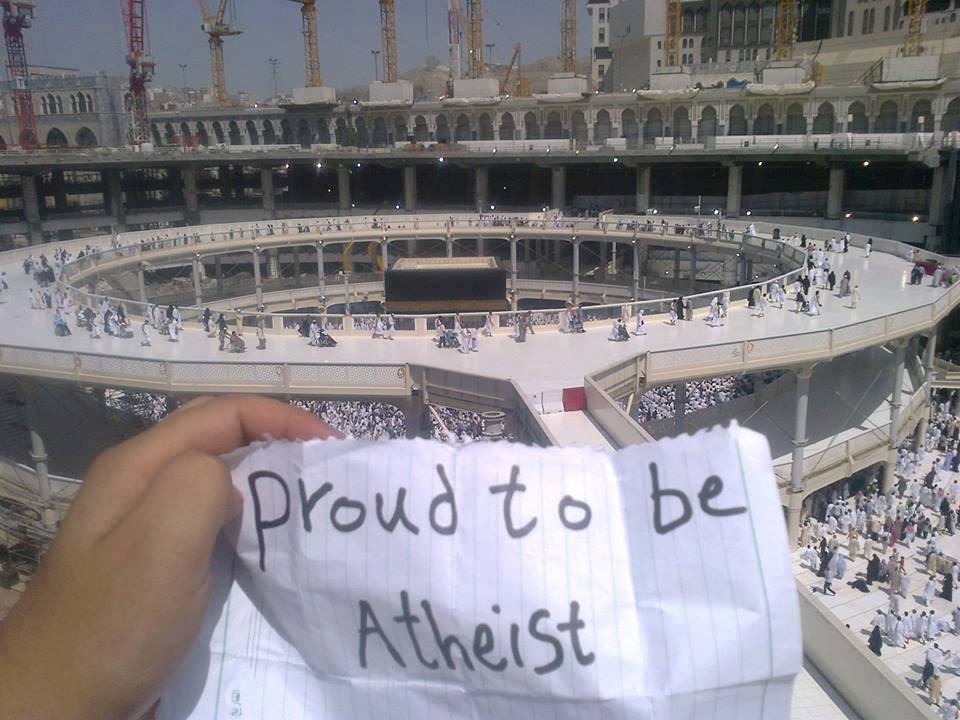
The rather cheeky picture above shows that even though Saudi Arabia only allows believers into Mecca, atheists walk among them as well!
Another avenue where internal experiences show the personal nature of religion is in religious apparel. The hijab or headscarf is now universally seen as the most obvious symbol of being Muslim, despite it being practiced by other Abrahamic faiths. However, the proliferation of hijab is a recent phenomenon, only decades old. During that time, the hijab became widespread through identity politics and also pressure by scholars. This is not to say that women have not put it on due to what they perceive to be a divine command. Obviously many have but many have also done so for social reasons.
Perhaps we should end these examples by returning to our first example above. In that example, we mentioned the most obvious thing in Islam, its first principle that there is only one God. But even this principle fails to take into account the diversity of divine experiences each of us have. The fact of monotheism is only of one level. What is of a deeper, more experiential level is how each of us interacts with the divine. Indeed the mystics of Islam have suggested as much through their notions of the spiritual journey. I understand the Quran’s concept of ‘deen’ (usually translated as ‘religion’) in the same way. To reach the purest level of deen (following the example of Ibrahim) is a very personal journey of struggle.
So if Islam is personal, what does this tell us? For me, it tells us that we must seek to empower others on their respective journeys, rather than have religious authorities which mitigate for us our faiths. In doing so can we truly have a relationship with the divine. A very personal Islam.
Stay in touch! Like Patheos Muslim on Facebook:
Previous Post

April 18, 2018
My Salam Is For Everyone
Next Post
March 11, 2016 Malaysia: Why Ban The 'Lets Read The Quran' Campaign?
Browse Our Archives
Select a Category Islamic Reform Islamofascism Islamophobia Jihadism Quranology Uncategorized
Select a Month April 2018 March 2018 February 2018 December 2017 September 2017 June 2017 May 2017 April 2017 March 2017 January 2017 October 2016 August 2016 July 2016 June 2016 May 2016 April 2016 March 2016 February 2016
Follow Us!
TAKE THE
Religious Wisdom Quiz
Who challenged Goliath to a duel before the army of Israel?
Select your answer to see how you score.
David Abner Jonathan Saul
Related posts from Muslim in the Middle


The Muslim Atheist and Friends: How To Peacefully...
The Callous Offense of ‘The Muslim Christmas Song’
TRENDING AT PATHEOS Muslim

25 Years Later: How Much Has Changed for...
As we approach the 25th anniversary of September 11th, I’ve found myself...

Podcast: Third Spaces & The Rise of Yemeni...
In the latest episode of The Artistic Foodies Podcast, hosts Abbas...

HalalFest Picks: Best 60 Halal Spots for Super...
Back in 2016, I came up with a list of 29...

Unity Is America’s Strength — Division Is Its...
by Hidayatullah Ahsan When Valentina Gomez, a Republican candidate for Congress in...

Zohran Mamdani and New York’s Fight Against Islamophobia
This past June, against all odds, Zohran Mamdani won the Democratic primary...

What the Fourth of July Means to a...
As we mark another Fourth of July, millions of Americans will celebrate...
view all Muslim blogs
Ad-Free & Subscriber Log-In Subscription Support
- About Us
- 2026 Calendar
- Videos
- Podcasts
- Library of World Religions
- Faith In Media Tracker
- Advertise With Us
- Write for Us
- Privacy Policy
- Terms of Service
- Do Not Sell My Data
- Contact Us
- Radiant Digital
- Manage Newsletter Subscriptions
- Unsubscribe From Notifications
- Sitemap
Copyright 2008-2026, Patheos. All rights reserved.
Subscription Support Ad-Free & Subscriber Log-In
Follow Patheos